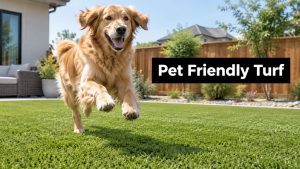

An Austin dog run can look perfect on installation day and still develop a sharp urine smell, bare patches, and loose granules around the edges. Add clay soil, summer heat, muddy paws, and heavy rain, and the problem quickly becomes more than a turf-fiber issue.
Pet friendly turf infill works only when the material, backing, aggregate base, slope, and cleaning routine work together. The right specification supports turf blades, cushions paws, lets urine move away from the surface, and limits loose material entering stormwater pathways. The wrong one only hides odor until the base becomes saturated.
This guide gives you a practical way to compare infill types, ask better safety questions, plan drainage, and build a maintenance routine that suits Central Texas. It also explains where product marketing stops and proper installation begins, so you can make an informed decision before scheduling an appointment with Modern Yard Landscapes.
Introduction to Pet Friendly Turf Infill
A homeowner in North Austin recently described the common sequence: the dog run started as a clean, mud-free solution, then the dog traffic displaced infill near the gate, urine odor lingered after warm afternoons, and water collected along one edge after storms. The turf itself wasn't necessarily defective. The system lacked the right relationship between infill, drainage, and maintenance.
That distinction matters. Infill isn't decorative sand sprinkled over synthetic grass. It affects cushioning, blade support, drainage behavior, surface temperature, and waste management. Pet areas put unusual pressure on every layer because dogs run, dig, urinate in concentrated locations, and track material beyond the perimeter.
Practical rule: If an installer discusses odor control without explaining the drainage path, you haven't received a complete specification.
Austin homeowners also need to think beyond the yard. Loose granules can migrate through paws, footwear, cleaning water, wind, and stormwater. An antimicrobial label may sound attractive, but it doesn't automatically prevent urine from remaining below the turf or stop infill from leaving the property.
The most reliable approach is system-first: choose an infill with documented composition and performance, install it over a properly prepared base, contain it at the edges, and maintain the surface according to actual pet use. The following sections compare materials, examine heat and microbial concerns, outline drainage requirements, and provide a straightforward checklist for reviewing estimates.
Understanding Pet Friendly Turf Infill
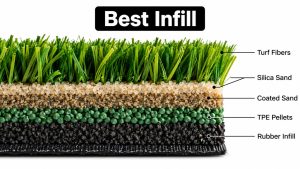
Think of artificial turf as a carpet installed outdoors. The turf fibers are the pile, the backing holds those fibers in place, the aggregate base acts like the structural floor beneath the carpet, and infill functions like the soil inside a planted lawn. It fills the space between fibers, supports them upright, adds weight and cushioning, and creates part of the pathway through which water travels.
A pet-friendly system normally depends on three interacting layers:
The surface and backing
The synthetic fibers take the direct contact from paws, claws, toys, and cleaning equipment. The backing keeps the fibers anchored and must allow water to pass through. A backing that drains poorly can leave urine and rinse water near the surface, even when the selected infill has odor-control properties.
The aggregate base
Beneath the backing, a compacted aggregate base provides stability and drainage capacity. It needs suitable depth, a deliberate slope, and a clear outlet or drainage route. If the base contains fines that compact into a dense layer, water can slow down before it ever reaches the subgrade.
The infill
Infill holds blades apart so they don't mat under traffic. It also adds mass, cushioning, and a working medium for water movement. Pet-specific choices may include silica sand, zeolite, coated sand, cork, coconut husks, TPE, or antimicrobial blends. Each behaves differently under heat, rinsing, traffic, and stormwater exposure.
Artificial-turf infill became a major engineered-surface component in the late 1990s. The NCCEH review of artificial turf systems reports that roughly 90% of North American sports fields use recycled tire crumb rubber, demonstrating how strongly infill affects durability, drainage, and surface performance.
That history doesn't mean tire crumb is automatically appropriate for a residential dog run. Sports fields and pet areas have different exposure patterns. A dog run needs easy waste removal, frequent rinsing, controlled migration, and a surface that remains comfortable during hot weather.
For a deeper explanation of the material's role, review what infill is for turf. Then ask the installer to identify the exact infill depth, application rate, backing type, base composition, and drainage outlet in writing.
Comparing Infill Types
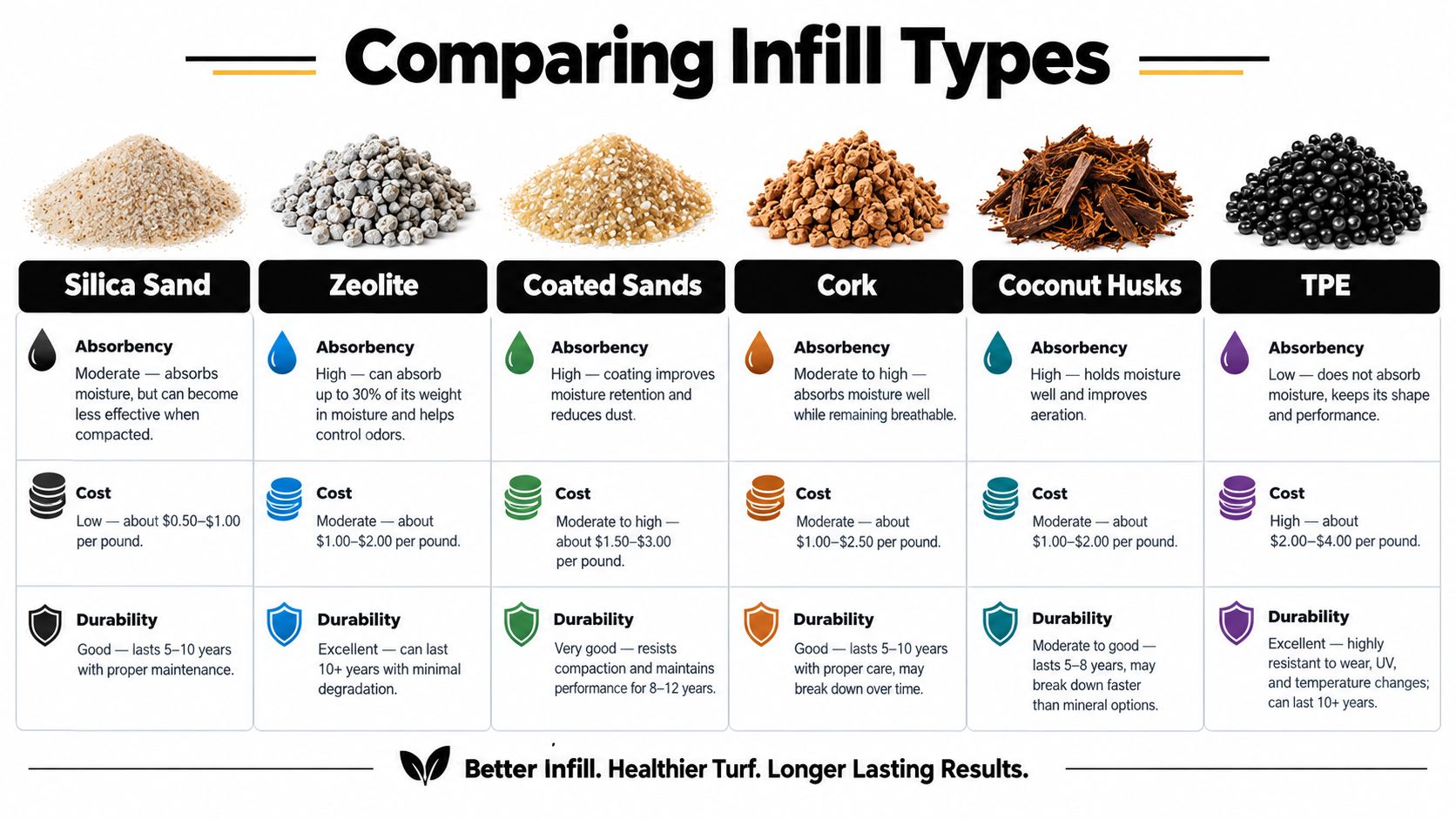
No single material wins every category. The right choice depends on whether your priority is odor adsorption, a softer feel, low migration, lower heat retention, or straightforward cleaning.
Silica sand
Silica sand is a familiar, stable option that helps weigh down turf and support fibers. It has a firm, granular feel and generally requires routine redistribution after concentrated traffic. Standard silica sand isn't a complete odor solution. It won't replace rinsing or solve a poorly draining base.
Its main strengths are availability, predictable installation behavior, and straightforward maintenance. Its limitations are heat retention, limited urine adsorption compared with purpose-designed odor-control materials, and the possibility of migration if the perimeter isn't contained.
Zeolite
Zeolite is often selected for pet areas because its porous mineral structure can help manage odor-related compounds. It offers a practical middle ground for owners who want more odor support than ordinary sand without relying on recycled rubber.
Zeolite still needs drainage and cleaning. It can become less effective when the system retains organic residue or when the material compacts. Specify the product, particle size, application depth, and replacement or replenishment procedure instead of accepting “odor control” as the only description.
Coated sands
Coated sands combine a sand core with a surface treatment intended to improve odor management, durability, or microbial control. They can provide a more controlled texture than loose organic materials and may suit high-traffic areas.
The coating is the important detail. Request the composition, safety data, test method, contact time, and cleaning instructions. A product claim without a recognized test standard doesn't tell you how the material performs after repeated urine exposure and rinsing.
Cork and coconut husks
Cork and coconut husks are organic alternatives identified by government and agency reviews alongside sand. They may provide a lighter, softer feel and can appeal to owners seeking non-rubber materials.
Organic infills require careful evaluation of moisture behavior, breakdown, migration, and maintenance. A material that feels comfortable when dry may behave differently after repeated wetting, intense sun, and concentrated pet traffic. Don't select an organic product solely because it sounds natural.
TPE granules
Thermoplastic elastomer, or TPE, granules can provide cushioning and a springier texture. They may appeal to owners who want a softer play surface, but the granules need strong containment and clear documentation about composition, heat behavior, and environmental release.
Any loose granule system can migrate during cleaning or storms. Review the edge detail, drainage capture, and replenishment plan before choosing it.
Antimicrobial blends
Antimicrobial infills are designed to limit odor-causing microbial activity or help neutralize odors. They can be useful, but the label doesn't eliminate the need for rapid drainage, solid-waste removal, and rinsing.
The best infill options for artificial turf should be compared using measurable criteria: urine adsorption, pH or ammonia control, cleanability, leaching potential, thermal behavior, and migration resistance.
Recycled-tire crumb rubber deserves separate scrutiny. Published material-safety guidance on crumb rubber notes that it can contain PAHs, VOCs, and heavy metals, so homeowners should request current safety data and third-party testing rather than accept a blanket “pet-safe” label.
| Infill type | Practical advantage | Main concern |
|---|---|---|
| Silica sand | Stable support and familiar installation | Limited odor adsorption and possible heat retention |
| Zeolite | Useful odor-management properties | Needs drainage and periodic redistribution |
| Coated sands | Controlled texture and treated surface | Coating claims need test documentation |
| Cork | Softer, non-rubber alternative | Moisture behavior and durability require review |
| Coconut husks | Plant-based option with a lighter feel | Potential breakdown and migration |
| TPE | Cushioning and resilient texture | Composition, heat, and containment must be verified |
Ensuring Safety and Managing Odor and Heat
Odor starts with retained residue, not with the turf blades themselves. Urine moves through the fibers and infill into the backing and base. When drainage is slow, dissolved nitrogenous compounds and organic material remain available for microbial activity, creating the familiar ammonia smell that becomes stronger during hot weather.
EPA findings make the material discussion more precise. The agency reports that all recycled tire-crumb samples collected from 40 synthetic-turf fields tested positive for a universal bacterial gene marker, 16S rRNA. That finding doesn't establish pathogenicity or prove a health risk, but it does support asking whether a residential dog run needs recycled rubber at all. The EPA tire-crumb technical questions and answers also report that most volatile and semi-volatile organic compound emissions were low or often below detection at 25°C, or 77°F, while some compounds increased at 60°C, or 140°F.
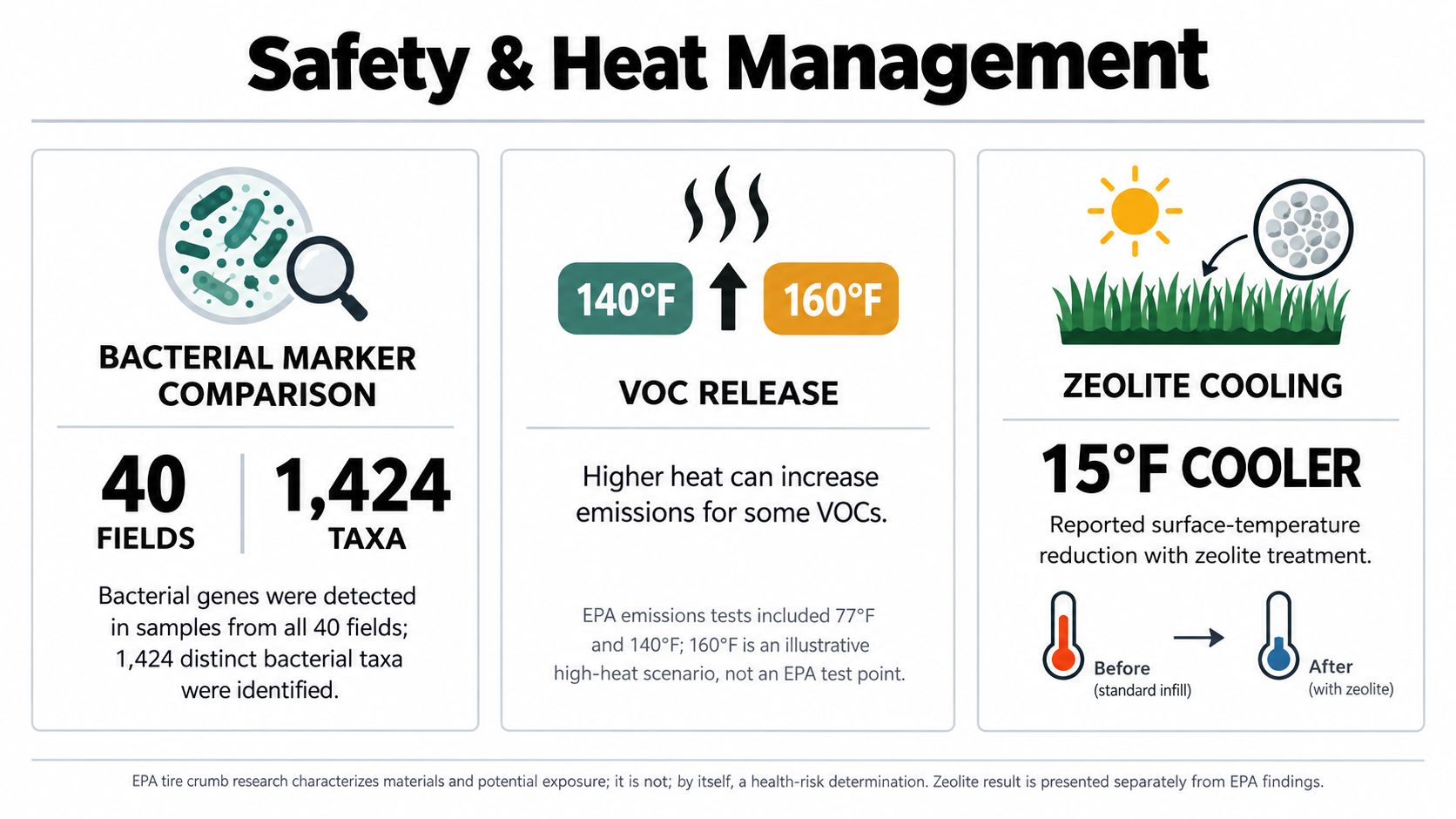
EPA field data recorded synthetic-turf surface temperatures from 84°F to 108°F, so Austin owners should treat heat management as a design issue, not a cosmetic preference. Lighter-colored or thermally moderated infills, shade where possible, and scheduled rinsing can improve the surface experience, but no additive compensates for a base that holds contaminated water.
A practical odor and heat routine
- Remove solids promptly: Pick up feces before rinsing so organic matter doesn't spread through the fibers or enter the drainage system.
- Rinse the high-use zones: Direct clean water through the dog's preferred bathroom areas and toward the intended drainage path. Avoid high-pressure washing that displaces infill.
- Groom the surface: Brush against the grain with a suitable turf broom when traffic creates flattened fibers or uneven material.
- Check the hot spots: Walk the run during a warm afternoon and identify areas that feel excessively hot or smell stronger after watering.
- Inspect the infill depth: Ask a professional to check whether gate approaches, corners, and bathroom zones have lost material.
- Use cleaners carefully: Choose a pet-appropriate cleaner compatible with the turf, backing, and infill. Never assume a strong chemical is better.
For indoor odor around entry points or mudroom transitions, an air purifier selection from EcoQuest Purifiers can complement outdoor cleaning, but it won't correct urine trapped beneath turf. Address the outdoor drainage path first.
If odor has already become persistent, review how to handle dog urine odor in the yard. The fix may require removing contaminated material, improving flow, or correcting low spots rather than adding another surface treatment.
Planning Drainage and Maintenance
Pet turf should be designed like a small drainage installation, not laid as a carpet over whatever soil happens to be present. Urine, rinse water, and rain all need a predictable route away from the surface. In Austin, expansive clay and intense storms make that route especially important.
Guidance commonly specifies drainage capacity of at least 30 inches per hour, paired with permeable backing and an aggregate base, to help urine and rainwater percolate quickly and reduce odor and bacterial growth. The pet turf drainage guidance gives customers a concrete performance criterion to ask about.
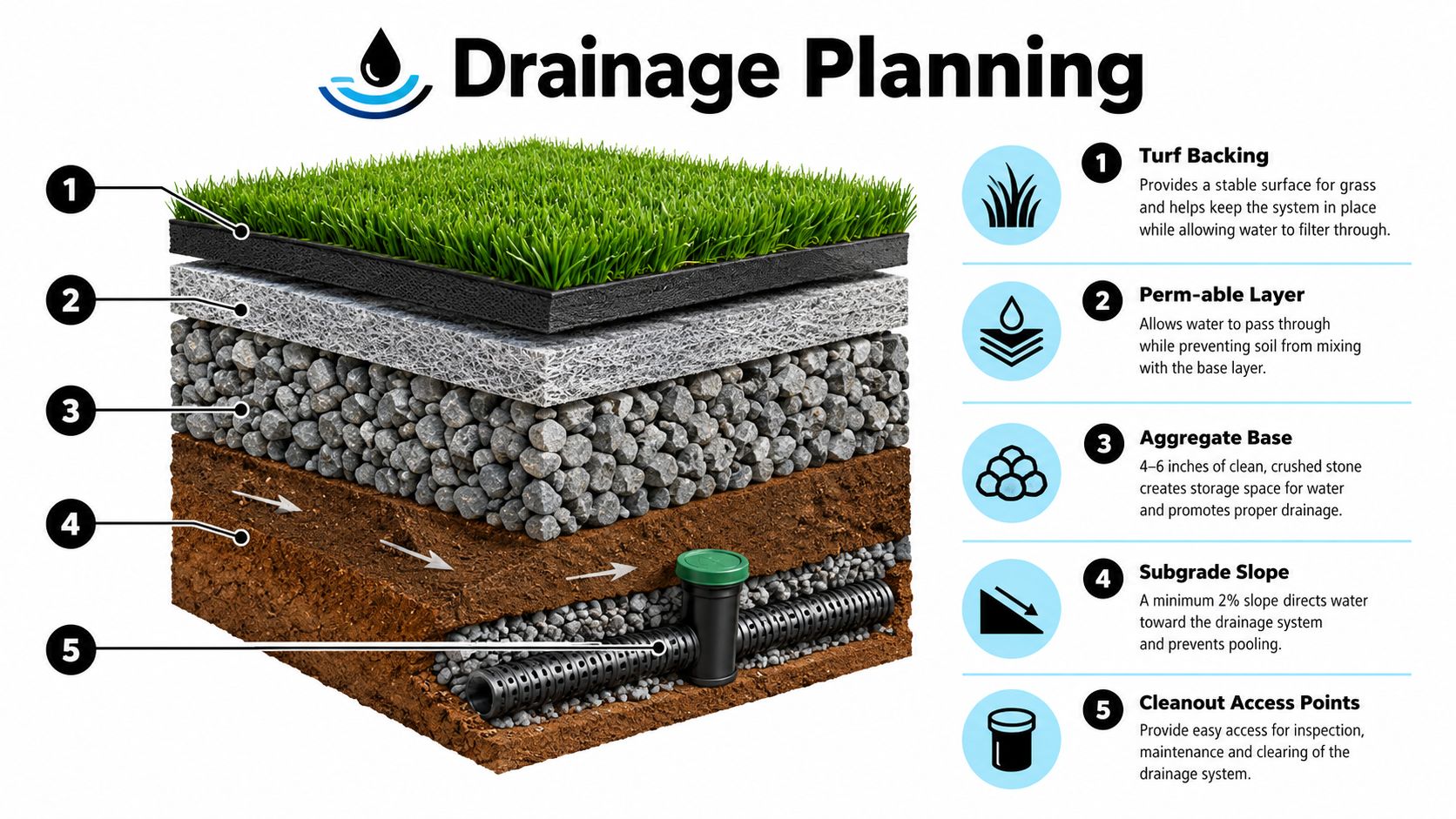
Build the water path before choosing the infill
Start below the turf. The subgrade should be shaped so water doesn't settle in a bowl. The aggregate base must remain open enough to transmit water, and the backing should allow flow through the entire surface rather than forcing water sideways toward one weak point.
Ask the installer to show you:
- The subgrade slope: Confirm where water will travel and where it will discharge.
- The aggregate base: Request the planned material and depth, not just the phrase “proper base.”
- The backing design: Verify that urine can pass through the turf rather than collect on top.
- The outlet or drainage tile: Identify cleanouts and access points before the turf covers them.
- The perimeter detail: Use edging, a contained border, or another barrier that limits infill loss at gates and low sides.
Containment matters because loose infill can leave a field through tracking, wind, drainage, and stormwater. A 2023 water-conservation report cited Swedish estimates of approximately 2 to 3 tons of infill lost from large synthetic athletic fields each year, and described Norwegian sampling in which crumb-rubber particles appeared in 85% of downstream water samples compared with 42% upstream. Those figures concern athletic fields, not residential dog runs, but they show why perimeter capture and cleaning-water control belong in the design.
Use a simple maintenance schedule
Every use day: remove solids and inspect the areas where dogs urinate most often.
During routine cleaning: rinse with low pressure, direct water toward the planned drain, and avoid pushing granules into seams or perimeter gaps.
After heavy rain or concentrated activity: look for displaced infill, flattened fibers, puddling, and sediment accumulation at outlets.
At seasonal inspections: check seams, edging, cleanouts, base settlement, and the depth of infill in high-traffic lanes.
A surface that looks clean can still drain poorly. If the odor returns quickly after rinsing, stop adding deodorizer and have the drainage path inspected. The artificial-turf drainage systems offered by Modern Yard Landscapes can be evaluated alongside the turf and infill rather than treated as an afterthought.
A good dog run lets clean water pass through quickly while keeping loose infill and contaminated runoff under control.
Cost and Selection Criteria
A low quote can be expensive when it excludes the work that makes pet turf function. Compare estimates by system components, not by infill name alone. The material, application rate, base preparation, drainage route, edging, labor complexity, and maintenance plan all affect the result.
I don't recommend selecting the cheapest infill without documentation. I also don't recommend paying a premium for an antimicrobial label that lacks a test method or measurable performance target. The synthetic-turf microplastics review identifies the central trade-off clearly: pet-friendly infill choices involve odor control, pathogen persistence, drainage, and environmental release, so homeowners should evaluate urine adsorption, pH control, leaching potential, and containment.
What to request with every quote
- Composition: Is the infill mineral, organic, thermoplastic, coated, antimicrobial, or recycled rubber?
- Safety documentation: Can the installer provide a current safety data sheet and independent testing?
- Performance method: What test standard supports the odor, antimicrobial, or cooling claim?
- Application details: What depth and quantity will be installed, and how will the crew verify distribution?
- Drainage specification: What capacity is expected, and how do the backing, base, slope, and outlet support it?
- Maintenance requirements: How often should the owner rinse, groom, inspect, and replenish the system?
- Replacement plan: What happens if a high-use zone loses infill or develops persistent odor?
There isn't a responsible universal price per square foot for pet-friendly infill because material choice and installation conditions vary. A small, level run with an existing suitable base is a different project from a sloped area over clay that needs excavation, drainage tile, edging, and difficult access.
Treat the cost comparison as a lifecycle decision. Basic sand may reduce the initial material cost but offer less odor support. A documented zeolite or coated-sand system may cost more while reducing the need for repeated odor treatments. Organic materials may appeal to sustainability-minded owners but require closer review of moisture and breakdown behavior. TPE can improve cushioning while increasing the importance of containment and composition testing.
The best estimate tells you what you're buying, how it drains, how it stays contained, and how the installer will support the finished system. If the proposal only lists “pet-safe infill” without a product name, depth, test information, or maintenance instructions, ask for a revised scope before signing.
Local Austin Considerations and Hiring Professionals
Central Texas punishes vague installation plans. Intense sun raises surface temperatures, clay soils can slow infiltration and move as moisture changes, and heavy summer storms expose weak slopes, undersized outlets, and poorly contained edges. A dog run that drains adequately during a light rinse may still fail when concentrated runoff arrives from a roof, patio, or adjacent lawn.
Start with the site, not the infill bag. Identify where water currently travels, whether the proposed run sits below a hardscape edge, and whether the soil can accept discharge without creating a new muddy area. Confirm any applicable local requirements for grading, drainage, and stormwater handling before construction.
Schedule installation when the site can be prepared and compacted properly. Avoid rushing excavation or base work because of a short weather window. A professional should explain the subgrade slope, aggregate selection, permeable backing, perimeter containment, and cleanout access in plain language.
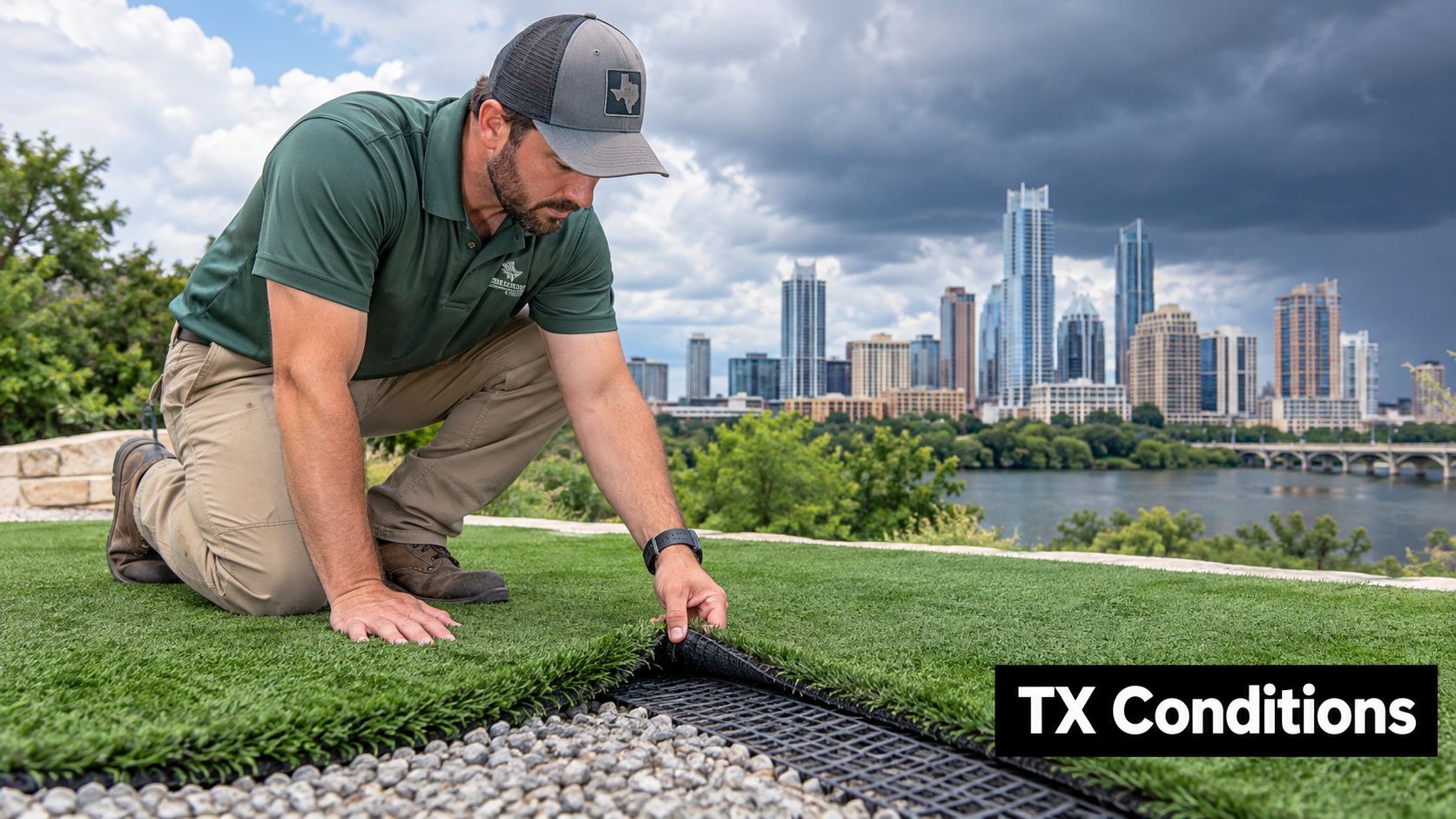
Call Modern Yard Landscapes when the run includes complex slopes, recurring puddles, clay-heavy soil, drainage tile, retaining-wall interfaces, difficult access, or a need for warranty-backed infill specifications. The company installs residential and commercial artificial turf systems in the Austin area, including pet-specific dog runs, drainage tile, and related site improvements.
During the consultation, ask for a transparent estimate that separates turf, infill, excavation, base preparation, drainage, edging, labor, and maintenance recommendations. You should also receive the exact infill composition and the documents supporting any antimicrobial, cooling, or safety claims.
A trustworthy installer won't promise that one granule eliminates every odor. They'll show you how the complete system handles urine, rain, heat, cleaning water, and material migration. That explanation is more valuable than a broad “pet-safe” claim.
Conclusion
A reliable pet turf installation starts with the infill, but it doesn't end there. Choose materials by documented composition, odor performance, cleanability, heat behavior, and migration resistance. Pair them with permeable backing, a properly sloped aggregate base, controlled drainage, contained edges, and a written maintenance routine. Austin conditions make professional site preparation especially important. Modern Yard Landscapes provides transparent estimates, pet-run installation, drainage solutions, warranty options, and a total satisfaction guarantee for homeowners who want a system designed around their property and pets.
Modern Yard Landscapes can design and install a complete pet-friendly turf system with specified infill, drainage, edging, and maintenance guidance for Austin-area homes. Schedule an on-site consultation with Modern Yard Landscapes to review your dog run, drainage path, and material options before odor and runoff problems become expensive repairs.