
The most popular advice about low maintenance landscaping trees is also the least useful: choose a drought-tolerant species and forget about it. That approach fails in Austin because a tree's workload depends on far more than its name. Soil depth, available root space, reflected heat, drainage, pavement, turf competition, and the quality of its establishment care determine whether a tree becomes a valuable shade asset or a stressed liability.
A tree that merely survives isn't necessarily low maintenance. It may grow slowly, lose canopy during extreme heat, need corrective pruning, or require replacement because its roots never had enough room. The better Austin approach is direct: assess the site first, then choose the tree that fits it.
Redefining Low Maintenance Landscaping Trees
Low maintenance doesn't mean no maintenance
Central Texas heat punishes careless planting. A drought-adapted tree can still fail in compacted soil, beside hot concrete, or inside a narrow bed that can't support its mature root system. “Drought tolerant” describes a plant's potential. It doesn't guarantee that the plant will perform well in your particular yard.
True low maintenance means reducing the work required across the tree's entire life. That includes irrigation, pruning, pest response, root correction, storm preparation, leaf cleanup, and eventual removal. The cheapest tree to maintain is usually the one that was given enough space and placed where its natural growth habit works with the property instead of against it.
Recent research shows that urban trees provide meaningful cooling only when the surrounding soil is sufficiently moist, with irrigation helping sustain evaporative cooling during prolonged heat, as documented in this research review of trees and urban cooling. That distinction matters. A tree may stay alive through drought while failing to deliver the shade and cooling that justified planting it.
Practical rule: Judge a tree by how well it performs under realistic site conditions, not by whether it can endure neglect for a short period.
Survival is not the same as performance
A surviving tree with a thin canopy can leave a patio hot, an artificial-turf area exposed, and nearby plants dependent on supplemental irrigation. A healthy, well-sited tree can shade soil and surrounding beds, reduce evaporation, and create a more stable microclimate.
This is why I don't recommend starting with a universal top-ten list. Start with the yard. Identify the available soil volume, the afternoon sun, the drainage pattern, and the maintenance you're willing to provide during establishment. Then select from the species and tree categories that can handle those conditions.
Low maintenance is an upfront design decision. Spend more attention on placement, soil preparation, and irrigation planning now, and you'll spend less time correcting the garden later.
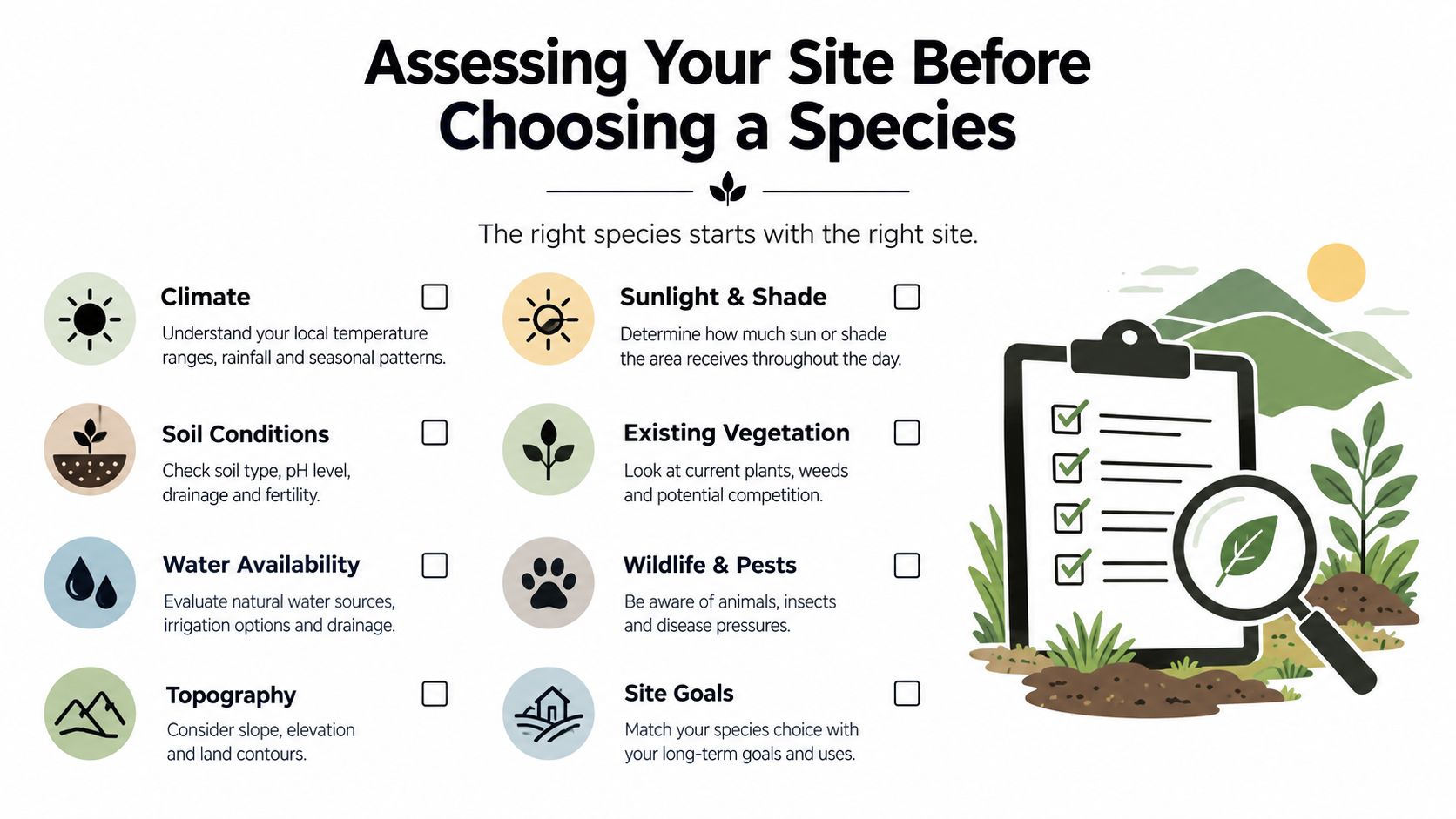
Assessing Your Site Before Choosing a Species
The right tree for a narrow planting strip may be the wrong tree for an open lawn. A tree that thrives in deep, undisturbed soil can struggle beside a driveway, while a smaller ornamental tree may perform well in a constrained courtyard if its root zone and drainage are properly prepared.
Read the site in four dimensions
Aboveground space comes first. Measure the mature canopy against the house, roof, fences, driveways, sidewalks, and utility lines. Don't choose a tree that requires constant pruning only because the nursery specimen looks appropriately small.
Belowground space matters just as much. A broad canopy usually needs a broad root zone, and fine water-absorbing roots can extend beyond the dripline. Preserving soil outside hardscape edges gives roots room to seek moisture without lifting pavement or crowding foundations.
Surface conditions reveal future stress. Concrete, stone, and artificial turf can reflect or retain heat around the planting area. Compacted construction soil may shed water rather than absorb it, while a low area with poor drainage can suffocate roots even during a dry season.
Infrastructure conflicts need attention before planting. Check overhead utilities, buried services, retaining walls, drainage tile, irrigation lines, and the route equipment will use to reach the planting location. A tree that can't be installed or maintained safely isn't a low-maintenance choice.
Choose the site before the species
A less celebrated tree with adequate soil volume will generally outperform a fashionable tree forced into a restrictive bed. That isn't a question of popularity. It's a question of root access, water movement, canopy clearance, and the amount of corrective work the property will demand.
Artificial turf changes the irrigation design, too. Don't spread irrigation across the entire yard when only the tree and planting beds need supplemental water. Create a dedicated zone that delivers moisture to the broader root area, not just the trunk.
Newer establishment research found that irrigation method significantly affected tree growth and stability, while USDA research identifies species selection, establishment, and the full tree life cycle as interconnected barriers to resilient urban forests, as explained in this USDA research on urban tree establishment.
The U.S. Forest Service has assessed approximately 3.8 billion trees in contiguous U.S. urban areas in one analysis, while a later assessment estimated 5.5 billion urban trees. Those differing estimates reflect different methods and time frames, but both show that urban trees are infrastructure, not disposable decoration. The later analysis estimated more than $18.3 billion in annual value from air-pollution removal, reduced building energy use, carbon sequestration, and avoided pollutant emissions, according to the U.S. Forest Service urban tree assessment.
Top Tree Categories for Central Texas Yards
Austin homeowners should compare tree categories by maintenance consequences, not just flower color or nursery availability. Consider mature canopy, shade density, cleanup, root behavior, storm exposure, and the amount of pruning a location can tolerate.
Match the category to the property
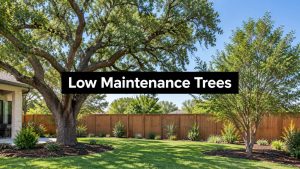
Native and regionally adapted oaks are strong candidates where there's generous soil volume and room for a substantial canopy. Their shade value can be excellent, but mature size, leaf drop, acorns, and clearance from structures must be planned from the start. They belong in open lawns, larger commercial sites, and broad planting beds, not narrow strips between pavement and a wall.
Desert-adapted accent trees can suit hot, highly visible locations where a smaller canopy and distinctive form matter more than dense shade. They're useful near patios, entries, and xeriscape areas, but their decorative value shouldn't tempt you to ignore drainage or root space. A small tree still needs a functioning root zone.
Fast-growing shade providers offer quicker visual impact, but speed often brings trade-offs. A vigorous tree can require more structural pruning, reach conflicts sooner, or develop a canopy that outgrows the original design. Use these trees only where the property can accommodate their mature dimensions and future care.
Evergreen screening trees can provide privacy and year-round structure, but they must be spaced for mature width rather than planted as an instant wall. Overcrowding creates dense competition for water and encourages corrective shearing. If your privacy goal can be met with fewer, properly spaced trees, choose that arrangement.
| Tree Category | Shade Value | Litter / Cleanup | Root Behavior |
|---|---|---|---|
| Native and regionally adapted oaks | High where mature canopy has room | Leaves and acorns require seasonal cleanup | Needs substantial soil volume and clearance |
| Desert-adapted accent trees | Light to moderate, depending on canopy | Often manageable, but varies by form and fruiting | Performs best in well-drained, dedicated beds |
| Fast-growing shade providers | High early impact | Can require more pruning and monitoring | Vigorous roots need planned space and stable soil |
| Evergreen screening trees | Moderate, with consistent privacy value | Lower seasonal leaf drop, but trimming can increase | Must be spaced to prevent crowding and competition |
The Forest Service's urban tree valuation reinforces the larger point: well-planned canopy can deliver shade, cooling, and infrastructure value over time. Your yard doesn't need the biggest tree available. It needs the right canopy in the right location.
For the lower planting layer around trees, use the same site-first logic when reviewing low maintenance landscaping shrubs. Group plants by water needs, preserve access for pruning and inspection, and don't fill every open space just because the bed looks sparse after installation.
Strategic Siting and Planting for Long-Term Health
Planting depth is where many future tree problems begin. Set the root flare at or slightly above finished grade, never bury it beneath soil or mulch. The trunk should widen visibly at the base, and the first major roots should have access to oxygen and moisture rather than sitting in a buried, waterlogged pocket.
Build the planting area around the roots
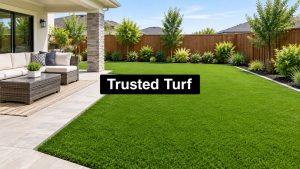
Preserve soil volume beyond hardscape edges whenever possible. A tree squeezed into a small cutout surrounded by concrete will experience more heat, less infiltration, and greater competition for moisture. If the design includes artificial turf, keep the tree's root zone distinct from the turf system and concentrate irrigation where the tree can use it.
Remove turf from around the trunk. Grass competes aggressively for shallow moisture, and mowing equipment can injure bark. Create a broad, clean planting bed with compatible groundcovers or mulch, while leaving enough open soil for water to enter and roots to expand.
Place mulch over the root zone, but keep it away from the trunk. A thick mound touching bark traps moisture and creates conditions that encourage decay. Homeowners looking for more detail on how to protect trees from trunk rot should focus on keeping bark exposed, improving drainage, and preventing chronic moisture against the trunk.
Use placement to reduce heat
Texas A&M AgriLife Extension recommends placing trees on the western side of a property when practical to block strong afternoon sun, reducing water lost from soil and plants through evapotranspiration, as described in this Austin tree-care guidance.
That placement isn't automatic. Check the mature canopy against the home, roof, utilities, and access routes first. A tree placed too close to a wall may create shade but still generate years of pruning and clearance work.
Use zone-controlled drip or soaker irrigation, keep drainage paths open, and inspect the planting area after heavy rain. A low-maintenance tree should have a root zone that receives water slowly, drains appropriately, and remains free from turf competition.
Navigating Austin Irrigation Rules and Deep Watering
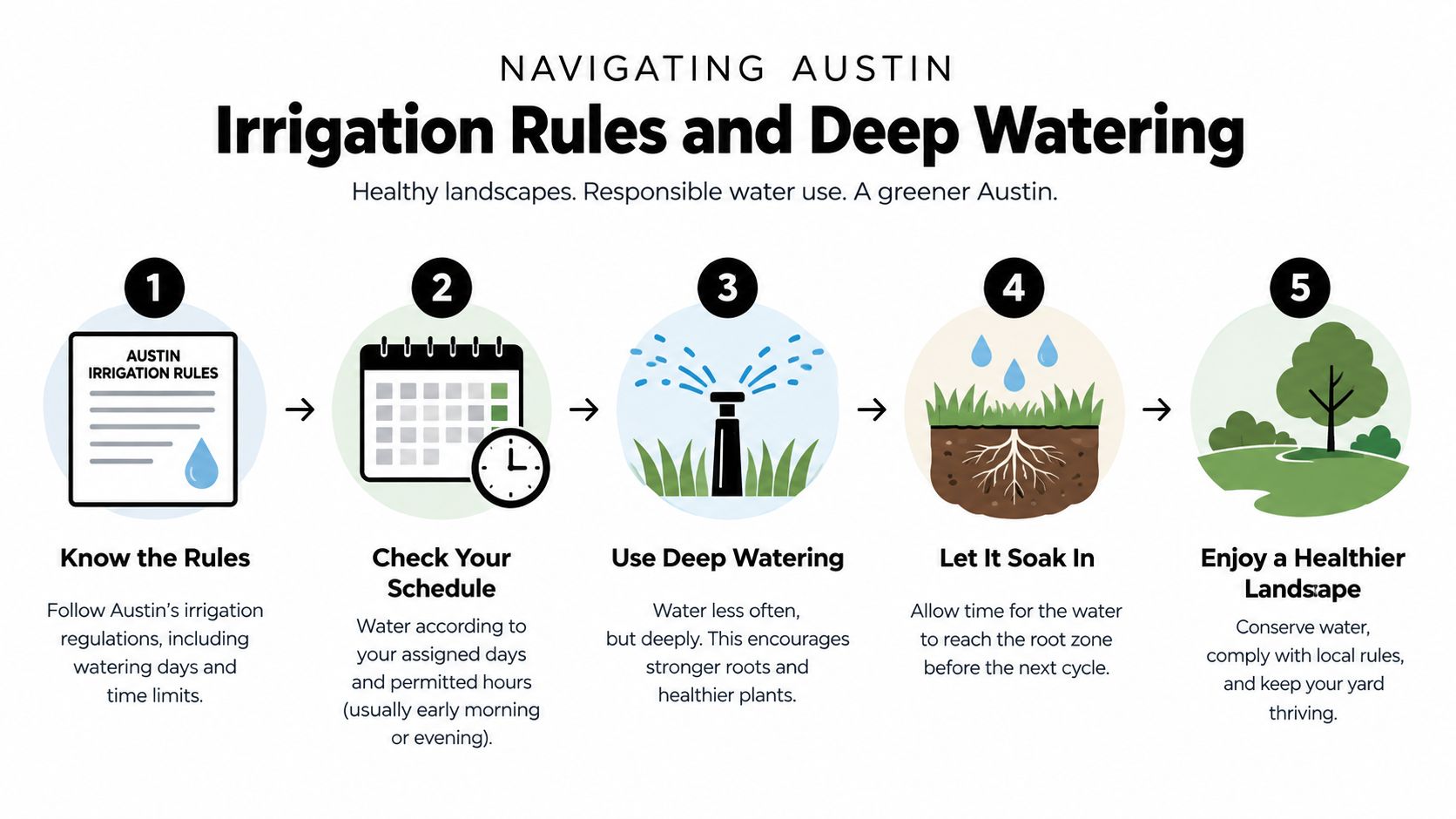
Drought-tolerant doesn't mean water-free, especially during establishment and extreme heat. Trees develop deeper and more extensive roots than turfgrass, so frequent shallow watering is the wrong pattern. Water slowly, soak the broader root zone, and allow the soil to dry to an appropriate level before watering again.
Water by trunk diameter and root zone
Austin guidance recommends watering trees to at least the dripline and applying approximately 5 to 10 gallons per inch of trunk diameter, using the lower end for healthy trees and the higher end for stressed trees or trees competing with turf and groundcover, according to this efficient tree and shrub irrigation guidance.
Apply water slowly enough that it infiltrates instead of running down a slope or across pavement. Check soil moisture 4 to 5 inches below the surface before watering. The trunk base isn't the target. The active absorbing roots extend through the surrounding root zone, often beyond the dripline.
Mulch reduces evaporation and moderates soil temperature, but it can't compensate for poor irrigation placement. Keep mulch off the trunk, maintain clear emitters, and inspect the system during hot weather rather than assuming an automated schedule is working.
Design around Austin's restrictions
Austin's official water-conservation plan limits automatic irrigation to no more than once per week for up to 15 hours during Conservation Stage, with watering generally allowed only before 10:00 a.m. or after 7:00 p.m. on designated days, as stated in the official Austin water-conservation plan.
Those rules make site preparation more important, not less. A tree planted in compacted soil or surrounded by turf may need more intervention to receive the same benefit as a tree planted in a properly prepared bed. Use a dedicated planting-zone controller, adjust emitters as roots expand, and follow current city requirements rather than relying on an old irrigation schedule.
For additional strategies, review this guide to reduce water usage across the broader outdoor areas. Efficient irrigation starts with grouping plants by water demand and keeping turf, trees, and xeric beds from competing inside one poorly managed zone.
When to Bring in a Landscaping Professional
Some tree projects are simple. Others involve grading, drainage, retaining walls, access limitations, buried utilities, artificial turf, and large root systems. If several of those conditions occur together, professional site preparation is cheaper than correcting a failed installation.
Know when the ground is the real problem
Bring in an experienced horticulture professional when water collects near the proposed planting area, when soil is heavily compacted, or when a retaining wall changes the grade. A tree can be perfectly suited to Austin and still fail because excess water has nowhere to go or roots can't penetrate the surrounding soil.
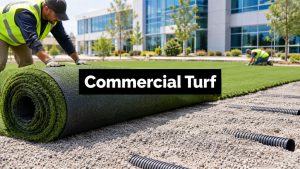
Professional planning also matters when integrating a large tree with artificial turf or drainage tile. The planting bed must remain functional after the turf, edging, walls, and irrigation are installed. The crew needs to preserve access, protect root space, and direct water without creating a saturated pocket beside the tree.
Large specimens create additional logistics. Equipment access, lifting, planting depth, root-ball stability, and post-installation irrigation all need coordination. A homeowner may be able to spread mulch and remove a damaged branch, but a complex installation deserves a plan that accounts for the whole site.
For broader context on evaluating tree work and removal decisions, consult this StumpSniper.com tree service guide. It's useful to understand the difference between routine care, risk management, and work that requires specialized equipment.
Demand transparent proof
A professional estimate should identify the factors driving cost, including soil preparation, drainage work, access, tree size, irrigation, edging, and future maintenance implications. Avoid proposals that promise a “maintenance-free” result without explaining establishment care and site constraints.
Trust also depends on reviews. The Federal Trade Commission states that businesses displaying online reviews should have processes ensuring that reviews accurately reflect feedback from genuine customers, protecting consumers who share honest opinions, as explained in its guidance on endorsements and reviews. Look for verifiable customer feedback, not selectively edited praise with no project context.
Ask who will perform the work, what the warranty covers, how drainage will be handled, and what happens if the tree struggles after installation. Clear answers tell you more than a long plant list.
Planning Your Low Maintenance Yard Transformation
A successful Austin yard starts with a site assessment, not a shopping cart. Map afternoon sun, mature canopy space, usable root-zone volume, drainage, pavement, utilities, turf competition, and the irrigation access you can realistically maintain. These details eliminate poor tree choices before they reach the property.
Match each tree to a job. Use broad-canopy trees where you need meaningful shade and have enough soil volume to support them. Use smaller accent trees in confined beds. Reserve screening trees for locations where their mature width will not demand constant shearing. Every tree is a long-term structural element, not temporary decoration.
Make the design carry its own workload
A low-maintenance yard uses hydrozoning, suitable soil volume, mulch, and targeted irrigation to reduce unnecessary intervention. One watering schedule should not serve every plant. Avoid covering every open area with turf, and do not place a large canopy beside a narrow walkway expecting pruning to resolve the conflict.
The EPA reports that converting a property to a water-smart design through careful plant selection and planning can reduce outdoor water use by 20% to 50%, according to its EPA water-smart yard guidance. The result depends on coordinated choices involving plant selection, layout, shade, irrigation, and maintenance practices.
The same rule applies beyond flat lawns. Slopes need stable drainage and root support, while compacted urban yards need soil preparation before planting. If your property has elevation changes, review this guide to low-maintenance hillside landscaping before choosing trees or hardscape.
Use a lifecycle test
Ask four questions before approving the plan:
- Will the mature canopy fit? Measure the future tree, not the nursery specimen.
- Can the root zone receive water? Keep soil open, limit turf competition, and place irrigation around the dripline and beyond.
- What happens during extreme heat? Define establishment care. Drought tolerance does not mean a tree can survive neglect.
- Who will maintain the result? Choose a design that matches your schedule, budget, and willingness to prune or monitor irrigation.
The lowest-maintenance tree is not automatically the most famous Austin species. It is the one matched to your soil volume, drainage, sun, root space, irrigation system, and long-term property goals. Get that match right, and the tree becomes a durable property asset instead of another recurring chore.
Modern Yard Landscapes can assess your Austin property, prepare the site, and design a durable setting around drainage, artificial turf, retaining walls, irrigation, and mature tree space. Visit Modern Yard Landscapes to schedule a consultation and get a clear plan for low-maintenance landscaping trees suited to your actual yard.