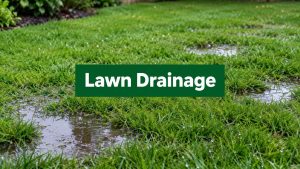

A lot of Austin homeowners start in the same place. The yard looks fine most of the year, then one hard rain hits and the whole space changes. Grass turns slick, low spots hold water, muddy paws track through the house, and the area you wanted to use for kids, pets, or entertaining becomes a mess for days.
That's usually the moment people start looking at turf. Not just because they want a green lawn, but because they're tired of losing their yard every time weather rolls through. The right turf system can solve that problem. The wrong one just hides it for a while.
Your Dream Yard Should Not Be a Swamp
A backyard can look beautiful on a sunny day and still fail where it matters most. In Austin, that failure usually shows up after a storm. Water sits along the fence line. The side yard turns to mud. The patch outside the patio never seems to dry out. Families stop using part of the property because it's always damp, slick, or dirty.
That's why drainage has to come first.
Artificial turf works best when you treat it as a drainage solution with a lawn on top, not as a decorative surface alone. If the yard already struggles with runoff, clay-heavy soil, or poor grading, laying turf over the problem won't fix it. It only makes the problem more expensive later.
A good installer starts below the grass line. They look at where water comes from, where it stalls, and where it can safely go. Sometimes the answer is a properly built turf base. Sometimes it also involves interception drains, grading corrections, or a more complete yard drainage strategy.
Most drainage failures don't come from the turf fibers. They come from what was skipped underneath.
When homeowners understand that, they ask better questions. What is the base made of? How is the slope handled? Is the backing fully permeable or just punched with holes? What happens when a sudden downpour hits hard ground after a long dry stretch?
Those are the questions that lead to a yard that stays usable.
Why Austin Soil Is Different and What It Means for Drainage
Austin is not forgiving to generic turf installs. The local combination of expansive clay soil, long dry periods, and sudden heavy rain creates a drainage problem that a standard install often can't handle.

Clay soil behaves differently than looser, more forgiving ground. In dry weather, it tightens and hardens. When a fast storm arrives, water often can't move through it quickly enough, so it runs across the surface or settles into low spots. That's why one part of the yard can bake hard for weeks, then turn sloppy in less than an hour.
Why the same turf detail doesn't work on every property
A lot of homeowners assume artificial turf always drains better than natural grass. That isn't the whole story. The New Jersey Department of Environmental Protection notes that at least one recent experimental study found natural grass could outperform synthetic grass in runoff reduction and water retention, which is exactly why drainage performance depends on the full engineered system, not just the turf layer alone, especially in flood-prone settings like Austin (NJDEP memorandum on synthetic turf runoff and drainage).
That point matters because many bad installs are sold as simple surface upgrades. They aren't engineered for Central Texas conditions. They're installed as if every yard drains the same.
Here's what commonly causes trouble in Austin yards:
- Flat grading near the house means water has nowhere obvious to go.
- Compacted native clay slows infiltration and encourages lateral movement.
- Low side yards become collection points during flash storms.
- Retaining transitions and bed edges can trap runoff if the base and gravel zones aren't planned correctly.
When drainage work ties into hardscape or elevation changes, details like proper base gravel matter just as much as the turf itself. Homeowners dealing with slopes, edging transitions, or wall-adjacent runoff often benefit from understanding how a retaining wall base gravel system supports water movement and long-term stability.
What local expertise looks like
A local drainage-minded installer doesn't start by asking which turf color you want. They start by reading the site.
They look for water marks on fences, erosion channels near gates, settled patio edges, and places where runoff from neighboring lots enters the yard. They pay attention to whether the problem is surface water, trapped subsurface moisture, or both.
Local rule: In Austin clay, the ground can be the bottleneck. If the base and grading aren't built correctly, even premium turf won't rescue the install.
That's the difference between a yard that stays clean after rain and one that starts smelling, shifting, or ponding months later.
The Anatomy of a High-Performance Turf Drainage System
A yard can look finished on day one and still fail in the first hard storm. We see it in Austin after fast, heavy rain. The turf looks fine from the street, but water sits on top, the edges start to ripple, and the base turns into a trapped wet layer that never really dries. The problem is usually below the turf, not in the grass fibers.

The top layer has a job, but it is not the whole job
The visible surface needs to pass water through quickly and evenly. According to Turf Network guidance on artificial grass drainage, modern artificial turf drainage systems can move water at very high rates, and fully permeable backing usually distributes flow more evenly than hole-punched backing because water is not limited to fixed exit points.
That matters on Austin installs. In a mild climate with sandy soil, a mediocre backing can sometimes get by. On clay, during a sudden downpour, uneven drainage shows up fast. Water finds the slowest spot and starts pooling there.
Perforations and backing design help, but spec-sheet drainage rates do not save a bad install. Homeowners comparing products usually get more value from understanding how the whole system is built. This breakdown of artificial turf layers explains what each layer does underfoot.
The middle layers control movement, support, and cleanup
Infill is one of the most misunderstood parts of the system. It supports the blades, helps hold the turf in place, and affects how water, pet waste, and fine debris move through the surface. The wrong infill can trap organics, stay damp longer, and make the yard harder to clean.
Some projects also need a drainage pad or mat under the turf. I use those selectively, not by default. They can help when a site needs faster horizontal water movement or added separation from a stubborn sub-base, but they do not fix poor grading and they do not replace a properly built stone base.
Material choice depends on how the yard will be used. A pet run, a shaded side yard, and a decorative front lawn do not need the same assembly.
The base determines whether the system works after real rain
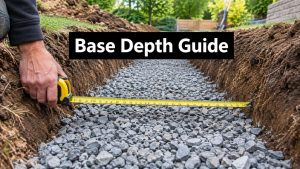
Installations in Austin hinge on the quality of the base. The base is not just there to make the yard flat. It has to store water briefly, move it in the right direction, and resist contamination from the clay below.
The right aggregate keeps open void space between stones so water can pass and disperse. Fines-heavy material does the opposite. It packs tight, holds moisture, and starts acting more like a barrier than a drain layer. On clay sites, that mistake shows up quickly because the native soil already drains slowly.
Good base construction comes down to a few hard requirements:
| Layer concern | What works | What fails |
|---|---|---|
| Water storage | Washed angular aggregate with open void space | Dense material with fines that clogs and stays wet |
| Flow direction | Consistent grade built into the sub-base | Hidden low spots under the turf surface |
| Separation from soil | Geotextile where clay migration is a risk | Base stone blending into native soil over time |
Compaction is another trade-off that gets missed. Too loose, and the surface settles. Too tight, and you choke off some of the drainage capacity you paid for. Experienced installers balance stability with permeability, especially near edges, utility corridors, and transitions to patios or retaining features.
On deeper or more technical sites, the same principles apply at a larger scale. This overview of deep excavation expertise by Integra Consultants is a useful reference for how soil, water control, and structural support have to work together.
A turf product can post impressive drainage numbers and still perform poorly if the base is flat, contaminated, or compacted the wrong way. That is why drainage work deserves more attention than turf color, blade shape, or showroom samples. In Austin, the layers below the surface decide whether the yard stays dry after the storm passes.
Choosing the Right Drainage Solution for Your Yard
A yard can look fine in dry weather, then turn into a mess after one Austin storm. I see it all the time. Water rushes off a patio, hits heavy clay that will not absorb it fast enough, and the low corner of the yard stays wet long after the sun comes back out. That is the point where picking the right drainage system matters more than picking the turf itself.

When integrated turf drainage is enough
Some yards do not need a long list of drainage parts. They need a turf installation built with drainage in mind from the start.
That usually applies when the problem is confined to the lawn area, the runoff volume is manageable, and the site has a usable outlet. In those cases, the turf system can do the bulk of the work if the sub-base is graded correctly and built with clean, open aggregate that lets water move through instead of trapping it. As noted earlier, a modest slope away from structures is usually part of that plan, especially in Austin clay where water tends to perch and spread sideways before it sinks.
This approach fits yards where:
- The surface turns muddy after rain, but water is not pouring in from another part of the property
- Foot traffic or pets have destroyed the existing grass and exposed compacted, slick soil
- The area has enough fall to move water out without relying on the turf base to store every storm
When you need more than the turf system
Other yards need drainage that intercepts water before it ever reaches the turf.
A French drain works well when runoff or subsurface moisture is entering from an uphill neighbor, a fence line, or the back side of a retaining wall. The goal is to catch that water early and send it somewhere controlled.
A channel drain makes more sense where hard surfaces dump water fast. Pool decks, patios, and driveways can overwhelm even a well-built turf section if all that runoff is allowed to sheet straight across the edge.
A dry well can help when there is no practical place to discharge water offsite, but Austin conditions then force a reality check. In clay soil, a dry well only works if the surrounding conditions allow it to empty in a reasonable time. If not, it becomes underground storage that stays full when the next storm hits.
The best results usually come from assigning one clear job to each part of the system.
A simple way to compare common options
| Problem in the yard | Best-fit solution | Why |
|---|---|---|
| Mud and puddling in the lawn area | Integrated turf drainage system | Rebuilds the lawn section so water passes through and exits predictably |
| Water entering from uphill or side yard | French drain | Intercepts flow before it spreads across the turf area |
| Runoff pouring off patio or driveway | Channel drain or swale | Collects fast-moving surface water at the source |
| No easy discharge path | Dry well or combination system | Provides temporary storage, if the soil and outlet conditions support it |
For homeowners trying to understand how grading decisions affect drainage outcomes, even outside Texas, this guide to Newark yard grading experts offers a practical comparison of site-evaluation thinking.
On projects where the lawn area needs subsurface collection, a professional drain tile system installation can be paired with turf so water has a defined path out instead of backing up in the base.
Modern Yard Solutions installs both turf and drainage-related systems. That matters on properties where the right answer is a coordinated build, not a single product dropped into a wet yard.
Our Process A Guarantee of a Dry and Beautiful Lawn
Homeowners usually notice the finished lawn. Installers know the outcome was decided much earlier. A dry, stable lawn comes from the process, not from the final brush-up.

We start by diagnosing water, not selling turf
The first visit should answer practical questions. Where does runoff enter the property? Are there visible low spots? Does water sit near the foundation, fence, patio, or side gate? Are there signs the yard has been patched repeatedly instead of corrected?
That site read matters more in Austin than most homeowners realize. Clay-heavy yards can look calm in dry weather and still be set up for pooling the minute a hard storm hits. Good planning happens before excavation starts.
The build sequence matters
A professionally engineered artificial turf drainage system can drain at over 30 inches per hour per square yard, far beyond natural grass, and when the turf's perforated backing is paired with a 1% to 2% sub-base gradient of crushed granite, water can move through without pooling, allowing use soon after heavy rain and supporting thousands of hours of reliable annual use (Synthetic Turf Council drainage overview).
That performance only shows up when the installation sequence is disciplined:
Assessment of the existing yard
Drainage patterns, soil behavior, and adjacent structures are reviewed before any material is chosen.Custom layout and drainage planning
The slope, edge conditions, outlet path, and any supporting drains are decided on paper before they're built in the field.Excavation and subgrade preparation
Weak material gets removed. The subgrade is shaped intentionally, not left to chance.Base construction
The aggregate layer is placed, compacted correctly, and checked so it supports both drainage and surface stability.Turf installation and finishing
Seams, edges, infill, and grooming come last, after the drainage foundation is doing its job.
What corners look like in real life
The most common shortcuts are easy to miss once the lawn is green.
- Too little excavation leaves unstable or poorly draining material under the system.
- Improper grading creates hidden low pockets that collect water beneath the turf.
- Wrong base material reduces void space and slows flow.
- Weak edge restraint allows movement that opens seams or changes grade over time.
Field note: If an installer talks mostly about the turf product and barely mentions excavation, slope, outlets, or base stone, that's a warning sign.
The best process isn't flashy. It's methodical. That's what gives homeowners a lawn that stays usable after weather, not just one that looks good on installation day.
Protecting Your Investment Costs and Long-Term Value
Most homeowners ask about price near the end of the conversation. That's fair. But the more useful question is what you're paying for. With drainage-focused turf, cost depends on site conditions more than surface appearance.
A simple, open yard with decent slope is one kind of project. A clay-heavy yard with trapped runoff, elevation changes, patio tie-ins, or discharge challenges is another. The materials may look similar from above, but the work underneath is not the same.
What drives cost on a drainage-focused install
A trustworthy estimate should reflect actual conditions on site, including:
- Yard size and shape because narrow side yards, curves, and tight access increase labor.
- Excavation difficulty since clay, rock, and restricted access change how the base is built.
- Drainage complexity when the project needs French drains, tile, grading correction, or outlet work.
- Material selection because backing type, infill, edging, and base components affect both performance and longevity.
That transparency matters. It helps homeowners compare bids based on scope, not just price.
Why long-term value usually comes from the unseen work
A modern, drainage-optimized turf system typically lasts 10 to 12 years, and while that's an upfront investment, it eliminates irrigation, fertilizers, and pesticides while saving thousands of gallons of water annually. That long-term value is one reason synthetic turf installations are projected to grow by 20% annually in the coming years (TenCate Grass on turf lifespan and long-term ROI).
The practical payoff is often bigger than maintenance alone. You get a yard that stays cleaner, is easier to use, and doesn't need the constant recovery cycle of reseeding, mud repair, or dead patch replacement.
A professionally built drainage system also protects the installation itself. Water that exits correctly is less likely to create odor issues, infill migration, base instability, or premature wear.
Cheap turf can be expensive when the drainage underneath fails first.
That's why the smart comparison isn't turf versus grass in a vacuum. It's repeated frustration and recurring yard repairs versus a surface built to handle Austin conditions from the start.
If your yard holds water, turns muddy after storms, or stays unusable longer than it should, the next step is a site-specific plan. Schedule a consultation with Modern Yard Landscapes to get a custom evaluation of your grading, soil, drainage needs, and turf options for an Austin yard that stays dry and usable.