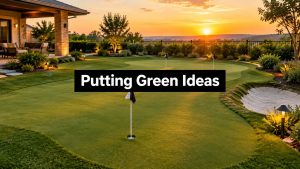

Picture the right backyard putting green before you build it. You're probably imagining more than a rectangle of artificial turf. You want a surface that looks intentional from the patio, fits the available space, gives you useful practice, handles Austin weather, and stays dependable after installation. The strongest backyard putting greens ideas balance visual appeal with practical decisions about drainage, slopes, shade, landscaping, cup placement, and maintenance.
A compact green can make a narrow side yard useful. A freeform design can blend into planting beds. A tiered layout can turn a difficult slope into a practice feature, while lighting can make evening play more comfortable. The right concept depends on how you'll use the yard, not on which project photo gets the most attention online.
Modern Yard Landscapes approaches the process as a full-service Austin landscaping partner. A site assessment, custom design, transparent estimate, documented project scope, and total satisfaction guarantee give you a clearer basis for deciding whether a putting green belongs on your property. These eight concepts will help you arrive at that conversation with better questions and realistic expectations.
1. Portfolio-Based Virtual Tours With Before-and-After Documentation
A portfolio should show more than a finished green under perfect lighting. It should help you understand what changed, why the design works on that property, and whether the same approach could suit your Austin backyard.
Start with before-and-after photographs that show the original lawn, access conditions, slopes, planting beds, and finished surface. A close-up can reveal turf texture and edge finishing, while an aerial view can clarify the relationship between the putting area, patio, fence, drainage routes, and surrounding grounds. A virtual tour adds another useful layer because you can study the green from the same sightlines you'll have at home.
Modern Yard Landscapes' residential turf installation gallery should be used as a decision tool, not just a collection of attractive images. Look for projects with comparable yard proportions, terrain, existing hardscape, and intended use. A small urban courtyard demands different design discipline than a broad backyard with room for chipping and multiple breaks.
What credible project proof should show
A trustworthy project record answers practical questions without forcing you to guess:
- Site challenge: Was the yard sloped, poorly drained, difficult to access, or crowded by existing landscaping?
- Design response: Did the installer use grading, drainage preparation, contours, fringe areas, or custom cup placement to solve the problem?
- Craftsmanship: Can you see clean edging, controlled transitions, consistent turf direction, and a natural relationship with nearby beds?
- Customer context: Does the project explain whether the green was designed for focused practice, family recreation, entertaining, or a combination?
A project gallery from Atlanta Concrete Solutions illustrates the broader value of organized visual proof for home-improvement decisions. For your appointment, ask to see examples that resemble your property rather than accepting only the company's most dramatic installation.
2. Transparent Consultation With Written Estimates and Project Timelines

A credible consultation turns a backyard putting green idea into a plan you can evaluate. The estimate should show how the total is built from site preparation, excavation, grading, base construction, drainage, edging, turf, infill, access, and custom features. Without those details, comparing proposals becomes guesswork.
Ask for site photographs and a written installation sequence. The scope should explain what happens before the turf arrives, how water will leave the green, which materials are included, which features cost extra, and what the crew needs from you. A realistic timeline also helps you plan around access, outdoor entertaining, pets, and other outdoor projects.
Drainage deserves direct attention in Austin. The University of Arkansas drainage guidance, which cites USGA construction principles, recommends rapid drainage, no pockets where water can remain, and drainage in more than one direction. For native-soil construction, it specifies subsurface drain lines spaced less than 10 feet apart. Use those criteria to test whether the site assessment addresses actual water movement rather than just promising a dry surface.
Ask for these documents before approval
- Written scope: Confirm demolition, excavation, grading, base layers, drainage, edging, turf installation, infill, cleanup, and cup placement.
- Site-specific estimate: Require material and labor explanations, not just a surface-area figure.
- Design alternatives: Compare compact, standard, and expanded layouts against your yard and practice goals.
- Warranty summary: Check that coverage and claim procedures are written in plain language.
- Project timeline: Confirm preparation, installation, inspection, and handover milestones.
You should finish the meeting knowing what you are buying, what can change, and why each recommendation fits the property. The consultation process described by Modern Yard Landscapes as a synthetic turf contractor provides a useful standard for that level of clarity. Documentation cannot remove every project variable, but it exposes avoidable ambiguity before you commit.
3. Client Referral Program With Documented Results
A neighbor's recommendation becomes useful when it helps you evaluate the work behind the finished putting green. Ask what communication felt like, how the crew protected the property, whether drainage problems were addressed, and what support continued after installation.
A referral program should connect prospective clients with relevant project examples, not replace honest customer feedback with promotional language. Modern Yard Landscapes can support that process by helping past clients share comparable designs, practical project details, and a clear appointment path. Any referral incentive should be disclosed, recorded accurately, and kept separate from the customer's freedom to describe the experience candidly.
The strongest referral includes specific evidence. A homeowner may explain how the team redesigned a side yard without removing mature planting, corrected a low area before installing the surface, or created a green that works for both children and adults. Those details show whether the installer can respond to property constraints and different practice goals.
Before you focus on appearance, ask the referred homeowner:
- Was the estimate understandable? Did the written proposal explain preparation, included work, and optional features clearly?
- Did the design fit the property? Does the green look integrated with the yard, or does it seem placed on top of the existing space?
- How was construction handled? Ask about access, site protection, cleanup, drainage work, and communication while the crew was present.
- What happened after completion? Find out whether follow-up was prompt and whether warranty support was explained and honored.
Request project photos or, where possible, visit a comparable installation. In Austin, nearby properties may share soil conditions, weather exposure, drainage patterns, and access limitations. That makes local referrals especially useful, because a similar yard provides stronger evidence than one oversized showcase project.
Use the referral conversation to test fit, not just popularity. Clear answers about preparation, design decisions, and aftercare give you more confidence before scheduling a professional consultation.
4. Specialized Expertise Demonstrated Through Education
A serious putting-green installer should explain why a design will perform well on your property. Terms such as “tour-quality” and “realistic” mean little until the company connects them to roll, slope, drainage, maintenance, and daily use.
Start with the technical details beneath the surface. Strong educational material explains base preparation, drainage, infill, UV exposure, antimicrobial options, pet use, surface temperature, and the difference between a decorative lawn and a practice surface. It should also identify trade-offs, such as where a feature improves play and where it adds upkeep or construction difficulty.
Modern Yard can demonstrate this knowledge through installation education, product information, professional credentials, and examples of work on sloped or difficult properties. Its guide to installing artificial turf gives homeowners a clearer view of the preparation beneath the finished surface. Use that information to compare similar projects and arrive at a consultation with specific expectations.
Ask these questions during the consultation:
- How will water leave the site? The answer should cover grading, low points, outlets, and subsurface drainage where conditions require it.
- How will the surface feel and roll? Ask about turf construction, infill, brushing, and the intended playing character.
- How will heat affect use? Shade, orientation, nearby materials, and time of day all matter in Central Texas.
- How will practice variety be created? Cup positions, flat zones, breaks, and uphill or downhill putts should support your actual training goals.
- What will maintenance involve? “Low maintenance” still includes inspection, cleaning, brushing, and infill management.
The USGA construction guidance offers useful benchmarks for systematic natural-green construction: lateral drainage pipes no more than 15 feet apart, a continuous drain slope of at least 0.5 percent, and a gravel drainage layer at least 4 inches deep. Those figures do not automatically govern an artificial residential project. They do show why a credible installer should explain every layer, document the recommendation, and connect it to your site before you approve an estimate.
5. Satisfaction Guarantee and Performance Warranty With Defined Terms
A guarantee only builds trust when you can understand it before signing. “We stand behind our work” sounds reassuring, but you need to know what happens if the surface develops a defect, water doesn't move as intended, an installation issue appears, or the finished result doesn't meet the agreed scope.
Modern Yard Landscapes' total satisfaction guarantee should be presented alongside a written warranty summary, not buried in dense legal language. Ask the company to explain material coverage, installation workmanship, drainage-related responsibilities, exclusions, maintenance obligations, and the steps for submitting a claim. The written estimate should reference the applicable warranty documents so there's no uncertainty about which terms govern the project.
A performance conversation should also distinguish appearance from playability. A green can look excellent in photographs and still disappoint if the roll is inconsistent, the breaks are poorly placed, or the surrounding edge makes useful practice difficult. Agree on the intended playing experience before construction begins.
Use measurement instead of vague promises
The USGA Stimpmeter measures ball-roll distance with a standardized 36-inch aluminum bar featuring a V-shaped groove and a release notch positioned about 30 inches from the tapered end. USGA Stimpmeter materials describe membership-play categories as slow below 7 feet 6 inches, medium from approximately 7 feet 6 inches to 8 feet 6 inches, and fast above 8 feet 6 inches.
A homeowner-focused green generally benefits from agreeing on a repeatable medium-speed target rather than chasing an unnecessarily demanding surface. Ask whether the installer will measure several rolls in opposite directions on a level section and record the result at handover. That creates a shared performance reference and can expose inconsistent preparation, seams, pile direction, infill distribution, or slope transitions.
6. Customer Testimonials and Social Proof That Explain the Experience
A finished photograph tells you what a green looks like. A strong customer testimonial tells you what it was like to buy, design, build, and live with.
Modern yard designs should collect reviews that address different properties and priorities. A golfer may discuss distance control and cup placement. A family may focus on outdoor use. A homeowner with pets may care more about cleanliness, drainage, and surface durability. A customer with a difficult slope can provide insight into grading, retaining work, access, and communication.
Video reviews can be especially useful when they show the completed green in its actual setting. Ask whether the customer discusses the original problem, the design decisions, the construction process, and the result. Before-and-after galleries and written case studies should provide the same context. A review that only says the crew was great offers limited planning value.
Look for evidence that is specific and balanced
Trustworthy social proof has identifiable detail:
- A real property setting: The project appears in a recognizable residential context, not only a staged close-up.
- A defined challenge: The customer explains what needed to be solved.
- A visible outcome: Photos show edges, transitions, drainage-related grading, and the usable practice area.
- A complete experience: The review covers consultation, installation, cleanup, and follow-up.
- A professional response: The company responds respectfully to both positive and critical feedback.
A short video can be embedded in a project page, while a written review can sit beside the relevant service description. A before-and-after video created with a social media video scaling tool can help present the transformation clearly, provided the underlying customer story remains authentic and accurately labeled.
Don't choose a contractor because a review count looks impressive. Choose one whose customer experiences resemble the decisions and constraints you're facing.
7. Strategic Partnerships and Industry Affiliations
Third-party relationships can support a contractor's credibility, but logos alone don't prove that a project will be handled well. The useful question is what each partnership contributes to your installation.
A turf manufacturer relationship may clarify product specifications, installation requirements, and warranty channels. A relationship with an architect can improve how the green fits the broader yard. A drainage specialist may help address persistent runoff, clay-heavy soil, or a site where a surface solution won't fix the underlying water problem. Golf design expertise can improve the practice value of breaks, elevations, fringe areas, and cup positions.
Modern Yard Layouts can make these affiliations more meaningful by explaining them in proposals and consultations. Instead of displaying a wall of badges, the company should identify the professional standard, product support, training, or design capability connected to each relationship.
Evaluate the partnership, not just the badge
Ask for practical context:
- What does the affiliation cover? Find out whether it relates to materials, training, installation, drainage, or design.
- Who performs the specialized work? Confirm whether the partner is involved directly or supplies a product.
- How is quality checked? Ask about site documentation, installation review, product records, and handover.
- What remains the contractor's responsibility? A manufacturer warranty doesn't replace responsibility for poor base preparation or incorrect installation.
- Is the credential current? Professional memberships and certifications should be maintained rather than presented as permanent proof.
A strong proposal can also identify how suppliers, designers, and drainage professionals influence the plan without making unsupported claims about third-party endorsement. That level of explanation helps you distinguish an integrated project team from a contractor who adds partner logos only for decoration.
8. Personalized Design Consultation With Custom Renderings
A putting green can look impressive on paper and still frustrate you every day. The right plan fits your property, protects usable yard space, and gives you the shots you want to practice. Generic contours often create awkward edges, poor circulation, or difficult positions that look better in a rendering than they play in real life.
Modern Yard Landscapes can assess existing grades, sun exposure, access, drainage, planting, patios, fences, and views from the house. A designer or architect then turns those conditions into a plan with practical flat areas, gentle breaks, uphill and downhill sections, fringe zones, and cup locations. The rendering gives you a clear opportunity to question the layout before excavation begins.
The professional landscape design service should connect the drawing to construction decisions, not merely present an attractive image. Ask how each contour affects ball speed, start direction, landing areas, furniture placement, maintenance access, and the relationship between the green and the rest of the yard. For context on how consultation standards can be documented, review this RPAS compliance consultation.
Build a shot inventory before choosing contours
List the practice situations you want the green to support:
- Straight start-line putts: Include a level area where alignment and face control are easy to isolate.
- Breaking putts: Use modest side slopes to practice reading direction without making every attempt extreme.
- Uphill and downhill putts: Add elevation changes for distance control, with enough landing area around each cup.
- Optional fringe shots: Include a transition zone if you want to practice approaches or short-game shots.
- Family and social play: Preserve approachable positions so beginners are not forced into difficult novelty putts.
Putting performance is measurable. The PGA Tour's Strokes Gained-Putting method compares a player's result from a particular distance with the average number of putts required by other tour players from that distance, course, and round context. PGA.com's explanation of the statistic notes that a putt from just under 8 feet was made approximately 50% of the time in the research used to develop the method, producing an expected result of about 1.5 strokes.
Use that benchmark when reviewing the plan. Include several usable distances around the 6-to-10-foot range, then vary breaks and speed without turning the green into a collection of trick shots. The final rendering should show how those practice opportunities work together before the first load of base material arrives.
Backyard Putting Greens: 8-Point Service Comparison
| Item | Implementation Complexity 🔄 | Resource Requirements ⚡ | Expected Outcomes ⭐📊 | Ideal Use Cases 💡 | Key Advantages ⭐ |
|---|---|---|---|---|---|
| Portfolio-Based Virtual Tours with Before-and-After Documentation | 🔄🔄🔄 High, professional photo/video, drone and 360° tour production plus web integration | ⚡⚡ Medium, photographer/drone operator, hosting platform, periodic updates | High, strong visual credibility, faster sales cycle, better lead qualification | Best for local residential prospects who need visual proof or remote decision-makers | Builds trust with real local examples; 24/7 accessible showcase that drives conversions |
| Transparent Consultation Process with Written Estimates and Project Timelines | 🔄🔄 Medium, process design, templates, staff training, legal review | ⚡ Low–Medium, documentation templates, CRM, trained estimators | High, reduces objections, prevents disputes, increases appointment conversions | Customers demanding clear costs/expectations and higher-value projects | Transparency and accountability; professional positioning that shortens sales cycle |
| Client Referral Program with Documented Results and Incentive Structure | 🔄🔄 Low–Medium, program design, tracking and communications | ⚡ Low, incentives budget, referral tracking tool, admin time | High, lower customer acquisition cost, higher conversion, neighborhood momentum | Established service areas with satisfied customers and tight-knit neighborhoods | Generates warm, qualified leads; cost-effective acquisition and strong word-of-mouth |
| Specialized Expertise Demonstration Through Educational Content and Certifications | 🔄🔄 Medium, content strategy, subject-matter creation, certification management | ⚡ Medium, content production, expert staff, certification fees | Medium–High (long-term), improved SEO, perceived authority, better-informed leads | Prospects researching technical issues (drainage, materials) or seeking expertise | Positions company as expert, reduces consult time, drives organic inbound interest |
| Satisfaction Guarantee and Performance Warranty Program with Clear Defined Terms | 🔄🔄🔄 Medium–High, legal/warranty drafting, policy, and quality-control systems | ⚡ Medium, insurance/reserves, admin processes, documentation | Very High, removes purchase risk, strong differentiator, higher close rates | Risk-averse customers and premium projects needing investment protection | Most powerful trust signal; reduces hesitation and strengthens closing arguments |
| Customer Testimonials and Social Proof Strategy with Video Reviews and Before-and-After Results | 🔄🔄 Medium, collect, edit, verify and publish multi-format testimonials | ⚡ Medium, video capture/editing, review management tools, modest incentives | High, social proof boosts credibility and appointment requests across segments | Broad appeal, prospects swayed by peer recommendations and visual results | Authentic third-party validation that addresses objections and increases trust |
| Strategic Partnerships and Industry Affiliations as Third-Party Endorsements | 🔄🔄 Low–Medium, secure partnerships, maintain certifications and standards | ⚡ Low, membership/ certification fees, relationship management | Medium, external validation improves perceived standards and supplier access | Commercial clients, environmentally-conscious customers, standards-driven buyers | Third-party credibility, access to premium materials, and reciprocal referrals |
| Personalized Design Consultation with Landscape Architect Involvement and Custom Renderings | 🔄🔄🔄 High, trained designers, 3D/ rendering workflows, iterative client reviews | ⚡⚡ High, licensed designers, 3D software, time-intensive consultations | High, increased perceived value, better-fit designs, justifies premium pricing | High-end residential clients and complex sites requiring tailored solutions | Tailored solutions that prevent design errors, create emotional buy-in and enable premium pricing |
Turn Inspiration Into a Confident Next Step
You don't need to choose the most elaborate concept. You need a green that suits the backyard you own, the people who'll use it, and the kind of practice you want to repeat.
Start by identifying the property's real constraints. Note the usable area, existing slopes, afternoon heat, shade from trees or structures, access for construction equipment, drainage patterns, patios, planting beds, and places where a missed ball could travel. A compact green may be the smartest choice if it preserves circulation and landscaping. A chipping-integrated layout needs open space and safe clearance. A tiered concept can make a slope useful, but it demands more careful grading, drainage, and construction planning.
Your golf goals matter just as much. If you want start-line practice, prioritize level sections and practical cup locations. If distance control is the priority, include uphill and downhill putts. If the green will anchor family gatherings, integrate it with the patio and preserve comfortable routes around the surface. If Austin's summer heat will determine when you use the yard, consider shade, orientation, surrounding materials, and evening lighting before finalizing the shape.
Don't compare contractors by appearance alone. Compare the evidence behind the appearance:
- Visual proof: Review completed projects with similar yards, slopes, edges, and landscaping.
- Site-specific design: Confirm that the plan responds to your property rather than reproducing a standard template.
- Drainage planning: Ask where water will go, how low points will be handled, and what sits beneath the turf.
- Material choices: Discuss turf construction, infill, edging, cooling considerations, and maintenance requirements.
- Written scope: Make sure preparation, installation, cleanup, timeline, and optional features are documented.
- Warranty terms: Read the guarantee before committing and ask how claims are handled.
- Customer feedback: Look for detailed experiences that cover communication and follow-up as well as the finished green.
Heat deserves a direct conversation in Central Texas. A 2025 field study reported average daytime synthetic-turf temperatures near 50 °C, compared with roughly 30 to 32 °C for natural grass, and recorded a maximum of 71.6 °C. The field-study discussion of synthetic-turf heat also explains that shade is one of the strongest mitigation strategies, while watering may provide only temporary cooling before temperatures rebound. Plan for comfortable use by comparing morning and afternoon exposure, considering tree canopy or a pergola, and deciding whether a planted or natural-grass buffer makes more sense than covering every part of the yard.
Natural grass also has a different maintenance commitment. The USGA reports that modern putting greens are typically maintained at or below 0.125 inch, or one-eighth of an inch, in cutting height. USGA guidance for homeowners considering backyard greens explains why a natural green requires specialized mowing, irrigation, and ongoing care rather than ordinary lawn service. If you choose synthetic turf, ask what routine brushing, cleaning, infill management, and inspection the surface still needs.
Modern Yard Designs can help you narrow the ideas to a plan that fits your Austin property. Bring your preferred features, practice goals, concerns about heat or drainage, and a realistic budget to the conversation. Ask the team to review suitable layouts, explain the construction layers, show comparable work, and provide the written information you need before installation begins.
Modern Yard backyards offers custom backyard putting green design and installation, including site assessment, grading, drainage preparation, base construction, artificial turf, contours, fringe areas, and cup placement. Visit Modern Yard Landscapes to discuss your backyard, review design possibilities, and schedule an Austin-area consultation with a team that can explain the work clearly before construction starts.