
A lawn can make a commercial property look neglected long before anyone complains about it. You see it in the bare walkways, the muddy corners after rain, the brown patches near entrances, and the weekly invoice that keeps arriving even though the property still looks inconsistent. For an Austin property manager, the question isn't whether the property should look better. It's whether the installation will keep performing after heavy foot traffic, intense sun, and sudden storms.
Commercial turf installation can solve that problem, but only when the contractor treats the project as a complete surface system rather than rolled-up green carpet. Materials matter. Drainage matters more. So does the confidence a contractor creates before work begins, from the first phone call to the final walkthrough.
Why Austin Businesses Are Switching to Commercial Turf
A business owner on South Lamar may start the day by noticing a tired strip of lawn outside the entrance. Customers see the same strip while they walk in. Employees track mud inside after rain, outdoor seating loses its appeal, and the maintenance crew keeps trying to revive grass that struggles under shade, traffic, and Texas weather.
Synthetic turf changes the operating equation. It provides a consistent appearance without mowing, fertilizing, or depending on natural growing conditions. For offices, restaurants, retail properties, hospitality venues, and sports facilities, that consistency supports a more professional customer experience. It also gives property managers a surface designed for use, not just for display.
The commercial turf industry has a longer history than many buyers realize. Chemgrass, the first widely recognized synthetic playing surface, was installed in 1964 at Moses Brown School in Providence, Rhode Island, then used at the Houston Astrodome in 1966 after natural grass failed beneath the stadium roof. By the start of the 1976 season, 16 of 28 NFL teams played on artificial turf, and adoption reached a peak of 17 of 28 teams in 1984. The history of synthetic turf and its professional adoption shows why commercial buyers began viewing turf as a dependable surface for demanding facilities.
The business case goes beyond appearance
A well-designed system can reduce routine disruption and keep high-visibility areas presentable throughout the year. It can also support spaces that natural grass cannot reliably handle, such as narrow courtyards, heavily used entry zones, rooftop areas, and outdoor gathering spaces.
That doesn't mean every commercial property needs turf everywhere. A smart contractor identifies where synthetic turf will perform better than natural grass and where another exterior treatment makes more sense. The right decision depends on traffic, drainage, shade, access, cleaning requirements, and the image the property needs to project. Review the business advantages of synthetic turf for commercial properties before comparing bids.
Understanding Commercial Turf Materials and Specifications
Not all artificial grass is commercial grade. A sample can look convincing in a showroom and still fail quickly when foot traffic compresses the fibers, infill migrates, or the backing can't handle the site conditions. Ask for the complete product specification, not just the color name or a photograph.
A technically typical commercial synthetic-turf build uses a pile height of roughly 40 to 70 mm. Infill commonly occupies about 25 to 40 mm of that fiber depth. Modern fibers are usually polyethylene, nylon, or polypropylene, with polyethylene the most common choice. Field guidance on artificial turf materials and infill explains why the dimensions and material selection need to work together.
Start with the fiber, not the sales pitch
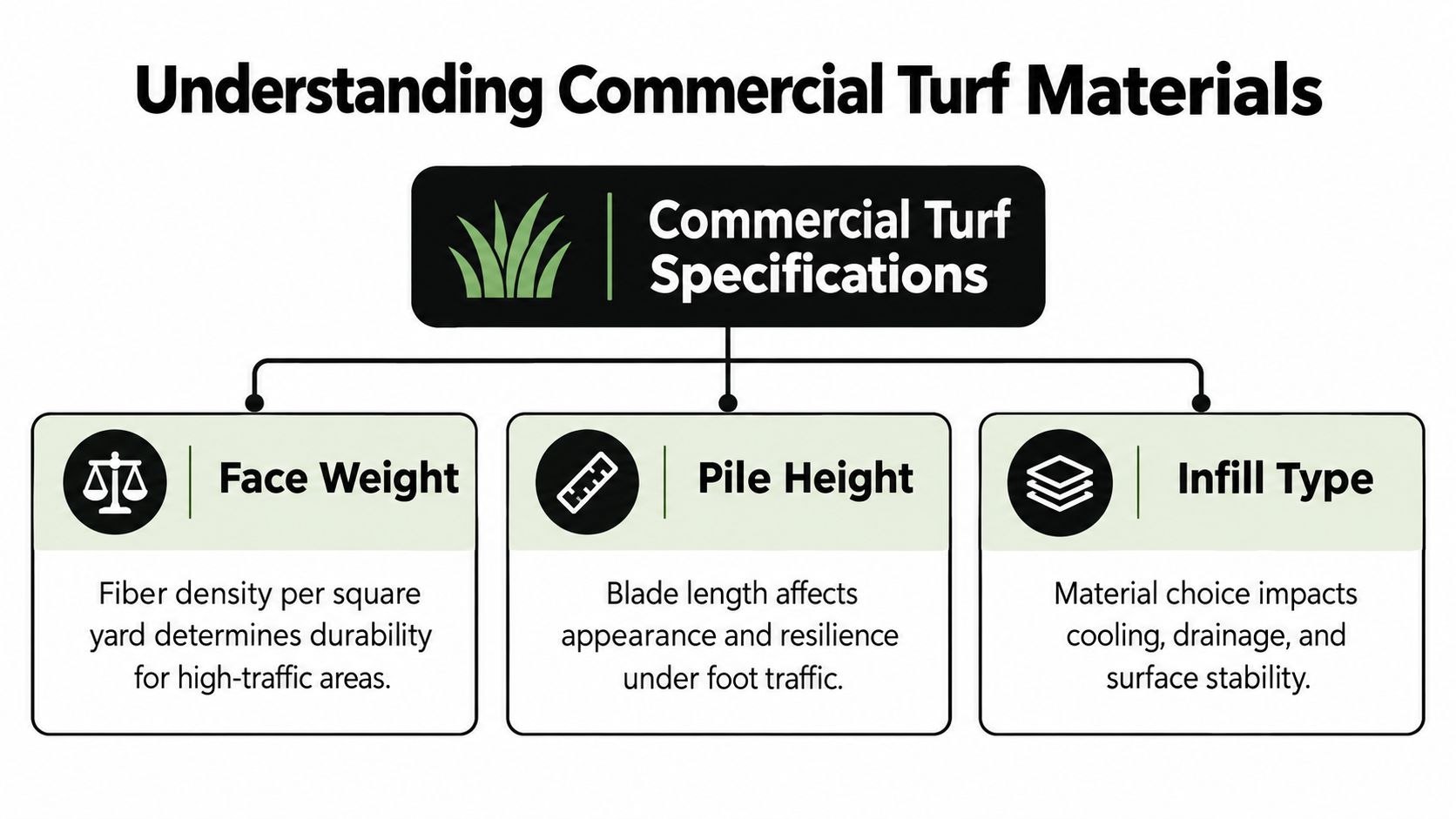
Face weight indicates how much fiber the turf uses across a defined area. More fiber generally supports a denser appearance and better resistance to repeated traffic, but it shouldn't be evaluated alone. Fiber shape, denier, backing construction, and infill all influence performance.
Pile height affects how the finished surface looks and responds under use. Taller fibers can create a lush appearance, but they need adequate infill support. A tall pile with insufficient infill can lean and flatten, while excessive infill can bury the blade tips and change the feel of the surface.
Fiber material affects appearance, resilience, and heat behavior. Polyethylene is common because it can provide a natural look with practical durability. Nylon and polypropylene may suit particular applications, so the contractor should explain why a product fits your traffic level rather than just presenting the most expensive option.
Infill is a working component
Infill adds ballast, helps keep fibers upright, and helps protect the backing from ultraviolet exposure and wear. It can also affect drainage, cushioning, cleaning, and surface temperature. The installer should maintain the depth to the manufacturer's specifications and inspect it routinely.
Ask these questions before approving a product:
- What is the face weight and fiber denier? You need enough fiber density for the expected traffic, not a residential specification placed in a commercial setting.
- What does the backing system include? The backing must support seams, drainage, and long-term dimensional stability.
- Which infill will be used? Require the product name, intended purpose, and maintenance requirements in writing.
- How will the contractor check infill depth? A maintenance plan should explain how the team will identify displacement and restore coverage.
- Where are the seams and high-traffic paths? Product selection should account for entrances, queues, play areas, and service access.
A transparent specification sheet is more valuable than a vague promise that the turf is “premium.” Compare commercial synthetic turf options and construction details before you commit.
The Step-by-Step Commercial Turf Installation Process
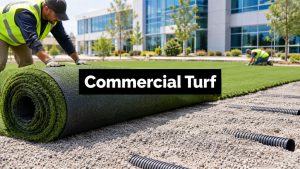
Installation quality determines whether the surface remains stable or begins showing problems at the edges, seams, and low points. A professional crew doesn't start by rolling out turf. It starts by understanding how people use the property and how water moves across it.
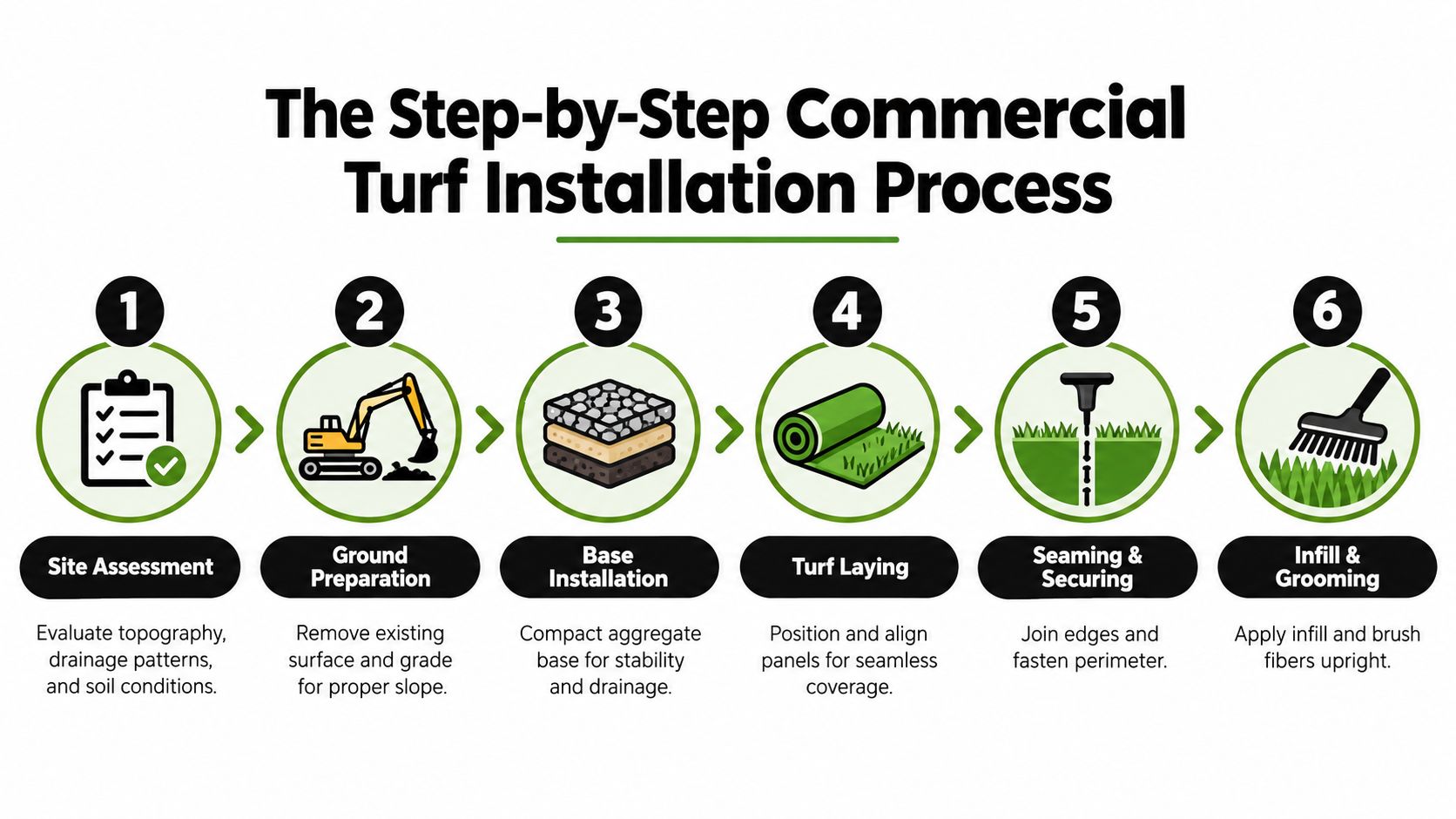
1. Assess the site before removing anything
The contractor should review topography, existing drainage patterns, soil conditions, access routes, irrigation conflicts, tree roots, utilities, and the locations where traffic concentrates. This assessment determines the excavation depth, base design, edge treatment, and whether drainage tile is needed.
2. Prepare the ground for the system
Existing grass, loose material, rocks, and unsuitable soil must be removed. The area is then graded to create positive runoff and shaped for the planned finish elevation. Skipping excavation or leaving unstable material beneath the base creates problems that no turf product can correct.
3. Build and compact the base
Independent sports-surface guidance recommends about 10 inches per hour of permeability for the turf, backing, and infill assembly, about 14 inches per hour for the base and finish stone, and at least 95% standard Proctor compaction for the base. The technical guidance on turf permeability and compaction connects these specifications to the system's ability to move water and resist deformation.
4. Lay, align, and seam the turf
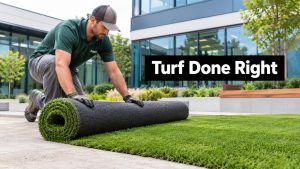
The crew positions panels so the fiber direction remains consistent. Panels are trimmed carefully, then joined with professional seam tape and adhesive. Poor alignment can create visible color shifts, while weak seams can open under traffic or temperature movement.
5. Secure the perimeter
Commercial-grade steel edging or another suitable restraint keeps the turf from shifting at walkways, planting beds, concrete, and other borders. Edges deserve the same attention as the center of the field because movement often begins where the surface meets another material.
6. Install infill and groom the fibers
The crew distributes infill evenly, brushes the surface upright, checks seams, inspects edges, and removes construction debris. The final walkthrough should document the finished condition and explain how the property team should handle cleaning, traffic, and future maintenance.
Practical rule: If a quote focuses on the turf roll but says little about excavation, base depth, compaction, and drainage, you're not comparing complete installations.
See the commercial artificial turf installation details before accepting a proposal that leaves the invisible foundation vague.
Commercial Turf Installation Costs and Budget Planning
Price comparisons only work when each contractor includes the same scope. One proposal may include excavation, aggregate, edging, seams, infill, and cleanup. Another may show a lower material price while leaving drainage work, disposal, access challenges, and repairs to the property owner.
Austin commercial turf budgets are shaped by four main variables:
- Material specification: Higher-density fibers, specialized backing, and purpose-built infill change the material cost.
- Project area: Larger areas may simplify purchasing, while small or fragmented areas can require more cutting and detail work.
- Site complexity: Slopes, tight access, existing concrete, poor soil, drainage corrections, and unusual geometry increase labor.
- Performance features: Cooling options, antimicrobial treatments, custom designs, drainage tile, and sports-specific requirements add scope when the site needs them.
| Cost Factor | Impact on Price | Typical Range |
|---|---|---|
| Material quality | Basic products cost less, while commercial-grade fiber and backing support heavier use | Entry-level to premium |
| Site access | Open access simplifies delivery and excavation; restricted access increases handling and labor | Low complexity to high complexity |
| Ground preparation | Stable ground requires less correction; poor drainage or unsuitable soil requires additional work | Standard preparation to corrective preparation |
| Design and detailing | Simple rectangles are faster to install than curves, logos, borders, and multiple transitions | Simple layout to custom layout |
| Drainage and base work | A properly engineered base adds upfront scope but protects performance | Basic drainage to engineered drainage |
A useful estimate should show quantities, material specifications, labor, base preparation, edging, seam work, infill, drainage, disposal, and maintenance guidance. Don't accept a single unexplained total when the project will affect customer-facing space and operating schedules.
The cheapest proposal often becomes expensive when it excludes the work that determines whether the surface drains, stays flat, and keeps its seams intact. Compare scope line by line, then ask each contractor to explain any difference in plain language.
Drainage, Heat Management, and Performance Optimization
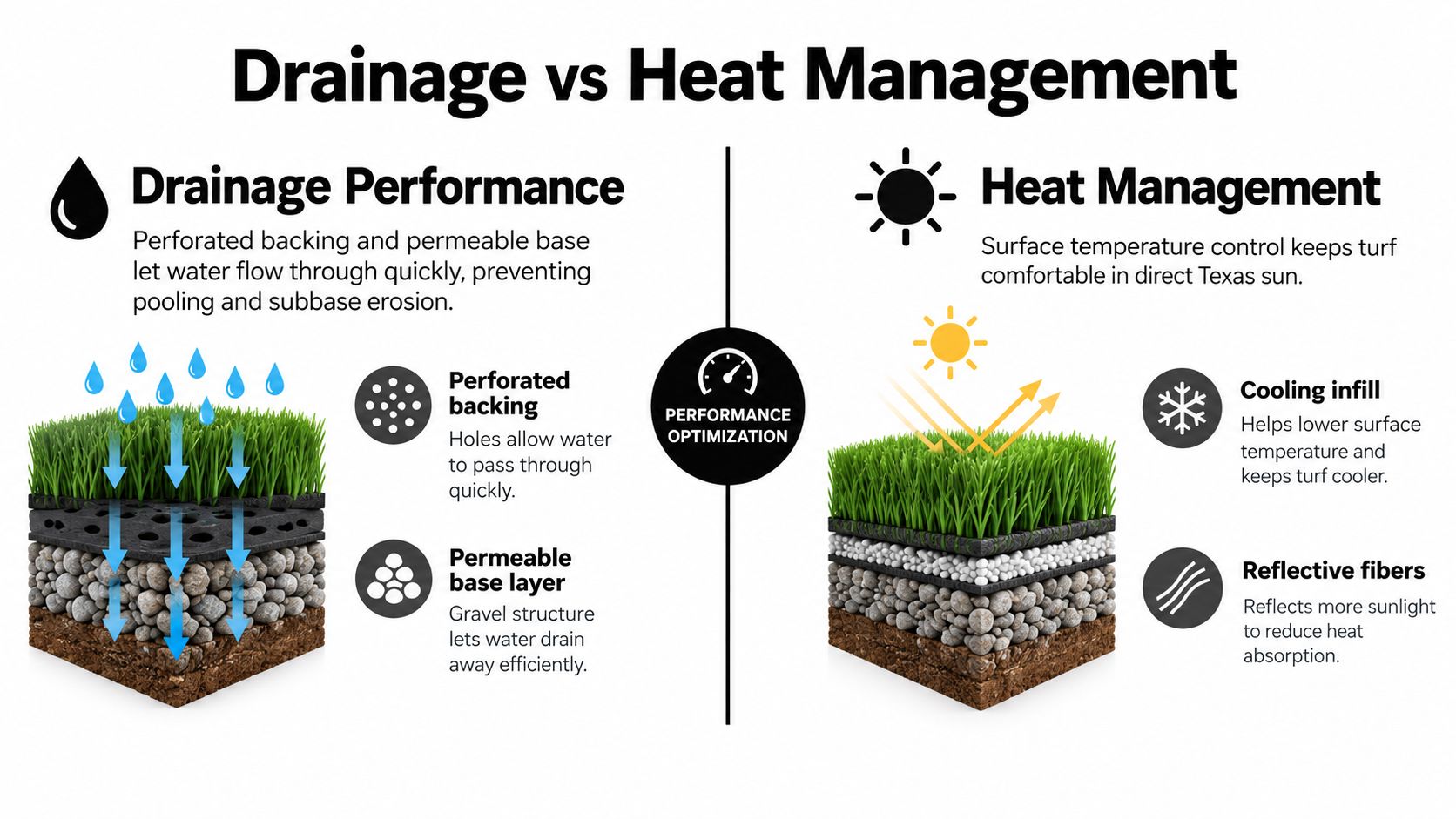
Austin's climate makes two installation decisions essential: engineer the base for drainage and plan for surface heat. Turf doesn't drain because it has roots. Water must move through the backing, aggregate layers, and prepared subgrade. If those layers restrict flow, the surface can pool even when the turf face itself is perforated.
Poor drainage creates more than an appearance problem. Water can increase hydrostatic loading beneath the carpet, stress seams, displace infill, soften localized areas, and create trip hazards. It can also delay reopening after storms or cleaning, which matters when a restaurant patio, office courtyard, or sports area supports daily operations.
Drainage starts below the visible surface
Ask the installer to identify where water will go, not merely to say that the turf drains well. The design may require a permeable aggregate base, corrected grading, drainage tile, channel drains, or a combination of methods. The right answer depends on the site's slope, surrounding hardscape, soil behavior, and discharge options.
A contractor should also explain how the base will be compacted and checked. Under-compaction leaves voids that can collapse, while an impermeable layer below the turf can trap water. The finished surface may look perfect on installation day and still develop soft spots after repeated storms if the foundation wasn't built correctly.
Heat planning belongs in the proposal
Synthetic surfaces can become uncomfortably hot in direct sun. One industry report says surfaces may reach 70°C at midday, while newer cooling fiber systems are reported to reduce temperatures by 10 to 15°C or 12 to 18°C, depending on the product claim. Current reporting on artificial turf heat management and cooling technologies also identifies infrared-reflective fibers and cooling systems as active innovation areas in 2026.
Those options don't replace shade planning, hydration access, operating guidance, or good site design. They give property managers another tool when the surface will serve children, athletes, employees, guests, or pets during direct sun.
A turf proposal that discusses color and pile but ignores water and heat is incomplete.
Review heat-resistant artificial turf options with the contractor, then make the decision based on actual exposure and use rather than marketing language.
Maintenance Requirements and Warranty Expectations
Commercial turf is low-maintenance, not maintenance-free. A property team still needs to remove leaves and debris, rinse contaminants, groom compacted fibers, inspect seams and edges, and monitor infill in high-traffic areas. Those tasks are simpler than mowing, fertilizing, irrigating, or applying pesticides, but neglect can shorten the system's useful performance.
The maintenance plan should match the property. A restaurant may need more frequent cleaning near outdoor dining. An office campus may need attention around entrances and pedestrian shortcuts. A sports facility may need regular grooming where users pivot, stop, and accelerate.
Put the maintenance promise in writing
A responsible handover should identify:
- Cleaning method: Specify suitable rinsing, spot-cleaning, and debris-removal practices.
- Grooming equipment: Confirm whether a power brush is recommended and which brush type is safe for the fiber.
- Infill inspection: Record the manufacturer's target depth and the conditions that require top-up work.
- Damage response: Explain how to report lifted seams, damaged edges, stains, or unusual soft areas.
- Warranty obligations: List the maintenance actions required to keep coverage valid.
Warranty language deserves careful attention. Ask whether coverage applies to fiber integrity, colorfastness, ultraviolet degradation, excessive matting, backing, seams, and workmanship. A manufacturer's product warranty and an installer's workmanship warranty may cover different problems, so don't treat them as interchangeable.
The strongest business case combines predictable upkeep with documented installation quality. Lower routine labor is useful only if the property team knows what to do and the warranty terms don't hide exclusions that could leave the owner responsible for preventable failures.
Choosing the Right Commercial Turf Contractor
A contractor earns trust before installation begins. You should be able to verify who will perform the work, what protection they carry, where they've worked locally, and what happens after you request an estimate.
Use this checklist during the selection process:
- Verify insurance and credentials. Ask for current insurance documentation and any relevant licenses or certifications. Don't rely on a logo displayed on a website.
- Review local project evidence. Look for real photos of completed commercial work, not only manufacturer images. Ask about properties with similar traffic, drainage, access, or design constraints.
- Read reviews in context. Look for details about communication, site preparation, cleanup, scheduling, and warranty response. A string of unexplained star ratings tells you less than a review describing the actual project.
- Demand an itemized estimate. The proposal should separate turf, excavation, base, drainage, edging, seams, infill, labor, disposal, and optional features.
- Test response quality. Notice whether the contractor answers direct questions, confirms the site details, and gives a clear expectation for the next contact.
- Confirm the process. A reliable sequence is request an estimate, confirm details, inspect the property, issue a quote, and schedule the work.
Easy scheduling matters because it removes uncertainty at the moment a buyer is deciding whether to engage. Research found that 94% of respondents would be more likely to choose a new service provider when online booking options were available, according to research on online booking expectations. Another source found that appointment friction lowered “Likelihood to Recommend” by 13.1 points, as reported in research on the last mile of appointment scheduling.
Trust check: The contractor who makes the consultation clear, documented, and easy to schedule is showing you how the project will be managed.
If financing becomes part of the project decision, a practical checklist to boost loan approval can help organize the documentation lenders may request. It isn't a substitute for comparing installation scopes, but it can make the budgeting conversation more orderly.
ROI, Sustainability Benefits, and Your Next Steps
A commercial turf project should earn its place in the budget through more than curb appeal. It can reduce dependence on irrigation, remove mowing and fertilizing from the routine schedule, and create a stable surface in areas where natural grass repeatedly struggles. It can also help a property present a consistent face to customers, tenants, employees, and visitors.
The sustainability discussion needs precision. Synthetic turf can reduce water and chemical inputs associated with natural grass, but the responsible choice still requires attention to product quality, heat, drainage, maintenance, and end-of-life handling. A property owner should ask about the materials being installed, cleaning requirements, infill management, and available disposal or recycling pathways rather than accepting a broad environmental claim.
The financial return depends on the property. A heavily used entrance with recurring repair and maintenance problems may justify turf quickly because it addresses both appearance and operational disruption. A lightly used lawn with simple irrigation may not produce the same result. Build the decision around your actual site conditions:
- Document current problems: Record irrigation trouble, muddy areas, worn paths, mowing constraints, and customer-facing defects.
- Separate one-time work from recurring work: Compare installation scope with the grounds tasks the property currently pays for.
- Price performance, not just appearance: Include drainage, edges, seams, infill, heat management, and maintenance instructions.
- Protect the investment: Choose a contractor that documents the work and explains warranty responsibilities before the crew arrives.
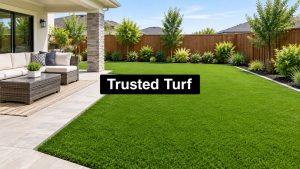
An Austin commercial property can look transformed when a worn lawn becomes a clean, usable outdoor area with defined edges and a consistent finish. The transformation is most valuable when the owner knows why the system was specified, how water will leave the site, how heat will be managed, and who will respond if something needs attention.
Schedule a site consultation before requesting a final price. The contractor should inspect the property, discuss traffic and exposure, identify drainage requirements, show suitable materials, and provide a written estimate that makes the tradeoffs visible.
Modern Yard Turf provides commercial turf design, installation, drainage preparation, maintenance, and material recommendations for Austin-area properties. Visit Modern Yard Landscapes to review the service options and schedule a consultation for your site.