
There's no single universal best infill for artificial turf. For athletic impact absorption, choose crumb rubber or TPE; for natural aesthetics, choose coated sand; for eco-friendly comfort, consider an organic blend, but remember that complete turf systems can exceed 150°F and no infill eliminates solar heating by itself.
That matters on an Austin lawn where a sunny afternoon can turn a comfortable-looking yard into a difficult surface for bare feet, children, and dogs. Homeowners often start by comparing bags labeled sand, rubber, cork, or polymer. The better question is what the entire installation must accomplish, including fiber performance, drainage, base stability, shade, watering access, and maintenance.
| Primary priority | Strong starting point | Why it fits | Main caution |
|---|---|---|---|
| Athletic impact absorption | Crumb rubber or TPE | Cushioned, resilient performance | Requires measured testing and heat planning |
| Natural residential appearance | Coated sand | Supports upright fibers and provides ballast | Can compact or retain heat if poorly specified |
| Pet comfort and odor management | A designed mineral and organic or specialty blend | Can balance drainage, moisture behavior, and comfort | Organic materials need careful water and maintenance planning |
| Eco-focused cooling design | Organic infill with engineered drainage and water storage | Can support evaporative cooling in a complete system | The infill alone won't solve heat |
| Putting green consistency | Fine, properly graded mineral infill | Supports predictable fiber position and ball roll | Installation depth and compaction control are critical |
Why Turf Systems Are Customized, Not Standardized
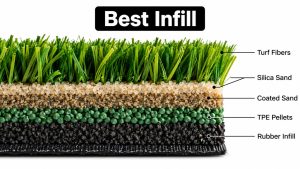
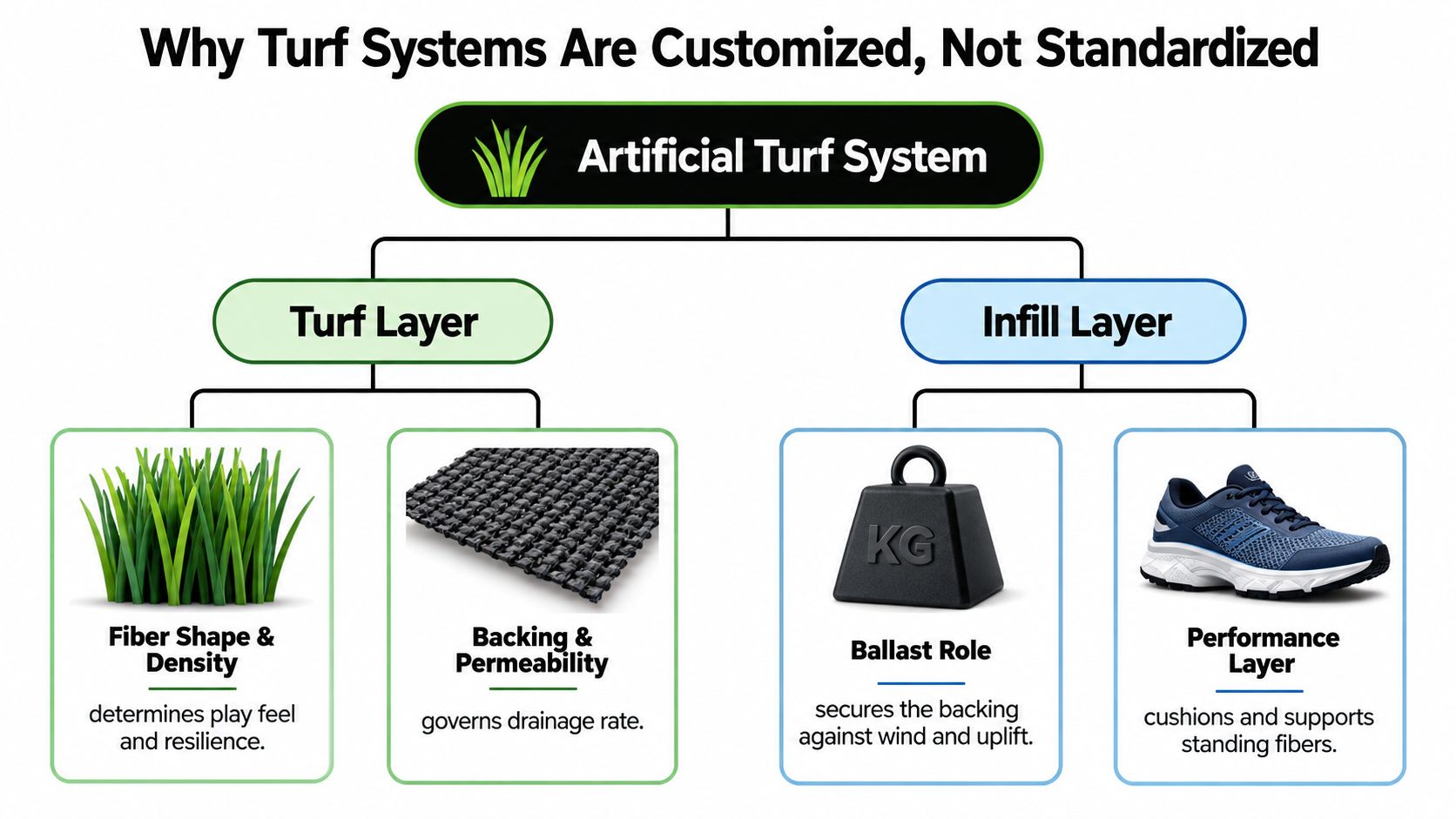
Artificial turf infill isn't a generic filler poured over the grass. It performs two different jobs. First, it adds ballast, helping hold the turf in place. Second, it acts as a performance layer, supporting synthetic fibers and influencing cushioning, footing, drainage, and surface feel.
The U.S. Environmental Protection Agency's federal synthetic-turf research describes a common construction pattern where sand sits as a lower infill layer to ballast the turf, while tire crumb rubber, or a sand-and-crumb-rubber mixture, sits above it to support fibers and affect field performance. The same EPA material identifies sand, coconut husks, and cork as alternatives to tire crumb.
Start with the site, not the product label
A reliable recommendation begins with the property. A sloped Austin side yard, a sunny backyard dog run, and a shaded putting green don't need identical construction. The installer should assess the existing soil, water movement, access, traffic pattern, intended use, and the amount of direct sun before selecting the infill.
The turf layer matters just as much. Fiber shape and density influence how the surface feels and how well it recovers from traffic. The backing and permeability govern how water moves through the grass. A high-performing infill can't compensate for a weak backing, undersized base, or drainage path that sends water toward the house.
Practical rule: Specify the infill together with its installed depth, weight, drainage plan, and maintenance requirements. “Rubber” or “sand” alone isn't a complete specification.
The base and drainage tile deserve equal attention. Infill may support the upper surface, but the aggregate base creates the stable platform beneath it. If that platform holds water, shifts, or settles, changing infill won't correct the underlying problem. Homeowners comparing installers should ask how each company will prepare the base, protect edges, control transitions, and verify the finished surface.
For a closer look at how the layers work together, review the artificial turf layer guide. A professional consultation is valuable because the same material can behave differently when installed at a different depth, over a different base, or in a different drainage environment.
Comparing Primary Infill Families
Most choices fall into two broad families, mineral infills and polymer or rubber infills. Mineral options, such as silica sand and coated sand, provide dependable ballast and fiber support. Polymer and rubber options generally offer more cushioning and resilience, making them more suitable for areas where people run, pivot, or land repeatedly.
Mineral infill is usually the sensible starting point for a decorative residential lawn without intense traffic. Properly graded sand can help fibers stand upright and can work well with a permeable backing. Coated sand adds a more refined surface feel and may be easier to manage in family or pet settings, depending on the specific product and installation design.
Read more about the role of mineral materials in sand infill for artificial grass. The important point isn't that sand is automatically good or bad. Grain shape, gradation, installed depth, and drainage determine whether it stays supportive or becomes compacted in busy zones.
Polymer and rubber choices
Crumb rubber remains a practical choice for athletic surfaces because it contributes cushioning and resilience. TPE can provide a cleaner, more uniform polymer option where consistent performance and user comfort justify a more specialized specification. Neither material should be chosen only because a salesperson calls it premium.
The EPA found that recycled-tire crumb-rubber particles used on synthetic-turf fields predominantly measured between 0.25 and 4 millimeters, with substantial variation across samples. That particle size affects how the material behaves under foot traffic, how it migrates, and how well routine maintenance retains it, as described in the agency's crumb-rubber characterization report.
| Deciding factor | Mineral infill | Polymer or rubber infill |
|---|---|---|
| Fiber support | Strong when correctly graded and installed | Strong, with added resilience |
| Impact feel | Firm to moderately cushioned | Softer and more shock-absorbing |
| Heat behavior | Can become hot in direct sun | Can also become hot, especially dark rubber |
| Best setting | Residential landscapes and greens | Athletic, play, and high-impact areas |
| Maintenance concern | Compaction and uneven distribution | Migration, replenishment, and localized hard spots |
Safety decisions need evidence rather than absolute claims. The U.S. Consumer Product Safety Commission's summary of the federal review states that available studies didn't show a higher health risk from playing on fields containing tire crumb, while also acknowledging data gaps and alternative materials. That supports a transparent conversation, not a blanket claim that every infill is risk-free or that one alternative solves every environmental concern.
Managing Heat in Central Texas Lawns
Austin homeowners often ask for the coolest infill. That's understandable, but it's the wrong first question. The practical question is whether the fiber, infill, backing, base, drainage, shade, and cooling plan work together during the hours when the lawn gets used.
Penn State's comparison found that individual fibers and infill materials could differ by as much as 20°F, but complete turf systems differed by 12°F or less. The same research reported complete-system surface temperatures exceeding 150°F and found that no tested product substantially reduced temperature compared with a conventional system using green fibers and black rubber infill. See the Penn State synthetic-turf heat report for the system-level findings.
Why the sub-base matters
A lighter infill may change how the surface absorbs and releases heat, but it doesn't stop sunlight from heating the synthetic fibers. The surface color, fiber density, backing, orientation, surrounding hardscape, and access to shade all influence the result. Drainage also matters because cooling strategies that depend on water require a system capable of receiving, distributing, and moving that water without creating wet spots.
A municipal technical memorandum reports that turf-fiber surfaces on sunny days may run roughly 40 to 50 degrees hotter than ambient air, while crumb rubber itself was only a few degrees above ambient. The same review reports that watering produced only short-term cooling. A separate measurement cited in the available technical evidence found a synthetic surface drop from 174°F to 85°F after watering, followed by rebound to 120°F after five minutes and 164°F after twenty minutes. Those figures make one point clear: hosing the grass isn't a permanent heat-control plan. The municipal crumb-rubber memorandum provides the supporting thermal discussion.
A more engineered approach can use shade, irrigation, water storage, and a capillary layer. A 2025 Wageningen University study tested below-field water storage, a capillary shock pad, and natural infill. On summer days near 30°C air temperature, the cooled surface reached 37°C, compared with 62.5°C for conventional artificial turf, while evaporation reached approximately 4 millimeters per day, about half the evaporation rate of natural grass, according to the Wageningen study on climate-proof playing conditions.
For Austin projects, heat-resistant artificial turf should mean a system discussion, not a promise that a bag of infill will make turf cool. Ask where shade can be created, whether irrigation is practical, how water will drain, and how the surface will be used during the hottest part of the day.
Application-Specific Infill Recommendations
The best infill changes with the activity. A lawn for occasional walking doesn't need the same impact profile as a commercial sports area, and a dog run has different priorities from a putting green. Choose the use case first, then choose the material and installation method.
| Application | Recommended Infill | Key Performance Benefit |
|---|---|---|
| Residential lawn | Coated sand or a carefully specified mineral blend | Ballast, upright fibers, and a natural underfoot feel |
| Pet-friendly dog run | Mineral base with an odor-conscious specialty or organic component | Drainage planning, moisture management, and comfort |
| Backyard putting green | Fine, consistently graded mineral infill | Stable fibers and predictable ball roll |
| Commercial or athletic space | Crumb rubber, TPE, or a tested hybrid | Impact attenuation, resilience, and consistent footing |
Residential lawns
For a front yard or backyard with ordinary household traffic, I generally favor coated sand or a well-designed mineral system. It gives the installer reliable ballast and fiber support without adding the specialized cost or maintenance profile of a sports infill. The material still needs correct gradation and depth, particularly around gates, walk paths, and areas where furniture sits.
Don't select a basic material just because the initial quote is lower. A residential lawn can develop flattened traffic lanes or compacted zones if the infill doesn't match the fiber height and use pattern.
Dog runs and pet areas
Pet turf demands more than a soft feel. Urine, rinse water, odors, drainage, shade, and cleaning access all matter. I prefer a system blend that uses a stable mineral component for support and a selected odor-conscious component where the site needs it. Organic infills, including cork, can offer comfort and a different heat profile, but they may require moisture management and closer observation for compaction, decomposition, or replacement.
The most important installation detail is rapid, reliable drainage through the full surface assembly. A product label can't tell you whether the base will move water away from the dog run or toward the foundation. Ask for the drainage path before approving the infill.
Putting greens
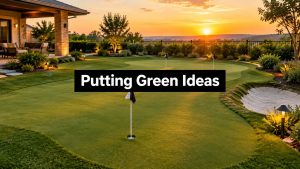
Putting greens need consistency rather than softness. Fine mineral infill can support short fibers and help preserve a predictable ball path, but the contractor must control the base, seams, grade, and final distribution. Uneven infill or localized compaction can change how a ball rolls even when the green looks attractive from a distance.
Commercial and athletic spaces
For high-impact applications, don't accept marketing language as a performance test. ASTM F1936 evaluates surface hardness using G-max, with an ASTM maximum of 200 G. The Synthetic Turf Council recommends keeping readings below 165 G throughout the field's service life, and lower G-max indicates greater shock absorption, according to the Synthetic Turf Council's field guidelines.
Those projects should specify infill type, installed weight per square foot, target depth, and commissioning tests. Testing should cover multiple locations because low-infill areas and compacted zones can create hard spots that a field-wide average may hide.
Cost and Maintenance Implications
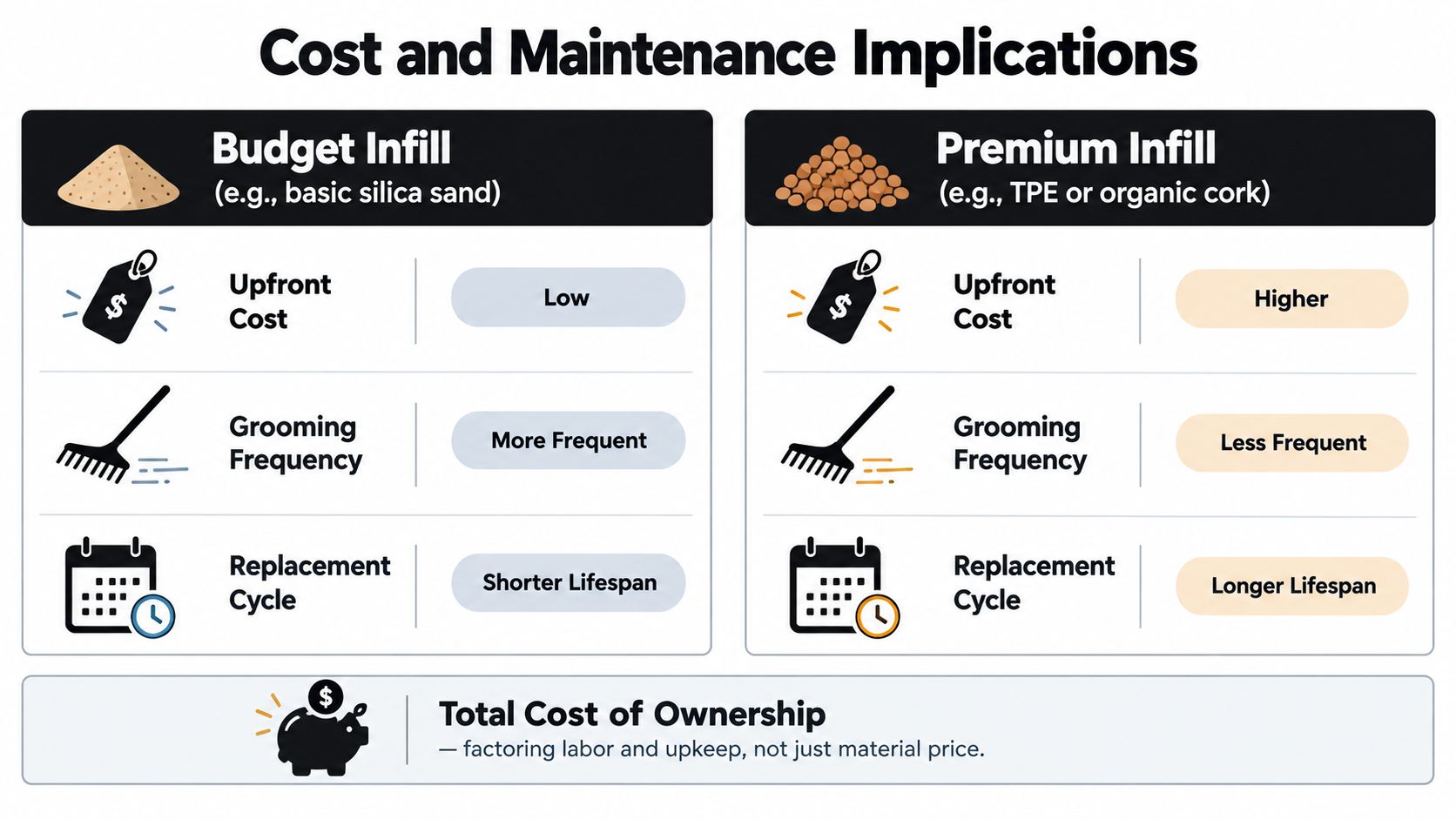
The cheapest infill isn't necessarily the least expensive system. Material price is only one part of ownership. Labor for grooming, inspection, replenishment, odor management, drainage repairs, and correcting uneven areas can matter more over time than the original difference between two infill products.
Budget mineral infills usually make sense where traffic is light and the surface is easy to inspect. Premium polymers and organic materials may offer a more customized feel, but they can require a more involved design, especially when cooling depends on irrigation or stored water. Compare the installed system, not just the price per bag.
What maintenance actually involves
Regular maintenance should include brushing fibers upright, checking for low or compacted areas, inspecting edges and transitions, and replenishing displaced material. Pet zones also need a cleaning plan that matches the drainage design. A good contractor should explain who handles this work and what signs indicate that the surface needs attention.
EPA research identified several ways crumb-rubber infill can leave an installation, including migration on shoes and clothing, movement during rain or snow, and routine maintenance. The agency's research on crumb-rubber movement supports a straightforward maintenance expectation: high-use areas need monitoring and replenishment rather than a claim of zero upkeep.
For a practical homeowner checklist, Task Masters Inc. maintenance advice offers useful guidance on routine artificial-grass care. Use it as a general reference, then follow the turf and infill manufacturer's requirements for your specific installation.
Compare ownership, not promises
Before choosing premium material, ask what benefit it adds to your property. If the answer is improved athletic cushioning, the added cost may be justified. If the answer is cooling, ask whether the design includes shade, water access, storage, and evaporation. If the answer is odor control, ask how drainage and cleaning work together.
EPA and CDC/ATSDR laboratory testing compared tire-crumb emissions at 25°C and 60°C. Some, but not all, organic chemical emission rates were higher at the higher temperature. EPA states that the federal report isn't a risk assessment and can't identify a health-effects threshold, so the responsible approach is to discuss heat, exposure, evidence limits, and complete-system materials without making absolute safety claims. The EPA and CDC/ATSDR webinar questions and answers provides that context.
Building Trust Through Professional Installation
Infill can't rescue a poorly prepared site. If the base is unstable, drainage is incomplete, or edging allows material to escape, even a well-selected product will underperform. The installation process determines whether the specified infill stays distributed, supports the fibers, and drains as intended.
A trustworthy Austin contractor should show you the reasoning behind the recommendation. That means discussing soil and grade, base preparation, drainage tile, fiber selection, infill depth, perimeter containment, intended traffic, pet use, shade, and maintenance. It also means explaining the limits. No responsible installer should promise that any infill will eliminate summer heat.
What to ask before signing
- System specification: Which fiber, backing, base, drainage components, edging, and infill will be installed?
- Performance target: What surface feel, drainage behavior, or impact performance is the design intended to provide?
- Verification: Will the installer check infill depth and distribution across multiple locations?
- Maintenance plan: How will the owner handle grooming, cleaning, migration, and replenishment?
- Warranty compatibility: Does the proposed infill meet the turf manufacturer's installation requirements?
Modern Yard Landscapes evaluates site and turf conditions, then installs the selected infill with the base, drainage, edging, and finished surface. Homeowners comparing artificial turf installation contractors should look for that same system-level accountability, especially when a property has heavy traffic, pets, drainage problems, or difficult topography.
Modern Yard Landscapes designs and installs complete artificial turf systems for Austin homes, commercial properties, pet areas, and custom putting greens, including site preparation, drainage, edging, and infill selection. Visit Modern Yard Landscapes to discuss your property, get a factors-based estimate, and schedule an appointment for a surface built around how you actually use your yard.