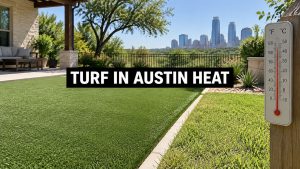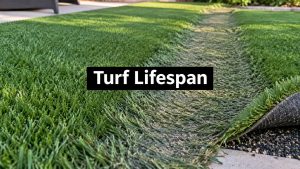

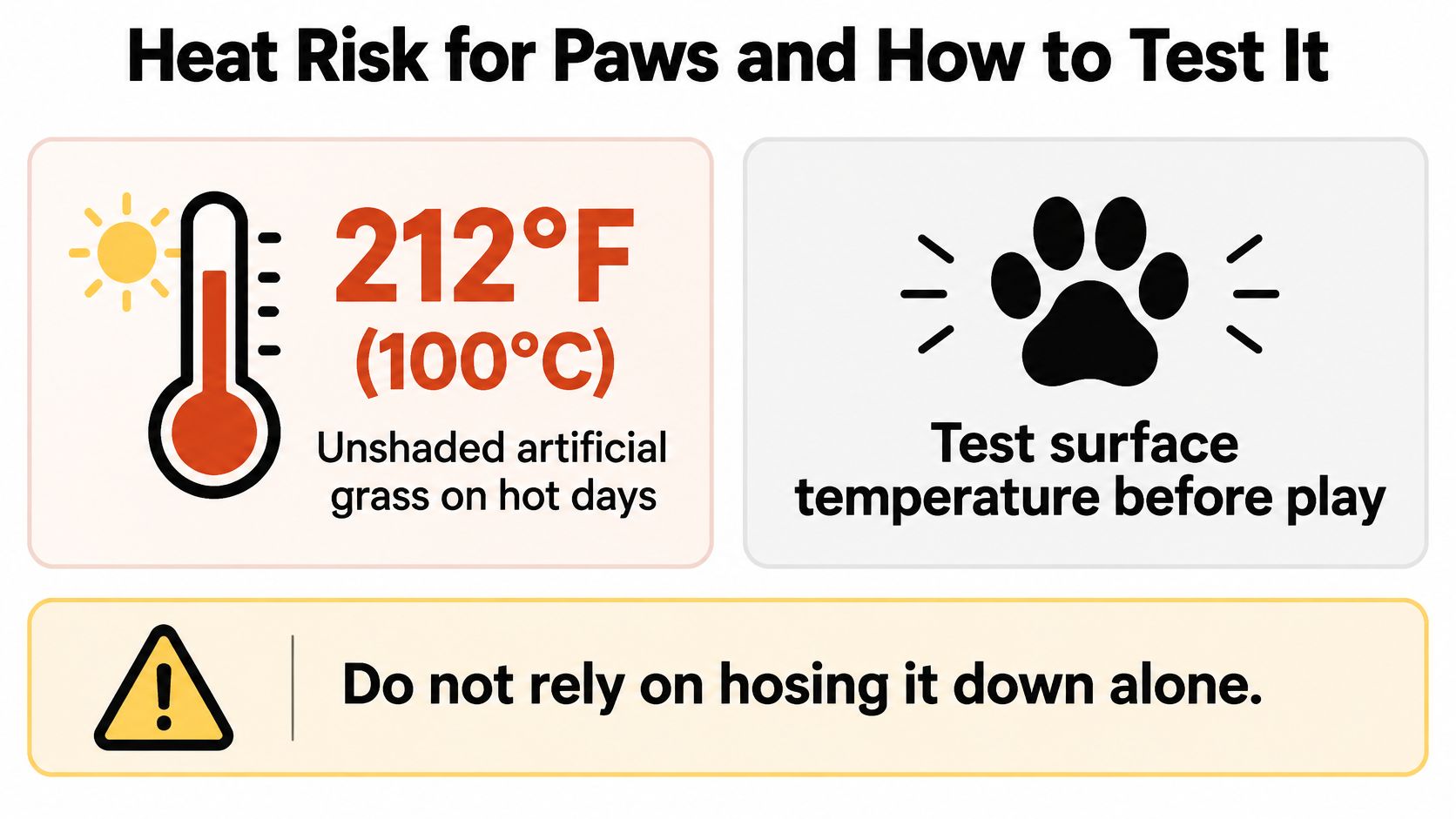
Artificial grass can be safe for pets when the infill is documented, drainage works, and heat is managed, but no single pet-friendly label settles it. Unshaded artificial grass can reach up to 212°F (100°C) on hot days, so a non-toxic material still needs a heat-management plan.
That distinction matters in Austin. A lawn can look clean and feel soft while hiding a slow-draining base or becoming uncomfortable under afternoon sun. The useful question isn't whether synthetic grass is safe. It's whether the complete installation suits your pet, your yard, and the maintenance you can realistically provide.
The Short Answer and the Five Risks That Matter
Artificial grass isn't automatically safe or unsafe for pets. Safety depends on the fibers, infill, backing, aggregate sub-base, drainage route, and what happens after your pet uses it.
Federal testing of recycled tire crumb found chemicals present as expected and exposure appearing limited. However, that work wasn't a risk assessment and doesn't specifically establish safety for dogs or cats. It's a reason to examine materials carefully, not a blanket verdict on every residential turf product.
The same distinction applies to daily use. Chemical documentation won't prevent hot paws, and an antimicrobial treatment won't fix standing wastewater.
Pet risks, drivers and controls at a glance
| Risk | Main driver | Most exposed pets | Main control |
|---|---|---|---|
| Chemicals in infill | Recycled tire crumb and other infill | Dogs that lick paws or swallow loose particles | Documented infill and contained installation |
| Surface heat | Synthetic fibers and dark infill absorb sun | Puppies, senior dogs, short-nosed breeds | Shade, cooling zones and avoiding midday use |
| Urine and odor | Liquid held in backing or base | Frequent urinators and multi-dog homes | Permeable backing, drainage and rinsing |
| Waste-borne bacteria | Feces left on surface and carried by rain | Outdoor dogs and cats | Prompt removal and compatible disinfecting |
| Blocked drainage | Poor sub-base or compacted soil | Any pet using a yard with standing water | Hose test, graded base and outlet |
Start with the yard, not the sample
A small turf sample can't demonstrate how the installed lawn will perform. Before choosing it, answer these questions:
- Which infill is used? Get the composition and supporting product documents.
- How hot does the surface get in afternoon sun? Evaluate the exposed area, not just a shaded corner.
- Where does liquid go? Trace rainwater and rinse water beyond the backing to their destination.
When someone asks, “Is artificial grass safe for pets?” those answers are more useful than a yes-or-no sales claim. Start with material disclosure, then check whether the site can support comfortable, hygienic use.
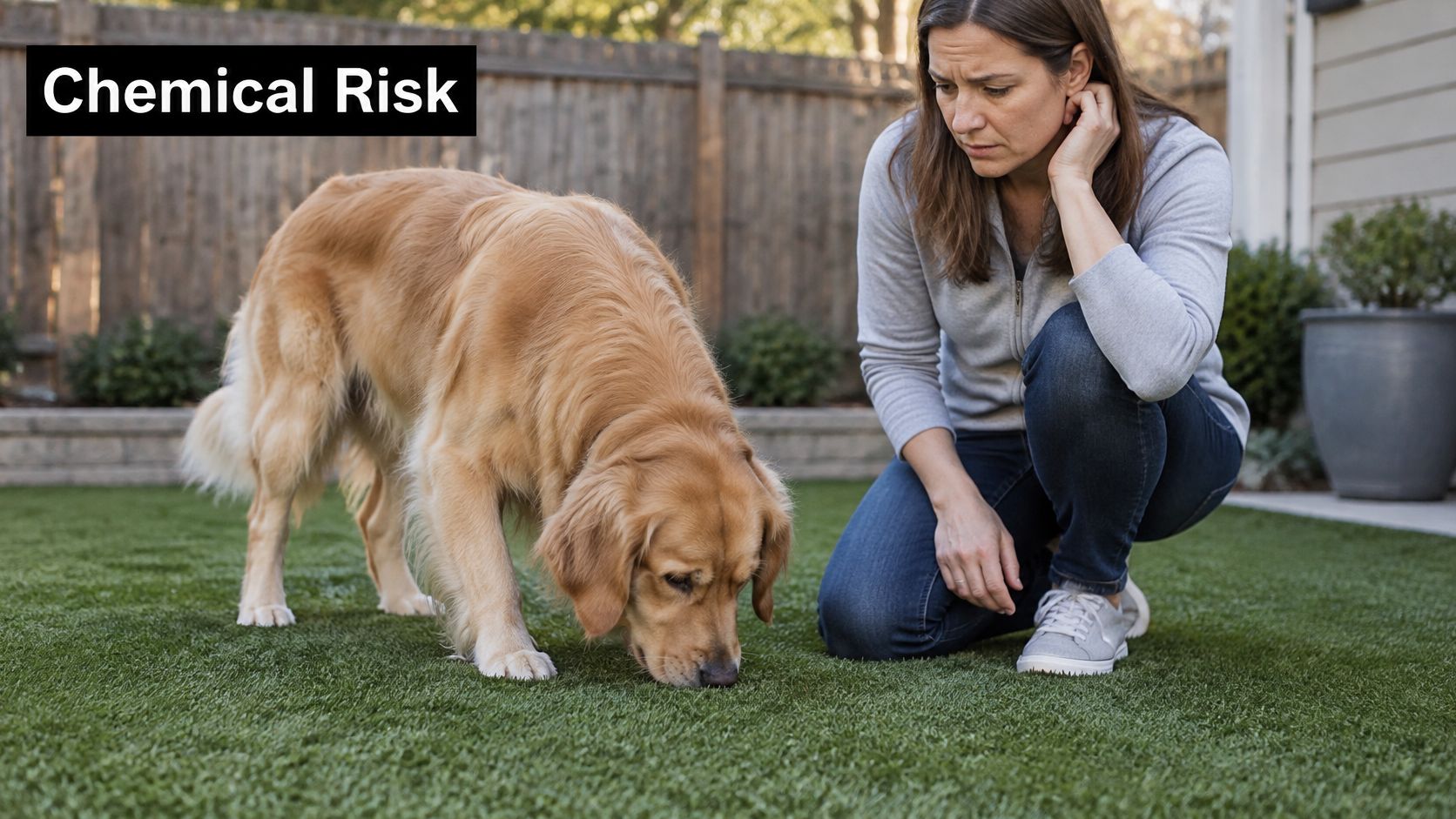
Chemical Risk and the Documents to Request Before You Install
Artificial grass isn't a single standardized material. The blades, backing, coatings, and loose infill can have different compositions. A statement about one component doesn't establish the safety of everything installed beneath your dog's paws.
Recycled tire crumb deserves particular attention because much of the available federal work concerns that infill, mainly in athletic-field settings. It isn't interchangeable with every residential pet-turf system. A dog that chews blades, licks its paws, or swallows granules also presents a different exposure question from a person walking across a field.
What the chemical evidence establishes
In February 2016, EPA, CDC/ATSDR, and the Consumer Product Safety Commission launched the Federal Research Action Plan to examine tire-crumb exposure through inhalation, skin contact, and accidental ingestion, including exposure to polycyclic aromatic hydrocarbons, according to EPA's tire-crumb exposure characterization report. EPA's 2019 characterization found chemicals present as expected but exposure appearing limited in air-release testing and simulated gastric fluid, saliva, and sweat.
The EPA said the report wasn't a risk assessment and couldn't establish a health-effect threshold. The findings don't demonstrate a higher health risk, but they don't specifically establish safety for dogs or cats either.
The New Jersey Department of Environmental Protection's artificial-turf memorandum describes metals and organic compounds with known hazards in tire-derived infill while summarizing likely minimal human exposure; New York's health department similarly describes low potential chemical exposure. The memorandum also discusses National Toxicology Program findings involving PAHs, metals, phthalates, and BPA, with chemical leaching and human-cell death under high-heat laboratory conditions, but without assessing long-term exposure or carcinogenicity.
Those laboratory findings aren't proof that routine backyard contact produces the same effects. They do explain why material identity and exposure conditions matter.
California's assessments also address different questions: Inside EPA's coverage of the OEHHA assessment describes DTSC's concern that PFAS in artificial turf may contribute to significant, widespread adverse impacts, alongside OEHHA's conclusion that recycled-tire crumb wasn't likely to create significant cancer or other health risks for users or spectators. Neither conclusion should become a universal claim about all turf components or pet behavior.
Request a product-level document package
Get these items in writing, matched to the actual products proposed for your yard:
- PFAS test results for fibers and backing. Identify which components were tested and what the results cover.
- Lead and heavy-metal results for infill. A blade test doesn't establish the composition of loose granules.
- Infill composition and tire-crumb disclosure. Know whether recycled rubber is present and how particles will be contained.
- Backing material and a written pet-use statement. Confirm intended use rather than relying on showroom language.
- Drainage specification. Separate the backing's permeability from the performance of the complete installed system.
- Manufacturer-approved cleaners. Establish compatible cleaning and disinfecting options before maintenance begins.
- Product year and formulation for older installations. Current marketing material may not describe an existing lawn.
For recycled tire crumb, I would require written testing and a containment plan. For rubber-free alternatives, check durability, particle migration, and odor performance rather than assuming that rubber-free means risk-free.
Odor-absorbing infill can support maintenance, but it can't replace drainage. Likewise, antimicrobial pet turf should be evaluated as an additional feature, not permission to skip cleaning.
Material-selection rule: If documentation is missing and your dog chews or persistently licks the surface, don't choose recycled-rubber infill.
The evidence supports neither “all artificial turf is dangerous” nor “all artificial turf is automatically non-toxic.” A trustworthy recommendation identifies the actual materials, acknowledges the limits of testing, and accounts for how your pet uses the yard.
Heat Risk for Paws and How to Test It
“Just hose it down” is incomplete advice. Water may temporarily cool the surface, but it doesn't provide reliable protection through an exposed Austin afternoon.
Reported surface temperatures in direct sun
The testing summarized by the PFAS Project's republication of reporting on artificial-turf heat includes these measurements, which describe particular conditions rather than a universal lawn temperature:
| Surface | Reported temperature | Source |
|---|---|---|
| Unshaded artificial grass on hot days | Up to 212°F (100°C) | Choice independent testing |
| Artificial turf on a hot June day | 154°F | Arizona State University Shade Lab |
| Asphalt on the same day | About 147°F | Arizona State University Shade Lab |
| Natural grass | Below air temperature | Arizona State University Shade Lab |
Synthetic fibers and infill absorb and retain solar heat. The immediate concern is paw-pad injury, even when the materials meet the chemical requirements you've set.
Use a repeatable pre-play check
- Measure before opening the yard. Use an infrared thermometer on exposed turf, shaded turf, and the intended resting area. Follow the instrument's distance guidance so you're measuring the target patch.
- Use touch only as a rough screen. Hold a bare hand or forearm against the surface for several seconds. If it's uncomfortable, keep your pet off it; comfortable contact isn't proof of safety for extended play.
- Change the schedule. Move exercise outside midday and reassess when sunlight reaches previously shaded areas.
- Provide a genuine alternative. Keep drinking water available and give pets access to shade and a cooler resting surface they can reach without crossing hot turf.
A practical guide to dogs using artificial grass notes the limits of temporary wetting and identifies puppies, senior dogs, short-nosed breeds, overweight pets, and dogs with heart or respiratory disease as needing extra heat precautions. Don't interpret a cooler surface reading as proof that those animals can tolerate the surrounding air temperature.
Our guide to how hot artificial turf gets can help you assess the yard's exposure before selecting a layout.
Shade is a design requirement for a hot pet yard, not an accessory to add after the lawn becomes uncomfortable.
A 2026 peer-reviewed study comparing canine responses found artificial turf substantially hotter than the other tested surfaces, reinforcing heat as a welfare concern separate from chemistry (published canine surface-comparison study). There's no universal safe-play threshold established by that finding, so conditions still need checking at your property.
Drainage and Installation Specs That Stop Odor
Drainage and installation specs to request
The Pet Boarding and Daycare technical pet-turf guide classifies drainage above 200 inches per hour as good and above 300 inches per hour as outstanding, while emphasizing that installers must solve drainage problems in the sub-base and site design.
| Component | Specification to request | Why it matters |
|---|---|---|
| Drainage rate | Above 200 inches per hour, good; above 300 inches per hour, outstanding | Indicates capacity to pass liquid rather than retain it |
| Aggregate sub-base | Graded and compacted; depth specified for site soil and drainage load | Moves water away from the surface |
| Backing | Perforated or highly permeable | Lets liquid pass through the turf |
| Outlet | Subsurface outlet or drainage tile where soil drains poorly | Prevents standing water in wet seasons |
| Weed barrier | Permeable fabric between sub-base and turf | Separates materials without obstructing the drainage path |
A backing's published flow rate isn't the same as whole-yard drainage. Water can pass quickly through the turf and still stop at compacted soil or an outlet that has nowhere to discharge.
Urine and rinse water must move through both the backing and aggregate base. Retained liquid can leave ammonium-containing residues, intensify odor in heat, and keep the surface contaminated.
Build the drainage path before laying turf
- Excavate and grade the site. Establish where water will travel, including around foundations and neighboring properties.
- Compact the aggregate base. Build a stable, consistently graded foundation without assuming that loose stone alone guarantees drainage.
- Place permeable weed barrier fabric between the sub-base and turf. We recommend this arrangement for pet owners, with fabric selected so it doesn't become a flow restriction.
- Specify a permeable backing. Match the turf to the intended pet use rather than choosing by blade appearance alone.
- Add drainage tile or a subsurface outlet where needed. Poorly infiltrating soil needs a designed escape route.
- Run a hose test before finishing. Observe the full path, including low spots and the discharge location.
Record the expected flow rate, base composition, site-specific base depth, slope, and outlet location. A hose test checks practical behavior; a measured drainage rate requires a defined test area and method, not a guess based on how quickly the surface looks dry.
Our artificial-grass drainage guide explains the distinction between a permeable surface and a functioning drainage system.
Antimicrobial additives may help between cleanings. They can't compensate for blocked drainage, standing water, or accumulated organic matter, and adding more infill isn't a sensible first repair for an unexplained wet spot.
The Daily and Weekly Cleaning Routine for Pet Turf
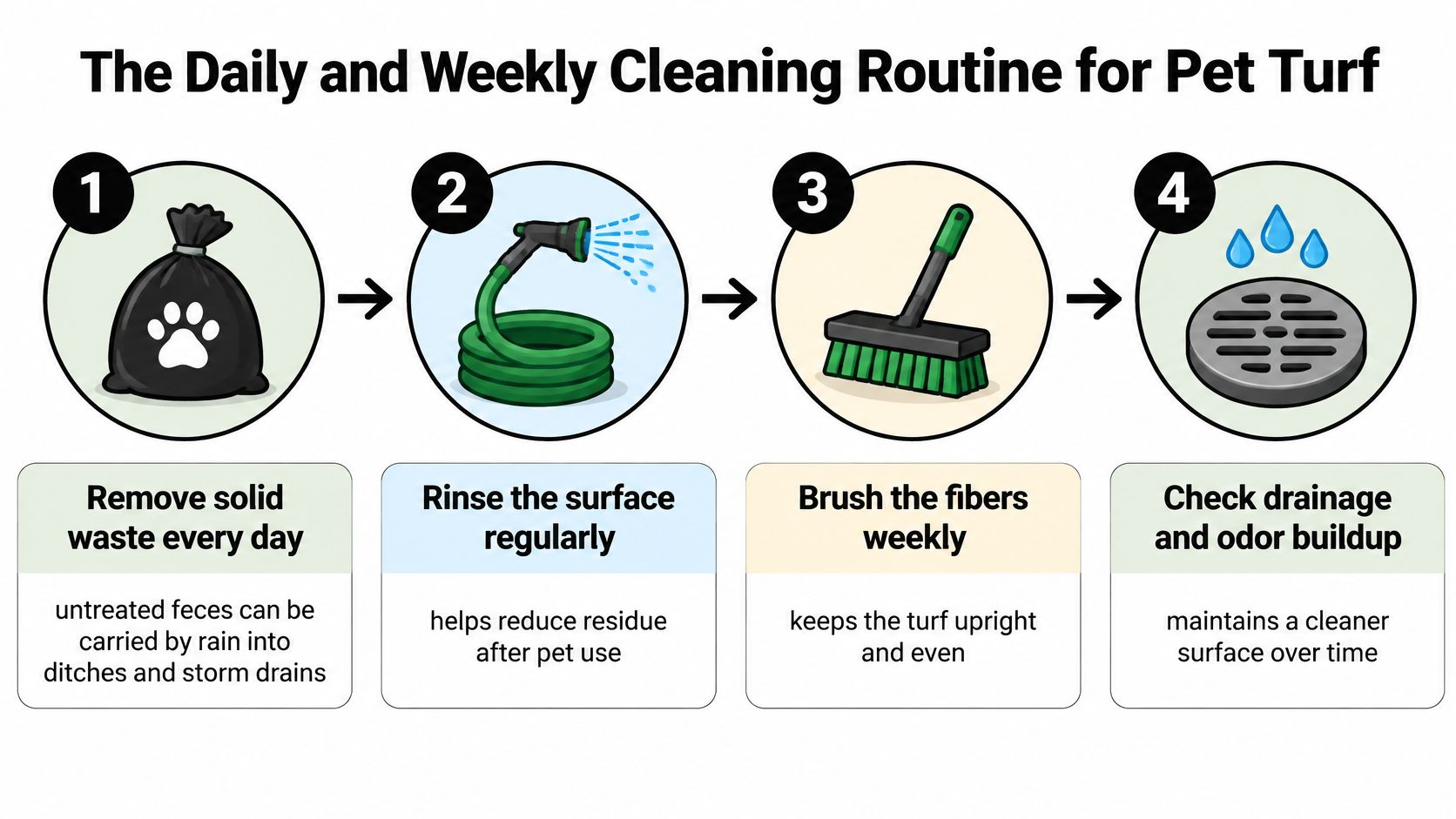
Pet turf is low-maintenance, not self-cleaning. A manageable routine removes waste before it becomes embedded and gives you a chance to notice drainage problems early.
Follow a routine tied to actual use
- Remove solid waste every day, preferably promptly. Washington State University explains that untreated feces can wash into ditches and storm drains and reach waterways carrying E. coli, other bacteria, viruses, and roundworms, as summarized in the Western Resource Advocates artificial-turf report. Bag the waste rather than breaking it apart with a hose.
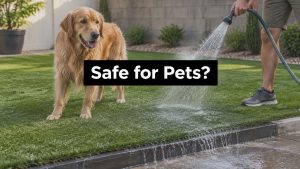
- Rinse urine zones at least weekly. We recommend weekly rinsing to remove dirt, pet hair, and debris, with additional attention after heavy pet use. Apply enough water to move residue through the backing instead of lightly wetting the blades.
- Use warm water and a gentle, compatible cleaner. We don't recommend boiling water because extreme heat can soften, warp, or permanently damage fibers and backing. Remove visible debris before applying a cleaner so you're treating the surface rather than soaking a layer of waste.
- Treat high-traffic spots with compatible products. Use a manufacturer-approved pet-safe enzymatic cleaner for organic residue or a compatible disinfectant when disinfection is needed. Follow dilution, contact-time, rinsing, and pet-reentry directions, and never mix cleaning chemicals.
- Address odor at its source. Maintain the specified infill level, rinse again after concentrated use, and investigate saturated or contaminated infill when rinsing no longer clears the smell. Replace affected infill where appropriate rather than masking persistent odor with fragrance.
- Inspect after heavy rain or flooding. Check low areas and outlets once the rain stops, and compare drainage with the yard's established performance. Keep pets away from standing contaminated water until the cause is addressed.
Judge results, not just effort
Brush the fibers with a turf-compatible brush to lift flattened areas and expose trapped debris. Avoid aggressive tools that pull at seams or scatter infill.
The routine is working when odor doesn't linger after cleaning, the surface dries within its documented site-specific period, and storms don't leave standing water. Agree on that drying expectation during installation rather than accepting an arbitrary universal deadline.
Use our guide to cleaning artificial turf for dogs to organize the job. If you're cleaning more often but getting worse results, inspect the drainage and infill before buying a stronger chemical.
Which Pets and Setups Need Extra Precautions
Say a sixty-pound retriever has a new turf lawn in a west-facing Austin backyard. The first hot afternoon is the practical test: does the dog have somewhere comfortable to stand, rest, and relieve itself without being confined to the exposed lawn?
That hypothetical yard needs a different plan from a shaded bathroom strip used briefly by a small dog. Match precautions to the animal's habits and the layout rather than treating every pet installation alike.
Match the precaution to the pet
| Pet or behavior | Priority precaution |
|---|---|
| Puppies and senior dogs | Keep play outside peak sun and check surface temperature before each session |
| Dogs that chew blades or lick paws | Apply the documented-infill rule and rinse paws after play |
| Short-nosed breeds, overweight pets, or dogs with heart or respiratory disease | Provide a cooler resting zone and shorter sessions suited to veterinary advice |
| Outdoor cats | Provide shade and keep accessible loose-granule areas out of reach |
| Indoor cats without yard access | Focus on preventing tracked-in loose material rather than direct lawn exposure |
For the retriever, watch where the dog chooses to stand. Reluctance to enter the lawn, repeated paw lifting, or seeking a cooler edge is a reason to stop the session and check conditions, not encourage another round of fetch.
Cats need a behavior-based assessment too. An outdoor cat may groom its paws after contact, so inspect edges and loose particles rather than assuming its lighter use removes exposure concerns.
Match the upkeep to the layout
- Multi-dog homes and frequent urinators. Tighten the rinsing schedule around the areas used, and verify that drainage remains effective under that concentrated load.
- Dedicated dog runs. A run concentrates waste in a smaller space, so prioritize the strongest practical drainage design and more frequent cleaning than a lightly used full lawn.
- Older installations. Request the product year and formulation, and arrange material testing where records are inadequate before allowing routine contact.
Choose the case that best describes your household and check its weakest point first. For a chewing dog, that's material disclosure; for a sun-exposed yard, it's a usable cool area; for a busy dog run, it's the drainage and cleaning workload.
Book a Pet-Safe Turf Assessment
Book an assessment before installation or before the next hot season, not after odor or heat makes the yard difficult to use. The appointment should turn broad safety claims into a written plan for your particular property.
Bring your pet's age, size, and habits, especially chewing, paw licking, and preferred bathroom spots. Note the yard's orientation, existing shade, and what water does after rain or rinsing, and gather the documents listed under Chemical Risk and the Documents to Request Before You Install.
Put the appointment to practical use
A useful assessment should address:
- Afternoon heat. Identify exposed areas for infrared-thermometer checks and locations for cooler rest zones.
- Drainage performance. Request a hose test and a recorded flow rate where measured, with the test method identified.
- The buried system. Review the sub-base, grading, and outlet design rather than judging only the visible turf.
- Materials and maintenance. Review infill documentation and establish a written cleaning plan you can sustain.
Modern Yard is an Austin-based artificial turf installer that builds pet dog runs using non-toxic turf materials. Our quality artificial grass with proper drainage is designed to prevent urine from soaking in or lingering, and our dog-run installations have superior drainage that eliminates puddles and mud.
Those features belong alongside heat checks and realistic maintenance, not in place of them. An appointment is the opportunity to decide whether the proposed setup fits your pet and what site work needs to happen first.
Modern Yard provides pet-focused turf and dog-run installations with attention to materials, drainage, and everyday cleaning. Visit Modern Yard Landscapes, then call to schedule an appointment and bring your product documents, pet details, and drainage observations so the conversation starts with facts.