
You've probably got one worn strip you can't ignore. It's the line from the back gate to the patio, the run along the fence where your dog patrols, or the shortcut between the driveway and the front door. The rest of the yard looks fine. That lane doesn't.
That's how high traffic areas fail. They don't wear evenly, and buying the toughest looking turf won't fix them if the fiber, infill, backing, base, and drainage aren't specified as one system.
Why High Traffic Areas Wear Turf Out Faster
Say a family uses the same route to the grill, a dog runs the fence line every time a neighbor walks past, and kids cut from the patio to the side gate on weekends. Nobody spreads that traffic across the whole lawn. People and pets take the shortest route, every day, and the wear stacks up in a narrow desire line.
That concentration matters more than total yard size. A few heavy users at peak times, summer evenings, guests arriving, dogs doing laps, can punish a two foot wide lane while the corners barely get touched.
The Three Failures You See First
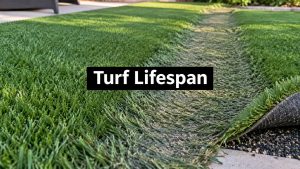
Fibers flatten and split first. Blades that stay bent lose cushion and catch light differently, so the lane looks shiny, pale, and tired even before tufts come out.
Next, infill migrates out of the lane. Feet kick it to the edges, rain washes it downhill, and the exposed backing takes direct abrasion. Once backing shows, tufts loosen faster because there's less material holding blades upright and shielding the base of each stitch.
Third, the base compacts and holds water. A compacted lane stops draining at the same rate as the rest of the yard. Water sits, softens fines under the surface, and the next round of foot traffic presses the wet base even tighter.
Walk your yard after rain and mark three things with flags or chalk. Note where grass bends and stays down, where soil or backing shows, and where water sits longest.
Those flags are your real project map. I wouldn't specify any product until you've marked those zones, because the busiest lane should drive your fiber choice, infill plan, and base depth, not the average conditions across the yard.
Turf Fiber and Denier Options Compared
Blade thickness is the first spec worth checking on a product sheet, and the sheet calls it denier: the weight of fiber per 9,000 meters. A higher number means a thicker, heavier blade that resists crushing better. It doesn't tell the whole story, but it's the fastest way to sort light duty turf from products built for repeated traffic.
| Fiber type | Typical denier range | Traffic suitability | Main trade-off |
|---|---|---|---|
| Single-fiber polyethylene | 5,000 to 8,000 | Light use, lounging | Flattens quickly under daily wear |
| Dual-textured polyethylene | 8,000 to 12,000 | Family yards, regular play | Mid-range cost, holds shape longer |
| High-density polyethylene (commercial grade) | Above 12,000 | Dogs, heavy play, commercial use | Higher cost and heavier product |
| Nylon | Typically 10,000 and above | Sports fields and the heaviest use | Highest cost, firmer feel underfoot |
Single-fiber polyethylene in the 5,000 to 8,000 range feels soft and suits lounge lawns where people sit more than they cross. Put it on a gate to patio lane and it'll mat quickly, because thin blades fold and don't recover.
Dual-textured polyethylene in the 8,000 to 12,000 range is the workhorse for most family yards. The mix of blade shapes helps the surface spring back after regular play, and it balances feel, appearance, and cost.
High-density polyethylene above 12,000 is what I'd specify for dog traffic, heavy play, and frequent cleaning. It's heavier and costs more, but the thicker blade tolerates repeated bending in the same lane.
Nylon is generally the most expensive and most durable turf fiber material, and it's often used for high-traffic areas like sports fields. That durability comes with a firmer feel underfoot, which some homeowners dislike for barefoot lounging.
What Denier Doesn't Guarantee
A high denier number alone won't save a poor product, or a poor base. Fiber is one part of a system: blades, infill, backing, and base all carry the load together, so a thick blade over a compacted, poorly draining lane still wears out on the same path. Check fiber shape, stitch density, and UV stabilization too, because sparse stitching leaves gaps that flatten regardless of blade thickness. Our guide to artificial turf specifications helps you compare those fields side by side.
Practical rule: Match denier to your busiest zone, not to your average yard.
Before you buy, pull the product sheet and confirm three lines.
- Denier and fiber type: Confirm the number matches the traffic in your worst lane.
- UV rating: Make sure stabilization is stated, not implied by marketing photos.
- Stitch gauge and density: Tighter construction supports blades in turning spots like gates and patio edges.
For Central Texas, we recommend high-density, UV-protected polyethylene turf for most busy residential zones.
Backing and Infill That Hold Up Under Use
Think of the system in two jobs. Infill is the cushion and ballast that keeps blades upright, adds weight, and protects the backing from foot abrasion. Backing holds every tuft in place. If either one is underspecified for traffic, the lane shows it first.
What to Check in the Backing
Look for a stable, drainage-ready backing with reinforced seams and strong tuft bind for repeated loading. In a worn lane, loose tufts are an early warning sign, especially where feet pivot at gates, steps, and patio corners.
Seams deserve the same scrutiny. A seam that crosses a desire line takes shear from every step, so seam placement and reinforcement matter as much as the turf roll itself. Don't accept a layout that puts a seam right where your dog turns at the fence corner.
| Infill | Traffic and pet fit | Heat behavior | Odor control |
|---|---|---|---|
| Silica sand | Moderate traffic, can compact over time | Runs hot in full sun | Limited, needs rinsing |
| Zeolite | Pet zones, stays put under foot traffic | Warmer than cooling infills | Strong mineral-based control |
| Cooling infill (coated or ceramic) | Lounge areas and dog runs | Lower surface temperatures than plain sand | Moderate |
| Rubber (SBR) infill | Cushioned play areas | Runs hottest of the group | Weak, can hold odor |
Silica sand is affordable and fine for moderate traffic, but it can compact and it runs hot in full sun. Zeolite is a mineral infill that controls odor well, which is why it fits pet zones where rinsing alone isn't enough.
Cooling infills, usually coated sand or ceramic based products, lower surface temperatures compared with plain sand and suit lounge areas and dog runs in hot climates. Rubber infill gives the most cushion for play, but it runs the hottest and can hold odor, so I wouldn't default to it for a sunny Austin dog run.
Our overview of artificial grass infill breaks down how to match these materials to pets, play, and sun exposure.
Keep infill depth consistent across the lane. Infill migrates out of exactly the spots that need it most, so top up the worn path first rather than broadcasting evenly and hoping it settles.
Choose infill by the biggest problem in that zone. Heat, odor, and cushioning rarely rank the same way in every part of a yard.
How to Build a Base That Survives Heavy Traffic
Your turf surface is only as durable as the layer under it. A premium fiber on a soft, poorly drained base will still rut, pond, and wear in the same lane, because feet are loading saturated material that moves under pressure.
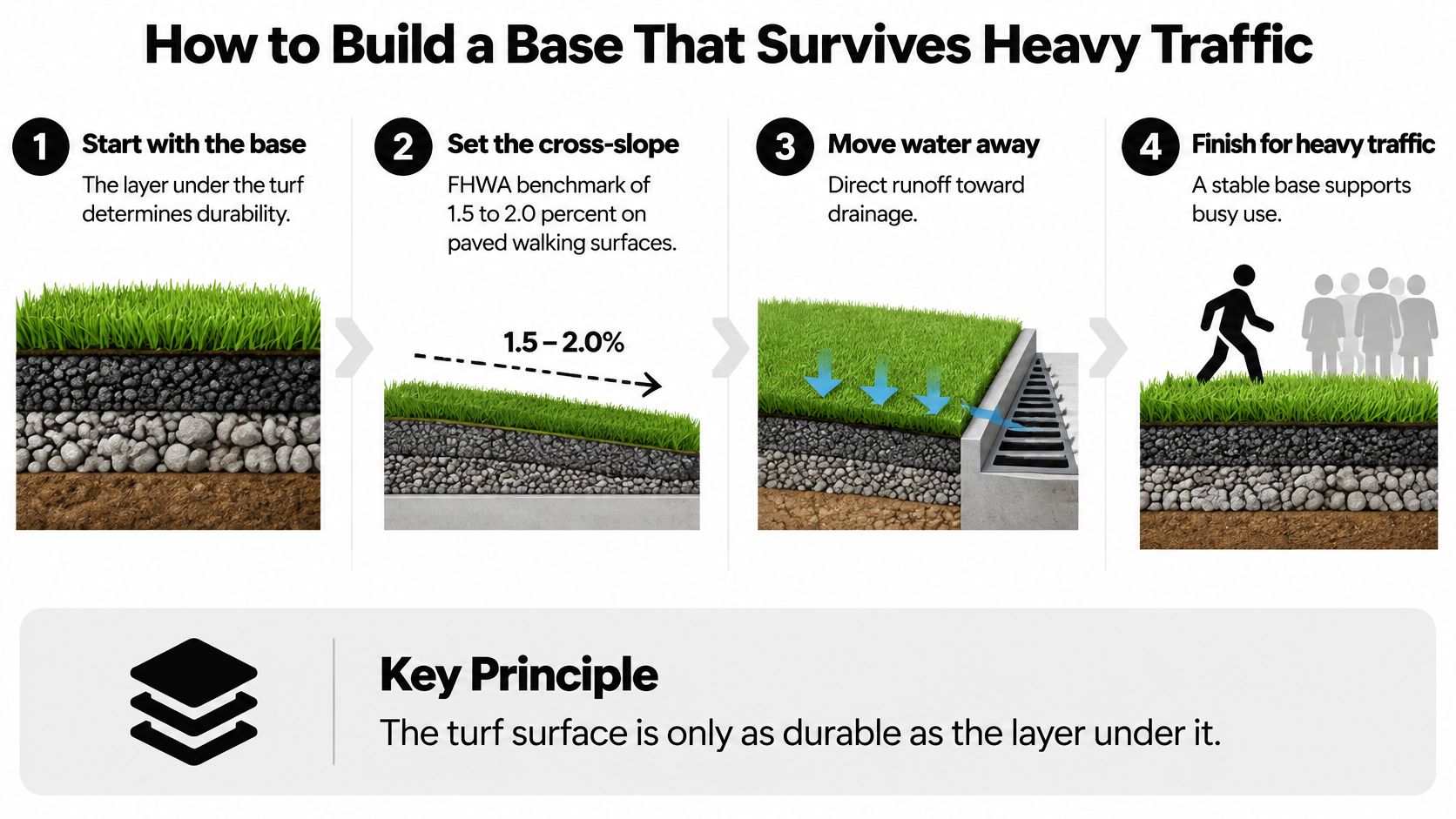
For the hardscape edges your turf meets, the Federal Highway Administration sidewalk guidance indicates paved walking surfaces generally perform best with a 1.5 to 2.0% cross-slope, which moves rainfall toward designated drainage points instead of letting it pond. Treat finished turf as a complete drainage system too, not as a slope you assign in isolation.
The Build Sequence
- Excavate to the depth your traffic requires. Remove soft and organic soil, because it decomposes and settles under repeated loading.
- Grade the subgrade to a consistent fall. Water needs a planned route to an outlet before aggregate goes down.
- Lay permeable aggregate in compacted lifts. Thin, compacted layers resist settlement better than one loose pour.
- Place geotextile where base meets native soil. This separation helps keep fines from migrating up and weakening drainage.
- Install drainage tile or a collection point where runoff concentrates. Gates, low spots, and downspout discharge areas need it most.
- Set turf and check edging. Steel or concrete edging that traps water at the perimeter defeats the base you just built.
Recent Austin Environmental Commission materials identify increased stormwater runoff, increased impervious cover, possible water-quality pollution, and negative effects on soil health as concerns associated with artificial turf. That's why water-saving doesn't automatically mean runoff-neutral, and why your base has to handle intense storms with a real overflow route.
Our notes on base material for artificial turf cover aggregate selection in more detail. We install a professional sub-base that ensures rapid drainage, even during heavy rains in Austin, Round Rock, or Georgetown.
Check four inspection points before turf goes down.
- Low spots: Ponding here accelerates sub-base deterioration.
- Gates and walkway crossings: Turning traffic loads these transitions hardest.
- Roof runoff entry points: Concentrated discharge overwhelms a base built only for direct rainfall.
- Edging transitions: Confirm water can exit instead of sitting against hardscape.
Heat and Chemical Questions on Busy Turf
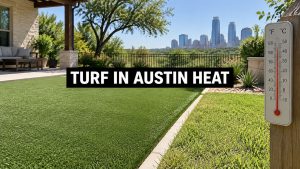
Busy turf usually sits next to driveways, patios, and pool decks, so it does not heat up in isolation. The EPA urbanization and temperature evidence reports daytime surface temperatures in developed areas are typically about 10 to 15°C higher than in rural areas. Adjacent concrete and asphalt often drive the comfort problem as much as the turf itself.
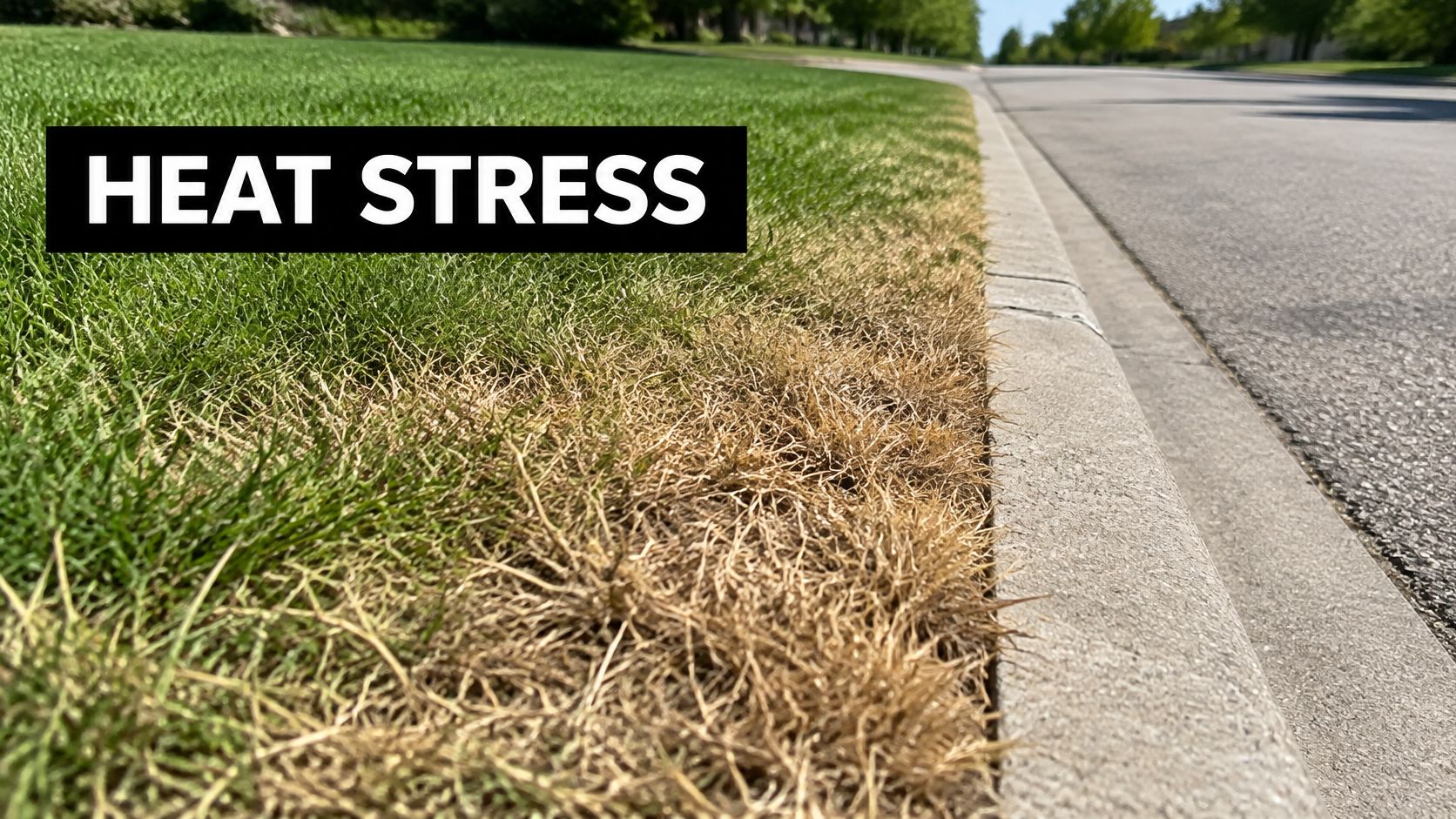
The 2025 review for Canada's National Collaborating Centre for Environmental Health reported an approximately 9.4°C or greater surface-temperature increase in the reviewed evidence, with results varying by surface and conditions. That same review notes Austin officials have identified urban heat, microplastics, PFAS, heavy metals, and water needed to clean or cool some installations as concerns.
Keep Heat and Chemicals as Separate Questions
Heat is a comfort and burn risk for bare feet and paws during afternoon use. Check surface temperature at peak exposure, not air temperature in the shade. Add shade near entrances, seating, and pet runs, use cooling infill where sun is unavoidable, and keep hot pavement runoff from draining onto turf. For backyards in Kyle, Lakeway, and Bee Cave, Modern Yard Landscapes recommends shaded areas, infill solutions, or cooling infills to keep the turf comfortable.
No single cooling feature eliminates hot surface conditions. Fiber color, orientation, shade, and surrounding pavement all change the result, so be skeptical of any claim that one infill solves a west facing, unshaded dog run. A darker blend may look better at noon and still punish paws at 4 p.m.
Chemical exposure is a documentation question. PFAS concerns in artificial turf can involve the blades as well as the infill, so asking only about infill misses part of the product. High traffic increases contact, wear, and cleaning frequency, which makes component disclosure more relevant, not less.
Ask these three questions before you buy.
- Surface temperature: What is the expected surface temperature on a sunny afternoon in a comparable, unshaded install?
- Component testing: Can the manufacturer provide current, component-level test records for fiber, backing, and infill?
- Rinsing needs: How often does this system need rinsing for cooling, odor, and cleaning in heavy pet or play use?
Maintenance Schedule by Traffic Level
A durable product stays durable only if you maintain the lane that's taking the abuse. Brushing lifts matted blades, infill top-ups restore support, and rinsing controls odor before it bakes into a sunny pet zone.
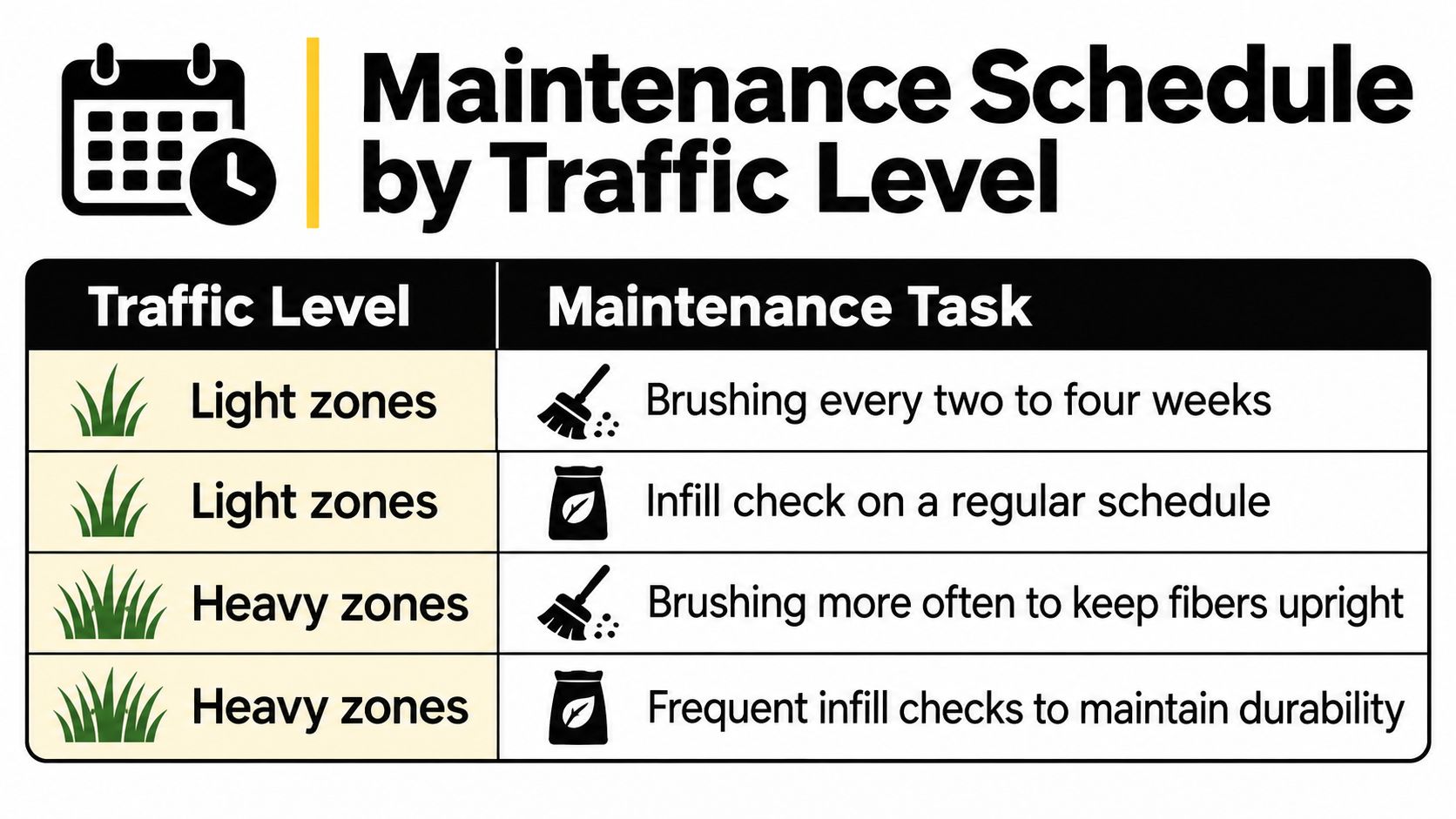
| Traffic level | Brushing | Infill check | Rinsing |
|---|---|---|---|
| Light (lounge lawns, side yards) | Every 2-4 weeks | Twice a year | After spills only |
| Moderate (family play, walkways) | Weekly | Twice a year, top up worn lanes | Monthly |
| Heavy (dog runs, commercial entrances) | 2-3 times a week | Every quarter | Weekly, more often in summer |
Use a stiff, non-metal brush or power broom and work against the grain in the traffic lane. You're lifting blades and pulling displaced infill back into the worn path, not just tidying the surface for looks.
Your Recurring Checklist
- Brush the lane: Focus on gates, patio edges, and turning corners where blades fold first.
- Rake infill back: Move material from the edges into thin spots, then top up if backing is close to showing.
- Rinse with purpose: Rinse pet zones for odor and rinse hot zones before afternoon use when cooling matters.
- Check after rain: Standing water tells you the base or outlet needs attention, not more brushing.
If blades don't recover after brushing, backing stays exposed, odor persists after rinsing, or puddles return after every rain, the zone has outgrown its specification.
Those signs point to fiber, infill, or base upgrades. More frequent grooming can't compensate for a lane that was built for light lounging and is now serving as a daily dog run.
Verify Your Installer Before You Sign
Trust should rest on evidence you can check, not on a polished sales pitch. In PwC's 2024 U.S. Trust in Business Survey, 90% of business executives believed customers highly trusted their companies, but only 30% of consumers did. Close that gap yourself by verifying documents before you sign.
Use this checklist on any quote, including ours.
- Proof of insurance: Request it in writing before the site visit, not after work is scheduled.
- Written warranty: Confirm what it covers, how long it lasts, and what maintenance you must perform to keep it valid.
- Itemized estimate: Require separate lines for base preparation, drainage, fiber, infill, and labor so you can compare quotes fairly.
- Sub-base description: Get the excavation, aggregate, slope, and drainage outlet in writing, not only a turf brand name.
- Recent, detailed reviews: Look for dates, turf area, drainage challenge, timeline, and outcome, and check how the company responds to negative reviews.
That last point matters because recency shapes decisions. A 2024 survey of 2,000 U.S. consumers found 67% rated reviews from the previous three months as highly or moderately important. Vague praise from years ago tells you little about current crews or materials.
Our page on artificial grass installers explains how we document projects. Ask any installer for two references from heavy-use installations similar to yours, then call them and ask specifically about drainage after heavy rain and wear in the busiest lane.
Book a Site Assessment Before You Install
Don't order product before you've mapped your traffic. A site assessment should turn your flagged lanes, photos, and sun notes into a zone-by-zone specification that follows real use instead of a catalog average.
Bring this information to the visit.
- Sketch each busy path: Mark the back gate route, dog run, driveway strip, play zone, and any commercial entrance or service path.
- Note users and timing: List pets, children, guests, deliveries, and events by zone, including peak hours.
- Photograph low spots after rain: Take photos within a day of rainfall so standing water is documented, not remembered.
- Record sun exposure: Note which zones are exposed at midday and late afternoon, when heat complaints peak.
- Mark water sources: Show roof runoff, gutters, downspouts, and gates that direct water into the turf area.
During the assessment, we check base depth, drainage outlet options, slope, and access constraints like narrow gates or confined side yards. Then we match fiber, infill, and backing to each zone, because a lounge corner and a dog run shouldn't automatically get the same build.
Commercial turf installations require professional installation that ensures proper base preparation, drainage, and infill distribution. With proper installation and maintenance, commercial turf can last 15 to 20+ years, even under heavy foot traffic and Texas weather.
You should leave the visit with a written zone-by-zone specification and itemized cost factors before any work begins. Call Modern Yard Landscapes to schedule your site visit, and bring your sketch and rain photos so the assessment starts with your real traffic patterns, not guesswork.
Ready to replace that worn lane with a system built for how your yard is used? Modern Yard Landscapes will assess your traffic zones, drainage, sun exposure, and access, then give you a written, zone-by-zone specification and itemized estimate before you commit. Visit Modern Yard Landscapes to schedule your site assessment and get clear answers on fiber, infill, and base options for your busiest areas.