
Most advice about antimicrobial pet turf starts in the wrong place. It treats a coated blade or treated infill as if it can solve every hygiene problem a dog run creates. In Austin, the failures I see usually come from standing urine, trapped organic material, poor base preparation, and infill that holds moisture, not from the absence of a magic antimicrobial label.
That doesn't make antimicrobial pet turf useless. It makes the feature easier to judge. A treatment can help slow microbial growth, but it can't remove feces, flush urine from the base, or fix a yard that drains poorly. Before you sign a contract, ask what was treated, which organisms were tested, how long the treatment works after cleaning, and where contaminated water goes.
The Uncomfortable Truth About Antimicrobial Pet Turf
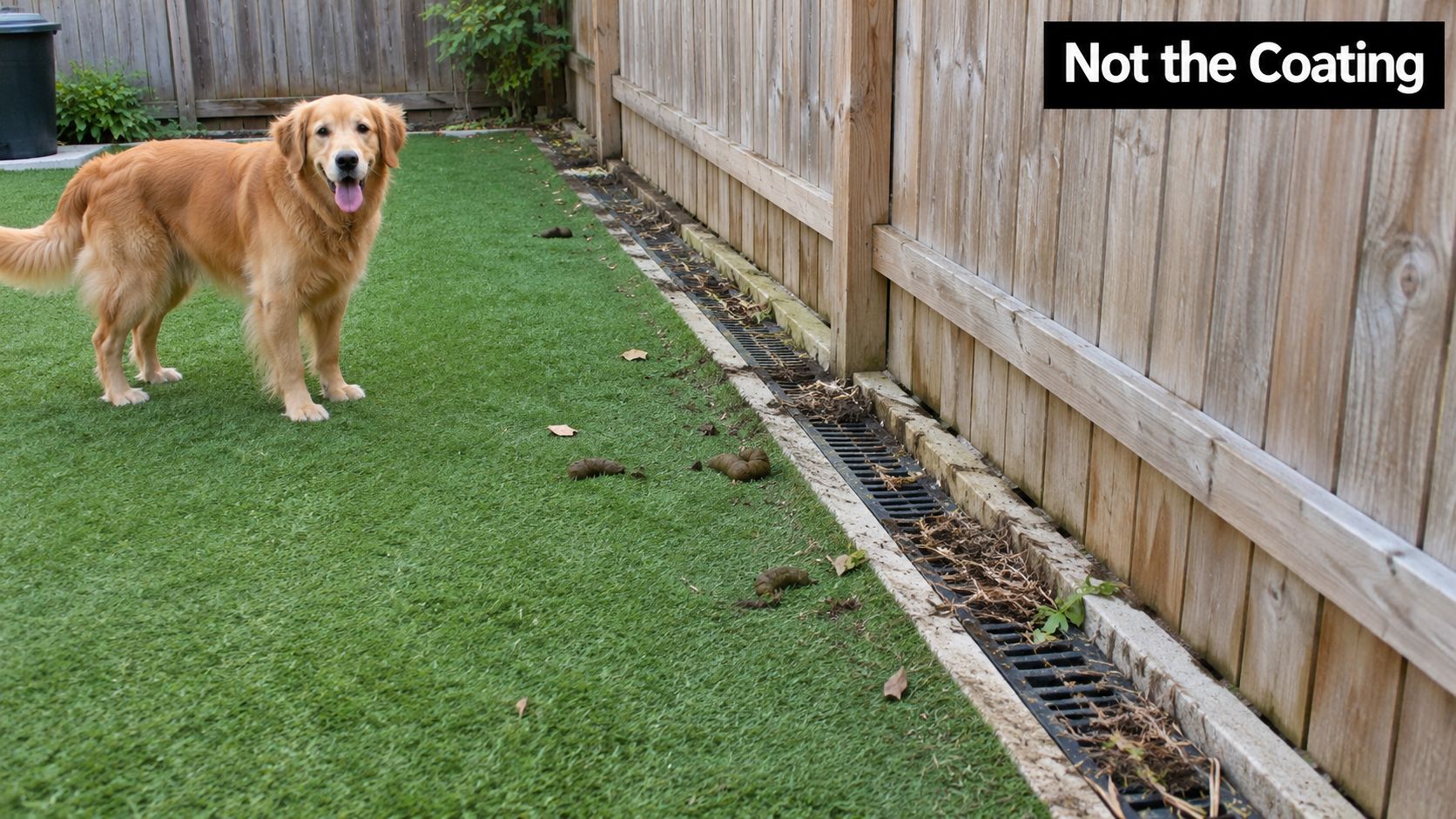
The popular promise is simple: install antimicrobial turf, and the dog area stays cleaner and fresher. That promise skips the part that determines whether the system performs. Antimicrobial treatment is one component of a pet-turf system, not a substitute for drainage, waste removal, and cleaning.
Dog waste creates a physical problem before it creates a chemistry problem. Feces can sit on the surface, urine can move into the backing and base, and organic residue can remain around infill particles. A treated fiber may inhibit growth on the material itself, but it has limited reach into a saturated or contaminated foundation.
The research supports a more practical interpretation. Penn State testing found that antimicrobial treatments reduced Staphylococcus aureus survival compared with untreated controls, but viable bacteria remained detectable on every treatment for at least 216 hours in the study conditions (Penn State's synthetic-turf testing). That is useful performance. It isn't sterilization.
What changes when you evaluate the whole system
You stop asking, “Does this turf have antimicrobial protection?” and start asking:
- Where does urine go? The backing and aggregate base should move liquid away instead of leaving it beneath the surface.
- What happens to organic waste? Prompt removal matters because residue can feed microbial persistence.
- What does the infill retain? Moisture-holding materials can change how long bacteria remain recoverable.
- What exactly does the claim mean? “Protects fibers from deterioration” is not the same as “kills pathogens.”
- How will I maintain it? A quote should include realistic rinsing and cleaning requirements.
Dogs also interact with turf in ways owners sometimes overlook. If you're curious about reasons dogs roll in grass, the behavior helps explain why surface cleanliness matters even when a dog run looks attractive. A clean-looking installation can still have problems beneath the blades.
Read the maintenance expectations alongside the product claim. Our guide to whether dogs can pee on artificial turf is useful for understanding the practical issue: pet turf can handle urine, but only when the installed system lets it pass through and the owner keeps the area rinsed.
My rule for Austin dog runs: If an installer talks for ten minutes about antimicrobial technology but barely discusses base grading, walk away from the sales pitch.
How Antimicrobial Treatments Actually Work
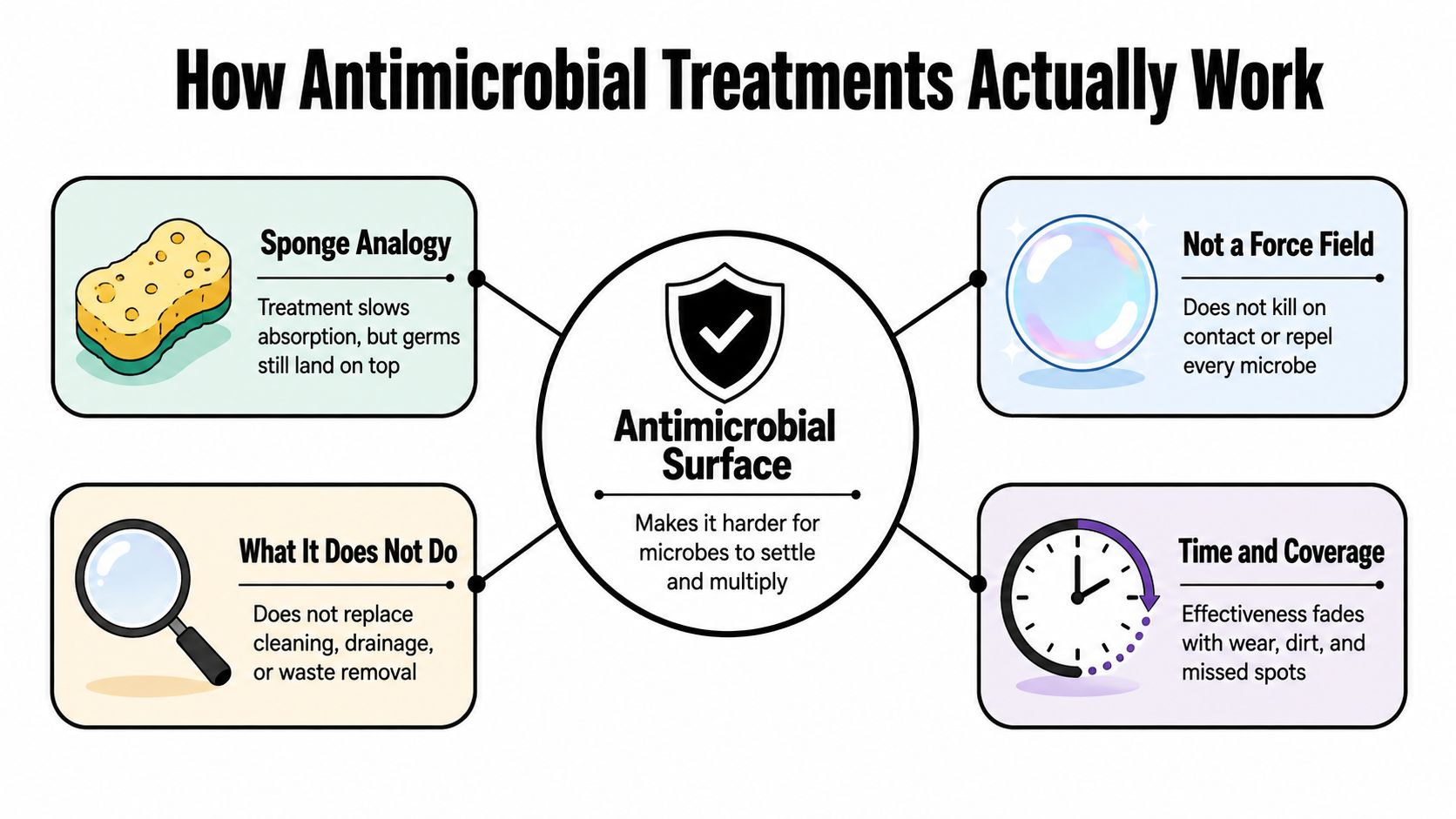
Think of antimicrobial treatment like making a sponge less welcoming to growth. It can slow down what happens after microbes land, but it doesn't stop every contaminant from arriving. Dirt, urine, feces, rainwater, and paws still reach the surface.
That distinction matters because antimicrobial does not mean sterile. The Penn State work found that most treatments reduced detected counts below 0.1 colony-forming units per square centimeter within approximately three hours, yet some test units remained positive nine days after inoculation (Penn State's treatment findings). The result is a growth-inhibiting surface, not a force field.
Three places treatment can appear
Blade treatment places the antimicrobial feature in or on the synthetic fibers. That targets the part of the system people touch and see, but it doesn't necessarily reach the backing, seams, aggregate, or soil beneath the installation.
Backing treatment applies protection to the material that supports the blades. It may help preserve the backing or limit growth on that component, but it still can't remove liquid or organic matter held below the surface.
Antimicrobial infill treats the loose material between the fibers. That location is important in a dog run because infill affects moisture retention, cushioning, and how long bacteria remain available for recovery. Our information on antimicrobial turf infill explains why infill should be evaluated as part of the drainage system, not purchased as an isolated odor solution.
The organisms tested also matter. A test against Staphylococcus aureus doesn't automatically prove control of every organism found in dog waste. A 2026 peer-reviewed dog-preference study noted that research in human sporting facilities has reported higher counts of pathogenic bacteria on artificial turf than natural grass, while also emphasizing that the comparison hadn't been explicitly investigated in dog areas (the peer-reviewed dog-area research).
What to demand on a quote sheet
Ask the installer to identify:
- The treated component, whether it's fiber, backing, infill, or more than one.
- The active ingredient or treatment name, not just the word “antimicrobial.”
- The organisms tested, including whether the test has relevance to the intended use.
- The contact time and test method, because a claim without conditions tells you very little.
- The effect of weather and cleaning, especially for an outdoor Austin installation.
Commercial cleaning companies face the same basic limitation in a different setting. Guidance about professional sanitizing for Toronto offices makes the broader point that sanitation depends on the surface, method, contact time, and procedure. Pet turf deserves the same discipline.
Why EPA Rules Matter for Your Dog Run
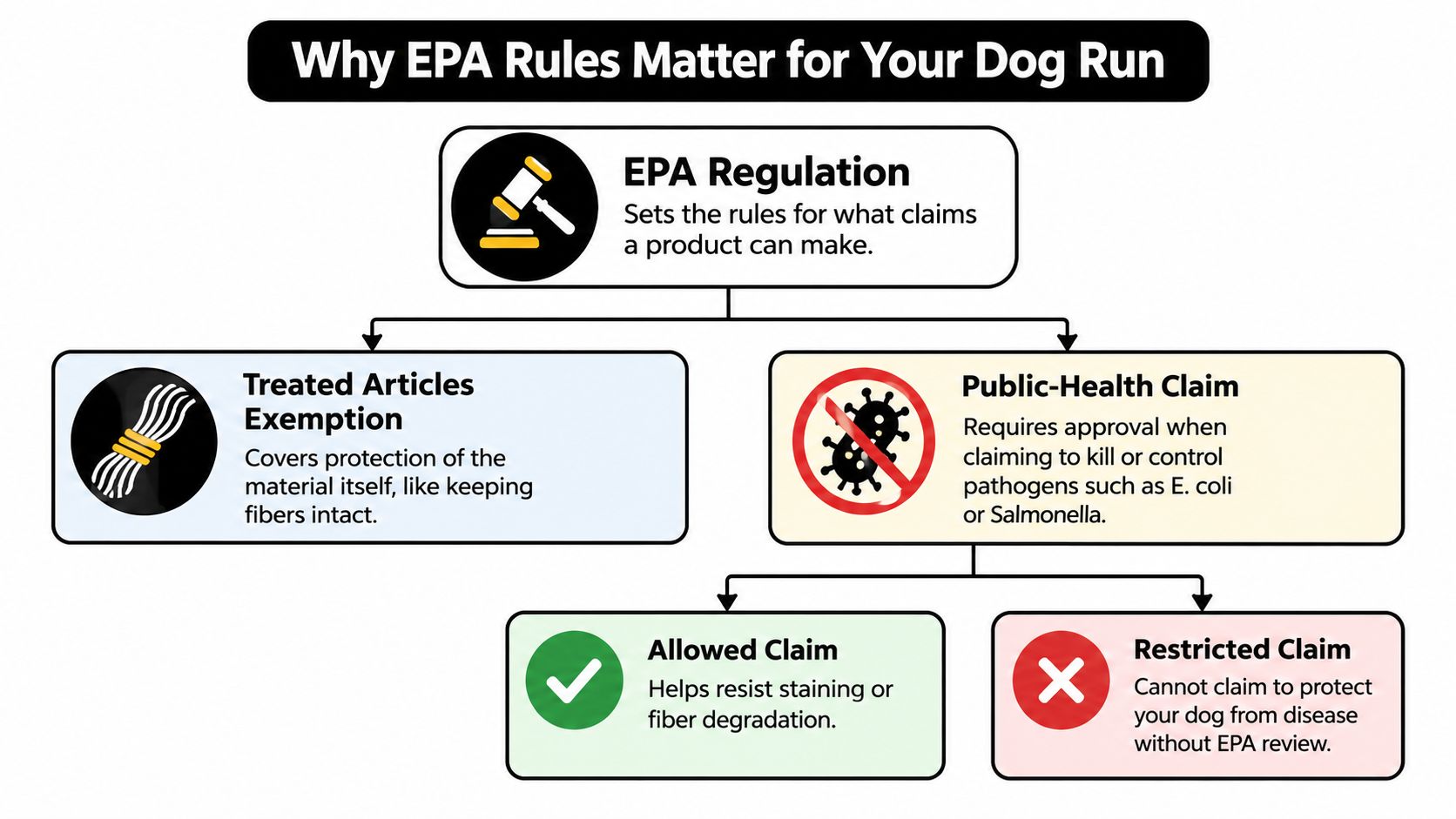
The word “antimicrobial” can describe two legally different ideas. One claim says a treatment helps protect the turf material from deterioration, spoilage, or fouling. The other says the product kills, controls, or reduces organisms that could affect public health.
The U.S. Environmental Protection Agency regulates those claims under the Federal Insecticide, Fungicide, and Rodenticide Act, or FIFRA. Under the treated-articles exemption in 40 CFR 152.25(a), an antimicrobial treatment may qualify for exemption only when the pesticide is registered for that specific use and the sole purpose is protecting the article itself from deterioration, spoilage, or fouling (EPA's treated-pesticide guidance).
Material protection is not pathogen protection
A manufacturer may describe a product as helping protect fibers or backing from microbial deterioration. That wording is materially different from claiming the surface sanitizes a dog run or reduces E. coli, Staphylococcus aureus, Salmonella, or Streptococcus.
EPA clarified this framework in PR Notice 2000-1, issued in 2000 (EPA's PR Notice 2000-1). The agency explains that treated products with public-health claims fall under FIFRA requirements, and products lacking required registration can't legally be distributed with those claims.
That isn't paperwork for its own sake. It tells you what the seller is willing and legally able to put in writing. If a brochure says “helps protect turf fibers,” don't read that as a health guarantee. If a salesperson says the product kills pathogens, ask whether the product is EPA-registered for that specific public-health use.
Questions to ask before approving the material
Use direct wording:
- Is the treatment intended to protect the turf material or make a public-health claim?
- If the product claims to control pathogens, is it registered with the EPA for that use?
- Which exact label language supports the claim?
- Which organisms were tested, using what method and exposure time?
- Does the claim survive outdoor weathering and routine cleaning?
A careful installer won't promise disease prevention from a turf sample. The responsible explanation is narrower: the treatment may inhibit growth under defined test conditions, while drainage, waste removal, and sanitation remain necessary.
Antimicrobial Turf Versus Untreated Turf
Antimicrobial turf is not “safe turf,” and untreated turf is not automatically unsafe. The practical difference is a system with an added growth-inhibiting feature versus a system that relies entirely on drainage, materials, and maintenance.
| Factor | Antimicrobial Turf | Untreated Turf |
|---|---|---|
| Odor control | Can provide extra resistance to microbial growth when paired with drainage and cleaning | Relies on drainage, infill behavior, rinsing, and prompt waste removal |
| Hygiene | May reduce survival of tested organisms under defined conditions | Has no antimicrobial treatment, so system design and maintenance carry the full burden |
| Longevity | May help protect selected materials from microbial deterioration, depending on the claim | Depends on backing quality, UV resistance, traffic, cleaning, and moisture management |
| Safety interpretation | Is not a sterilization or disease-prevention guarantee | Has no treatment claim that should be confused with a health guarantee |
| Maintenance | Still requires waste removal, rinsing, and periodic cleaning | Requires the same core maintenance, with less margin when conditions are poor |
| Infill considerations | Treated infill may affect microbial persistence, but does not eliminate contamination | Infill chemistry and moisture retention still affect recoverability and odor |
| Cost of ownership | Can suit high-use pet areas when the entire system is properly installed | Can suit areas with excellent drainage and consistent owner maintenance |
Infill can change the timeline
Infill is not a minor specification. A 2020 investigation of synthetic turf reported approximate MRSA availability windows of about two hours on EPDM rubber infill, seven hours on cork-based infill, nine hours on polymer-coated material, 12 hours on crumb rubber, 13 hours on thermoplastic elastomer, and 27 hours on sand. The investigation also reported that fewer than 15% of cells remained available after 48 hours.
Those results do not show that any infill eliminates pathogens. They show why the material beneath the blades deserves the same scrutiny as the blade treatment. Moisture retention, particle surface, and organic buildup affect what remains recoverable. Ask for the infill name, its documented performance, and the cleaning requirements before approving a sample.
Which option fits your household?
Choose antimicrobial turf when you want an added microbial-growth control feature and will maintain the area properly. It makes more sense for busy dog runs, multiple pets, and spaces where rinsing access and prompt waste removal are already practical.
Untreated turf can still perform well with a properly draining installation and consistent upkeep. It gives you less room for poor maintenance, especially where moisture lingers or organic waste builds up.
For either option, inspect the full system before signing. Confirm the backing, base, drainage path, infill, rinse access, and maintenance instructions. Antimicrobial treatment can add a useful margin. It cannot rescue a saturated base, blocked drainage, or feces left on the surface.
What a Good Austin Installation Actually Includes
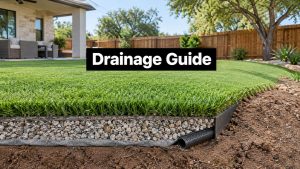
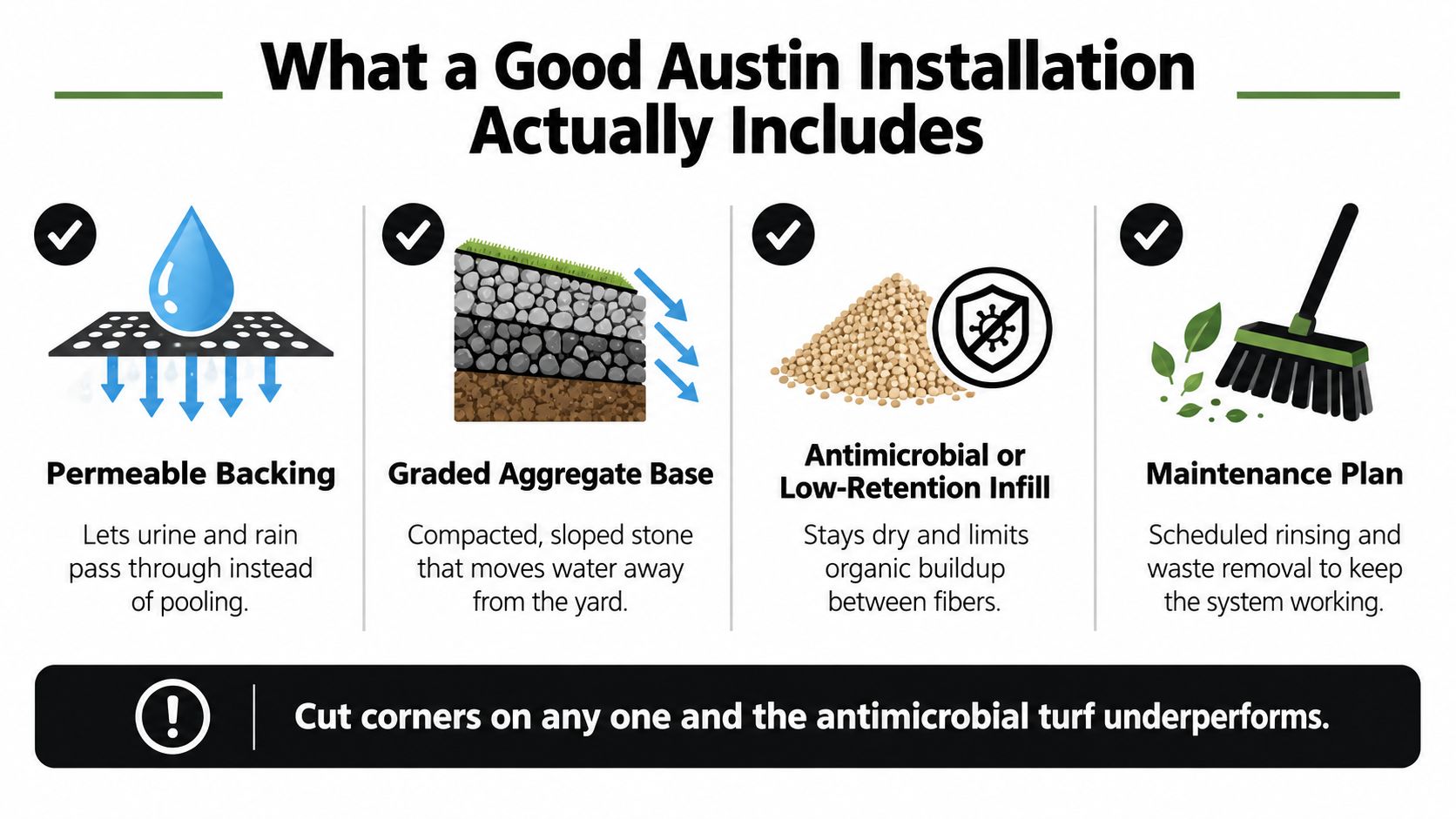
Antimicrobial treatment can't compensate for a weak installation. Austin yards often combine dense clay soils, uneven grades, and intense summer rain. If the base doesn't move water away from the pet area, the turf becomes a cover over a drainage problem.
Start below the blades
Permeable backing gives urine and rain a route through the surface. A supplier should be able to explain the backing design, not just show you a green sample.
A graded aggregate base creates the working foundation. The installer should remove unsuitable material where necessary, place the aggregate correctly, compact it, and establish a grade that moves water toward an appropriate discharge point.
Infill choice affects how wet the system stays between cleanings. Ask whether the proposed infill has documented antimicrobial performance, low-retention characteristics, or another reason it suits a pet area. Don't accept “odor control” without asking what physical mechanism supports it.
Hose access turns maintenance from a chore into a manageable routine. A dog run needs reachable areas where the owner can rinse urine and cleaning residue through the system rather than merely wetting the top.
Put the performance details in writing
Your contract should identify the backing, base preparation, infill, edging, drainage approach, and maintenance requirements. It should also identify what the antimicrobial claim means and what it doesn't mean.
Urine odor develops partly when microbes convert urea into ammonia. Trapped liquid and organic buildup are therefore serious risks, even when the polymer itself is nonporous. A system that looks perfect on installation day can smell later if the base stays wet or the infill holds residue.
For a closer look at project scope, review the artificial turf installation details before comparing quotes. A legitimate proposal should discuss site preparation and water movement, not only fiber color and blade height.
The installation should be judged from the soil up. The antimicrobial label belongs near the bottom of your checklist, after drainage and base preparation.
A Realistic Maintenance Rhythm for a Pet Run
Antimicrobial features give you margin. They don't give you permission to leave waste in place. The routine below is practical for a busy Austin homeowner and keeps the system from carrying more contamination than it was designed to handle.
Every visit and every week
Remove feces promptly, including small pieces trapped between blades. Solids can shield microbes from sunlight, drying, and cleaning agents, while residue supplies nutrients that support persistence.
Check the usual bathroom areas after heavy use. Hose those spots thoroughly so liquid moves through the turf and backing. A quick surface sprinkle isn't the same as a meaningful rinse.
Once a week, brush high-traffic sections to lift flattened fibers and inspect seams, edges, and drainage outlets. Use a pet-safe enzymatic cleaner on urine areas when odor begins to develop. Enzymatic products work by breaking down organic residue rather than masking it with fragrance.
For additional practical guidance on tackling E. coli on turf, focus on the cleaning method and the contaminated material, not just the product label.
Monthly checks
Walk the entire area after rinsing. Look for slow-draining spots, compacted infill, standing water, exposed edges, and areas where dirt has collected at the perimeter. If one location repeatedly smells, don't keep adding cleaner. Find out whether the liquid is reaching the base and exiting properly.
Top up or redistribute infill according to the installer's specification. The correct timing depends on traffic, brushing, weather, and the selected product. Ask for that guidance at installation rather than guessing later.
Use a written cleaning guide for artificial turf used by dogs as a household reference. The owner who follows a simple routine will get more from antimicrobial turf than the owner who buys a premium treatment and ignores the drainage path.
Seasonal attention
Before periods of heavy rain, clear leaves and debris from edges and outlets. After storms, inspect for washed aggregate, shifted seams, or sediment that may block flow. During hot, dry weather, rinse as needed to remove concentrated urine residue and cool the surface.
A treated blade can still have odor and biofilm around contaminated material. The maintenance plan isn't an optional add-on. It is what lets the antimicrobial feature perform within its intended limits.
How to Vet a Turf Installer Before You Call
A trustworthy installer makes every claim easy to inspect. If the proposal says “lifetime antimicrobial protection,” ask what that phrase covers, how it was tested, and whether the warranty includes labor.
The Federal Trade Commission says warranty and guarantee advertising must not be deceptive and should clearly explain coverage and the meaning of the terms used (FTC guidance on advertising warranties and guarantees). For a pet-turf project, ask how long coverage lasts, whether materials and labor are included, which maintenance steps are required, and how you submit a claim.
Use evidence you can verify
Reviews show how a company communicates and handles problems, but they cannot prove that every installation performs the same way. GatherUp's 2025 consumer survey reported that 39% of respondents always read local-business reviews before choosing a business, while another 34% do so most of the time (GatherUp's 2025 local review survey). The survey also found that 19% completely trust local reviews, 31% mostly trust them, and 44% somewhat trust them.
Use reviews to assess cleanup, workmanship, responsiveness, and follow-through. Then ask for dated project photos, base-preparation details, drainage information, and examples of how the company handled questions after installation.
Ask this before scheduling
Send the installer these questions:
- What component is antimicrobial, and what is the active ingredient or treatment name?
- Which organisms were tested, and where can I see the test method?
- What contact time produced the stated result?
- Does the treatment remain effective after UV exposure, weathering, and cleaning?
- What backing, aggregate grade, and drainage route will you specify for my yard?
- What maintenance is required, and what happens if odor develops below the surface?
- What exactly does the warranty cover?
Modern Yard Landscapes is one Austin provider that specifies antimicrobial fibers and infill alongside permeable drainage and hose-down maintenance. Compare those line items against every other proposal, rather than judging the system by its label.
Schedule a walkthrough only after the installer answers in concrete terms. The visit should cover grade, soil, access, drainage, pet traffic, hose locations, and the maintenance routine your household can realistically follow. A treated fiber cannot correct poor base preparation or blocked drainage.
Visit Modern Yard Landscapes to request a walkthrough and get a project recommendation before committing.