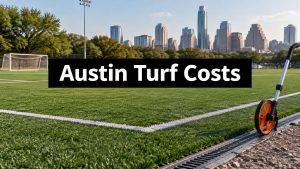

A typical installed turf soccer field runs about $6 to $15 per square foot, which puts an 80,000 square foot regulation field at roughly $480,000 to $1.2 million or more. Your total will land within or above that range depending on scope, site conditions, drainage, base work and the turf system you choose.
That range answers how much does a turf soccer field cost at installation. It doesn't answer what you'll spend to own, program and replace that field in Austin heat and heavy rain. A low per square foot number can look decisive on paper while leaving out the work that decides whether the field drains, stays playable and holds up under your schedule. Don't compare totals until every bidder has priced the same field, the same base and the same hours of use.
What a Turf Soccer Field Costs at a Glance
Start with the cleanest benchmark available. In 2025, a typical installed turf soccer field was estimated at $6 to $15 per square foot, implying approximately $480,000 to more than $1.2 million for an 80,000-square-foot regulation field, according to Keystone Sports Construction. Use that as your screening range, not as your budget approval.
Turf soccer field price ranges by project scope
| Project scope | Price per sq ft | Estimated total |
|---|---|---|
| Full-size 80,000 sq ft regulation field | $6 to $15 | $480,000 to more than $1.2 million |
| Basic synthetic field of comparable size | Under $5 to $12.50 at 80,000 sq ft | Under $400,000 to approximately $1 million |
| FIFA-standard 7,140 sq m field, Europe | $7.50 to $14.57 | $576,000 to $1.12 million |
The first row is the practical planning anchor for a full-size field. If a bidder quotes well below it, your first question shouldn't be how they got so efficient. Ask which part of the field they removed from the scope.
The second row shows why wording matters. A basic synthetic field of comparable size can run from under $400,000 to approximately $1 million depending on scope and specifications. That spread isn't a pricing error. It reflects differences in excavation, base depth, drainage, shock pad, infill, edging, access and whether surrounding site work is included at all.
The third row gives you an international check on a higher specification. In 2025, the estimated total cost for a 7,140-square-meter FIFA-standard artificial football field was $576,000 to $1.12 million in Europe, according to Mighty Grass. A field built to a defined performance standard shouldn't be priced like a basic carpet replacement.
Why the square foot rate misleads
Smaller fields usually cost more per square foot because mobilization, drainage connections, seaming, edging and base work don't shrink in proportion to area. Larger areas spread those fixed tasks over more square feet. Site access changes the rate too. A field that requires long material hauls, difficult grading or extensive soil correction will not price like a flat, open site with straightforward drainage.
Quote test: If the proposal gives you one square foot rate and no breakdown for base, drainage, turf, infill and edging, you don't have a comparable quote yet.
Treat the surface as one line item inside a construction project. Compare every proposal against the ranges above, then require a line-item breakdown before you decide. The cheapest total is only cheaper if it includes the same preparation and performance.
The Factors That Move Your Turf Field Price
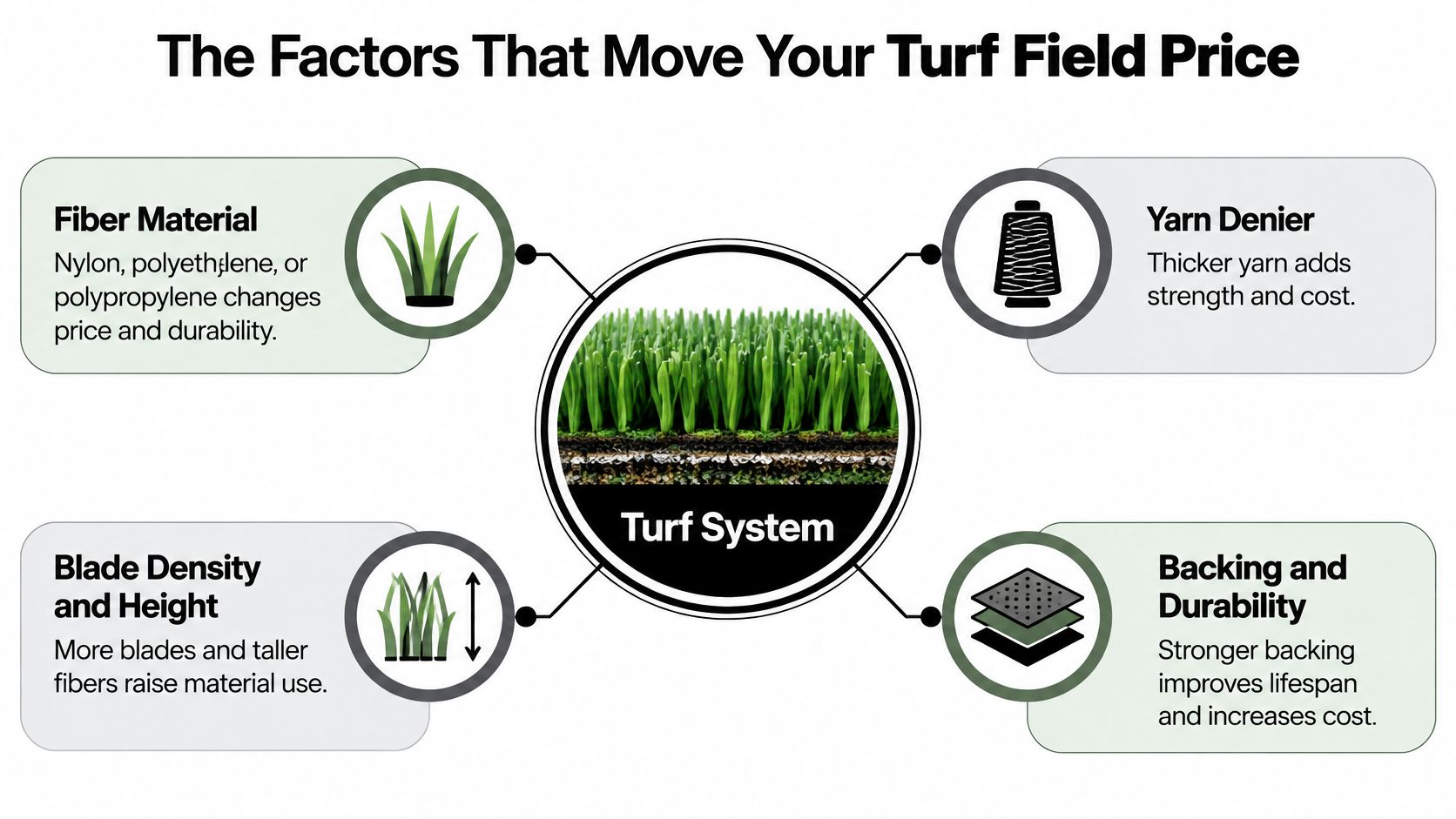
Price the field from the fiber down to the soil. Each layer changes playability, lifespan and replacement risk, so saving money in the wrong layer usually moves the cost into repairs or early resurfacing.
Fiber, yarn and backing
Fiber material is your first major choice. Nylon is generally the most expensive and most durable turf fiber and is often used for high-traffic areas like sports fields. Polyethylene offers a good balance of softness and durability at a mid-range price, while polypropylene options can reduce material cost where the workload supports them.
Yarn denier, blade density and blade height then determine how much material is in each square foot. Thicker yarn adds strength. Denser, taller blades use more fiber and hold infill differently. Backing quality affects dimensional stability, seam performance and how well the carpet tolerates repeated play. Two products can look similar in a sample box and behave very differently after seasons of cleats, sun and grooming.
We estimate turf project cost by considering fiber material, yarn denier, blade density and height, backing, durability, features, infill, and manufacturing and origin. Ask for those specifications in writing. "Premium turf" is not a specification.
Base, grading and drainage
Proper installation includes extensive soil preparation and compaction, precise grading for drainage, professional seaming, correct infill application and distribution, and proper perimeter securing. The sub-base has to carry play, preserve the intended slope and move water away quickly after heavy rain. Skimping here creates puddling, uneven settlement and seams that work under stress.
Before you approve a surface, price the ground under it. Our guide to site preparation cost explains why excavation and base conditions belong in the estimate from the first visit. A field with weak soil or poor fall needs corrective work whether the bidder mentions it or not.
Site and usage drivers
FIFA identifies location, field size, material and equipment transport distance, site accessibility, earthwork, drainage, soil composition, and the selected turf-quality level as measurable cost drivers in its football turf installation guidance. Those aren't abstract planning categories. Each one can add labor, material, equipment time or a higher-performing system.
Usage belongs on that list. A field specified for heavy weekly programming needs more durability than an occasional-use surface, and matching the system to the workload costs money up front. Under-specifying is false economy because the field reaches visible wear sooner.
Require a site-specific estimate that separates turf, earthwork, base, drainage, transport and quality level. When each driver has its own line, you can change a decision deliberately instead of discovering it during construction.
Upgrades That Add to the Final Bill
Upgrades aren't automatically upsells. Some protect players and the base. Others improve comfort or extend usable hours. Your job is to buy the ones your site and schedule justify, and to see each one priced separately.
A shock pad adds cushioning under the turf and makes strong sense for training fields, youth play and frequent use. It is a distinct material and labor line, not something hidden inside the carpet price. If player impact and consistent underfoot response matter to your program, price it. If you're comparing bids, make sure one bidder hasn't deleted it.
Infill choice affects ball behavior, footing, maintenance and surface temperature. In Texas, cooling performance deserves a line in the decision. Residential synthetic turf comes in multiple blade colors and thicknesses, has a natural-looking thatch layer underneath, and uses cool-touch technology that prevents summer scorching. For a soccer surface, ask how the selected fiber and infill work together in direct sun rather than treating cooling as a brochure claim.
Drainage tile earns its cost where water sits after rain or where runoff enters the field from surrounding grades. Perimeter steel edging and proper securing keep edges stable under heavy use, maintenance equipment and repeated traffic at entry points. Those are durability items, not decoration.
Retaining walls and grading changes become necessary when the site cannot deliver a stable, correctly sloped field without them. Lighting is different. It doesn't protect the turf, but it can transform the economics by allowing evening training and rentals. Price it as a capacity investment and judge it against the hours you'll program.
Buy drainage, stable edges and site correction before cosmetic extras. A field that stays level and dry protects every dollar spent on the surface above it.
Ask for the base quote and each upgrade on separate lines. My recommendation is simple: treat drainage, perimeter securing and necessary grading as essential, treat shock pad and cooling features as program-driven priorities, and treat lighting as optional unless evening use is central to your plan.
Maintenance, Warranty and Replacement Costs Over Time
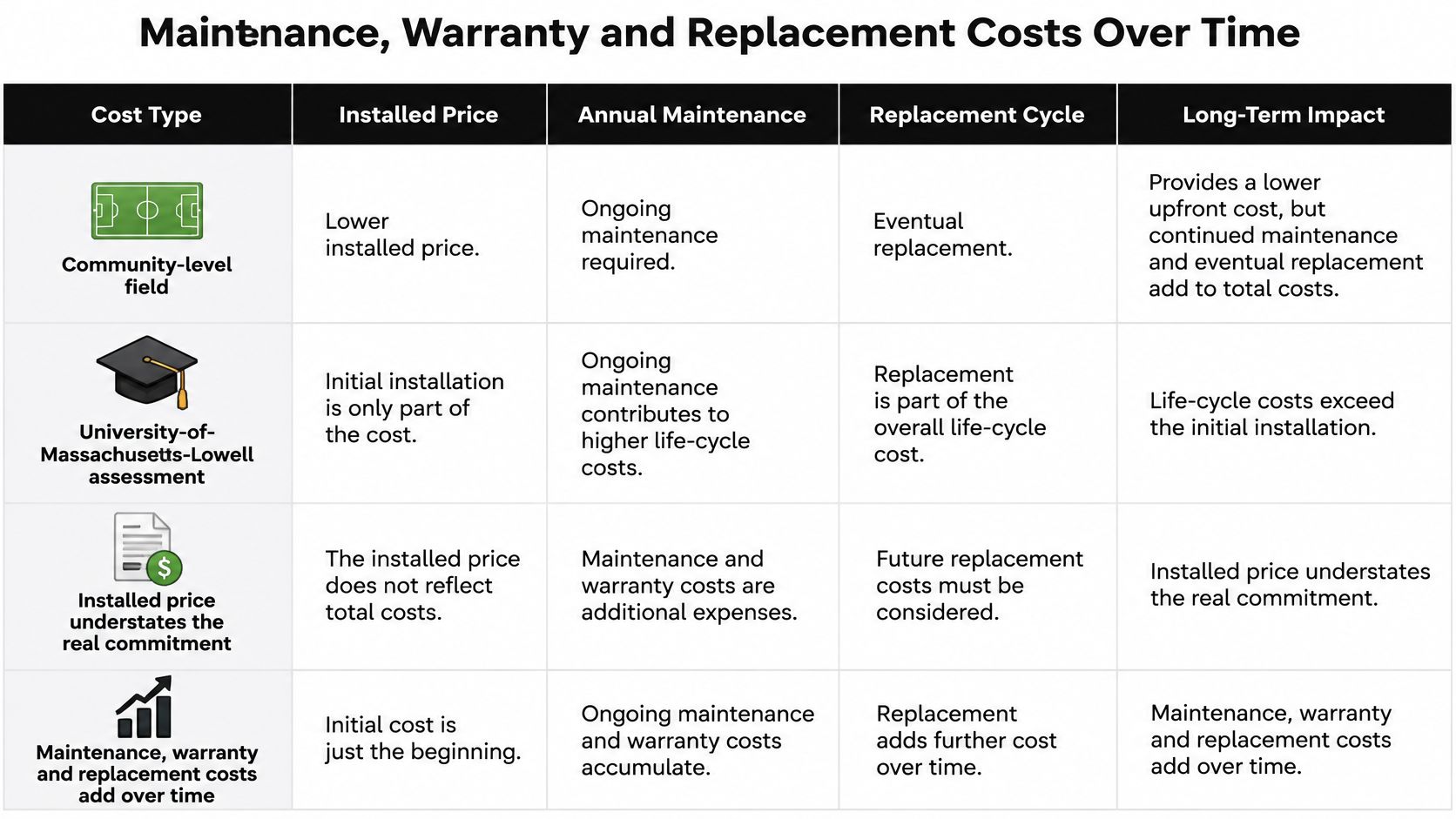
The first invoice can hide the larger commitment. A University of Massachusetts Lowell assessment reported construction cost of approximately $153,000 for community-level natural grass versus $508,000 for synthetic turf. The same comparison estimated 25-year life-cycle costs of $724,000 for natural grass and $1.813 million for synthetic turf, a difference of $1.089 million.
Construction and life-cycle cost, synthetic turf vs natural grass
| Cost item | Synthetic turf | Natural grass |
|---|---|---|
| Construction (community level) | $508,000 | $153,000 |
| 25-year life-cycle cost | $1.813 million | $724,000 |
| 50-year life-cycle cost | $3.118 million | $1.295 million |
Those figures don't make synthetic turf a bad purchase. They mean you should stop judging it only by reduced mowing and irrigation. Synthetic systems commonly require resurfacing or replacement after roughly 8 to 12 years, depending on use, maintenance, ultraviolet exposure and infill condition, according to the Oregon cost and playability analysis. That analysis found average synthetic-field installation of approximately $1.212 million, annual maintenance of $7,000 and resurfacing of $377,000. Carry those three lines separately in your budget. A single blended life-cycle number hides which line is driving the total.
A defensible ownership model includes annual grooming and repairs, infill replenishment and redistribution, seam work, drainage checks, replacement-year resurfacing, removal and disposal or recycling, and financing escalation. It should also include maintenance staffing, utilities, supplies, depreciation and planned renovation. Leaving those out makes the opening quote look cleaner and the future budget worse. Budget for drainage checks every year, not only after a problem shows up. Water sitting under a field shortens the base life and turns a small repair into a reconstruction line.
The sports fields maintenance guidance from Modern Yard Landscapes covers the routine care that protects playability and delays avoidable wear. With proper installation and maintenance, commercial turf can last 15 to 20 or more years, even under heavy foot traffic and Texas weather. That longer service life is your best defense against replacement cost, but it depends on doing the work, not merely owning synthetic fiber.
Warranty and cost per usable hour
Read the warranty as a budget document. Ask exactly what's covered for fiber wear, seams, backing, infill performance, drainage and workmanship. Confirm the term, exclusions, maintenance conditions, repair response and whether coverage is written into the contract. A long warranty with narrow coverage can be worth less than a shorter, clearly defined one. Get the maintenance conditions in writing too. A warranty that voids when you skip a specified grooming schedule is a cost document, not a safety net.
Then ask for cost per usable hour. A Palo Alto analysis estimated natural grass at $179 to $203 per operating hour over 20 years, compared with about $79 per hour for synthetic turf when fully programmed, according to Palo Alto Online. Grass closures for maintenance and rain recovery drive that difference.
That's the comparison high-use schools, clubs and municipalities should demand. Synthetic turf may cost more to own in total while delivering enough additional playable hours to lower the cost of each booking. Require low, moderate and high usage scenarios beside the installation price. If an installer can't show that math, you're only seeing half the purchase.
How Austin Heat and Rain Shape Your Budget
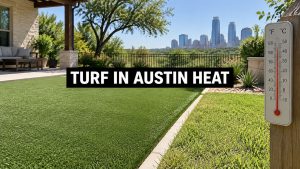
Austin doesn't let you treat heat as a footnote. Artificial turf can feel warmer than natural grass in direct sunlight, and field measurements show how large that gap can become. A 2025 California environmental assessment recorded synthetic-turf surface temperatures reaching 131°F under ambient temperatures of 70 to 100°F, according to the California field characterization report.
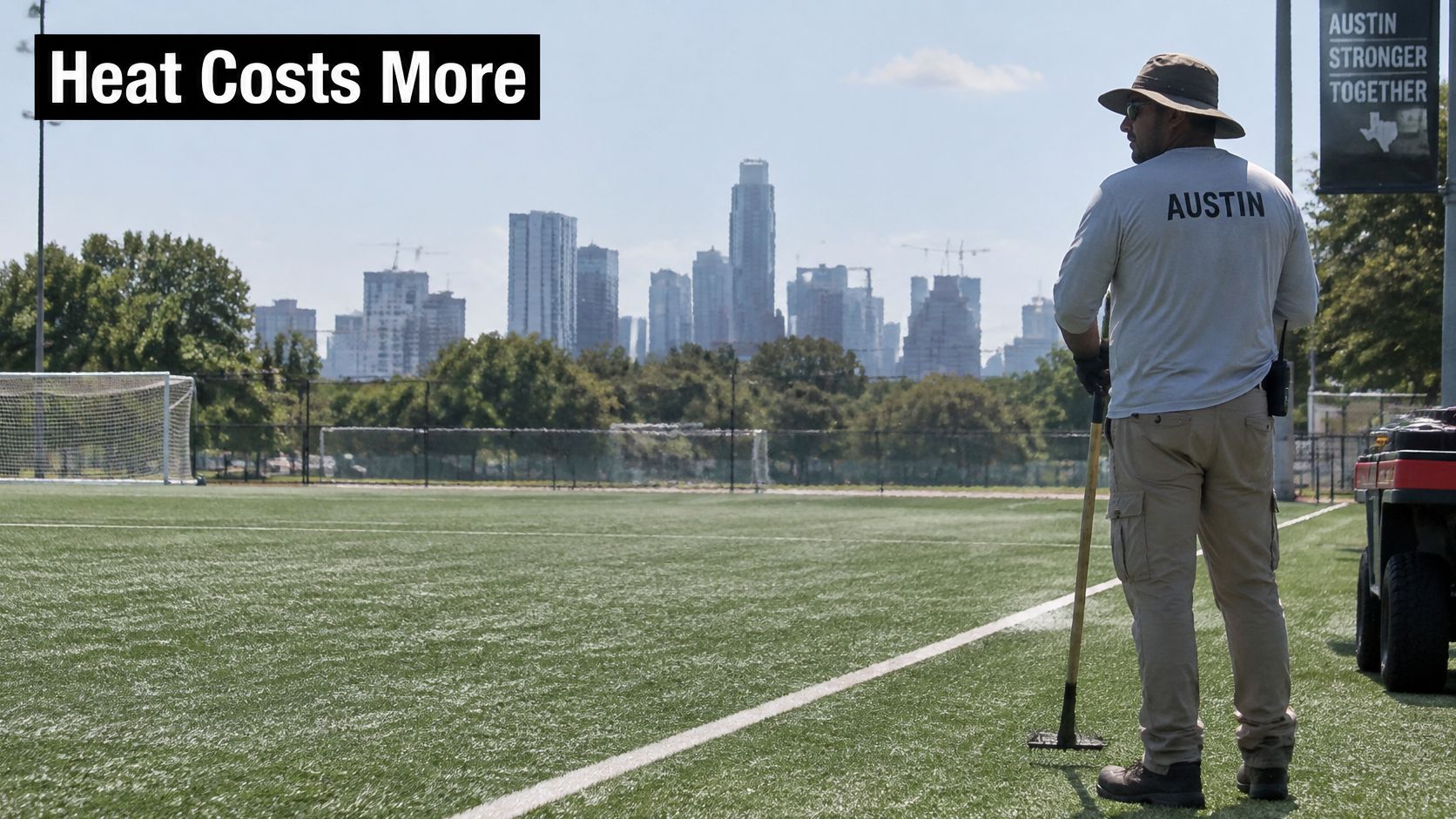
An EPA review reports a Connecticut synthetic field where air temperature was approximately 36°C, grass-fiber surface temperature reached 69°C, and crumb-rubber temperature at a depth of one inch reached 44°C, according to the EPA tire crumb study response. Not every field reaches the same temperature. Fiber, infill, sun exposure, wind and surrounding surfaces matter. That's exactly why your proposal should discuss them for your site.
Price cool-touch fiber, infill selection, shade, hydration access and scheduling rules as operating decisions. Our explanation of how hot artificial turf gets helps you frame the right questions before the first summer session. A written heat policy, shaded team areas and afternoon breaks can affect playable hours just as surely as rain closures affect grass.
Rain creates the other Austin test. Intense storms expose weak grading, undersized drainage and poorly compacted base material. Modern Yard installs a professional sub-base that ensures rapid drainage, even during heavy rains in Austin, Round Rock, or Georgetown. Correcting a failed base after the carpet is installed means disturbing the finished field, so drainage is the most expensive place to gamble.
Water savings remain a real offset. Artificial turf can reduce water usage by up to 70 to 90% compared to natural lawns, and typical installations from our team cause water bills to drop 60 to 70%. Put that saving in the lifecycle model, but don't let it distract you from heat management and storm drainage.
Austin rule: Ask the installer to explain, for your exact site, where stormwater goes, how the surface handles direct sun and when play should pause for heat.
A local quote should connect those answers to specific materials and construction lines. A generic national rate can't do that.
Real Project Benchmarks and What They Include
Public contracts expose the gap between buying turf and building a finished field. Use these projects to test whether a proposal is missing major scope, not to assume your Austin project should match another district's total.
Recent turf project contracts and what they included
| Project | Year | Reported figure | Scope included |
|---|---|---|---|
| Woodland Community College synthetic soccer field | 2025 | Approximately $4.2 million construction contract | Synthetic soccer field construction |
| Sunland Park, New Mexico second turf field | 2026 | $1,625,624 before gross-receipts tax | Drainage, concrete, retaining walls, protective netting, irrigation improvements |
| California 86,000 sq ft synthetic field replacement | 2025 | $5,576,296 approved budget | Perimeter drainage, water cannons, track repairs |
In 2025, Woodland Community College's synthetic soccer-field construction contract was awarded for approximately $4.2 million, according to Yuba Community College District meeting documents reported by the Daily Democrat. Institutional construction can include procurement, site and supporting work that a surface-only estimate never captures.
In 2026, Sunland Park, New Mexico, awarded a contract totaling $1,625,624 before gross-receipts tax for a second artificial-turf soccer field, with a main construction bid of $1,518,024, according to Organ Mountain News. The scope included drainage, concrete work, retaining walls, protective netting and irrigation improvements. That is a sports-field development package, not a carpet price.
A 2025 California project had an approved budget of $5,576,296 for an 86,000-square-foot synthetic turf football/soccer field replacement, including perimeter drainage, water cannons and track repairs, according to the California Environmental Quality Act database. Replacement can therefore cost far more than the new surface when surrounding systems need work at the same time.
The lesson is consistent. Concrete, walls, netting, drainage, track repairs, taxes and supporting infrastructure explain why finished projects exceed attractive surface estimates. When reviewing commercial turf installation, identify which benchmark resembles your site and force every bidder to price that scope.
Scale changes the purchase, but use still decides the value. We install commercial turf for apartments, HOAs, schools and municipalities. One commercial customer says the synthetic turf installation paid for itself in just over three years and the property looks better than competitors'. At residential scale, a Mueller family couldn't keep real grass alive in shady parts of their yard, so we installed synthetic turf and their kids now play soccer on it every evening. Different budgets, same principle: usable hours matter.
Request Your Turf Quote and Book a Visit in Austin
Get your measurements and intended use settled before you ask anyone for a number. A quote built on guessed dimensions and vague programming will stay vague, no matter how polished the proposal looks.
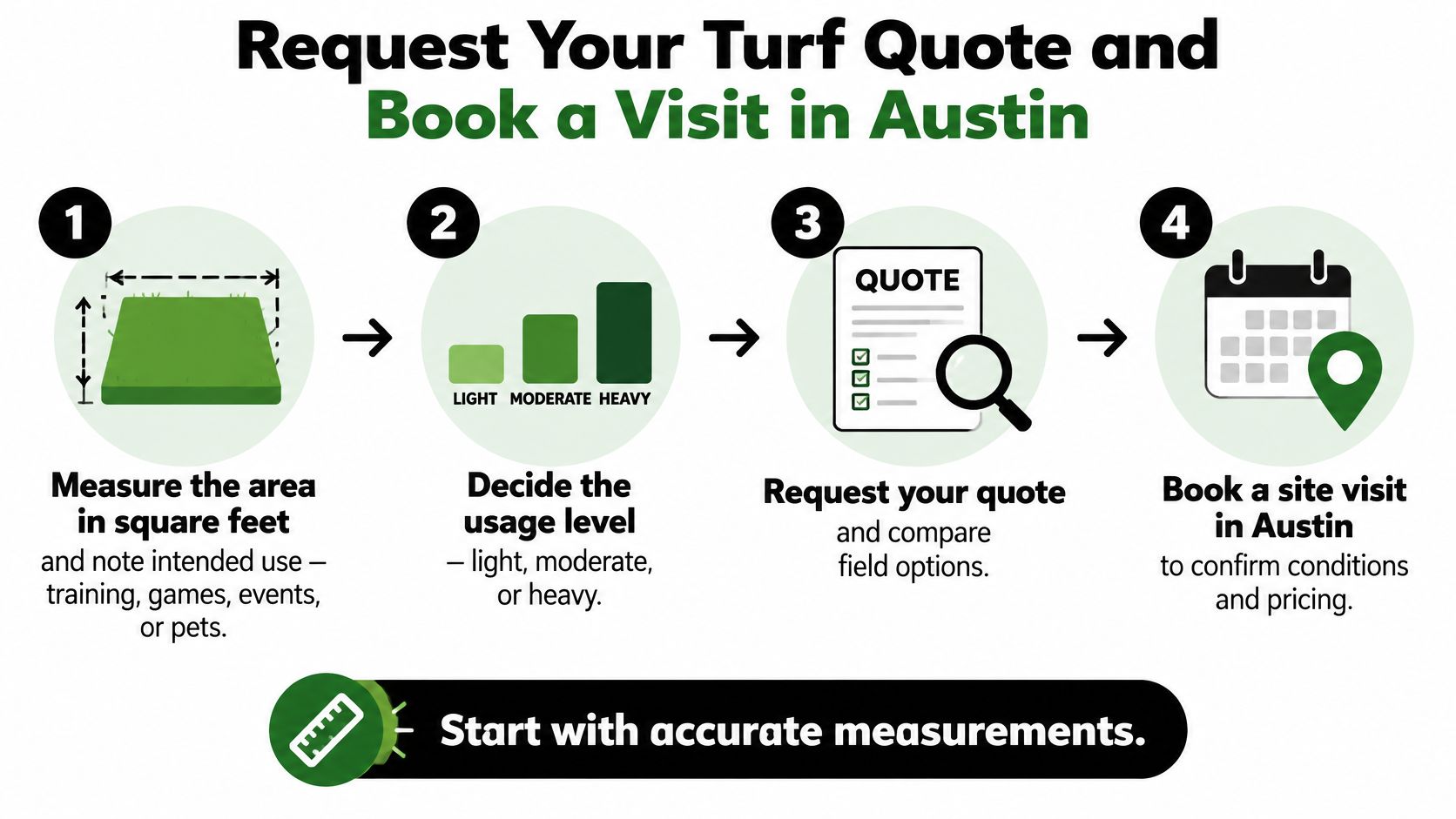
- Measure the area: Record the field in square feet and note whether it's for training, games, events, multi-sport use or another purpose. Mark access points, slopes, drainage paths and shaded areas.
- Set the usage level: FIFA states that FIFA QUALITY PRO is designed for professional football and typical use of up to 20 hours per week, while certified surfaces are assessed for recreational, training and grassroots applications capable of handling 40 to 60 hours of play per week, according to FIFA stadium turf guidance.
- Choose required upgrades: Decide whether the project needs a shock pad, specific infill, cool-touch fiber, drainage tile, edging, walls or lighting. Price each item separately.
- Request the on-site consultation: Provide your square footage and preferred date for an estimate. Our turf installation quote request form asks for square footage and an ideal date for an estimate, and we offer a free turf consultation.
- Require a line-item estimate: Ask for fiber, backing, infill, base preparation, drainage, edging, upgrades, warranty terms and maintenance on separate lines. Include removal and replacement reserves if this is a long-term facility budget.
- Verify certification claims: FIFA uses a two-stage process in which the turf product is tested in a laboratory and the completed field must pass an on-site field test by a FIFA-accredited test institute before receiving the FIFA QUALITY or FIFA QUALITY PRO mark, according to the FIFA Quality Programme.
- Challenge every gap: Compare the written quote with the opening ranges. If a total is unusually low or high, ask the installer to identify the exact scope, material or site condition responsible.
We've been installing premium synthetic turf for 15 years. Call us with your measurements, target hours and preferred visit date, and we'll inspect access, drainage, sun exposure and base conditions before giving you an Austin-specific number. You'll know what is included, what is optional and what the field will require after installation. That's the basis for a quote you can trust.
Call Modern Yard for a free turf consultation and a line-item Austin quote based on your field size, intended hours, drainage and heat exposure. Book your on-site visit through Modern Yard Landscapes, and we'll price the turf, base, drainage, upgrades, warranty and maintenance clearly before you commit.