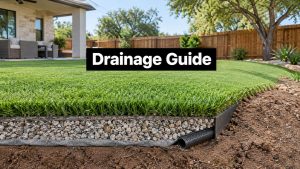

You've installed artificial grass to escape mud, mowing, and patchy growth. Then an Austin downpour leaves a soft spot near the patio, water gathering beside the fence, or a puddle that stays long after the rain stops. The turf may look perfect, but the hidden drainage assembly is telling you something is wrong.
Drainage for artificial grass is a site-design issue, not just a turf feature. Water has to travel through the blades, backing, infill, aggregate, and subgrade, then reach a safe outlet without undermining the surface or redirecting runoff toward a foundation, street, or neighboring property. A reliable installation starts with that entire path.
Why Drainage Matters More Than You Think
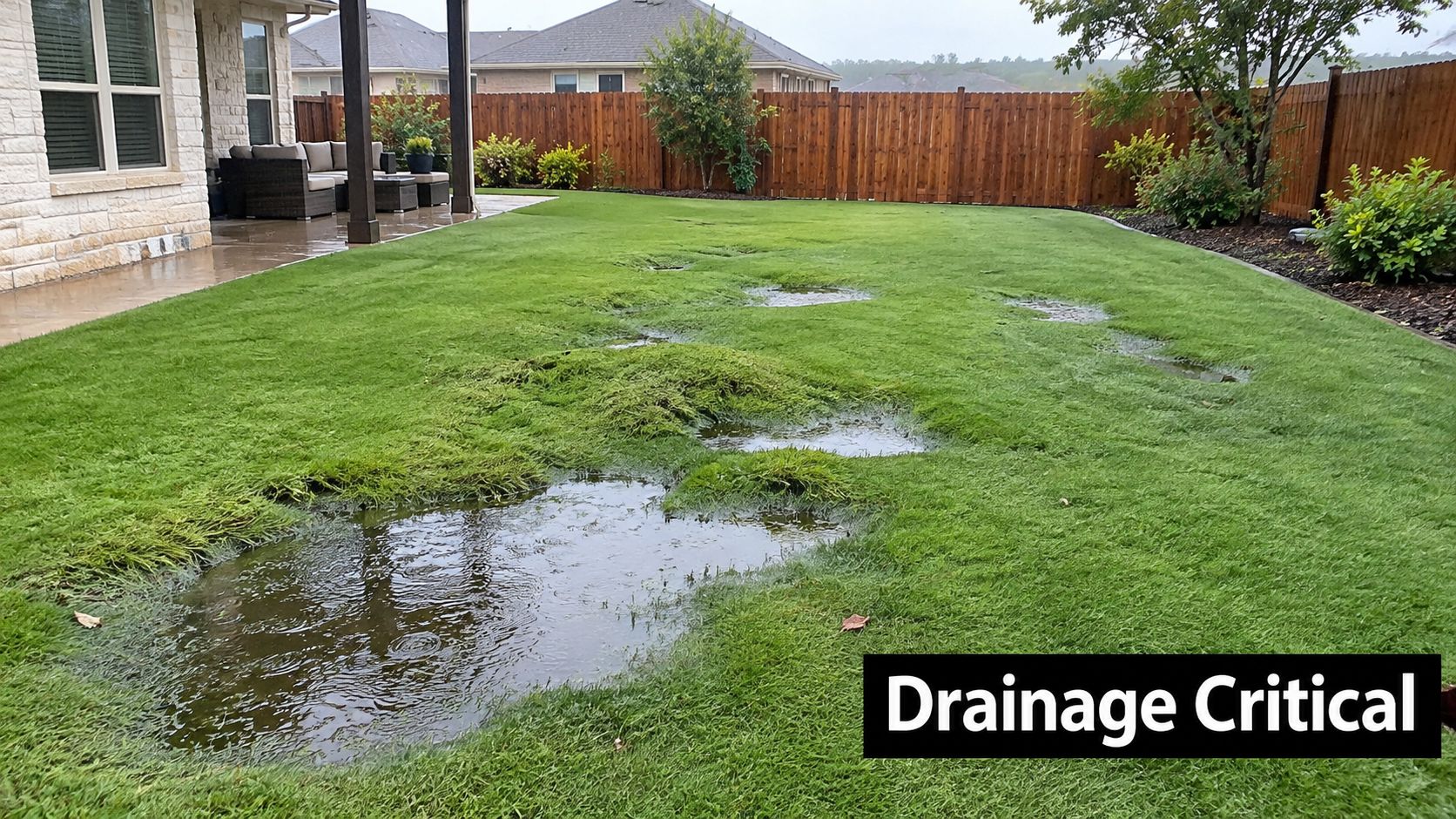
A synthetic lawn can fail beneath an attractive surface. If the prepared base contains low spots, the soil below is compacted, or the finished grade directs water toward a structure, the turf may develop ponding and soft areas even when its backing is highly perforated.
The surface is only the first layer
Rain first passes between the synthetic fibers. It then moves through the backing, infill, and aggregate base before encountering the native soil. Each layer has a different job:
- Turf and backing: Let water pass through the finished surface.
- Infill: Supports the blades while allowing water to move through the carpet.
- Aggregate base: Provides a stable, open structure for vertical and lateral movement.
- Geotextile separation: Helps keep native soil from migrating into the base.
- Subgrade and outlet: Receive, infiltrate, or safely convey the water away.
A weakness in any layer can affect the whole assembly. Uneven compaction can leave depressions. Migrated fines can close the voids in the rock. Saturated soil can stop otherwise well-filtered water at the bottom of the system. The result may be ponding, shifting, odors, turf movement, or erosion at the discharge point.
Homeowners often focus on whether the turf has drainage holes. That question matters, but it doesn't answer whether the property can accept the water beneath the surface. A roof downspout, sloped yard, retaining wall, or neighboring lot may add concentrated flow that the turf area wasn't designed to handle.
Practical rule: A product can be permeable while the completed installation still performs poorly.
Drainage problems also show why adjacent systems deserve attention. Roof water should be managed before it reaches a new turf area, and practical guidance on Atlanta gutter replacement insights offers useful context on how functioning gutters influence water movement around a property. In Austin, the correct response may involve grading, a collector drain, drainage tile, or a defined overflow route rather than another layer of turf material.
The right installation begins with a site assessment. Before choosing materials, inspect the slope, identify low points, trace downspout discharge, evaluate the soil, and determine where excess water can go. That approach protects the lawn and helps the customer understand exactly what the installation is expected to do.
Understanding the Layered Drainage System
On an Austin property, artificial grass is only the visible top of a stormwater assembly. Beneath it, each layer must support foot traffic, resist settlement, keep incompatible materials separated, and move water toward infiltration or a planned outlet. Treating turf as a roll-out product overlooks the section that controls long-term drainage.
What each layer contributes
The turf surface allows rainfall to pass through the blades. Its backing and infill form the first pathway below the visible surface, but a manufacturer's carpet rating describes the material, not the completed installation. Seams, infill distribution, compaction, aggregate fines, and the subgrade can all change performance.
The aggregate base provides structure and creates space for water to move. Common design benchmarks call for 10 inches of water per hour through the turf, backing, and infill, measured under ASTM F1551 or EN 12616 methods, and 14 inches per hour through the base and finish stone under ASTM F1551 or ASTM D2434 according to the ASTM F1551 and EN 12616 benchmark summary. These figures help compare materials and layer specifications. They do not guarantee the same rate after construction.
Austin's expansive clay often controls the result. The 10-inch-per-hour carpet rate is rarely the limiting factor. Once saturated, field infiltration can drop below 0.2 inches per hour, leaving water to move sideways toward a low point instead of draining downward. A permeable upper section cannot overcome a restrictive subgrade.
Why the soil changes the design
A geotextile can keep native soil from mixing with aggregate, but it cannot make slow clay drain quickly. Depending on the site, the assembly may require a deeper aggregate section, positive grading, a perforated collector, an underdrain, or drainage tile connected to an appropriate outlet. The correct configuration depends on soil, slope, finished elevation, and available discharge rather than one universal turf specification.
For a practical materials overview, review what goes under artificial turf. The relevant question is whether the layers function together under the property's actual rainfall and soil conditions, not merely whether each layer is present.
An Austin drainage review should address:
- Soil response: Does the subgrade accept water, or does it saturate quickly?
- Finished elevation: Will water move away from buildings toward an approved route?
- Aggregate structure: Is the base clean, correctly graded, and evenly compacted?
- Concentrated flow: Do downspouts or slopes send more water into the area than ordinary rainfall?
- Overflow planning: Where will water go when the base and soil are already full?
A successful drainage assembly stays stable while carrying water through the entire section. Turf permeability matters, but the completed system determines performance.
How to Test if Your Turf Drains Correctly
A manufacturer's laboratory result describes a material. It doesn't prove that the installed lawn drains as designed. Construction changes the conditions through compaction, seams, infill placement, aggregate grading, soil contact, and outlet configuration.
Test the assembled system
ASTM F2898 evaluates the in-place permeability of the assembled surface and base, including turf, infill, pads or drainage boards, and aggregate layers. The method uses a non-confined flood test, which makes it useful for observing how the completed section handles water rather than assuming the carpet's rating represents the whole installation as described by ASTM.
A practical quality-control sequence looks like this:
- Inspect the prepared base. Check the finished grade, visible low spots, edge conditions, and aggregate consistency before the turf is installed.
- Test the base where appropriate. This can reveal whether compaction, fines, or subgrade conditions are already restricting flow.
- Install the complete system. Include the turf, infill, pad or drainage board, seams, edging, and any collection components.
- Perform an in-place flood test. Observe how water enters, spreads, exits, and whether ponding or surface migration appears.
- Record the result. Keep the flow observation, test location, site conditions, and any corrective work with the project documentation.
What the test can expose
A flood test may reveal fines that have migrated into the aggregate, uneven compaction that creates a basin, or a subgrade that accepts water too slowly. It can also show whether water reaches the intended outlet instead of moving laterally toward a foundation or adjacent property.
Testing doesn't replace grading. A permeable area still needs a positive route for overflow, particularly on clay soils, slopes, and sites with concentrated runoff. Ask an installer what will be tested, at which stages, and how the result will affect the drainage design. Clear answers are more valuable than a product brochure that only discusses the turf backing.
The Hidden Cost of Poor Subsurface Drainage
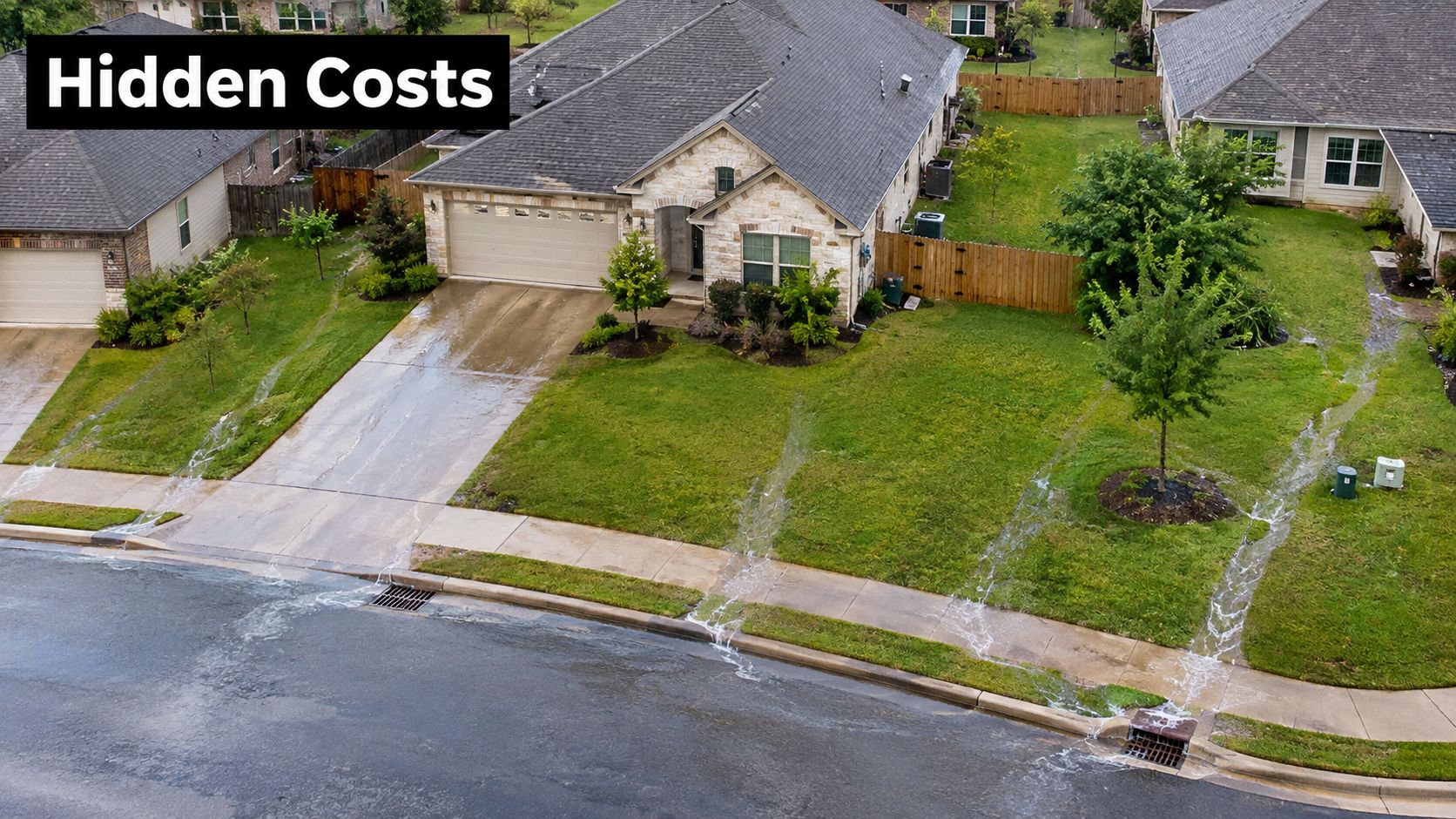
A turf surface can look dry while its drainage assembly carries sediment, debris, pet waste residue, or loose infill toward a catch basin and storm drain. That risk matters in Austin, where clay soils, intense runoff, and nearby waterways can turn a surface upgrade into a broader stormwater-management decision.
Water quantity and water quality are connected
The New Jersey Department of Environmental Protection's 2025 review identifies synthetic turf as a potential source of microplastic pollution in the technical review. Its discussion of infill loss connects material movement with use, maintenance, runoff, and snow removal. The figures do not mean every installation releases the same amount. They do show why drainage should be designed around what water may transport, not only how quickly it leaves the surface.
A dog run, playground edge, commercial courtyard, or lawn near a creek needs controls suited to its use. Perimeter containment, appropriate infill selection, accessible catch basins, and maintenance that keeps loose material away from outlets all reduce avoidable migration. Leaf removal and brushing should follow the drainage route. Pet areas also require routine waste removal so contaminants do not collect in the surface or wash into the subbase.
For a pet run draining toward a Barton Creek tributary, specify a catch basin with a removable sediment basket at the low corner and schedule quarterly cleanout. Document that detail in the yard drainage system cost estimate, rather than treating collection and maintenance as later additions.
A dry surface isn't the entire definition of good drainage. The assembly should move water while limiting the material that reaches each outlet.
Design for inspection and maintenance
Keep cleanouts, catch basins, outlet points, and overflow routes accessible enough for inspection. A buried system may continue conveying water while sediment reduces its capacity, but inaccessible components make that decline difficult to identify and correct. Give the homeowner a simple map showing each service point and the approved discharge path.
An existing downstream blockage can also make a sound turf assembly appear to fail. For urgent plumbing or drain problems outside the turf system, emergency drain cleaning may help address a backed-up pathway before the surface or subbase is altered.
Before approving the design, ask:
- Where does overflow go? Identify a real swale, drain, tile, infiltration area, or approved outlet.
- What captures transported material? Use a catch basin, sediment basket, or perimeter detail where infill migration is a concern.
- How will the system be inspected? Accessible collection points make routine maintenance practical.
- What changes the risk? Pets, slopes, concentrated roof water, clay soil, and nearby waterways affect the required controls.
The right assembly balances a usable lawn, stable construction, responsible discharge, and maintenance that an owner can realistically perform.
Austin-Specific Drainage Regulations and Challenges
Austin doesn't apply one universal drainage solution to every property. The city reviews stormwater discharge patterns and quantities to prevent adverse flooding impacts, considers downstream erosion, determines whether drainage easements are required, and applies floodplain provisions under Land Development Code sections including 25-7-61, 25-7-32, 25-7-152, 25-7-33, and 25-7-92 through its site-plan guidance.
Start with the property, not the product
Before excavation, document the yard's existing conditions:
- Trace roof downspouts and identify where they discharge.
- Mark slopes, low areas, retaining walls, and likely flow paths.
- Check whether the property is near a creek, drainage channel, or floodplain.
- Review the plat and deed for drainage easements.
- Decide whether the proposed outlet is permitted and physically capable of receiving the flow.
Austin Watershed Protection states that permanent structures are generally not allowed in drainage easements and warns that intensive landscaping can block water flow or restrict maintenance access. The agency also advises owners to review property, plat, and deed records because easement terms can allow limited improvements in some cases in its floodplain-management guidance.
Artificial turf, edging, drainage tile, and retaining features can all affect how water moves across a lot. An installer who doesn't verify easements may create a finished surface that later conflicts with access or drainage requirements.
Know when review may apply
Austin regulates projects in both the 25-year and 100-year floodplains, and the city issues permits and conducts inspections for specified stormwater infrastructure and business activities under its codes and regulations. Larger development-related work can involve flood management, conveyance, mitigation, water quality, and stream-bank stability.
A homeowner shouldn't assume that every grading adjustment or drainage tile installation is exempt from review. A documented assessment makes the conversation more precise and helps separate ordinary yard improvements from work that may require engineering or city involvement. For broader background, what stormwater management means provides useful context for thinking about discharge as a property-wide issue.
Trust grows when an installer explains limitations before work begins. Ask for the proposed flow path, the treatment of downspouts, the location of any easement, and the intended overflow route in writing.
Troubleshooting Standing Water and Ponding
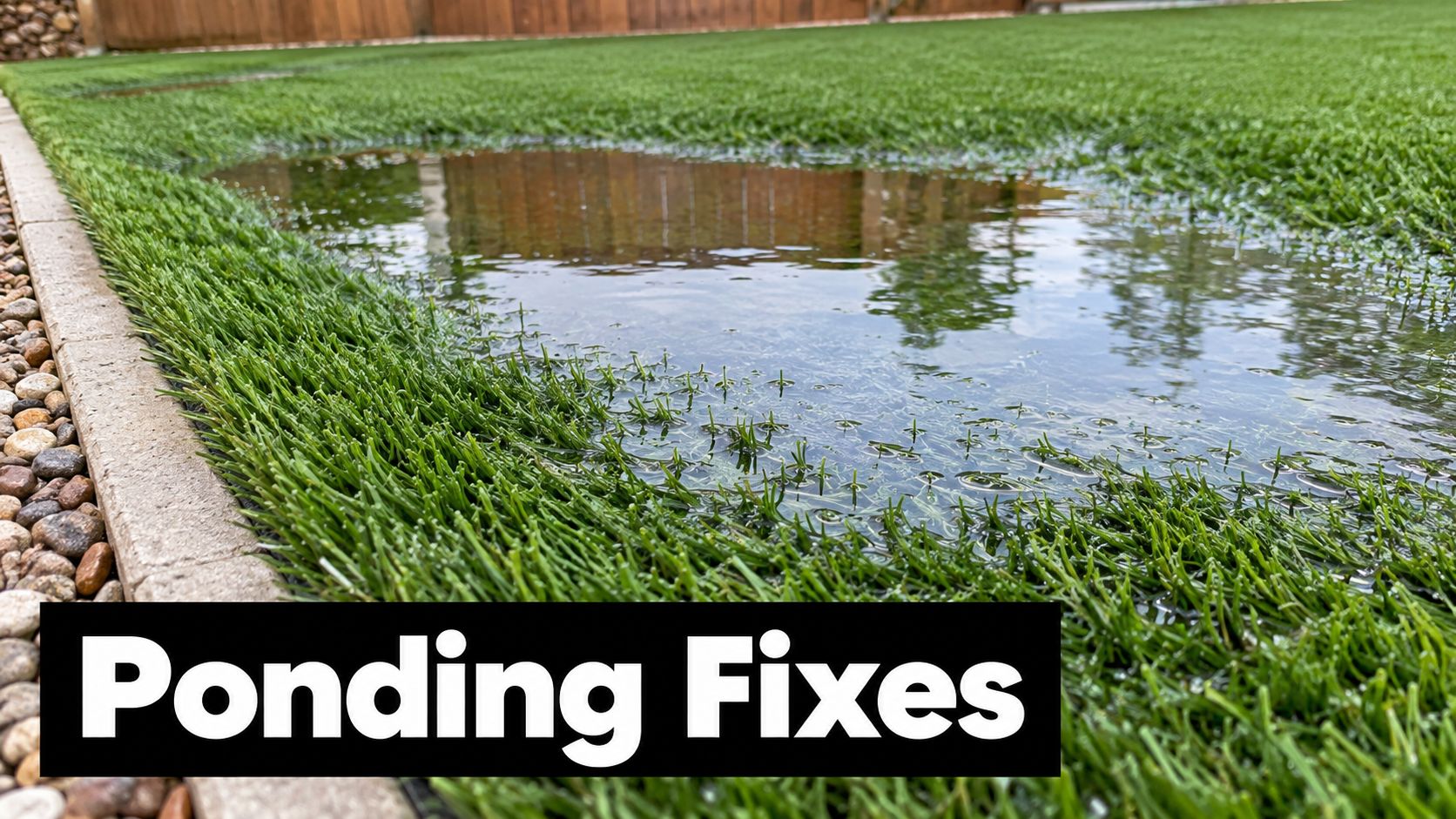
A puddle that appears in the same location after every storm usually has a repeatable cause. The turf may be covering a low spot, a blocked outlet, insufficient base preparation, or a subgrade that can't accept the incoming water.
Match the symptom to the cause
Start with a simple observation during or shortly after rainfall. Note where water enters, where it remains, whether the puddle sits near a seam or edge, and whether a downspout contributes concentrated flow.
- A shallow isolated depression: Regrading or correcting the base may solve the issue when the surrounding soil accepts water.
- Water collecting along a structure: The finished grade or outlet may be directing flow toward the foundation.
- Ponding across a broad area: Saturated subgrade, inadequate base depth, or widespread compaction may be limiting infiltration.
- Water appearing near an outlet: The line, catch basin, or downstream discharge route may be restricted.
- Runoff crossing a property boundary: The system needs a safer discharge path, not just more openings in the turf.
Water can move laterally through a saturated or poorly connected subgrade. That explains why a puddle may appear several feet from the original low point. Adding surface infill won't correct that movement.
Choose the least invasive effective repair
A small surface defect may need localized base correction. A persistent low area, clay bottleneck, or concentrated flow path may require a French drain, collector drain, or drainage tile that carries water to an approved outlet. The work should protect foundations, avoid sending discharge toward neighbors, and preserve access for inspection.
A focused resource on artificial turf drainage problems can help homeowners compare symptoms before scheduling an assessment. Don't cut the turf or excavate blindly. First identify the source, the bottleneck, and the destination for the water. A repair that only hides the puddle can leave the underlying failure in place.
When to Hire a Professional Installer
Professional installation earns its value before the turf arrives. The installer has to coordinate excavation, aggregate selection, grading, compaction, separation fabric, turf seams, infill, edges, outlets, and any drainage tile. Austin requirements and easement conditions add another layer of responsibility.
Look for evidence, not promises
A credible contractor should explain the site conditions in plain language and provide a defined scope. Look for:
- A drainage assessment: The proposal should identify slopes, low areas, soil limitations, downspouts, and the planned outlet.
- Clear material specifications: Ask what aggregate, separation fabric, infill, edging, and drainage components will be used.
- Quality-control records: Confirm whether the prepared base and completed system will be inspected or tested.
- Insurance documentation: Request a current certificate of insurance, verify the named business and effective dates, and ask what coverage applies to workers and property damage.
- Written responsibilities: Make sure the contract addresses grading, outlet access, easements, workmanship, maintenance, and warranty coverage.
TxDOT's contractor requirements provide a useful verification model. Contractors with employees must carry workers' compensation insurance for those contracts, and required insurance and endorsements must be obtained before work begins under TxDOT's contractor requirements. Private residential work isn't automatically governed by those rules, but requesting specific insurance evidence remains a sensible customer safeguard.
Pay for the assembly, not just the carpet
The cheapest quote often leaves out the work that determines whether the lawn remains stable. A professional plan may include a collector drain in a low area, an engineered outlet, or additional preparation where the subgrade drains poorly. That cost is easier to evaluate when the contractor explains the reason for each component.
Modern Yard Landscapes is one Austin-area option that combines artificial turf installation with site preparation and drainage-tile work, while customers should still compare scope, documentation, and insurance with any contractor they consider. If you're also planning a patio, visual references such as California and Arizona patio designs can help you think through how hardscape elevations and turf drainage need to meet at the same property.
A dry, stable lawn comes from a coordinated stormwater assembly. If you want the work handled responsibly, choose an installer who will inspect the site, explain the trade-offs, document the plan, and stand behind the completed installation.
Modern Yard Landscapes provides Austin artificial turf installation, drainage tile solutions, pet-friendly turf areas, and related outdoor work designed around the property's actual grade and water movement. Visit Modern Yard Landscapes to schedule a site assessment and discuss the right drainage plan before your artificial grass project begins.