
The surface takes the credit and the blame, and it rarely deserves either. When a dog run turns to soup after a heavy rain or smells like a kennel by August, the turf fiber and the grade of gravel are usually innocent. The failure sits underneath: what the water drains into, where the edges stop moving, and whether a hose reaches the far corner.
That's why comparing dog run materials by feel or by price per square foot hands homeowners the wrong answer. Every option below can work. Each one fails in a specific, predictable way. Judge the material as a complete system of surface, base, drainage, wash-down access and documented composition, and the decision gets much simpler.
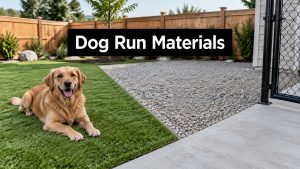
Dog Run Materials Compared at a Glance
Five questions settle a dog run surface, in this order. Where does water go after a two inch rain? How does waste come off the surface? What does a determined dog do to it by July? How hot does it run at three in the afternoon? And who is holding the hose or the rake? Appearance ranks sixth and answers none of them.
The table is the reference for everything that follows.
Dog run surface materials compared
| Material | Drainage | Cleaning | Durability | Summer heat | Best fit |
|---|---|---|---|---|---|
| Synthetic turf on permeable aggregate base | Good when the base is graded | Hose down; needs wash-down access | High under heavy play | Warmer than natural grass in direct sun | Small to mid-size runs with water access |
| Washed stone dust or crusher fines | Good when permeable and graded | Waste is visible; sift and remove regularly | High, low maintenance | Moderate | Large runs with several dogs |
| Natural grass | Poor on clay; mud when wet | Waste is hard to detect and remove | Low under constant use | Cooler than turf | Large areas where upkeep is feasible |
| Pea gravel | Good when edged | Waste sinks and is hard to remove | Moderate; migrates out of the run | Hot, and rounded stone holds heat | Budget runs with edge restraint |
| Wood mulch | Poor | Hard to detect and remove; retains odor | Low; breaks down and needs replacement | Cooler than stone but dries unevenly and blows | Not recommended for high-use runs |
| Concrete or hard surface | Good with correct slope | Easiest to hose and sanitize | Very high | Hot in direct sun | Entrance zones and gates |
How to read the table
Read across the columns that will cost you money. Cleanability and durability are the two columns that decide long-term satisfaction, and stone dust and concrete lead both. Concrete is unbeatable at a gate because it takes a hose and a squeegee, while stone dust lets waste be seen and lifted rather than buried.
Comfort and appearance are the columns where synthetic turf earns its place. On a graded base with wash-down access, turf gives a clean, paw-friendly surface that handles heavy play and doesn't turn into mud. Take away the base or the hose bib and the same product becomes an odor problem with a warranty.
The test that separates good installs from bad ones: ask what happens to a bucket of water poured on the surface in the worst corner of the run. If the answer involves a shovel, the base is wrong.
Where the rows split
Three rows cover most Austin yards: turf on a proper base, washed stone dust, and concrete at the gate. Natural grass only holds up on large properties where someone is willing to rest and re-seed it. Wood mulch belongs in planting beds, not in a run that sees daily traffic, because it holds odor, drains poorly and breaks down.
Pea gravel is the honest budget option, and its ceiling is the edging. Without a rigid edge the stone migrates into the lawn and the run thins out within a season, and waste sinks between the pebbles where a rake can't reach it.
Shortlist two materials that fit your yard's drainage and your dog count, then pressure-test the base specification behind each one before you think about price. The base is where quotes differ most and where cheap quotes hide.
Why the Base Beneath the Surface Decides Drainage
A surface drains only as fast as the layer under it will accept water. Turf over clay puddles. Stone dust over a flat pan of compacted subsoil puddles. Concrete pitched back toward the house puddles. The soil and the slope do the work; the finish material only decides how water reaches them.
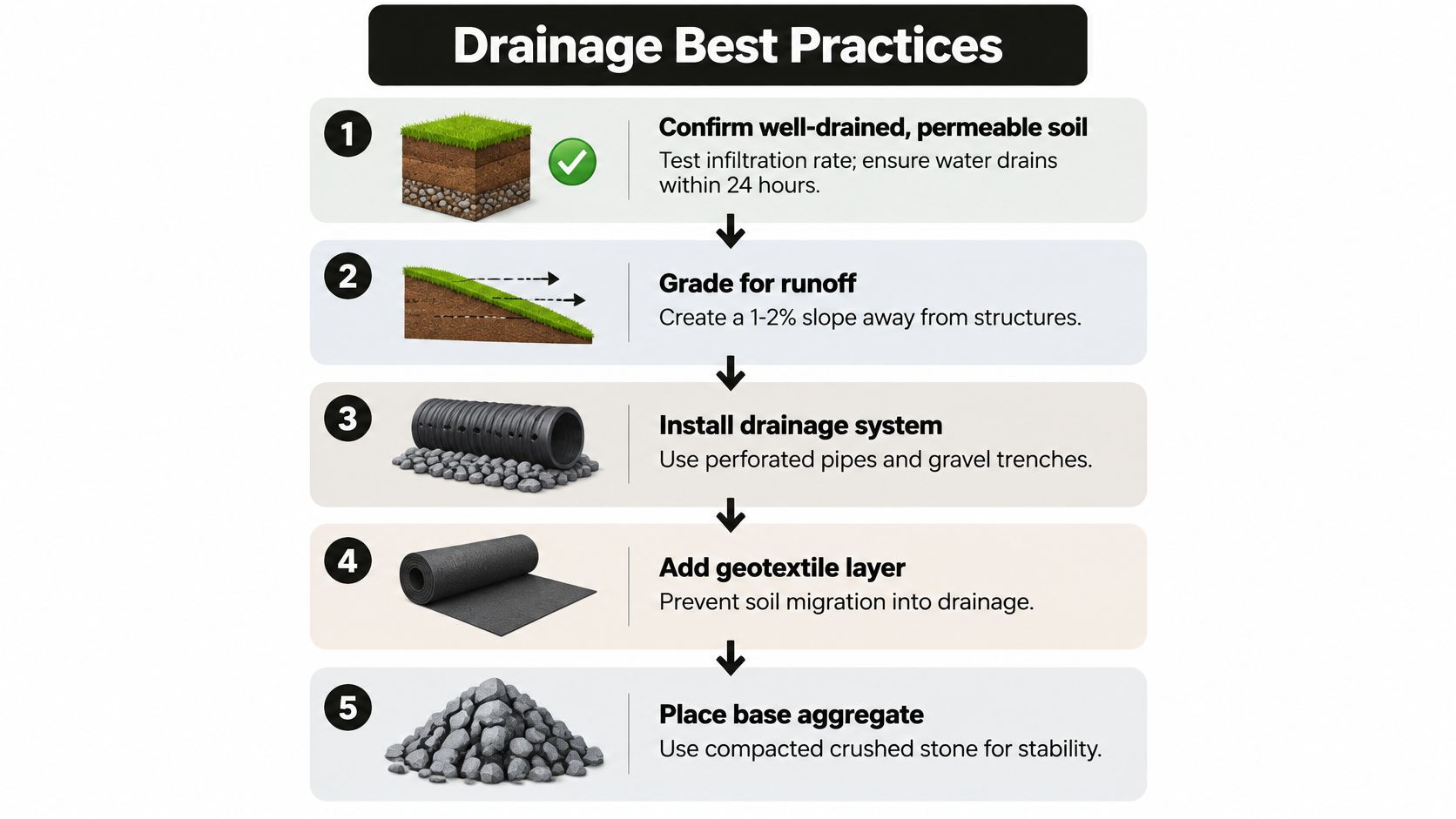
The stack runs bottom to top: subgrade, compacted permeable base, drainage layer, barrier fabric, surface. Here is the build order that keeps each layer doing its job.
The stack, bottom to top
- Confirm the subgrade drains. Dig a hole a foot deep in the middle of the proposed run, fill it with water, and check whether it empties overnight. Slow infiltration means water will sit under the surface no matter what you lay on top.
- Set a finished slope with a real fall. Guidance for public dog parks works from an approximate finished slope of 1.5% to 4.5%, and the MSI dog park best-practices bulletin notes that excessive slope and clay soils raise the risk of standing water, mud and faster surface deterioration. Too flat and water sits. Too steep and the surface migrates downhill.
- Identify clay and fix it. Clay-dominated subgrades need amending or partial replacement, because water sheets across them instead of entering. This is the step most low bids skip, and it's the one that shows up as a permanent mud patch in the low corner.
- Install a compacted, permeable aggregate base. Crusher fines and washed stone dust are common municipal choices for exactly this reason, and the base has to be graded and compacted in lifts rather than dumped and smoothed.
- Separate the layers with fabric. We recommend a weed barrier fabric between the sub-base and the turf so fines don't pump up into the surface and weeds don't push through from below.
- Restrain the edges. A curb, steel edge or buried restraint keeps aggregate from creeping into the lawn and keeps the surface plane intact. Without it, the run slowly spreads.
- Harden the gate zone. Entrance areas should use concrete or another hard, cleanable surface for safety, accessibility and waste control. Gates collect the most urine and the most foot traffic, so they take the most abuse.
Where the water plan goes wrong
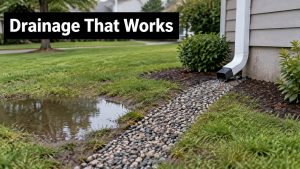
The most common failure is a run built on a slope that sheds water toward the gate and then stops, because nobody gave the water a destination. The second is a run built perfectly flat, which is the same problem spread across the whole yard.
Fix the grade before you buy the infill. No product on the market compensates for a low spot.
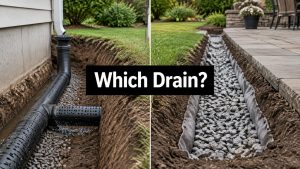
The depth and compaction of the aggregate layer carries the whole system, and the guide to synthetic grass base material covers layer thickness and compaction in more detail than a comparison table can. For shared installs where several households book time on one run, the access and scheduling side sits on top of these same build decisions, and managing a members-only dog run is a useful reference for how other groups have handled it.
The test after the first storm
Wait for the first heavy rain and walk the run while it's still wet, then again an hour later. Water should be moving toward the drain or the edge, not sitting in the middle. Any puddle, and especially any puddle at the gate, means the grade needs correcting before a single bag of infill goes down.
We build turf dog runs with proper drainage and a deodorizing infill precisely because the surface and the water plan have to be designed together. A surface that drains is a surface you can keep clean.
Durability Under Heavy Pet Traffic
Wear on a dog run comes from three directions at once: claws turning at speed, urine landing in the same spot every morning, and the surface flexing under a running start. Materials don't wear evenly across those three, which is why a product that looks tough in a sample book can fail in a season.
A municipal dog-park design evaluation settled on washed stone dust as its preferred surface because of minimal maintenance and high durability. That's the benchmark for a high-traffic run, and it's worth understanding why a plain aggregate beat more engineered options.
Where each material fails first
Synthetic turf tolerates heavy wear, and its failures are rarely the blades. They show up at seams that weren't bonded properly, at edges without restraint, and at infill that migrates out of the pile. The same evaluation is blunt about the trade: turf requires a subsurface drainage system plus irrigation or a hose connection to rinse accumulated urine and waste, and without that wash-down capability odor and sanitation become limiting factors.
Natural grass is the opposite problem. It wears to bare soil along the running line, the bare line becomes mud, and recovery needs rest that a daily-use run never gets.
Pea gravel and wood mulch both lose to movement. Aggregate migrates out of the run without a rigid edge, and mulch breaks down into fines that hold moisture and odor. The municipal evaluation is direct on mulch: it's less suitable for high-use runs because waste is harder to detect and remove, drainage is poorer, and the material tends to retain odors.
A durability checklist for comparing quotes
Copy these five lines into whatever quote you're reviewing and make the contractor answer each one in writing.
- Fiber and backing specification. Fiber type, denier and backing construction determine how the pile handles claws and how well it holds infill.
- Infill retention. Ask what stops infill from migrating and how much top-up is expected per year.
- Edge restraint type. Steel, aluminum or buried concrete, specified by product, not by description.
- Drainage layer and base depth. Depth in inches, aggregate type, compaction method.
- Replacement interval. A stated expectation in years, tied to your dog count.
Test durability against the heaviest dog's actual routine, not a showroom sample under a hand. A surface that survives a 30 pound dog napping on it tells you nothing about what happens when two Labradors sprint the fence line every evening.
Comfort and Surface Temperature in Hot Weather
Comfort is a material performance issue, not a finishing touch. A surface that's too hot to stand on doesn't get used, and a run a dog avoids in July is a run you paid for and don't get.
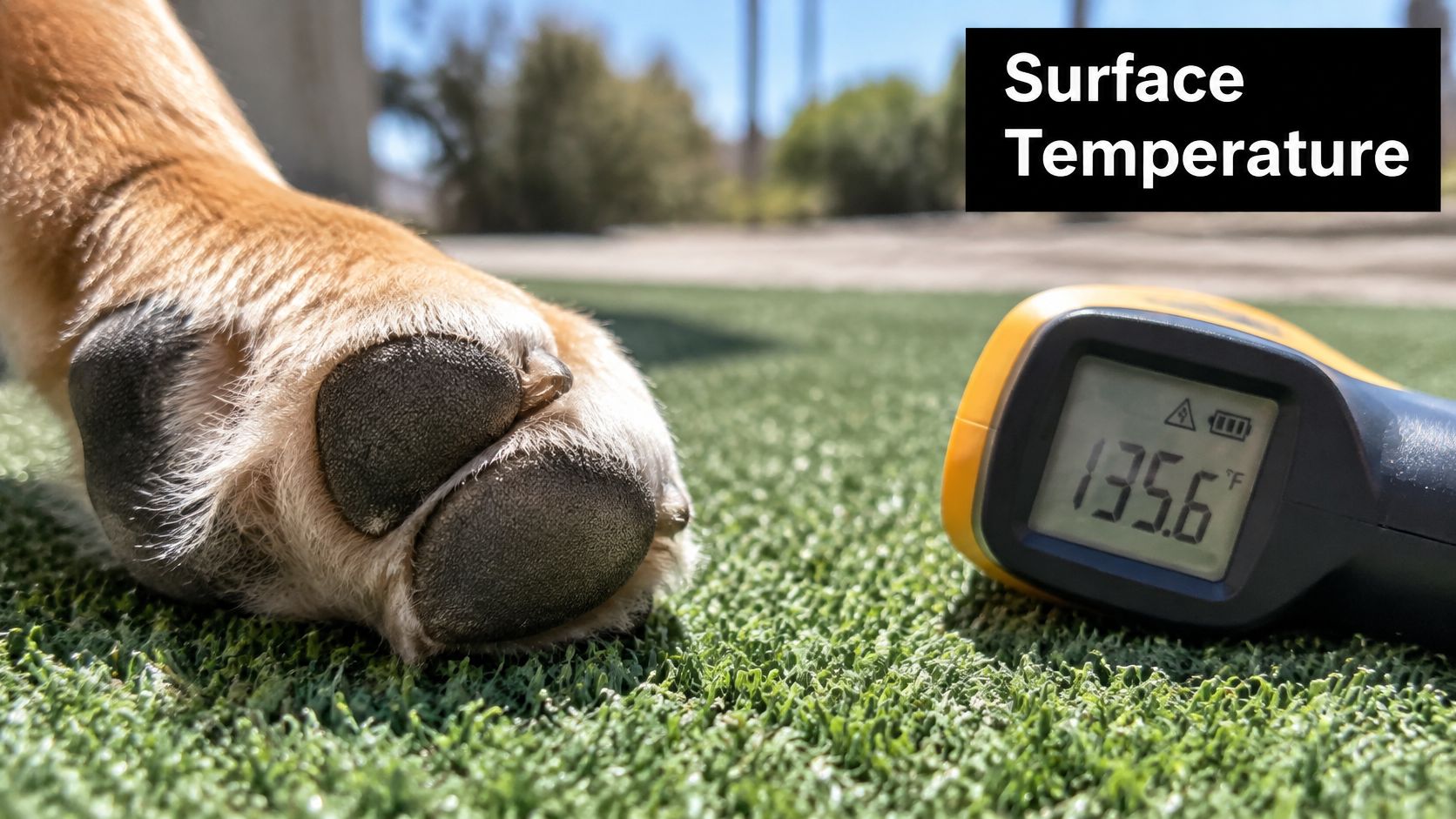
A 2026 controlled study put numbers on the gap. Over 10 structured play sessions with 10 dogs, artificial turf averaged 25.2°C (95% confidence interval 24.5 to 25.8°C) against 19.4°C for natural turf (95% confidence interval 18.7 to 20.1°C), and the artificial surface later stabilized at 20.0°C (95% confidence interval 19.3 to 20.6°C), according to the published comparison of artificial and natural turf for dogs. The stabilization matters as much as the average. Turf surface temperature moves with shade, moisture and time of day rather than sitting at one fixed number.
What moves a surface temperature
Six design variables do most of the work: surface color, fiber construction, subbase drainage, shade, irrigation or cooling strategy, and access to a cooler adjacent area such as lawn or a shaded patio. A light-colored fiber in open sun behaves differently from a dark one, and a base that drains well dries faster, which pulls heat down with it.
In Central Texas, a dark surface in full midday sun can be uncomfortable underfoot. That doesn't rule out turf. It argues for scheduling play in the mornings and evenings, planting or building shade over part of the run, and keeping water within reach. Our own approach favors heat-resistant, UV-stabilized turf for exactly this climate, and the heat-resistant artificial turf guide explains how fiber and color choices affect summer performance.
How to measure your own yard
Don't argue about brands on a forum. Measure.
Take a handheld infrared thermometer and read surface temperature on a sunny afternoon between two and four, at the same time of day, on each material you're considering. Read three spots per surface and take the middle number. Compare shade and full sun separately, because the shade number is the one your dog will live on.
The study involved only 10 dogs and cannot set a universal safety threshold or predict how every product will perform. Use it as a reason to test your own shortlist, not as a guarantee.
Cleaning, Odor and Parasite Risk on Each Surface
Cleaning depends on the whole dog-run system: surface, base, drainage, washdown access and maintenance. Soil and sand can retain canine intestinal parasite stages, so fecal contamination left in a shared, poorly maintained run can create a reservoir.
A 2020 study in Niš, Serbia, analyzed 200 soil samples and 50 sand samples from public parks. It found developing forms of endoparasites in 38% of samples from Park 1, 38% from Park 2, 46% from Park 3 and 20% from Park 4, according to the published survey of parasite contamination in public parks. For a backyard, the practical lesson is to choose a surface that makes waste easy to remove and maintain it consistently. Natural surfaces where contamination cannot be removed completely can retain eggs and larvae.
What each surface needs
Natural grass and soil need regular raking and prompt waste removal, especially under heavy use, plus periodic aeration. Waste that is left to break down enters the soil profile, where a rake cannot reach it.
Aggregate surfaces keep waste visible on the surface. On stone dust or crusher fines, sift and remove waste regularly with a scoop or rake head. Smaller aggregate is easier to sift, but still needs routine attention.
Synthetic turf is easiest to clean when the installation provides wash-down access and proper drainage. Hose it down occasionally, spot-treat high-traffic areas, and use pet-safe solutions for disinfecting and odor treatment rather than harsh chemicals. Modern Yard's turf cleaning service includes rinsing, disinfecting with pet-safe solutions and treating odors, with extra attention to dog runs and high-traffic spots. Its guide to cleaning artificial turf for dogs covers rinsing and cleaning routines.
Concrete is simple to hose and squeegee, but the surface still needs a drainage path so wash water does not collect in the run.
No material eliminates pathogens. The Niš study does not establish that artificial turf removes parasite risk, nor does it make a universal comparison among turf, soil and sand. Surface choice and maintenance both affect environmental hygiene, and neither replaces the other.
A routine that keeps odor down
Odor control comes from regular rinsing and waste removal. Rinsing urine before it concentrates helps keep odors from building up.
- Weekly: remove solid waste and hose the full surface. Give the gate zone an extra rinse if several dogs use the run.
- After playtime in multi-dog homes: Modern Yard team recommends a quick rinse for homes with multiple dogs or larger breeds.
- Monthly: disinfect turf with a pet-safe solution, sift aggregate, and turn or top up infill in traffic lanes.
- Seasonally: inspect seams, edges and the base for settlement, and clear debris from the drain or outlet.
For commercial turf, proper drainage, pet-friendly infill and occasional rinsing help control odor. At home, a suitable base and wash-down access matter as much as the surface itself.
If fleas and ticks are a concern, yard maintenance is only part of prevention. You can also compare flea preventives for dogs when considering protection options.
Pet Safety Claims to Verify Before You Buy
"Synthetic turf" is not one exposure category, and a pet-safe sticker doesn't tell you what's in the finished assembly. What a dog contacts is fiber, backing, infill, adhesives, edging and drainage layers together, and each of those is a separate question with a separate answer.
A municipal review notes that artificial-turf components may contain PFAS and that fibers or backing can shed microplastics into water. It also reports that PFAS has been detected across blades, infill and backing in as many as 76% of tested samples, while emphasizing that the evidence base remains limited, according to the City of Palo Alto turf study appendix.
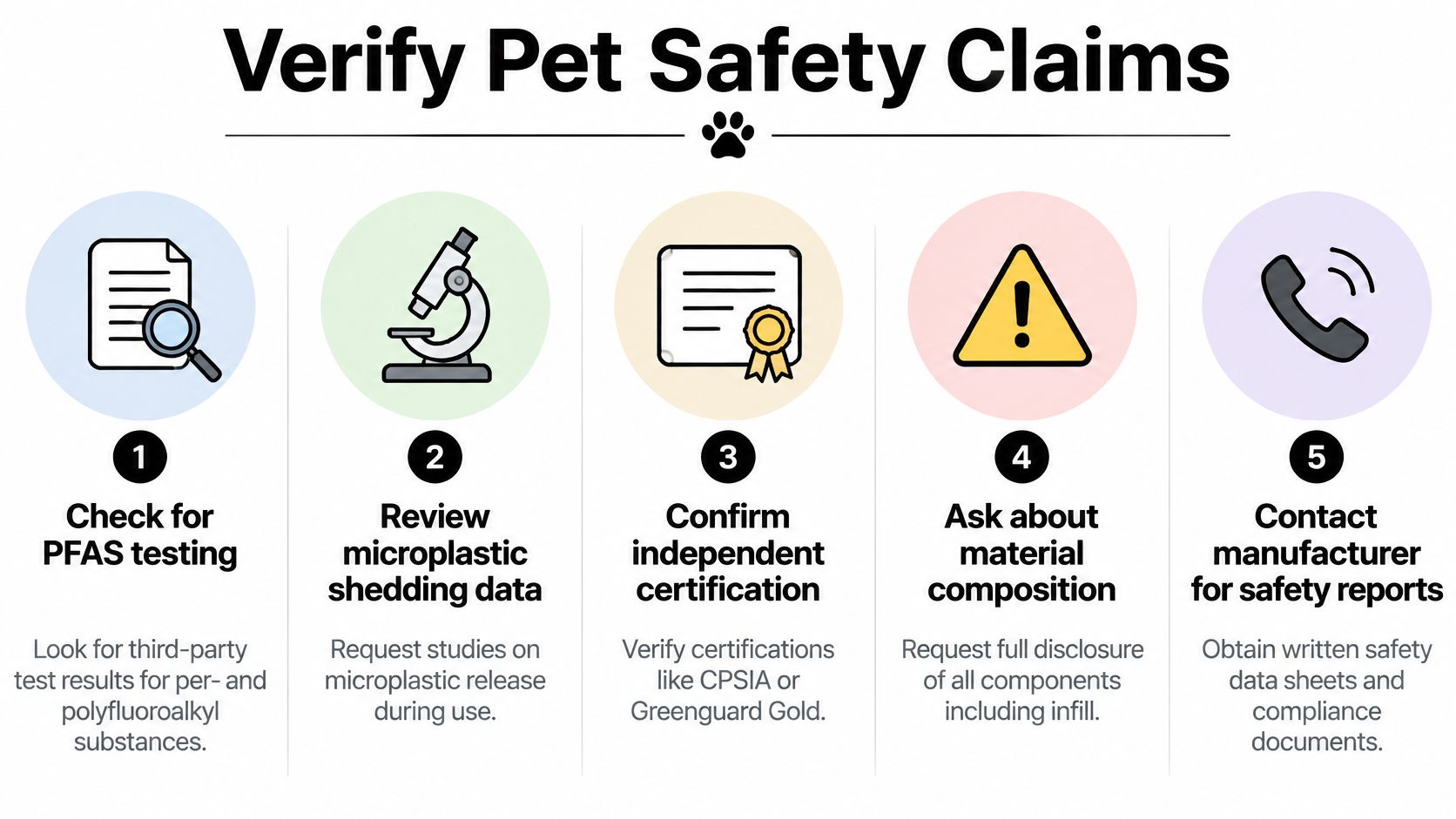
Separate the issues before you compare products
Public-sector memos treat these as four distinct questions rather than one generic safety claim: PFAS leaching, microplastic shedding, chemical or heavy-metal exposure from some infills, and heat-island effects. A product that answers one of those well can be weak on another.
Recycled tire crumb is the clearest example. It's a different exposure profile from a coated sand or an encapsulated infill, and the two shouldn't be judged by the same sentence.
Documents to request in writing
Bring this list to any quote conversation. A contractor who can produce these without deflecting is a contractor worth scheduling.
- Product-level composition for fiber, backing and infill, named by manufacturer and product line.
- Infill disclosure, stating whether recycled tire crumb is used and what alternative infill is offered.
- Antimicrobial additives, named and identified, if any are present, since antimicrobial treatments for pet turf are a common add-on that changes what the surface contains.
- Third-party test reports, with the specific compounds tested listed rather than summarized.
- Stormwater and migration plan, covering containment on site and how infill stays in the run.
- End-of-life disposal plan, because replacement is a real future cost with real rules.
No material is universally risk-free. Risk depends on the complete assembly, the climate, the drainage, the maintenance routine, and whether dogs ingest or track material into the house. Anyone promising otherwise is selling, not specifying.
Get these documents in writing before you sign anything. A verbal assurance about "pet-safe materials" is not a specification, and it isn't something you can compare against a second quote.
Matching the Material to Your Yard and Dogs
Four yard types cover most of the calls. Each one has a defensible answer, and none of them is the answer for the yard next door.
A small urban yard with clay soil and one dog
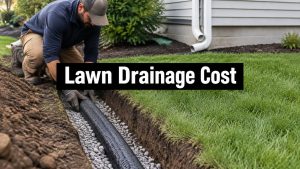
Clay is the deciding constraint, not the size of the dog. Amend or partially replace the subgrade, install a permeable base with a proper fall, and run drainage tile if the low corner has ever held water. Synthetic turf on that base gives a single dog a clean, small footprint that hoses off in five minutes. Confirm the subgrade infiltration test before you agree to anything.
A large sloped suburban lot with several dogs
Volume and slope point to washed stone dust or crusher fines with rigid edge restraint and a hard surface at the gate. Aggregate takes multiple dogs, drains well when graded, and lets you see what needs removing. Confirm the water has somewhere to go at the bottom of the slope instead of sheeting toward the house.
A shared commercial dog park with heavy traffic
Traffic at that scale needs a concrete entrance zone plus a durable running surface and a written wash-down plan. Turf can work here, but only with a subsurface drainage system and a hose or irrigation connection, because the surface has to be rinsed, not just scooped. Confirm who cleans, how often, and where the rinse water goes before opening day.
A hot lot with little shade
Heat, not material, runs this decision. Build shade over part of the run, add a cooler adjacent surface, and set operating hours for mornings and evenings. Turf plus shade plus water access performs well in Central Texas; turf in full sun with no shade is a surface your dog will avoid from noon to five.
Multi-dog homes and larger breeds raise the spec on both ends. More urine means more rinsing, and more running weight means a thicker, better-compacted base. Don't buy the small-dog package and hope.
The table gives you the quick scan. The base specification gives you the answer. Write down your two best options along with your drainage situation, budget, sun exposure and dog count, and bring that list to the next conversation.
Book a Site Assessment for Your Dog Run
A useful site assessment specifies the whole dog run system: surface, base, drainage, wash-down access and product composition. Bring practical details about the yard so the recommendation fits your dogs and site, not just a square-foot estimate.
What to bring to the appointment
- Dimensions and slope of the proposed run, even rough measurements.
- Soil type, such as clay or sand, based on a handful dug below the surface.
- Water behavior after heavy rain, including where it pools and where it drains away.
- Hours of direct sun, separating morning exposure from afternoon exposure.
- Dog count and size, plus how often and how long the run is used.
- Hose access, including whether a spigot is nearby or a connection would need to be added.
Ask the contractor to assess drainage and grading, then recommend a surface and base with reasons specific to your yard. Request a written estimate that separates material quality, area, labor complexity and any specialty features, such as shade or cooling.
Get the layer specification and drainage plan in writing. Ask for the turf's product composition and the third-party test reports identified in the safety checklist. For a turf dog run, confirm the drainage design and deodorizing infill, and establish how rinsing and pet-safe cleaning will fit the maintenance routine.
How to check a contractor's track record
Reviews can help you assess a contractor's work. BrightLocal's 2024 Local Consumer Review Survey surveyed a representative panel of 1,141 U.S. consumers. It found that 75% of consumers always or regularly read online reviews, and 59% believe a business should have between 20 and 99 reviews before they trust its average rating. Look for useful detail, not just stars. A review describing drainage after a storm says more about a dog run than a string of brief compliments.
Ask for honest, unedited feedback. The FTC consumer review rule prohibits buying or selling fake reviews, using reviews from people who did not experience the service, and tying compensation to positive sentiment. Ask neighbors with dog runs about their experience too. Photos a customer has authorized, showing a run after rain, can help you assess the finished work.
Modern Yard offers dog run design and installation, with proper drainage and deodorizing infill. Its turf dog runs are cleaned by rinsing, with pet-safe disinfection and odor treatment as needed. Call the Austin team to arrange a site assessment, and bring your drainage and product-disclosure questions so the visit can focus on the details that determine fit.