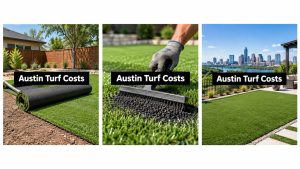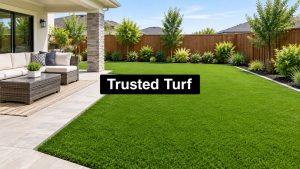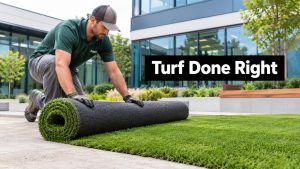

A lot of Austin homeowners start in the same place. The lawn is thin, the soil is hard, the sprinkler schedule keeps getting longer, and parts of the yard still turn brown or muddy depending on the week. By the time they look at artificial turf, most of their attention is on the grass itself. They compare color, blade shape, softness, and how natural it looks from the patio.
That's understandable, but it misses the part that decides whether the project holds up. Synthetic grass base material is what keeps turf flat, drains water, supports foot traffic, and prevents the headaches that show up after installation. If the base is wrong, the turf can look good on day one and still fail later.
Your Perfect Lawn Starts Beneath the Surface
One of the most common situations in Austin is a yard that seems impossible to keep balanced. One area dries out fast. Another stays soggy after rain. The side yard turns into a dog run and wears down. The backyard slopes just enough to move water toward the house instead of away from it.
That's usually when homeowners realize the yard problem isn't just a grass problem. It's a ground problem.

Why the base matters more than most people think
A turf system is only as good as the support under it. The blades are the finish surface. The base is the structure. If the structure moves, traps water, or settles unevenly, the lawn won't stay smooth no matter how good the turf product is.
That's not a new lesson in this industry. Synthetic grass systems have been improving for decades. The University of Delaware history of artificial turf notes that the first functioning synthetic-grass playing surface was developed in the mid-1950s, and the Houston Astrodome installation in 1966 gave the product major visibility. Turf evolved from early short-pile surfaces into more engineered systems because the industry learned that performance depends on the full build, not just the top layer.
Practical rule: If an installer talks mostly about blade color and barely discusses excavation, compaction, grading, and drainage, you're not hearing the important part of the job.
What homeowners usually regret
The expensive mistakes aren't subtle. They show up as low spots, puddles, lifted seams, spongy edges, and turf that feels unstable underfoot. In Austin, those problems often trace back to a generic install approach that ignores clay soil, hard rain, and heat.
A proper base does three jobs at once:
- Supports the surface: It carries foot traffic, furniture, pets, and daily use without shifting.
- Manages water: It gives water a path out instead of letting it sit under the turf.
- Protects the finish: It helps the seams stay tight and the grade stay even.
Homeowners usually call for turf because they want a clean, green yard with less work. That result starts below the surface, long before the grass roll goes down.
The Anatomy of a Flawless Turf Base
The easiest way to understand a turf base is to think about a house foundation. You don't pour a slab on loose ground and hope it stays level. A synthetic grass base material system works the same way. Each layer has a job, and when one layer is skipped or done poorly, the whole surface suffers.

Start with the native soil
Every project begins with the existing ground. Sometimes that means stable soil. Sometimes it means reactive clay, old roots, buried debris, or fill that was never compacted properly. Before any aggregate goes in, the subgrade has to be shaped and compacted to support what's above it.
That first step gets overlooked in budget installs. It shouldn't. If the subgrade is weak, the rest of the system has to fight movement from below.
The separation layer and aggregate base
After the native soil is prepared, many installations benefit from a geotextile fabric layer. Its role is simple but important. It helps separate the soil from the stone above, limits mixing between layers, and adds stability where the ground wants to move or pump fines upward.
Then comes the main aggregate base. This is the true working layer of the system. It provides structure and drainage at the same time. For most artificial turf installations, the Turf Network guide to sub-base materials says the sub-base depth is commonly recommended at about 3 to 4 inches, using compacted aggregate such as Decomposed Granite or Class II Road Base to help prevent settling or shifting over time.
If you want a closer look at the ground prep sequence, this guide on how to prepare ground for artificial turf walks through the sitework side of the project.
The turf itself doesn't fix grade problems. The base fixes grade problems.
What sits above the base
Once the aggregate is compacted and fine-tuned, the installer may add a leveling course, a shock pad for specific applications, or go straight to turf depending on the project. Then come the turf, seams, edge restraints, and infill.
A clean build usually looks like this:
- Compacted subgrade that holds shape
- Geotextile fabric where soil conditions call for separation
- Aggregate base layer for drainage and support
- Turf and infill to finish the system
Each layer should answer a question. How does water leave? What stops settlement? What protects the seams? If there isn't a clear answer, the base design isn't finished.
Comparing Common Synthetic Grass Base Materials
Austin installs fail for predictable reasons. A crew uses the same base material they use everywhere else, lays it over clay, gets one hard storm, and the yard starts holding water or developing soft spots. The turf on top gets blamed, but the problem started below it.
Base material has to match the job. Drainage demands, soil movement, traffic, and finish tolerance all matter. In Central Texas, that choice matters even more because some materials handle clay and flash rain far better than others.
Crushed limestone or open-graded rock
Crushed limestone and other open-graded stone are the first materials I consider when drainage is the pressure point. The void space between the stones gives water a path to move instead of trapping it in the base. On Austin properties with runoff from a slope, tight side yards, or heavy clay underneath, that can prevent a lot of callbacks.
The trade-off is finish control. Open stone does not fine grade as easily as a material with more fines, so it usually takes more care to get a clean, even surface before turf goes down. For a standard lawn, that is often manageable. For a short-pile putting surface, it usually is not the final answer by itself.
Decomposed granite
Decomposed granite is popular because it is easier to shape and smooth. Installers can dial in grade changes and surface finish with more precision, which is why DG shows up often in projects where appearance and surface consistency matter.
It also has limits.
DG can tighten up too much in the wrong setting, especially if the soil below already drains slowly. In Austin, that matters on clay-heavy lots where water already struggles to move downward. I use DG carefully, often as part of a layered approach rather than assuming it can solve every yard by itself.
Crusher run or dense road base blends
Crusher run and dense road base blends compact into a very firm platform. That firmness helps in general lawn areas, paths, and spots that need good structural support under foot traffic.
But the fines that help it lock together can also slow drainage. If the blend is too dense for the site, or the grade is even slightly off, water can linger in the base after one of Austin's fast storms. That is where homeowners get that spongy feel and start seeing low spots over time.
A quick comparison table
| Material | Key Characteristic | Best For | Austin-Specific Note |
|---|---|---|---|
| Crushed limestone or open-graded aggregate | Fast drainage and solid support | Yards with runoff, heavier traffic, or slower native soils | Often a safer choice where clay and stormwater put pressure on drainage |
| Decomposed granite | Easier fine grading and smoother finish | Putting surfaces, finish courses, selected residential lawns | Works best when drainage below it is already handled correctly |
| Crusher run or dense road base | Firm compaction and strong load support | General turf areas that need a stable platform | Can hold moisture if the fines content is too high for the site |
Base choice also needs to match the turf product above it. A putting green build and a pet lawn do not ask the same things from the sub-base. Homeowners comparing surface options can see how pile height and intended use affect the build in this guide to artificial grass types.
The right base material is the one that fits the yard, the use, and the water flow on that property.
What works and what fails
The jobs that hold up are designed from site conditions outward. The failures usually start with a stock material choice made before anybody studies runoff, soil behavior, or how the space will be used.
A flat backyard with decent drainage can accept a different build than a dog run along a fence line that stays wet after rain. A backyard practice green needs tighter grading than a play area. A full-sun yard in Austin also bakes harder and shows imperfections faster than a shaded corner.
That is why material choice comes after evaluation, not before.
The Austin-Specific Formula for Success
Generic turf advice breaks down fast in Central Texas. Austin yards deal with a rough combination of expansive clay soil, intense heat, and sudden heavy rain. Those conditions punish one-size-fits-all installs.
A base that looks acceptable in a mild climate can struggle here. Clay expands, contracts, and slows drainage. Heat hardens surfaces and exposes uneven grading. Fast storms test whether the base moves water or just stores it.

Clay changes the whole conversation
Many guides recommend a generic 2 to 4 inch base, but they rarely deal with what happens when expansive clay is part of the site conditions. This drainage and base discussion focused on artificial grass installs points out that expansive clay soils can require geotextile separation or subsurface drains to avoid common installation failures.
That matters in Austin because the problem usually isn't just depth. It's interaction. Clay below a base can hold water, shift with moisture swings, and contaminate the aggregate layer over time if the system isn't separated properly.
Heat and stormwater expose shortcuts
Heat doesn't just affect comfort. It also reveals weak prep. In summer, compacted areas and low spots become easier to notice because the surface response is inconsistent. Then a strong rain comes through and shows exactly where the water wants to go.
The right approach is to design the base around the site, not around a template. In practical terms, that often means looking closely at:
- Existing slope: Water has to leave the turf area predictably and away from structures.
- Soil behavior: Clay-heavy sections may need separation fabric and more drainage planning.
- Use pattern: Dog runs, side yards, and entertainment spaces don't stress the base the same way.
- Discharge path: It's not enough for water to move through the turf. It has to go somewhere.
If heat is part of your decision, this guide on heat-resistant artificial turf explains how surface choices and system design affect comfort in Austin conditions.
In Austin, “standard install” often means “standard problems later.”
Local judgment beats generic specs
Experience matters. Two yards on the same street can need different base strategies because grade, shade, runoff, irrigation, and subsoil vary more than people expect.
A good installer doesn't just quote turf and aggregate. They read the site. They look for water entry points, soft edges, buried construction debris, hardscape transitions, and where clay will cause movement. That local judgment is what keeps a clean-looking install from turning into a repair job after the first serious weather cycle.
Choosing Your Base for Pets and Putting Greens
Specialty turf projects fail when people treat them like ordinary lawns. A dog run and a backyard putting green ask for completely different things from the base.
For pets, drainage is the priority. For putting greens, precision is the priority. The synthetic grass base material should reflect that from the start.
Pet areas need drainage first
Base material choice directly affects long-term performance in pet applications. The base prep guide from Install Artificial notes that poor base selection can lead to compaction, rutting, and inadequate drainage of pet urine, which hurts hygiene and lifespan over time.
That lines up with what shows up in real yards. If liquid can't move through and away from the system efficiently, odors linger. If the base softens or ruts under repeated use, the surface gets uneven and harder to keep clean.
For pet turf, the decision usually comes down to a few practical questions:
- How fast can liquid exit the system
- Will the base stay stable under repeated traffic in the same lanes
- Does the design give rinse water a path out
For homeowners planning a dedicated dog area, this page on pet turf installation shows how the full system gets designed for cleanup and drainage.
Putting greens need consistency
A putting green is less forgiving than a standard lawn. Small imperfections matter. A little settling that might go unnoticed in a play area becomes obvious when a ball drifts off line.
That's why putting surfaces often benefit from a tighter, finer-finished base profile. The goal isn't maximum permeability at all costs. The goal is a stable, smooth plane that holds grade and supports a predictable roll.
A pet area can tolerate some texture. A putting green can't.
Same product category, different build logic
Homeowners sometimes ask whether one base recipe can handle everything. It can't, not if performance matters.
For pets, lean toward a drainage-driven build. For golf, lean toward a precision-driven build. For a general backyard lawn, balance both. The installer's job is to match the build to the use, not force every project into the same material stack just because it's faster to quote that way.
Why Professional Base Preparation Is Essential
A lot of turf projects in Austin look good on install day. Then August heat bakes the surface, a hard rain pushes water across the yard, and the first low spot starts to show. A few months later, seams look stressed, edges start to creep, and the turf feels uneven underfoot. The grass did not fail first. The base did.
DIY jobs and low-bid installs usually miss the same part of the work. They treat base prep like a quick gravel step instead of what it really is: soil work, drainage control, and compaction done in the right order for the site you have.

What professional prep actually covers
Good base work starts before stone goes down. The crew has to read the yard, identify how Austin clay will behave when it gets wet and then dries hard, and set grades that move water where it should go during a flash storm.
That means controlling excavation depth, correcting soft spots in the subgrade, compacting in lifts, protecting drainage paths, and making sure the finished surface stays true after the first season of heat and rain. On some properties, the biggest problem is expansion and contraction in clay. On others, it is runoff speed. A flat, generic recipe misses both.
Where cheap prep usually breaks down
The shortcuts are easy to spot once you know what to look for:
- Loose or uneven subgrade: The turf starts smooth, then settles in pockets.
- Base material that does not match the site: Water either stalls in the system or washes fines where they should not go.
- Weak perimeter restraint: Edges spread, shift, or lose their line.
- Poor finish grading: Water heads toward the house, patio, or fence instead of draining out properly.
In Central Texas, those mistakes show up fast. Clay holds water longer than installers expect, then hardens like concrete in dry weather. If the base is thin, poorly compacted, or built with the wrong aggregate, that cycle telegraphs right through the turf.
Why experienced installers matter
Homeowners are not hiring a pro just to save labor. They are paying for judgment. The installer should know when a yard needs deeper excavation, when a separator fabric helps, when drainage needs to be added before turf goes in, and when the quoted base plan is too light for the soil and traffic.
Modern Yard Landscapes installs artificial turf systems and related sitework such as drainage improvements. That kind of work matters because turf performance depends on more than the visible surface. A qualified installer should explain the subgrade condition, the base material choice, the compaction approach, and where the water goes after a heavy rain.
If a proposal gives plenty of detail about the turf product but stays vague on excavation, base depth, compaction, and drainage, stop and ask for specifics.
Repairs are expensive because the fix starts underneath. Turf has to come up, base material often has to come out, and the yard gets rebuilt twice. In Austin, professional base preparation is the minimum standard for a turf installation that stays level, drains correctly, and holds up through heat, clay movement, and flash floods.
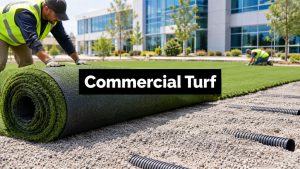
If you're planning turf for a lawn, dog run, commercial space, or putting green, the smartest first step is a site-specific evaluation. Modern Yard Solutions can inspect your soil, grade, drainage path, and use case, then recommend a base system that fits your property instead of forcing a generic template onto it. Schedule an appointment to get clear answers before the install starts.