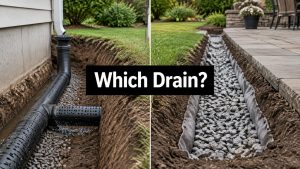

Almost every guide to wet yards says the same thing. A French drain is the cheap fix, drain tile is the expensive upgrade. That sentence has cost Austin homeowners more money than any other piece of landscaping advice, because it asks you to pick a price before you know which problem you have.
The two systems are built from the same parts. Perforated pipe, washed gravel, filter fabric, and a fall toward an outlet. What separates them is the job, and the job is decided by two facts about your lot: whether the soil can take water, and whether there's a lawful place for that water to go once it's collected.
What I ask on the first walk-through: where does this water end up when the ground is already soaked? If nobody can answer that, no trench should be dug yet.
Get those two answers and the choice mostly makes itself. Skip them and you'll pay for a trench that fills up in the first real storm and does nothing for the wall it was supposed to protect. What follows is the decision order that holds up on site.
Drain Tile vs French Drain Side by Side
Drain tile and French drains share materials, not missions. Drain tile is a buried perforated-pipe network that gathers water across a broad area and moves it to a defined outlet, and around a property it can pull the water table down. A French drain is a gravel trench that catches water before it reaches a foundation, walkway, retaining wall, or the low corner of the lawn.
The names blur because most modern French drains contain perforated drain tile. That's why the drain tile vs French drain question can't be settled on vocabulary. It's settled on function and placement.
For foundation-scale work, the hardware is already standard. Neutral building guidance calls for rigid 4 in. or 6 in. perforated pipe, at least 6 in. of clean gravel around the pipe, and a filter fabric layer separating the aggregate from native soil, as laid out in the BC Housing site and foundation drainage guide. Anyone quoting you a label instead of those numbers is quoting you nothing.
Drain tile vs French drain at a glance
| Criteria | Drain tile | French drain |
|---|---|---|
| Primary job | Carry collected water to an outlet | Intercept water before it reaches the protected area |
| Typical structure | Perforated pipe with connected laterals and mains | Gravel-filled trench, often with perforated pipe |
| Typical pipe size | 4 in. or 6 in. perforated pipe | Commonly 4 in. perforated pipe |
| Gravel envelope | Washed gravel, about 6 in. around the pipe | Gravel-filled trench around the pipe |
| Filter fabric | Wrapped around gravel and pipe where soil allows | Used only where soil silt content allows |
| Best site | Foundations, slabs, low points, broad wet areas | Wet edges, slopes, yard runoff, walls and turf borders |
| Outlet need | Positive grade to daylight, drywell, storm sewer or sump | Positive grade or pump to a defined outlet |
Those values describe residential, foundation-scale work, not the deep agricultural grid that drains farm fields.
One line settles the choice. If the water has to be carried somewhere, plan a pipe network to that outlet. If it has to be caught before it arrives, plan an interceptor trench.
Drain tile moves water out fast, which is why the ground above it dries instead of staying spongy. We install drain tile as a new system and we repair existing tile that's silted up or disconnected.
Matching the Drain to the Water Problem
The product name does not pick the drain. Austin clay over bedrock does, along with whether that soil can take water in and whether a lawful outlet exists downhill. If the clay will not infiltrate and no legal discharge point is there, a cheap gravel trench only stores water. Get a site assessment, with a soil check and a confirmed outlet, before anyone cuts a trench.
Water shows up in four ways. Match the drain to the pattern.
Water at the wall after storms. It seeps through a crawl space or basement wall, or pools against the block. Watch whether it enters at the seam between wall and footing and how long it stays. That is drain tile set beside the footing. The water arrives at that depth and has to be intercepted there.
Sheet flow across the yard. Water crosses the lawn, runs the driveway apron, and heads for a patio or garage slab. Watch where the flow concentrates. A French drain laid across that path catches the water while it is still moving.
Whole-lawn saturation. The entire turf footprint stays wet for days, not one corner. Agricultural tile sits 3 to 4 feet down, with 3, 4, or 5 inch laterals feeding larger mains that carry water to an outlet (University of Minnesota Extension). That is farm scale. On a wide residential lot the same principle holds: a network lowers a high water table in a way one trench never will.
One low corner. Standing water sits in a single dip. Look for a downhill outlet. If one exists and discharge there is allowed, run a trench to it. If it does not, stop. A trench with nowhere to go fails.
A drained field can send up to 63% of rainfall through the drainage system while overland flow drops 29% to 65% compared with undrained ground, according to the University of Minnesota Extension subsurface drainage guidance. Those are agricultural measurements, not a residential promise. They still show why a graded network beats one trench on a wide soggy lot.
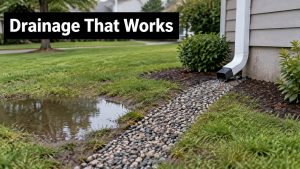
Shallow silty clay over bedrock percolates poorly. On that ground, use a pipe drain to a confirmed outlet, not a gravel-only trench that stays saturated and backs up. The site-fit table later in this article lines each Austin site up against the drain that belongs there.
Turf changes the math. The surface sheds rain quickly. The base and the surrounding clay decide where that water goes. Plan drainage around turf as part of the whole-site runoff path. Do not treat it as a standalone upgrade.
Many properties need both a perimeter interceptor and a pipe run to a real outlet. Modern Yard Landscapes installs drainage tile for soggy yards, standing water around foundations, and commercial property flooding. The yard drainage repair guide walks the same diagnosis in more detail.
Installation Specs That Decide Performance
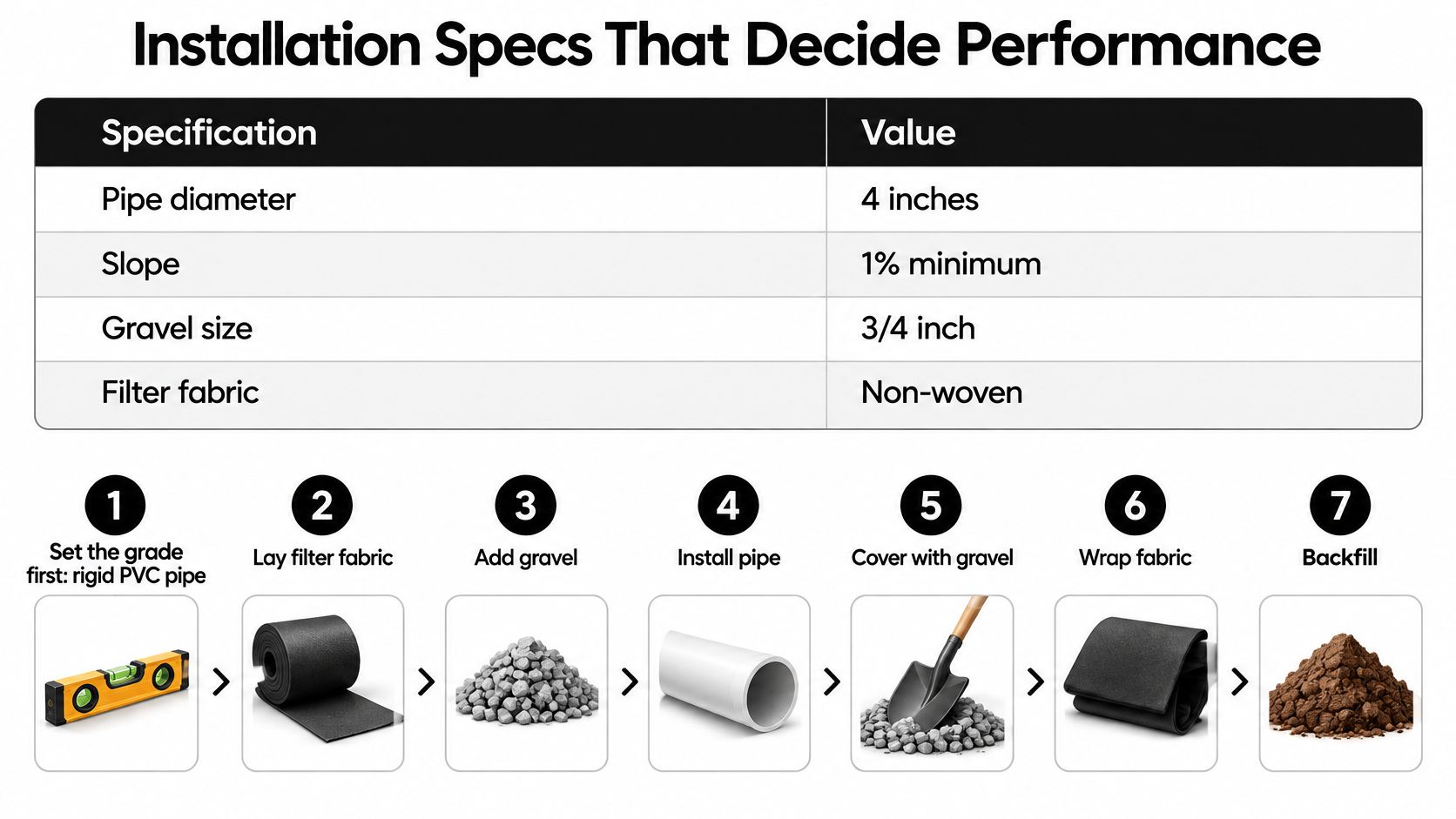
A drain fails on its build, never on its name. This is the part of a quote you can verify with a tape measure and a sample of the gravel.
Foundation-scale drain specifications
| Specification | Typical value | Why it matters |
|---|---|---|
| Pipe diameter | 4 in. typical, 6 in. for larger flows | Carries peak inflow without backing up |
| Minimum pipe slope | 1% for rigid perforated pipe | Keeps water moving toward the outlet |
| Trench size | About 16 in. wide by 16 in. deep for 4 in. pipe | Leaves room for protective gravel |
| Gravel | Washed 1/2 to 3/4 in., free of fines | Prevents silt from clogging perforations |
| Gravel cover | About 6 in. above and at least 2 in. below pipe | Protects pipe and allows water entry |
| Filter fabric | Wrapped around gravel and pipe | Stops soil migration into the drain |
This flow chart shows the sequence a crew should follow on any footing or trench drain.
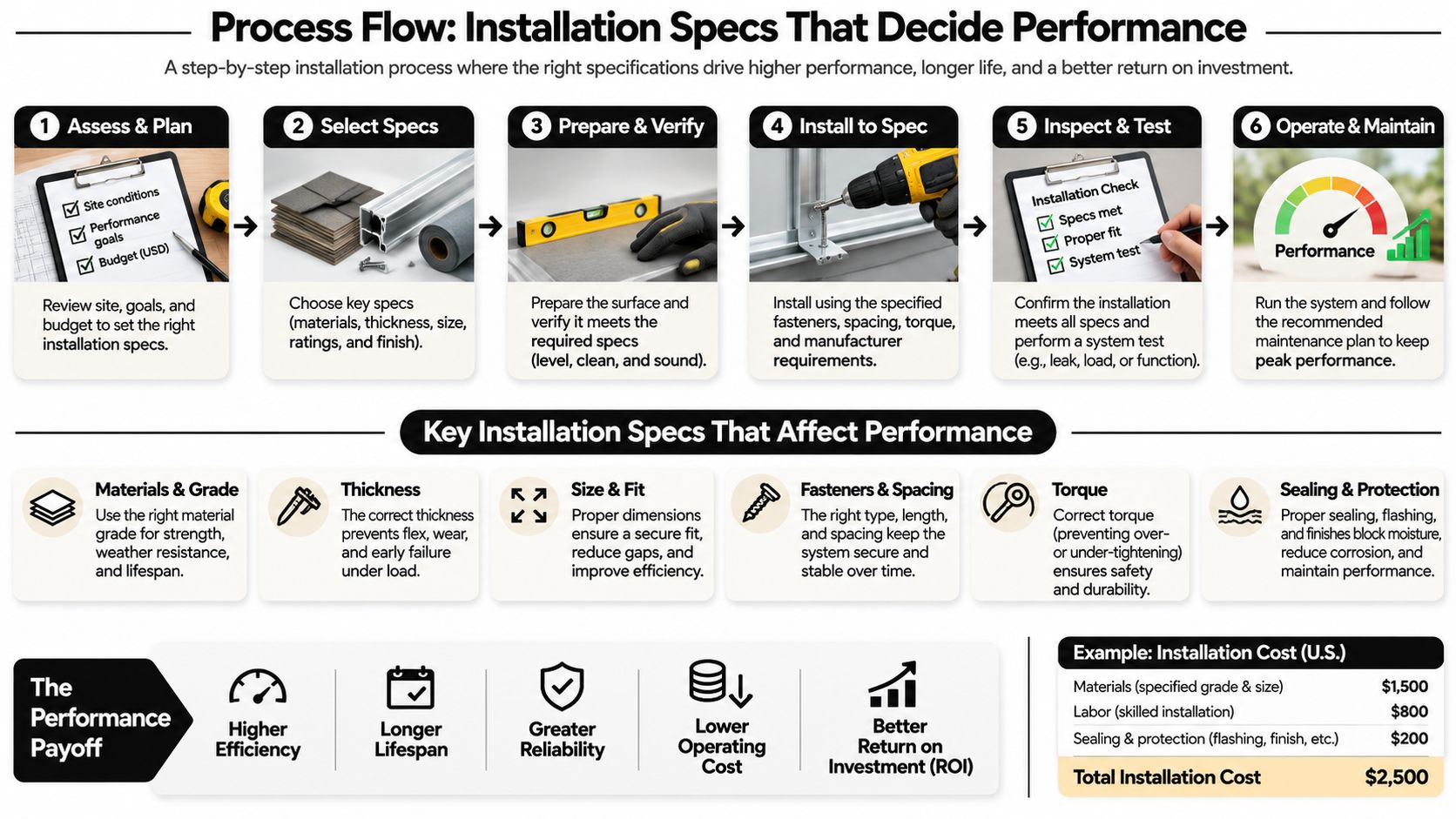
The build sequence and what skipping a step costs
- Set the fall before any digging is finished. The pipe needs a continuous drop to the outlet with no sag between stakes, perforations facing down, and the outlet elevation confirmed first. Skip it and the line becomes a holding tank that silts solid within a season.
- Excavate to real dimensions. For a typical 4 in. pipe, that means a trench about 16 in. wide and 16 in. deep. A tight trench starves the pipe of water entry on both sides.
- Bed it in washed stone. At least 6 in. of 1/2- to 3/4-inch washed gravel above a standard 4 in. footing-drain pipe and at least 2 in. below it, per the Building America Solution Center. Fines are the enemy here, because silt and sand work into the perforations and cut flow.
- Wrap the fabric only where the soil allows. Filter fabric around the gravel and pipe limits soil migration, but a fabric chosen without looking at the ground can seal the trench instead of protecting it.
- Switch to solid pipe at the discharge. The perforated section should end before the outlet so collected water isn't reabsorbed in the last few feet.
- Prove the outlet under load. Run a hose wide open into the top of the run and watch the discharge. If it ponds at the exit during a test, it will fail during a storm.
The consequences stack. A sag traps water and turns the gravel into a settling basin. A missing fabric lets fines bridge the openings. An undersized outlet turns the whole network into a slow-release reservoir that saturates the turf above it.
We prepare a professional sub-base that ensures rapid drainage even during heavy rains in Austin, Round Rock, or Georgetown, and proper turf work depends on the same discipline: soil preparation and compaction, precise grading for drainage, and proper perimeter securing. If you want the installation method in full, the drain tile system installation page covers it.
Testing the Outlet
A product name does not pick the drain. The soil either accepts water or it does not, and a lawful outlet either exists or it does not. Price the trench only after both answers are on paper.
Austin profiles often show 15 to 36 inches of silty clay followed by bedrock, which sharply limits percolation and leaves an infiltration-style gravel trench saturated and backing up in a storm, as documented in the City of Austin flood study appendix. Dig a hole in the wettest part of the yard, fill it, and watch it. If the water is still sitting hours later, that gravel trench is a bathtub.
Three more checks finish the call. A low slab or low footing sets the depth where water has to be intercepted. Shallow rock caps how deep the pipe can run and forces the grade. Daylight, a storm connection, a drywell, or a pump has to be a real discharge point before work starts. Skip that site assessment and the bid is a guess.
The outlet test: if you cannot name the exact point where the water leaves the property, you do not have a drainage plan. You have a hole.
Austin design storms can deliver several inches in a day, so a sump or engineered overflow belongs in the plan from the start.
Placement is as strict as capacity on foundation work. The U.S. Department of Energy specifies a typical 4 inch pipe and warns it should sit beside the footing, not on top of it, because water collects at the seam between wall and footing and wicks into the structure from there (Building America).
Which drain fits which Austin site
| Site scenario | Better fit | Why |
|---|---|---|
| Water seeps against a foundation wall after storms | Drain tile placed beside the footing | Intercepts groundwater at the depth it arrives |
| Runoff crosses the yard toward a patio or retaining wall | French drain interceptor across the flow path | Catches water in transit before it pools |
| Whole lawn or turf stays soggy for days | Subsurface drain-tile network with grading | Pulls the water table down across the lot |
| Shallow silty clay over bedrock, poor percolation | Pipe drain to a confirmed outlet, not a gravel-only trench | A gravel trench can stay saturated and back up |
| Dog run turf turns to mud after rain | Turf with drainage base and perimeter trench | Water leaves the run instead of pooling |
| Commercial lot with recurring flooding | Combined system with engineered outlet | Manages the full runoff path, not one corner |
Surface cover still needs that outlet. Residential synthetic turf is permeable enough to handle heavy Texas downpours, and dog run turf with proper drainage eliminates puddles and mud. A Hyde Park couple tired of a muddy backyard after every rain had a turf dog run with proper drainage built. The yard stayed usable because the base and the discharge were designed together.
What Actually Drives the Cost Difference
The cheapest-looking trench is usually the most expensive thing on the property. Not because the materials are bad, but because a low bid usually trims the outlet, the gravel volume, or the grade, and you pay for all three later when the system has to be opened up and rebuilt.
Quotes differ on scope, not on product pedigree. Compare these seven line items side by side and the numbers start making sense.
- Trench length and depth, which sets excavation hours and haul-off.
- Number of laterals and mains, because a network with branches costs more than one straight run.
- Pipe diameter, since a 6 in. main moves more water than a 4 in. line and prices accordingly.
- Washed gravel and fabric volume, the material that makes up a large share of a proper install.
- Excavation access, because a tight side yard with a fence and mature shrubs takes longer than an open lot.
- Turf or landscaping removal and replacement, including base rebuild if the trench crosses a turf area.
- The outlet itself, whether daylight, drywell, storm connection, sump, or pump.
That seventh item is where the outlet test from earlier pays off. A site with a legal gravity outlet supports a modest budget. A site with nowhere to send water needs an engineered discharge route before anyone can price the drain.
Hydraulic performance depends far more on grade, filter compatibility, and outlet capacity than on whether the invoice says French drain or drain tile. NRCS drainage standards require sizing subsurface conduits with Manning's equation, designing the system to flow without internal pressure, and specifying filter or envelope material that blocks soil migration while still letting water in, with a minimum 1% pipe slope for rigid perforated PVC and perforations facing down (USDA NRCS subsurface drain standard). A cheap trench that can't hold grade toward a working outlet is money spent twice.
Ask any contractor four things: what outlet is planned, what pipe size and gravel are specified, how the fabric was chosen for this soil, and what the warranty covers. Vague answers on any of the four are your signal to keep calling.
A French drain is often the right lower-scope fix for one wet edge. A drain-tile network costs more up front and covers a larger saturated area. Neither is a bargain if it's the wrong one. You can compare drainage tile installation costs by scope rather than by guesswork, and our free drainage tile consultation prices your actual lot instead of a label.
Maintenance and Failure Points That Shorten Lifespan
The filter is where most drains die, and it's the detail almost nobody asks about. A New York State subsurface drainage specification requires continuous perforated pipe to be enclosed in fabric-type filter material, but states plainly that fabric should not be used where the surrounding soil's silt fraction is 40% or greater (New York State drainage specification). Where fabric is used, it has to completely encase the conduit and cover the openings with at least 3 inches of filter material.
That single rule explains a lot of failed drains in fine-grained ground. The same fabric and stone package gets installed on every property, and on silty soil it either clogs the pipe or lets fines straight through.
A question worth asking any installer: what soil did you observe here, and why is this filter compatible with it? If the answer is that it's the fabric they always use, that's your answer.
Five failure points to watch, each with its own check.
- Fines in the gravel envelope. After a storm, look at the discharge. Muddy water means soil is migrating into the drain.
- Clogged inlets and perforations. Clear surface inlets and grates each season, especially under trees.
- Blocked or submerged outlets. Confirm the outlet still runs after heavy rain. A submerged outlet backs water up the entire line.
- Sags or reversed grade. Re-inspect after any nearby construction, grading, or retaining wall work, since new grades change how the pipe drains.
- Storms beyond design capacity. Plan an overflow path so extreme rain has somewhere to go other than the slab.
Existing systems are often repairable rather than replaceable. We take on both new drainage tile installation and repairs to existing drainage tile, and if you're sorting out symptoms first, this guide to common lawn drainage problems helps you describe what you're seeing. On commercial sites with pet traffic, we also recommend proper drainage, pet-friendly infill, and occasional rinsing to keep odor down.
Confirm the Right Drain Before You Commit
Austin clay over bedrock decides the drain, and so does one yes-or-no: does a lawful outlet exist? The product name on the trench does not.
Walk the yard and sort the water before anyone prices a ditch.
Water against a wall, or seepage into a crawl space, calls for drain tile beside the footing, set at the depth the water arrives. Surface runoff crossing the yard, driveway, or patio calls for a French drain interceptor laid across the flow path. Widespread saturation, or symptoms you cannot pin to one spot, means stop. Guessing the trench is the expensive route. Get a site assessment before any trench is dug.
A French drain only performs if the soil can take water in and the pipe has a legal place to discharge. Clay sitting on rock often cannot infiltrate fast enough for a gravel trench to make the water vanish. No downhill outlet means no working system. Dumping flow onto a neighbor, or into a storm inlet you have no right to use, is not a design.
Bring five facts to that visit. Where the water first appears. How long it lingers after rain. Whether a downhill outlet exists. What was repaired before, and whether it held. Which service you think you need. Those details shorten the visit and sharpen the recommendation.
Drainage also fits beside other yard work. When a turf install, retaining wall, or hardscape is already going in, grading and drainage can be one job. Reopening finished ground a year later costs more.
The gain is water leaving the property before damage starts, not a dry patch you patch again every spring.
Modern Yard Landscapes offers a free drainage tile consultation in Austin for a new drainage tile installation or a repair to existing drainage tile. Book a visit, bring that list, and say where the water shows up first at Modern Yard Landscapes.