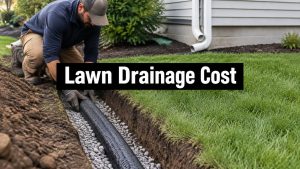

Most lawn drainage systems cost between $500 and $13,000, and the 2024 national average is $3,570. That band is wide because a short surface fix and a buried collector are not the same job.
The gap is the wet run, the soil under it, and where the water is allowed to leave. Two Austin lawns can look the same size and still deserve very different bids. A lump sum hides that. An itemized sheet does not. Pace each soggy stretch in feet, note the low point, and you already have the numbers a fair quote has to match.
Typical Lawn Drainage System Costs at a Glance
Forbes Home put the 2024 national average for a yard drainage-system installation at $3,570, inside a reported span of $500 to $13,000. Use that pair as a sanity check, not a contract price. The useful number is the unit rate, because you can multiply it by a tape measure.
Angi publishes these national ranges. Yard size, run length, problem spots, materials, access, soil, slope, and labor all move the total.
| System | Typical cost | Billed per | Best fit |
|---|---|---|---|
| Swale | $5 to $15 | linear foot | Gentle grade changes on open lawn |
| Surface drain | $10 to $40 | linear foot | Sheet runoff across flat areas |
| French drain | $20 to $50 | linear foot | Subsurface collector for soggy lawns |
| Trench drain | $30 to $70 | linear foot | Runoff at hardscape edges and driveways |
| Dry well | $300 to $1,000 | unit | One concentrated low spot |
| Catch basin | $50 to $200 | unit | Collection point at a low grade |
| Site preparation | $300 to $1,000 | project | Grading, debris removal and utility marking |
A swale is a shallow grassed channel. It suits a gentle regrade on open lawn where water already wants to move. A surface drain catches sheet flow on a flat pad. A French drain is the subsurface collector for a soggy run. A trench drain sits at a driveway or patio edge where hardscape dumps water in a line. A dry well handles one low pocket. A catch basin is the box at the low grade. Site preparation covers grading, debris removal, and marking utilities before anyone cuts a trench.
Why the unit rate beats a lump sum
Multiply your own footage and you can see whether a bid is in the neighborhood. A single total hides labor, gravel, and the outlet. The $20 to $50 French-drain band in this table is Angi's broader national figure. A tighter professional benchmark of $15 to $30 per linear foot shows up in the run-length math below. Expect those two bands to overlap, not match dollar for dollar.
Walk the yard after a rain. Mark the wet spots and the low point, measure each wet run, and bring those feet to a consultation. Modern Yard installs drainage tile for soggy yards, standing water around foundations, and commercial property flooding.
What Drives the Price and How Run Length Sets It
Same lawn size, different quote. The price follows the measured run, not the lot square footage. Measure the wet path in feet before you listen to a total.
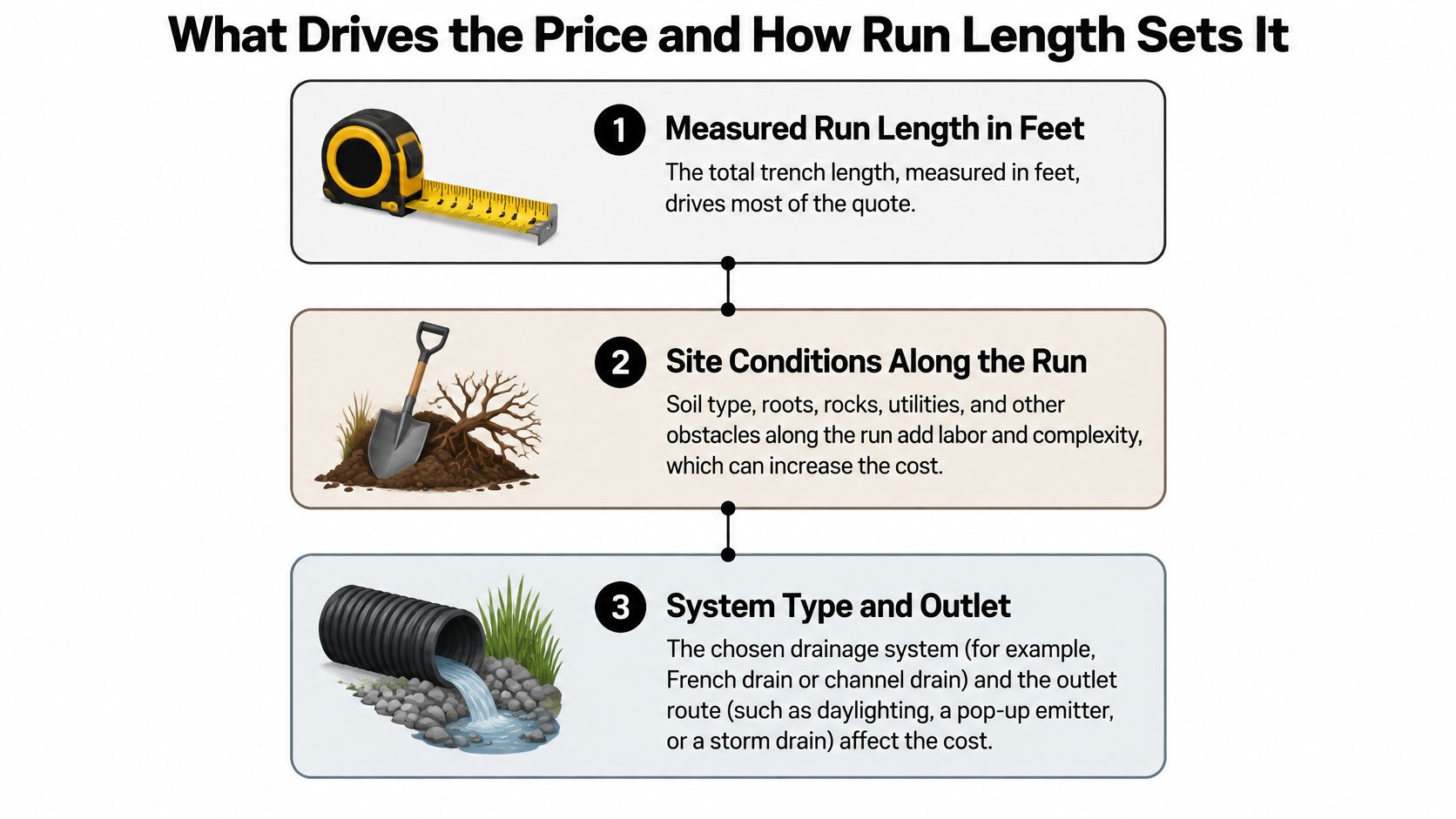
Homes & Gardens puts professional French-drain installation at about $15 to $30 per linear foot. A 100-foot system therefore plans at about $1,500 to $3,000 before unusual excavation, access, disposal, restoration, or permits. Treat that as a planning band for Austin, not a fixed bid. Rock, tight equipment access, steep grades, ties into existing drainage, and lawn or hardscape repair can push it up.
Planning ranges you can check
| Run length | Planning range | Basis |
|---|---|---|
| 50 feet | $750 to $1,500 | $15 to $30 per linear foot |
| 100 feet | $1,500 to $3,000 | $15 to $30 per linear foot |
| 150 feet | $2,250 to $4,500 | $15 to $30 per linear foot |
| 200 feet | $3,000 to $6,000 | $15 to $30 per linear foot |
Those cells are straight multiplication. They do not include a pump, a permit, or putting the lawn back.
Materials are the cheap part
Basic materials sit far under the installed price. Perforated PVC pipe runs about $3 to $5 per foot, filter fabric about $1 per square foot, gravel about $25 to $45 per ton, and catch basins roughly $25 to $50 each. On a 100-foot run the pipe itself might be a few hundred dollars. You are not buying a coil of pipe. You are buying the trench.
The gap is labor, excavation, grading, equipment, hauling, and surface replacement. A separate estimate for labor-heavy residential French-drain work lands around $3,000 to $5,000, and it still moves with length, site conditions, and how many days the crew is on the property. Where a permit is required, reported costs are commonly about $100 to $500.
Three tiers that change the bid
Primary drivers are run length and trench depth. Longer and deeper means more spoil, more gravel, and more time. Depth also has to hold fall all the way to daylight or a storm line.
Access factors are what stop a machine. Dense clay or rock, a narrow gate that forces hand digging, and poor fall at the outlet that needs a pump all sit here. Say you need 120 feet of French drain across a clay backyard, and the only way in is a 4-foot side gate. Hand digging that run can cost far more than the same footage in an open field a skid steer can cross.
Add-ons are buried utilities to work around, turf, concrete, or pavers to restore, and that permit line. A transparent estimate splits linear-foot installation, catch basins, discharge points, permits, excavation difficulty, and restoration. If those sit in one number, you cannot test it.
Practical rule: Measure each wet run, multiply by $15 to $30 as a planning figure, then list which access and restoration factors apply before you call.
Our drainage systems redirect water away from the property before problems start. Drainage tile helps that water move out quickly so the turf dries fast. The quote should show the feet, the outlet, and the restoration, or it is not ready to sign.
How Soil and Groundwater Decide the Design
Pricing a drain from the lawn outline is a guess. The soil's intake rate picks the system, and square footage does not.
University of Texas design criteria treat about 0.20 inches per hour as a generally accepted clay-soil infiltration rate. They also require at least 12 inches of separation between an infiltration facility and the seasonally high groundwater level or the capillary fringe. A dry well drawn on a clay lot that cannot meet that separation is not a design. It is a hole that fills.
When the design has to change
UT guidance calls for underdrains where infiltration is below 0.5 inches per hour. Typical specs are 4- to 6-inch perforated pipe, openings of 1/4 to 1/2 inch spaced 6 inches on center, at least 2 inches of gravel cover, and a minimum pipe slope of 0.5%. That slope is not optional. Without it, the pipe stores water instead of moving it.
Austin-area clay often cannot take runoff fast enough for a simple dry well or a French drain that dead-ends in the yard. The design then shifts to a perforated collector tied to a positive outlet, an underdrain, or stormwater conveyance. That switch adds excavation, aggregate, outlet piping, cleanouts, geotextile, permitting, and sometimes a pump or erosion control. Those lines are why a "small soggy spot" quote jumps.
Say a Round Rock yard stays soggy two days after rain. Clay at 0.20 inches per hour will not empty that water on its own. Nobody should price it until there is an outlet with real fall, or a pump if fall does not exist. Turf, concrete, a foundation, or a retaining wall can also block the grade the pipe needs.
Ask whether the estimate includes an infiltration test and a named outlet route, and whether the design states how deep the groundwater check went.
A usable bid separates testing and design, trenching and site restoration, drainage components, and outlet work. If your lot is the heavy-clay case, start with clay soil drainage improvement before you accept a per-foot number that assumes the ground will drink.
Austin Rules and Easements That Add to the Budget
In Austin you cannot solve a wet lawn by shoving water onto the next lot or into a creek. Post-development runoff is not allowed to add flooding to waterways or storm drains, and that rule shows up as line items.
City guidance, in the Austin drainage criteria, requires on-site control of the two-year storm under Section 25-7-61. Peak runoff leaving a drainage area in the developed condition cannot exceed the existing-condition rate. The city also regulates the two-, ten-, 25-, and 100-year storms. Peak flows have to stay inside allowable levels through on-site storage, off-site storage, or an approved regional program. A pipe that only relocates the peak does not meet that test.
What an easement does to the price
Drainage easements may hold pipes, ponds, or ditches. Buildings, fences, and pools are generally not allowed inside them. You typically keep the easement clear of debris and obstructions. That is a design limit and a maintenance duty, not a free discharge corridor.
Budget lines this creates:
- Survey or design review: someone has to show the developed peak does not exceed the existing rate.
- Easement limits: the trench may have to stop short of the easement line.
- Discharge strategy: daylight, a storm tie-in, or storage, each with its own fittings.
- Grading: the yard has to deliver water to the inlet without creating a new low spot.
- Permitting: separate from the pipe price when the city requires it.
A lot that backs onto a creek easement is the clear case. The discharge may need a route that stays out of the easement, plus an engineer's review, before a crew should dig. Pipe and labor can match the neighbor's bid and the totals still will not, because one lot carries that review and the other does not.
We install a professional sub-base that keeps drainage moving in heavy rain across Austin, Round Rock, and Georgetown. That base work belongs on the same sheet as grading and discharge, not as a surprise after mobilization. Ask whether your lot has an easement, and whether survey, design review, and permit work are inside the price or written as their own lines. For the bigger picture of where yard water is supposed to go, see what stormwater management covers.
How to Check an Estimate Line by Line
A fair sheet names every line, states quantities, and adds up. If you cannot rebuild the total from the lines, do not sign it.
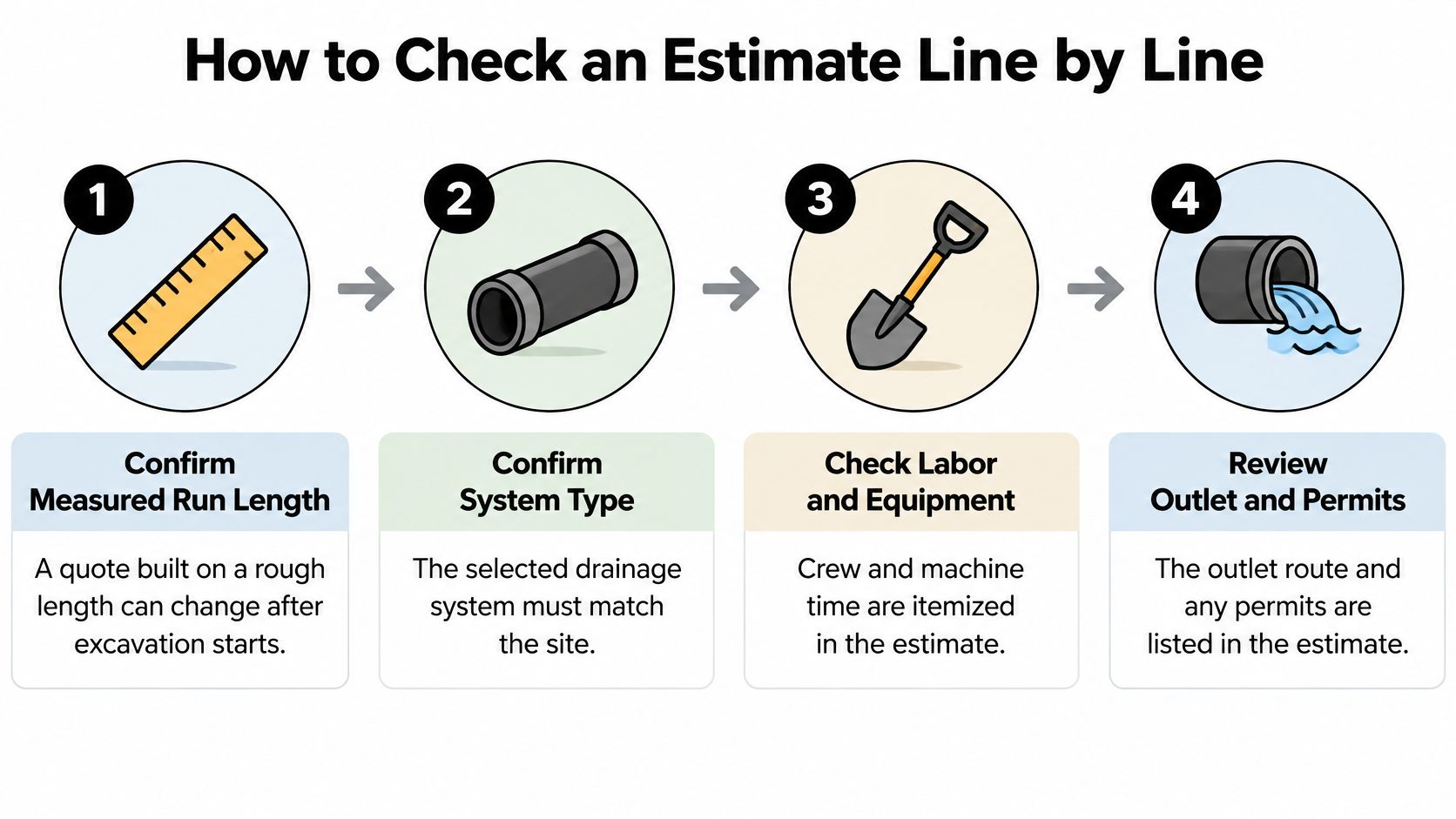
- Confirm the measured run length. Total trench length drives most of the price. A quote built on a paced guess changes once the crew hits the actual path. The common miss is a round number with no start and end stakes.
- Confirm the system type for each zone. A French drain on the wet run and a catch basin at the low point are different lines. Mixing them under "drainage" hides which piece costs what. Ask which zone gets which system.
- Check the outlet and discharge route. This is the line most often missing. The quote should name a positive outlet, and a pump if the fall is poor. "Drain to daylight" without a location is not an outlet.
- Ask how excavation difficulty is priced. Rock, hand digging, and a narrow gate can cost more than the pipe. If those conditions are real on your lot and the bid assumes machine access, the change order arrives after the first day.
- Confirm permits and easement review as their own lines. Do not let them vanish into "misc." If the city or an easement is in play, the sheet should say who pulls the permit and who pays the reviewer.
- Verify site preparation. Grading, debris removal, and utility marking belong on the bid before trench day. Skipping the locate is how a drainage job becomes a utility repair.
- Check surface restoration and contingency. Turf, concrete, and pavers are not free to put back. A contingency line is honest. A bid with zero allowance for unexpected rock is optimistic, not cheap.
What "clear" looks like
Each line has a name and a quantity. Feet of pipe, tons of gravel, count of basins, hours or a stated method for hand dig, and a restoration unit. The total is the sum. If a number appears that no line explains, ask for the line.
Add a maintenance line too. Ask who clears the outlet and the catch basins, how often that should happen, and whether that visit is priced separately. A blocked outlet is a common reason the yard pools again six months later. We help you choose a lawn solution from your budget, how you use the yard, and what has to stay dry, which is the same conversation as yard drainage system installation.
Book Your Free Drainage Consultation in Austin
A fair lawn drainage system cost needs a site visit. Soil intake, gate width, and the outlet route cannot be confirmed from a photo or a lot size, and each one changes the price.
On site, the crew measures the wet run, checks the soil, looks at how equipment gets in, and plans where water leaves the property. The estimate then rests on those conditions instead of a national average stretched over your address. That is the difference between a number you can audit line by line and a number that moves after the first shovel.

Get the guarantee in writing
Federal Trade Commission guidance says a seller should use "satisfaction guarantee," "money-back guarantee," or similar wording only when it refunds the full purchase price on request, unless clearly stated material limits apply. Copies of the warranty or guarantee should be available before the sale, and the seller has to perform. Ask for those terms before you sign, not after the first rain.
Separate three promises, because the limits differ:
- Workmanship warranty: covers how the trench, pipe, and grade were built, for a stated period.
- Materials warranty: covers the pipe, fabric, and basins, often on the manufacturer's clock, not the crew's.
- Performance promise: says what the yard should do in ordinary rain. Read the exclusions before you treat it as a promise that the lawn never holds water.
Check whether blocked outlets, extraordinary rainfall, altered grades, utility conflicts, and owner changes are excluded. The writing should also say how you open a claim and by when. Accurate limits protect you from a slogan that cannot be enforced.
We offer a free drainage tile consultation, and a free turf quote in Austin if the lawn itself is part of the decision. One commercial customer reports the drainage system works perfectly, with no pooling even after heavy rains. That is the result the estimate sheet should be built to deliver, with the outlet location and the maintenance duty written down.
When you call, say where water pools, after which storms, and share the address. Ask for an itemized estimate built on the checklist above, and for the guarantee terms in writing before any work starts.
One call schedules the visit. The visit prices the run.
Modern Yard Landscapes measures the wet run, tests the yard, and prices drainage tile as line items you can check before you sign. If standing water, a soggy foundation line, or a flooded commercial edge is the problem, bring your measurements and we will put a real outlet plan against them. Visit Modern Yard Landscapes to schedule the free drainage consultation.