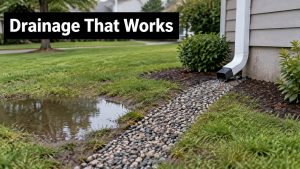

The storm has passed, the sun is out, and a puddle is still sitting by the fence two days later. The grass at the edge is yellowing. The dog path is mud. That leftover water is one of the yard drainage problems and solutions we walk Austin lots for, and it almost never starts with a product catalog.
Most of these problems come from a few repeat causes. Water starts on a roof, a driveway, a patio, or an uphill lot. It needs a legal place to go that is not your foundation and not a neighbor's yard. The soil either takes it in or holds it on the surface. Clay accepts water much more slowly than sand, so two yards can get the same rain and look nothing alike the next morning. Construction traffic and fill packed while it was wet make that worse.
The right fix depends on where the water starts, where it has to go, and how the soil holds it. The eight fixes below are organized by the symptom you notice first, so you can match the puddle, the damp wall, or the mushy lawn to the system that addresses it. If you want to see how that sequence looks on another property, these Peoria yard drainage fixes follow the same idea: read the water, then choose the work.
Walk your yard during the next heavy rain before you buy pipe. Note where water enters, where it stalls, and where it finally leaves. That short watch saves a wrong trench.
1. Standing Water in Low Spots After Rain Means Regrading the Yard
A shallow bowl in the lawn is the complaint we hear first. Soil settles, feet and mowers pack the same path, and a low center forms. Water runs there and stays, sometimes for hours, sometimes into the next day. If the shape of the ground is the problem, another gadget on top of it only hides the symptom.
Regrading reshapes the soil so water moves away from the house toward a safe outlet, such as the street, a swale, or a drain we already know can take the flow. A common target around the foundation is about 6 inches of fall over the first 10 feet, then a gentle slope across the rest of the lawn. The USDA Natural Resources Conservation Service reports steady infiltration of more than 0.8 inches per hour in sandy soils, 0.2 to 0.4 inches per hour in loams, and only 0.04 to 0.2 inches per hour in clay. Grade cannot change clay into sand, but it stops water from sitting in a bowl while that slow soil tries to catch up.
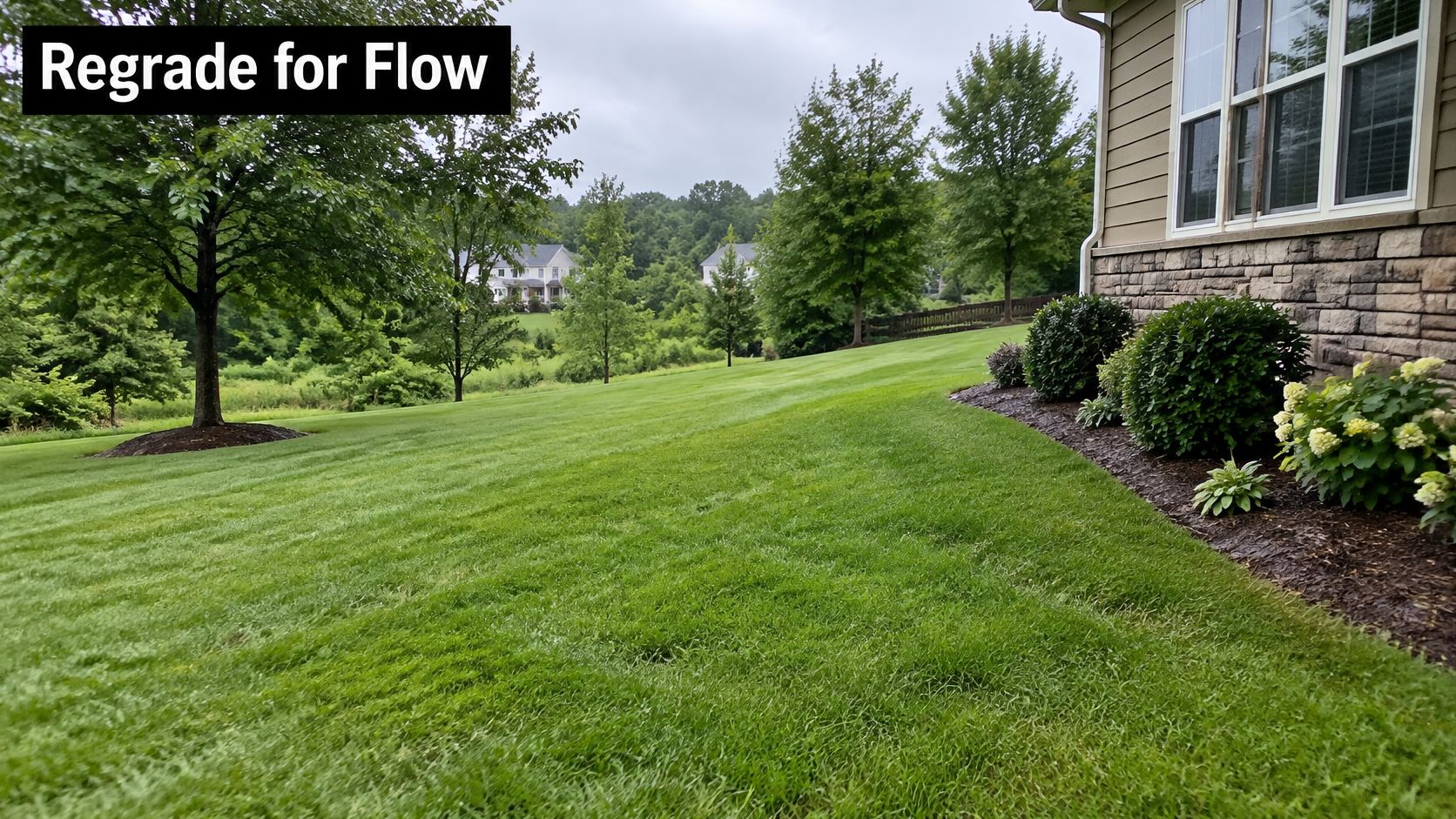
Say a Central Texas backyard holds water in the middle for two days after every storm. Cutting that low center toward a side swale lets the lawn shed water within hours of the next rain, without a buried system. Commercial lots around Austin use the same move so parking and green areas do not pond at entrances.
Practical rule: New soil and sod settle. Top up the low spots after the first few rains before you judge the grade.
We look at topography during site preparation so the new slope works with your home, walks, and outlets. Yard grading and drainage is the first conversation when the puddle is really a shape problem. Call and we will walk it with you.
2. Downspout Water Pooling Against the Foundation Needs Extensions and Underground Routing
Roof water that dumps at the wall is a different symptom. You see a dark band of soil, a soggy bed, or damp masonry that lines up with a downspout, not with a low spot in the middle of the lawn. That concentrated splash saturates the soil exactly where settling, cracks, and seepage start.
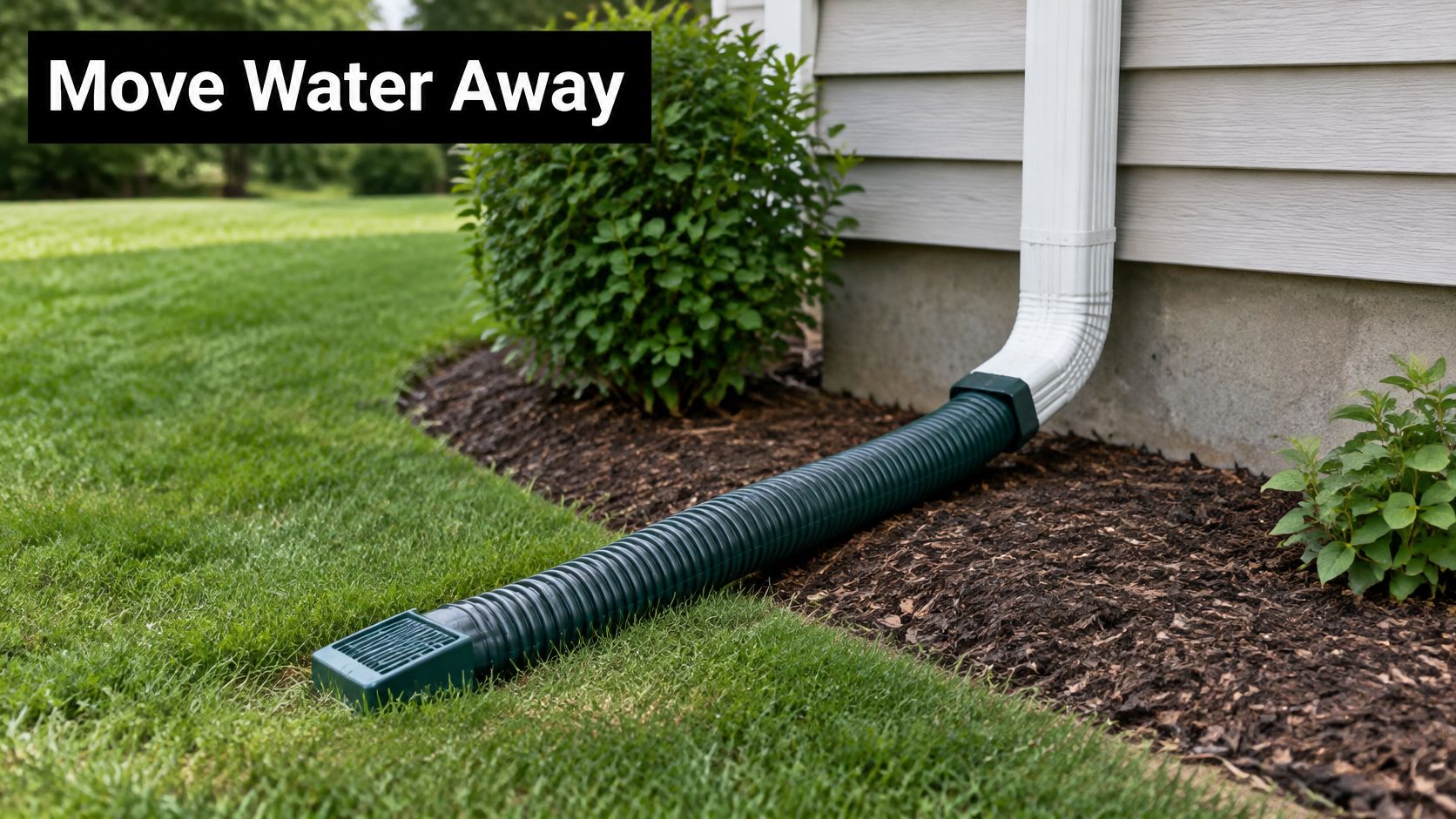
A surface extension carries water several feet out. Underground routing sends it through buried pipe to drainage tile, a dry well, or the curb, so you are not tripping over a plastic tube every time you mow. I recommend discharge at least 4 to 6 feet from the foundation, and farther on a slope. Every downspout needs a destination, and that destination cannot be the neighbor's lot.
Homes with a long damp strip along the foundation often dry out once those outlets tie into a buried line. Austin remodels do the same when new gutters would otherwise soak a fresh patio.
Keep the gutters clear or the best extension still overflows at the first elbow. A practical rhythm is at least twice a year, and more often under oaks. This note on how often to clean gutters matches what we tell homeowners before we bury anything.
- Watch one storm: See which corners overflow, not which ones look suspicious on a dry day.
- Check the outlet: Water should leave your property at a permitted point, not across a shared fence.
- Pair the work: Routing and drainage tile belong in one plan so you do not dig the beds twice.
Bring us the downspout layout on a site visit. We will mark where pipe can run before landscaping locks the route in.
3. Saturated, Slow-Draining Soil Calls for French Drains and Drainage Tile
The lawn feels like a sponge a day after the sky clears. Footprints fill with water. That is saturated soil, common on Austin clay, not a missing splash block.
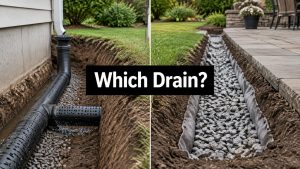
A French drain is a sloped trench of clean gravel around a perforated pipe. Water enters the stone, drops into the pipe, and leaves at an outlet. Drainage tile is the same idea, pipe at a steady grade, used to intercept water before it fills the root zone. A pipe with no fall, or an outlet that is higher than the inlet, just stores the problem underground.
Say a wet side yard in Central Austin gets a French drain along the fence that daylights at the curb. The surface firms up because the water has a path. Under a new turf area, tile at the low edge keeps the base from turning to mud, which is what makes the lawn usable after a storm.
EPA design guidance treats an underdrain as necessary where measured permeability is below 0.5 inches per hour, and it wants that test early. Adding more gravel will not fix a high water table, shallow rock, or a blocked discharge.
- Set the fall: Aim for a consistent slope, typically at least 1 percent, toward a real outlet.
- Use the right stone: Clean, washed gravel and drainage fabric, not native clay shoveled back on the pipe.
- Call 811: Locate utilities before the first shovel.
Flush and check outlets on a seasonal French drain checklist so sediment does not seal the pipe. We test how water moves through your soil before we pick the route. Schedule that look before the next week of rain.
4. Water Collecting in a Low Spot With No Outlet Needs a Catch Basin
Some yards have a hole with no downhill exit. Water runs in from a patio or drive and stays, a pond by the fence or a slick corner of a parking lot. Regrading would mean raising a slab you do not want to rebuild. A catch basin is the tool for that symptom.
The basin is a box, concrete, plastic, or polymer, set at the low point. A grate takes surface flow, and a pipe carries it to a curb, swale, or other approved outlet. It does not make clay drain faster. It gives trapped water a door.
A property manager at a low parking-lot corner can stop sheet flow onto a walkway with basins at that corner. A backyard pond by the fence can do the same, one basin tied to a line that reaches the street.
Hard surfaces are why these low corners fill so fast. In one urban, suburban, and rural stream study, the EPA watershed research found individual catchments at 10.5 to 20.3 percent impervious cover, with the watershed overall near 19.8 percent. Roofs and pavement deliver water in a pulse. The basin has to be sized for that pulse, not for a gentle lawn sprinkle.
Set the rim slightly below the surrounding grade so water falls in instead of skating past the grate.
Match the grate to the load. A lawn grate will crush under a tire. Plan to lift it and clear leaves, especially under trees. We will tell you on site whether a basin, a grade change, or both is the smaller dig. That visit is the right time to book the work.
5. Persistent Wet Spots With Nowhere to Go Point to Dry Wells
You have collected the water, and then you look around and there is no curb, no ditch, and no lower lot you are allowed to use. A dry well is temporary underground storage that lets water soak out through the surrounding soil. It is a perforated chamber or a fabric-wrapped gravel pit, not a magic hole.
It works when the soil can take water back. In tight clay it has to be larger, or paired with an overflow, or skipped. I will not size one from a guess. A percolation check comes first, and the well stays clear of foundations, walls, and septic components.
Picture downspouts that currently dump into a clay corner. A modular dry well there can take a normal storm and be empty within a day if the soil cooperates. Commercial roofs sometimes use the same chamber beside a permeable area, with a pipe that can overflow when the chamber is full. Without that overflow, a big storm backs into the yard you just tried to dry.
Trade-off, stated plainly: a dry well hides the water, so a failure is invisible until the yard floods again. Sediment, a high water table, or bedrock close to the surface will stall it. Surface grading or a piped outlet is more honest on those lots.
- Test first: Know the soak rate before you buy the chamber.
- Keep distance: Do not park storage against the foundation.
- Give storms an exit: An overflow path is part of the design, not a later patch.
We check percolation and layout together so you are not paying for a tank the soil cannot empty. Call and we will say so before anyone digs.
6. Erosion and Fast Runoff Across the Lawn Need Swales and Rain Gardens
This symptom is movement, not a puddle. You see gravel washed onto the walk, roots exposed, and a fan of silt at the fence after every downpour. The water has speed. The fix is to slow it and give it a planted path.
A swale is a shallow vegetated channel that guides flow along a line you choose. A rain garden is a planted depression that holds runoff, then lets it soak. Both filter sediment instead of delivering it to a patio. They are not ponds. Standing water that never leaves is a failed grade, not a garden.
A sloped Texas yard can take driveway runoff in a native-plant rain garden at the bottom and stop the fence-line washout. A grass swale along the property edge can slow the same water and hand it to a drainage-tile inlet.
In an EPA-documented retrofit in Burnsville, Minnesota, rain gardens sized for 0.9 inches of rain cut total runoff volume by about 90 percent, and more than 75 percent of storms produced no observed runoff in the treated area, according to the EPA Burnsville summary. The same guidance found systems without underdrains averaged 89 percent volume reduction, while systems with underdrains averaged 56 percent. On Austin clay or shallow rock, that is why we test infiltration and add an underdrain or overflow instead of hoping the basin empties.
Hold water for a short time, about one to two days, then it should be gone. Use plants that handle Central Texas heat and a wet-then-dry cycle. Mulch or an erosion blanket covers bare soil while roots establish. Landscape erosion control starts with mapping the paths water already takes. We do that walk with you so the swale sits where the water runs.
7. Artificial Turf That Stays Soggy Needs a Permeable Base and Drainage Layers
The lawn still squishes two days after the rain. It smells, or the surface ripples underfoot. Water is sitting under the carpet.
A sprinkle can shed off the blades and still leave a mushy yard if the base is flat, dirty, or has no outlet. A sound build uses compacted, well-graded aggregate, a drainage layer, and a slight slope to tile or another exit. Water should pass the infill, move through the base, and leave. A blocked discharge will pond under a lawn that looks dry from the street. Turf on a bad subgrade will not fix that.
Take an Austin install graded to drainage tile at the low edge. After a hard rain the surface stays firm because the water never sat in the soil. A permeable base lets water pass through instead of pooling. Putting greens and pet runs need that same layer. A green that holds water plays wrong. A dog run that holds water smells, no matter how often you rinse it. Match the infill to the use. Those two jobs are not the same spec.
On clay, the compacted stone and sand base is what keeps the surface from sinking or going wavy. It lets water through, keeps the top dry, and limits organic matter breaking down underneath. Artificial turf drainage systems belong in the plan before the first roll is laid, outlets included, not as a patch after the yard fails.
- Compact and slope first. Leave native clay under the turf and the job will stay soft.
- Name the outlet. I will not call a plan finished if it never shows where the water leaves.
- Set the infill for the use. Pet runs and greens fail for different reasons when that step is skipped.
Modern Yard Spaces prepares every artificial grass installation with groundwork that improves drainage and stability. Book the site visit before you order grass.
8. Hillside Runoff and Pressure Behind Retaining Walls Need Drainage Behind the Wall
A wall that bulges, cracks, or leans after storms is telling you about water you cannot see. Soil behind the wall gets saturated. Hydrostatic pressure pushes. The stone or block is not the first failure. The missing drain is.
Water from the slope above has to leave through the back of the wall, not through the face as a muddy seep. That means free-draining gravel backfill, not native clay, a perforated pipe at the base, and weep holes or outlets that stay open. Grade or a swale at the top should keep surface flow from pouring over the cap.
A sloped Austin lot with a stone wall can send that water to an outlet through gravel and a base pipe, and the wall stops bowing after storms. Commercial walls above parking do the same so soil does not creep onto the drive.
Weep holes placed and then buried in mulch do nothing. So does a pipe with no daylight. I would rather see a simple, visible outlet you can check than a hidden system nobody can flush.
Direct upslope water with a swale before it ever reaches the backfill. The wall drain is a relief valve, not a river.
Retaining wall drainage belongs in the design, with the wall and the tile going in together. We review that detail before the footing is poured. If your wall already shows movement, call and we will look before the next soak.
Yard Drainage Fixes at a Glance
| Item | Best For | Needs Outlet | Visibility |
|---|---|---|---|
| Standing Water in Low Spots After Rain: Regrading the Yard | Shallow ponding caused by uneven ground | Yes, a safe drainage destination | Visible changes to lawn slope |
| Downspout Water Pooling Against the Foundation: Extensions and Underground Routing | Roof runoff collecting near the foundation | Yes, a safe discharge point | Extensions visible; buried routing mostly hidden |
| Saturated, Slow-Draining Soil: French Drains and Drainage Tile | Persistently soggy soil and subsurface water | Yes, a suitable outlet | Mostly hidden underground |
| Water Collecting in a Low Spot With No Outlet: Catch Basins | Surface water trapped in a low area | Yes, a suitable outlet | Flush grate remains visible |
| Persistent Wet Spots With Nowhere to Go: Dry Wells | Runoff where no surface outlet is available | No surface outlet; needs permeable soil | Hidden underground |
| Erosion and Fast Runoff Across the Lawn: Swales and Rain Gardens | Fast runoff, erosion, and sediment movement | Depends on site flow and infiltration | Visible landscape features |
| Artificial Turf That Stays Soggy or Pools Water: Permeable Base and Drainage Layers | Pooling beneath artificial turf | Yes, an approved outlet | Mostly hidden beneath turf |
| Hillside Runoff and Water Pressure Behind Retaining Walls: Drainage Behind the Wall | Water pressure and runoff behind retaining walls | Yes, a safe drainage outlet | Mostly hidden; outlets may be visible |
Stop Guessing and Get a Drainage Plan for Your Yard
A puddle still sitting two days after the rain is not the same problem as a wet stripe against the house, a lawn that stays spongy, or a dog run that never dries. Point at the mark you see. That mark decides whether the water needs a new path off the surface, a buried line to a real outlet, or a base under the turf that lets it pass through.
Walk the yard during the rain, or as soon as it stops. Mark where water enters, where your shoes sink, and where it is allowed to leave. Shoot the same corner on a dry Tuesday and a wet Thursday. Those two photos show the path more clearly than a guess from the street.
Modern Yard Landscapes installs drainage tile for soggy yards, standing water around foundations, and flooding on commercial property. The work moves water off the property before it sits against a foundation, softens a turf base, or loads a wall. The drainage tile consultation is free. On that visit, soil, slope, downspouts, and outlets get checked together, including tight gates and small backyards where the equipment has to fit the lot.
Austin storms do not hand you many dry weeks to experiment. Clay that feels only damp today can hold a pond by the weekend. A wall that stays damp can start to move. I recommend you call while the last high-water marks are still easy to see. A line that ends with nowhere for the water to go does not solve the yard.
For homes and commercial lots, Modern Yard installs drainage tile, retaining walls, and artificial turf on a base built so water drains and the surface stays firm after Austin rain. If the yard holds water, washes out, or leaves a soggy dog run, the useful next step is a walk of that symptom and a map of where the water should go. Visit Modern Yard Landscapes and schedule your free drainage tile consultation.