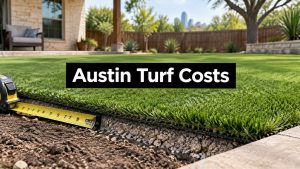

Professionally installed artificial turf in Austin runs about $8 to $17 per square foot in 2026. A typical mid-grade residential lawn lands near $13 per square foot, while the turf material by itself sells for roughly $2 to $8 per square foot.
That gap is the whole story. When someone searches how much does turf cost per square foot, most pages hand back the price of a roll of grass instead of the price of a finished lawn. The roll is the cheap part, and it's the part that decides nothing.
What follows is the tier table I open every estimate conversation with, then a line-by-line audit you can run on any bid before you sign it. Work through both and you'll know whether the number in front of you is a real quote or a guess with a logo on it.
What Turf Costs per Square Foot in Austin
In Austin, a finished artificial turf installation runs about $8 to $17 per square foot in 2026, with a mid-grade residential lawn typically near $13. Material alone runs roughly $2 to $8 per square foot, priced by grade.
Material-only numbers dominate search results because material is the one line anybody can price without a site visit. That's also why they mislead. A published Austin artificial turf cost estimate reports an installed range of about $8 to $17 per square foot, with low, mid and high examples at $8, $13 and $17. In that same estimate, a representative project's materials ran $2,870 to $9,225 while labor ran $1,969 to $5,334. Labor and preparation aren't a rounding error. They're the bigger half of the bill.
Artificial turf cost per square foot in Austin (2026)
| Turf grade | Material only per sq ft | Installed per sq ft in Austin | 1,000 sq ft installed |
|---|---|---|---|
| Basic polyethylene | $2–$4 | about $8 | about $8,000 |
| Mid-grade polyethylene | $4–$6 | about $13 | about $13,000 |
| Premium multi-tone | $6–$8 | about $17 | about $17,000 |
| Pet-specific turf | $4–$7 | priced per design | priced per design |
| Putting-green turf | $5–$10 | priced per design | priced per design |
Turn those rates into a budget. A 500-square-foot yard lands near $4,000 to $8,500 installed. A 1,000-square-foot yard lands near $8,000 to $17,000. Both totals assume a straightforward site with no structural or drainage surprises.
Pet turf and putting greens sit open in the installed column on purpose. A dog run gets priced around drainage, antimicrobial infill and wash-down access. A putting green gets priced around contouring, cup placement and speed. Neither is a lawn with different grass on it, and a flat per-foot rate is the wrong tool for either.
The rule that matters: a per-square-foot rate is a starting position, not a quote. It becomes a real number when someone measures your yard, checks slope and access, and prices the base.
Austin yards aren't uniform, which is why the range is wide. West of MoPac you meet slope and limestone shelves that change how a crew grades. East of I-35 you meet heavy clay that holds water and has to be shaped deliberately. The estimate behind those Austin figures puts it plainly: pricing should come from measured area, turf specification, access, demolition, grading, drainage, edging and intended use, not from square footage alone.
Everything below exists to help you work out where on that range your property sits and what to ask so nobody guesses on your behalf.
Material Price versus Installed Price
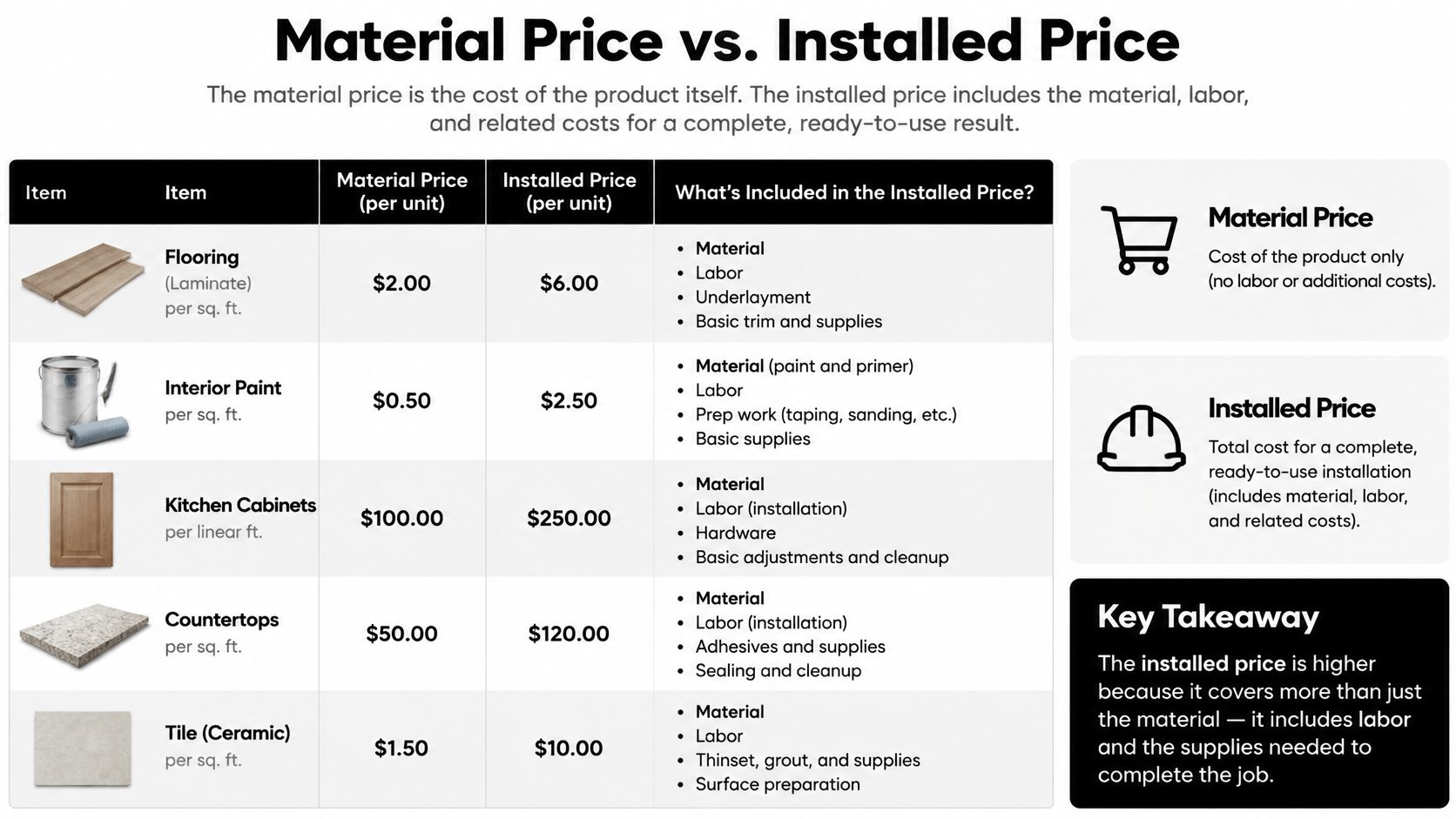
Turf gets sold two ways, and the two prices share no common ground. Buying turf material is like buying hardwood by the box. Paying for an installed lawn is like paying for a finished floor, where the subfloor gets repaired, leveled and covered before anyone admires the grain.
The same split shows up across home improvement. Material is one line item. The finished system is the number that hits your budget.
Forbes Home's artificial grass guide puts artificial grass material alone at about $2.50 to $4.00 per square foot, and that's before excavation, base preparation, seams, edging, infill, drainage and labor.
Installed figures disagree with each other because they're answering different questions. A broader HomeAdvisor estimate cited in the same guide places professionally installed artificial grass at roughly $2 to $8 per square foot nationally, with installation labor alone at $4 to $9 per square foot. A California water-efficiency program's engineering analysis uses $6 to $10 per square foot for a complete installed system and modeled it over an assumed service life of roughly ten years. A 2025 Recreational Industries cost guide reports $8 to $20 per square foot across residential and commercial projects.
None of those sources is wrong. They're pricing different scopes:
- Material and basic labor only. The cheapest-looking models leave out demolition, haul-away and aggregate base, which is exactly where the money hides.
- Complete installed system. Turf, excavated subgrade, compacted base, drainage, edging, infill, seams and disposal.
- Higher-spec or commercial work. Sports surfaces and heavy-use installations carry a different build standard than your backyard.
Run the math yourself. One thousand square feet of turf at $2.50 to $4.00 costs $2,500 to $4,000 before a shovel touches the ground. A turnkey bid on that same lawn can land thousands above it, and that difference isn't profit. It's the base, the grading, the hauling and the crew hours.
One question filters most bad quotes: does this per-square-foot price include both materials and installation? If the answer takes more than a sentence, you're looking at a material price.
The warning sign is a headline rate that shows up well under the local range with no line items behind it. In practice, that means the base, the drainage or the dump fees were never priced, and one of them will reappear mid-project as a change order. Use the Austin installed table above as your reference point rather than a national average that was never built for this market.
Inside the Installed Price Line by Line
A one-number quote tells you nothing about what you're buying. Ask for the stack instead, in writing, and you can compare two bids line against line.
Turf material is the visible layer and the least of your worries, as long as it's specified properly. What matters is fiber type, yarn denier, blade density and blade height, backing quality, and the thatch layer that makes the surface read as grass instead of carpet. Thin backing and sparse thatch look fine in month one and mat flat by year two.
What an installed turf price includes
| Cost component | Typical range | What it covers |
|---|---|---|
| Turf material | $2–$8 per sq ft by grade (Austin table) | fiber type, denier, blade density and height, backing, thatch layer |
| Installation labor | $4–$9 per sq ft | excavation, grading, compaction, seaming, infill, perimeter securing |
| Old lawn or turf removal | $1.75–$2.25 per sq ft | sod or turf cutting, hauling, disposal |
| Aggregate base | priced by depth, compaction and site access | crushed rock, grading and compaction for drainage |
| Infill | priced by infill type and quantity | sand, pet-safe or cooling infill spread and brushed in |
| Edging and borders | priced by linear foot | steel edging, bender board or mow strip |
What the crew is actually doing for that labor
The labor line buys a sequence, not a set of hands. Proper installation includes extensive soil preparation and compaction, precise grading for drainage, professional seaming, correct infill application and distribution, and proper perimeter securing. Skip any step and the failure shows up later, on your dime.
Removal is its own line. Taking out old sod or a worn synthetic surface runs $1.75 to $2.25 per square foot according to a 2024 reposting of a University of Massachusetts Lowell analysis, and it covers cutting, hauling and disposal. If a bid omits removal entirely, ask where the old lawn is going.
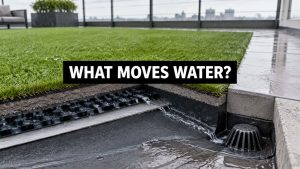
Base is where the engineering sits, and it's the line most often thinned out. It means compacted crushed rock, graded so water moves off the lawn instead of pooling underneath it. We install a professional sub-base that ensures rapid drainage even during heavy rains in Austin, Round Rock or Georgetown, and it's the single reason a lawn still sits flat after three summers. The full breakdown of what site preparation cost covers is worth reading before you compare bids, because a cheap base is the most expensive thing you can buy.
Infill keeps blades upright and cushions the surface. Edging holds the perimeter where you put it. Both are small lines that decide whether the finished lawn looks installed or laid down.
Where cheap bids cut corners first
Base depth and drainage get reduced first, because neither is visible after the turf goes down. Infill gets shorted next, then edge fixing, then haul-away. Every one of those shortcuts shows up within two seasons as sinking, pooling, seam separation or a border that creeps. Mark each line on your quote as included, allowed as an allowance, or excluded, and you'll see the shortcuts before they cost you.
What Pushes Your Price Up or Down
Two families of levers move your number: the product you choose and the property you own. Product levers move the rate by a few dollars a foot. Site levers can move it further than any turf upgrade.
Product levers
Polyethylene is the mid-range workhorse for homes, and that's not a compromise. It offers a good balance of softness and durability for residential use at a middle price. Nylon sits at the top of both price and durability, which is why it turns up on high-traffic areas like sports fields rather than the average backyard.
Beyond fiber, an honest estimate weighs yarn denier, blade density and height, backing, durability class, infill type, features such as antimicrobial or cooling treatments, and manufacturing origin. That's how Modern Yard builds a turf project cost, and it's the difference between quoting a product and quoting a guess. If you're still comparing grades, this guide to types of turf walks through how the fibers behave underfoot and under sun.
Site levers
These are the ones that surprise homeowners, and they're almost all about access and water:
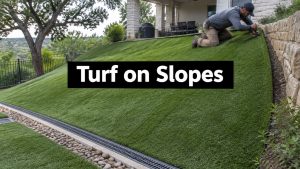
- Slope correction. A yard that falls away from the house needs grading and sometimes a retaining structure before turf goes down.
- Clay-heavy soil. Central Texas clay holds water. It needs shaping and a base designed to move water off the surface.
- Tight side gates. If equipment can't reach the work area, everything gets carried. Labor hours climb with every wheelbarrow.
- Drainage corrections. Drainage tile, French drains or regrading where water already pools after rain.
- Custom borders and shapes. Curves, circles and turf cut around pool decks add cutting time and material waste.
- Specialty builds. Pet runs and putting greens are priced around design, not area.
A rule of thumb worth trusting: a flat, open yard with a wide gate prices near the bottom of the Austin range. A sloped yard behind a narrow gate with a drainage problem climbs toward the top, and no turf grade changes that.
The practical takeaway is simple. Price your yard, not the average. Two houses on the same street can land thousands apart because one has a straight run to the backyard and the other has a sixty-foot carry past a pool cage.
Why Smaller Yards Pay More per Square Foot
A per-square-foot price is a ratio, and ratios have denominators. Fixed costs don't shrink when the yard does. Mobilization, delivery, equipment, dump runs and the first passes of base preparation cost roughly the same on 300 square feet as on 1,500, so on a small job they get divided across far fewer feet.
That shows up in published pricing. A green industry cost comparison reports approximately $14 to $17 per square foot for 400 to 700 square foot jobs, against $9 to $10.50 above 2,000 square feet. The work per foot barely changes. The overhead per foot collapses.
Price per square foot by project size
| Project size | Published rate per sq ft | Why the rate moves |
|---|---|---|
| Under 400 sq ft | highest rate, quoted per project | mobilization and base prep dominate a small total |
| 400–700 sq ft | $14–$17 | fixed setup costs spread over fewer feet |
| 1,000 sq ft | $8–$17 installed in Austin | grade and site access set the tier |
| Above 2,000 sq ft | $9–$10.50 | material and crew efficiencies at scale |
Cost per square foot tends to be lower for larger turf areas, and installations under 500 square feet often carry a higher price per square foot for exactly that reason. It isn't a penalty. It's arithmetic.
Three Austin yards, three different rates
A 500-square-foot dog run. This gets quoted per project rather than per foot. Drainage, wash-down access, antimicrobial infill and a secure perimeter matter more than area, and applying a lawn rate to it would be fiction either way.
A 1,000-square-foot mid-grade lawn replacement. At the mid-grade installed rate, this lands around $13,000. Straight access and a flat grade keep it there. A slope or a drainage fix pushes it up.
A 700-square-foot backyard bundled with a small putting green. Putting-green turf material alone runs $5 to $10 per square foot before base work and contouring, and the contouring is where the labor lives. Bundling it with the surrounding lawn is usually cheaper than treating it as a separate project.
Bundle while the crew is already there: if mobilization and base are budgeted, adding an adjacent dog run or play area normally lowers your blended cost per square foot compared with booking two jobs in two seasons.
That's the practical move for a small yard. Don't hunt for a company willing to shave the rate on 400 square feet. Add scope so the fixed costs get shared, and you'll pay less per foot for more finished space.
Hidden Costs to Weigh Before You Sign
Give turf its due first. Routine mowing stops, weekly irrigation mostly stops, and the water line moves. Typical installations from Modern Yard Landscapes cause water bills to drop 60 to 70%. That's real money, and it's the reason the upfront number is worth comparing at all.
Then budget the honest extras.
Heat. Synthetic surfaces run hotter than natural grass, and a recent safety review of athletic field surfaces notes that synthetic turf may be irrigated to temporarily reduce high temperatures, citing research in which synthetic materials reached higher temperatures than natural grass. A municipal field analysis counted about 250,000 gallons of additional water a year for cooling, and roughly 390,000 to 450,000 gallons per year once production and cooling are included over the assumed lifespan. On a residential scale that's rinsing, not irrigation, but it belongs in your expectations. Cool-touch technology in residential turf is built to take the edge off summer surface heat, and it's worth asking which product you're getting.
Lifespan and disposal. That same 2025 resource says artificial turf typically lasts eight to ten years and is commonly landfilled afterward, though some components may be reused. Replacement timing is a budget line, not a surprise you discover in year nine.
Austin operating costs. Cooling rinses, pet sanitation frequency, and drainage repairs that a per-foot quote never mentions. Poor drainage is the expensive one, and it's why drainage for artificial grass should be designed before turf is chosen, not after water starts pooling.
The six questions that separate real quotes from cheap ones
- What's included per square foot? Name every line: turf, removal, base, drainage, infill, edging, labor, disposal.
- Which lines are included, allowed as an allowance, or excluded? An allowance is a placeholder, and placeholders move.
- What warranty and service life are promised, in writing? Ask what voids it.
- What infill and drainage design is planned? Get the infill type and the drainage route described.
- Who hauls off the old lawn, and what disposal is assumed? Dump fees are charged by weight.
- What cooling and cleaning routine is expected? Rinsing, brushing and pet-area sanitation all have a cadence.
A company that answers those six before you ask, in writing, is the one worth calling. A company that answers with a single rate and a promise is selling you a number.
What Happens at the On-Site Estimate
The visit is where a range becomes your number. It follows a sequence, and you should expect to see all of it.
- Measure. The crew measures length times width for each area and marks out irregular shapes rather than eyeballing them.
- Check the ground. Slope, soil and drainage trouble spots get inspected, including wherever water already pools after a storm.
- Record the constraints. Gate width, equipment access, sun exposure, pet use and any putting-green plans all get noted.
- Quote in writing. The estimate arrives as line items covering turf, removal, base, drainage, infill, edging and labor, with every allowance named.
Until someone has measured and inspected the property, a quote is an installation price, not a guaranteed final price. Anyone who offers a firm number sight unseen is guessing, and you'll meet the guess later.
How trust gets verified
Reviews carry less weight than they used to. A 2025 BrightLocal survey of 1,026 U.S. adults found that 42% of consumers trust online reviews as much as personal recommendations, down from 79% in BrightLocal's 2020 report. Star ratings alone won't get a thoughtful homeowner to pick up the phone.
What actually moves a homeowner to call: a reference in the same part of town, a project described in enough detail to be checked, and a price explanation that shows its work.
The rules tightened too. The Federal Trade Commission's Consumer Reviews and Testimonials Rule took effect on October 21, 2024, and it addresses deceptive conduct involving reviews and testimonials, with civil penalties for knowing violations. Reviews or testimonials connected to incentives fall under its requirements. In plain terms, a customer story tied to a discount should say so.
Word of mouth still outperforms everything else. Nielsen's research on trust in advertising reported that 88% of respondents trusted recommendations from people they knew more than any other channel, and that those recommendations were trusted by 50% more people than lower-ranked channels such as banner ads and SMS.
That's how a turf decision should get made. Ask for verifiable local references near you, look at completed projects with permission from the homeowner, and ask directly whether any incentive sits behind a testimonial you're shown. Our artificial grass installers page is the place to start that conversation, and no one should promise you the same savings or result another homeowner got, because the property is different.
Get Your Exact Turf Price in Austin
The exact number is knowable, and you can start it yourself. Measure length times width for each area, then note sun exposure, pet use, drainage trouble spots and gate access. Bring those to the conversation instead of accepting an average that was never about your yard.
The on-site visit is where slope, soil and access get priced into a firm number, and there's no obligation to proceed once you have it. Modern Yard offers a free turf quote in Austin. The quote request form asks for square footage and an ideal date for an estimate, which is enough to get the visit scheduled.
Send your measurements, book the on-site estimate, and turn the $8 to $17 per square foot Austin range into a fixed number for your property. Most residential installations are completed in 2 to 5 days once the work begins, so the timeline is short. The decision is the part worth doing carefully.
Modern Yard installs artificial turf across Austin with the base, drainage and edging priced as line items rather than folded into a single mystery rate. If you want a factors-based estimate that shows how turf grade, site access and drainage design change your total, visit Modern Yard Landscapes and send your square footage to get an on-site visit scheduled.