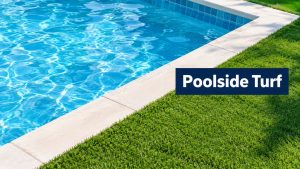

A property manager's maintenance budget rarely gets relief from one dramatic expense. It gets squeezed by recurring mowing, irrigation repairs, seasonal reseeding, chemical treatments, wet-weather damage, and the labor required to keep high-traffic areas presentable. Meanwhile, tenants, visitors, and customers still expect green space that looks intentional every day.
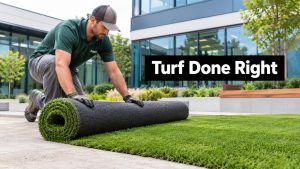
That's why commercial artificial grass installation deserves to be evaluated as an infrastructure decision, not a decorative shortcut. The surface people see matters, but the drainage, grading, compacted base, material specification, and maintenance plan underneath determine whether the investment performs or becomes an expensive replacement project.
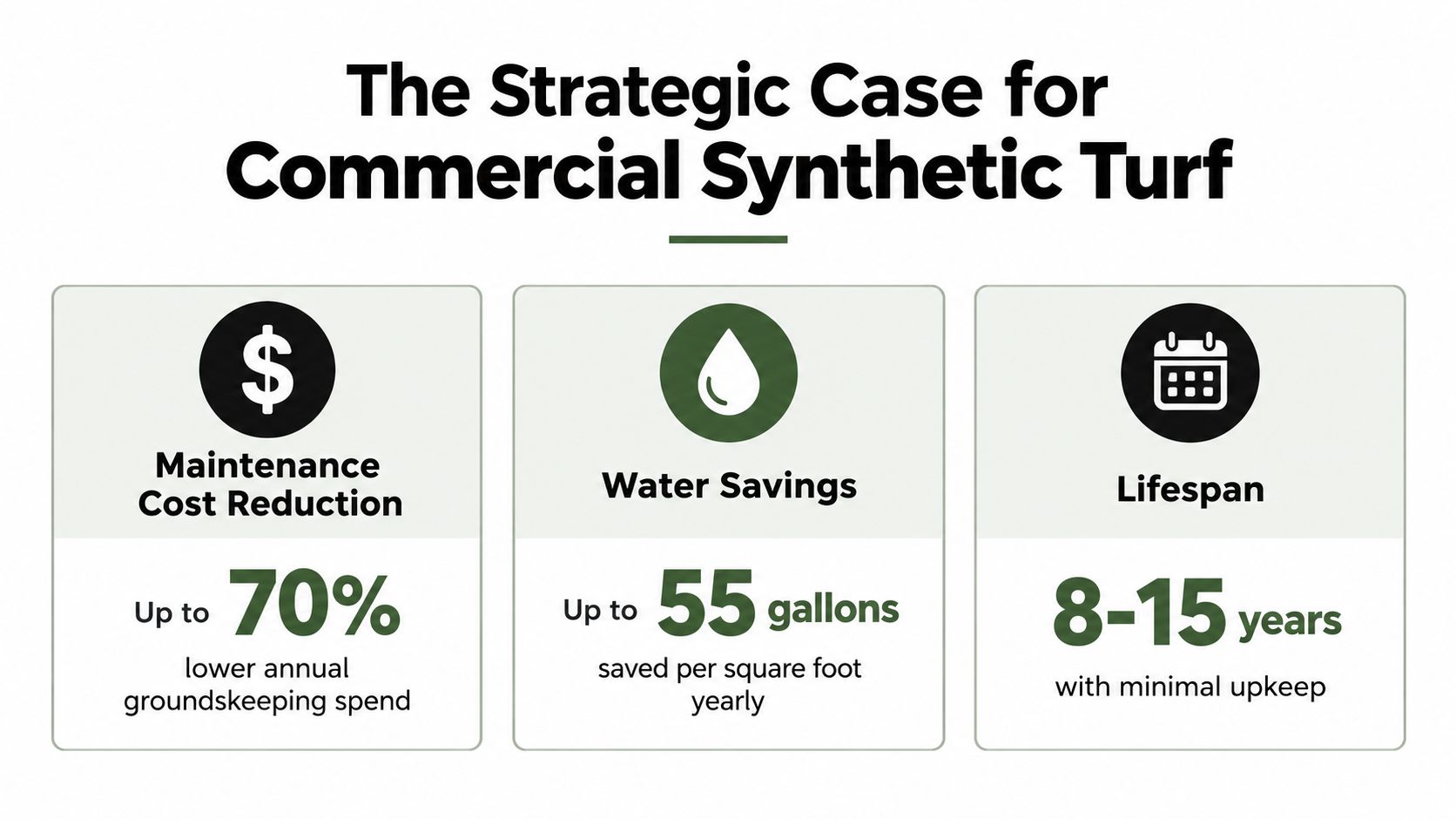
The Strategic Case for Commercial Synthetic Turf
Commercial synthetic turf is moving beyond sports venues. Corporate campuses, retail centers, hospitality properties, and municipalities are adopting it because they need usable green space without the recurring demands of living grass. One major market report valued the overall artificial turf market at USD 7.3 billion in 2025 and projects it to reach USD 13.7 billion by 2033, with an 8.3% CAGR. The same artificial turf market analysis projects commercial applications to grow at an 8.6% CAGR, while the dedicated commercial artificial turf submarket was valued at USD 608.9 million in 2025 and is forecast to grow at a 7.8% CAGR from 2025 to 2033.
Those figures reflect a practical shift in how owners think about site performance. A commercial property doesn't need greenery that merely looks attractive on installation day. It needs a surface that remains usable through foot traffic, weather exposure, tenant activity, and changing maintenance conditions.
Where the operating case becomes clear
Synthetic turf can remove or reduce several recurring tasks:
- Mowing and trimming: Crews aren't repeatedly dispatched to keep a designated lawn presentable.
- Irrigation dependence: The grounds no longer rely on regular watering to maintain a consistent green appearance.
- Chemical treatments: Fertilizers and many routine lawn-care treatments become unnecessary for the turf surface.
- Seasonal recovery: The property doesn't have to wait for living grass to recover from heavy use, heat, or traffic.
That doesn't mean artificial grass eliminates every outdoor expense. Edges, drainage infrastructure, surrounding planting beds, litter, and periodic turf care still require attention. The strategic advantage comes from replacing unpredictable biological maintenance with a more controlled surface system.
For a property manager, the right question isn't “Does synthetic turf look like natural grass?” The better question is whether the proposed system can lower maintenance intensity, support drought resilience, and preserve the function of the space. A well-engineered installation can do that. A thin product laid over an unstable base cannot.
For a closer look at the broader property-management rationale, review this guide to why synthetic turf works for commercial properties. Then evaluate the project as a capital improvement with an operating plan, not as a quick cosmetic refresh.
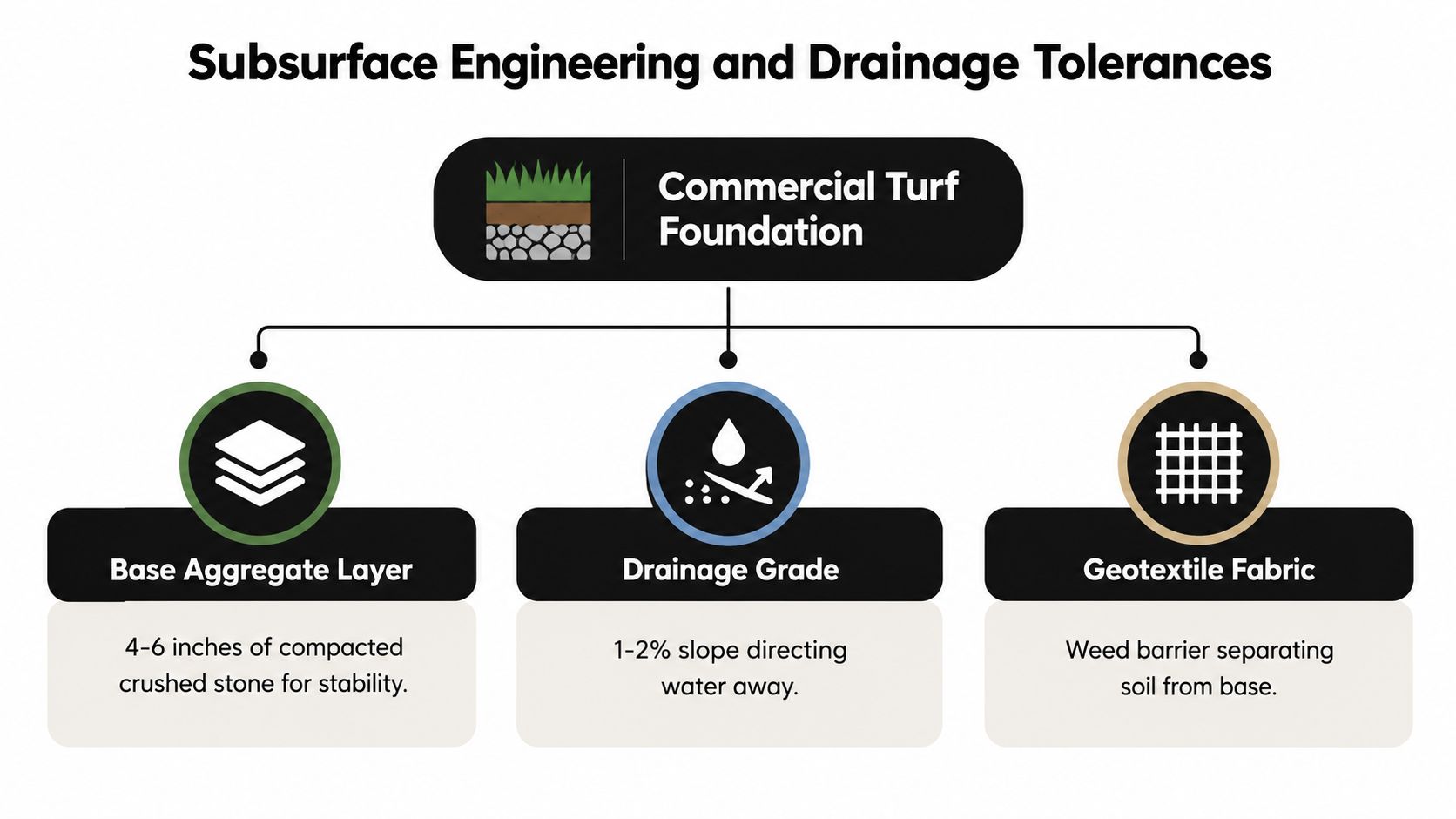
Subsurface Engineering and Drainage Tolerances
The surface is the last part of a commercial turf project that should command your attention. Before the first roll is positioned, the installer needs to understand the soil, slope, water movement, access limitations, and expected loading across the site.
The base system acts as a hydraulic control element, not merely a support layer. Industry guidance calls for a stabilized, shaped, and compacted sub-grade with a pitched surface that directs stormwater into an active drainage system. On a large commercial site, laser-guided grading helps maintain consistency across the installation. The Synthetic Turf Council installation guidelines emphasize that the base strongly influences both appearance and long-term performance.
What the installer must control
A sound commercial foundation depends on several connected conditions:
- Grade the sub-grade accurately. Water needs a defined path toward collection points or discharge areas. A surface that appears level to the eye can still hold water if the pitch is inconsistent.
- Compact the aggregate in controlled lifts. The material needs uniform density throughout the base. Adding more stone does not correct poor lift placement or inadequate compaction.
- Verify permeability before turf placement. Water must move through the backing and base at a rate appropriate for the site's rainfall and use.
- Inspect the finished plane. Depressions and ridges create stress points that become visible after installation.
Technical specifications commonly require a free-draining backing with perforations measuring 3/16 to 1/4 inch in diameter at 4 inches on center or less. They also call for the prepared base to remain free of moisture, dirt, dust, and petroleum contamination before placement. The commercial turf specification from Greatmats also describes compacted aggregate placed in 3- to 4-inch lifts and sub-base tolerances of approximately 1/4 inch over 10 feet.
Why shortcuts become visible later
If the pitch, compaction, or permeability is wrong, water can pond below the turf. That moisture creates more than an appearance problem. It can contribute to seam stress, soft spots, infill migration, wrinkling, and loss of full contact between the carpet and the base.
Ask for the base plan in writing. A credible bid should identify excavation, aggregate type, compaction process, grading method, drainage connections, and tolerances. If the proposal only describes “premium turf installation” without explaining what supports it, you're being asked to approve a surface before seeing the system that makes it work.
For drainage-specific planning, compare the proposed installation with these commercial artificial turf drainage systems. The point isn't to choose the most elaborate design. It's to specify the simplest system that matches the site's water conditions and use.
Selecting Commercial-Grade Materials and Infill
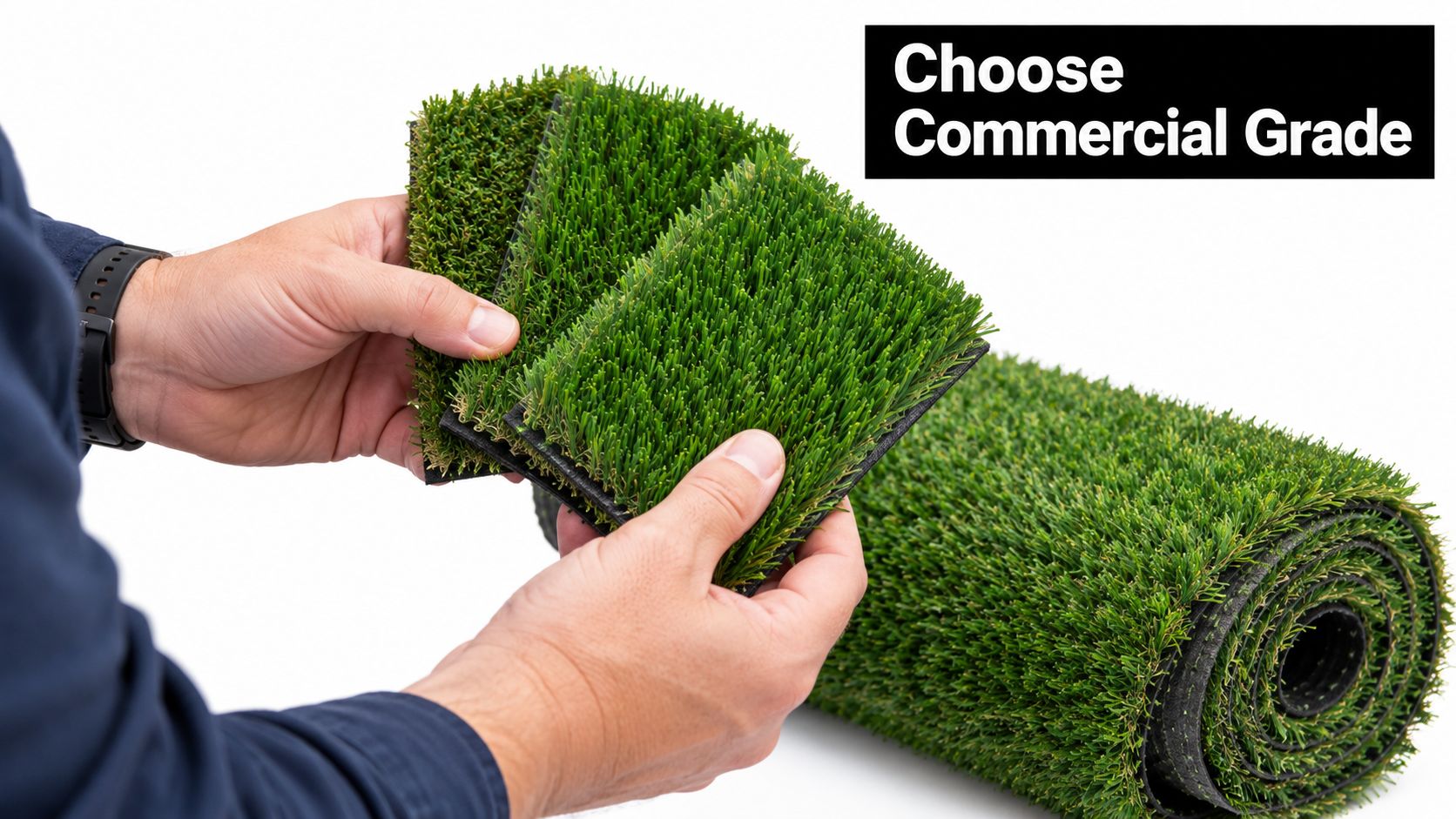
Commercial turf materials should be selected by exposure and workload, not by a showroom sample alone. A property manager needs to know how the fibers will respond to ultraviolet exposure, repeated pedestrian movement, cleaning, furniture, carts, and the particular activity planned for the space.
Start with the fiber. UV-resistant, high-denier fibers are appropriate considerations for areas exposed to strong sun and sustained use. Fiber shape, density, backing strength, and drainage capability all affect how the surface feels and recovers. The most attractive sample isn't automatically the most suitable one. A dense product can still fail if the backing, seams, or base system are poorly specified.
Match the infill to the use
Infill helps support the fibers and affects the behavior of the finished surface. The correct selection depends on traffic, comfort, odor control, heat exposure, and cleaning requirements.
- High-traffic courtyards need an infill system that supports fiber recovery and resists migration.
- Pet-accessible areas may benefit from antimicrobial treatment and enhanced drainage planning.
- Sun-exposed walkways deserve consideration of cooling technologies where user comfort matters.
- Shared amenity spaces need an infill and maintenance specification that aligns with cleaning practices.
A commercial-grade steel edging system can also provide a more durable perimeter than improvised edge restraint, particularly where carts, maintenance equipment, or frequent pedestrian movement could disturb the boundary. The bid should state what edging, seam method, adhesive, infill, and backing are included. “Commercial grade” is not a sufficient material specification by itself.
Treat the warranty as a specification document
A warranty is only useful if the chosen materials and installation methods satisfy its requirements. Ask whether the warranty covers fiber performance, backing integrity, seams, color stability, and installation workmanship. Also ask what maintenance records the manufacturer expects.
The visual side of material selection still matters. Property managers comparing outdoor improvements can use Pinnacle Property Media's guide to buyer-friendly flooring as a useful reminder that people evaluate surfaces through both appearance and perceived durability. The same principle applies outdoors. A surface that looks good but feels unstable or shows premature wear damages confidence in the entire property.
Review the available commercial artificial grass infill options before approving a product. Your contractor should explain why the selected infill fits the site, rather than hiding a material downgrade inside a vague allowance.
Navigating Hardscape and Elevated Surface Installs
Turf over soil and turf over concrete are not the same installation. On soil, the installer can excavate, shape the sub-grade, build an aggregate base, and connect drainage through the ground system. On a rooftop, balcony, podium deck, or concrete courtyard, the existing structure controls what can safely happen next.
A simple “yes, turf can go there” isn't a professional answer. The installer must first confirm that the structure is sound, that the added system is compatible with its load capacity, and that water has a controlled path to an approved drain or outlet.
Soil-based installation
A conventional ground installation typically allows the project team to:
- Remove unsuitable soil and organic material.
- Establish the finished grade through excavation and aggregate placement.
- Integrate subsurface drainage into the surrounding site.
- Secure the perimeter with edging suited to the soil and adjacent paving.
That flexibility doesn't remove the need for engineering. It gives the installer more room to correct site conditions before the turf is placed.
Elevated hardscape installation
Hardscape projects reverse the priorities. The installer must protect the waterproofing assembly, avoid obstructing existing drains, manage transitions at doors and parapets, and accommodate the structure's slope. Drainage tiles, protection layers, perimeter details, and removable sections may become more important than excavation.
Water intrusion is the risk property managers should focus on. If a rooftop turf assembly blocks a drain, concentrates runoff, or allows water to remain against a vulnerable transition, a cosmetic surface project can become a building-envelope problem.
The commercial turf and decking installation guidance is useful when evaluating deck-adjacent areas, but every raised site still requires a property-specific review. A contractor should inspect plans where available, identify drains and scuppers, verify transitions, and coordinate with the building owner or structural professional when the site warrants it.
For Austin-area properties with rooftop patios or podium decks, insist on a written hardscape scope. It should identify the surface condition, drainage approach, protection measures, edge restraints, access route, and responsibility for structural approval. If those details aren't documented, the proposal isn't ready for approval.
Calculating ROI and Long-Term Water Savings
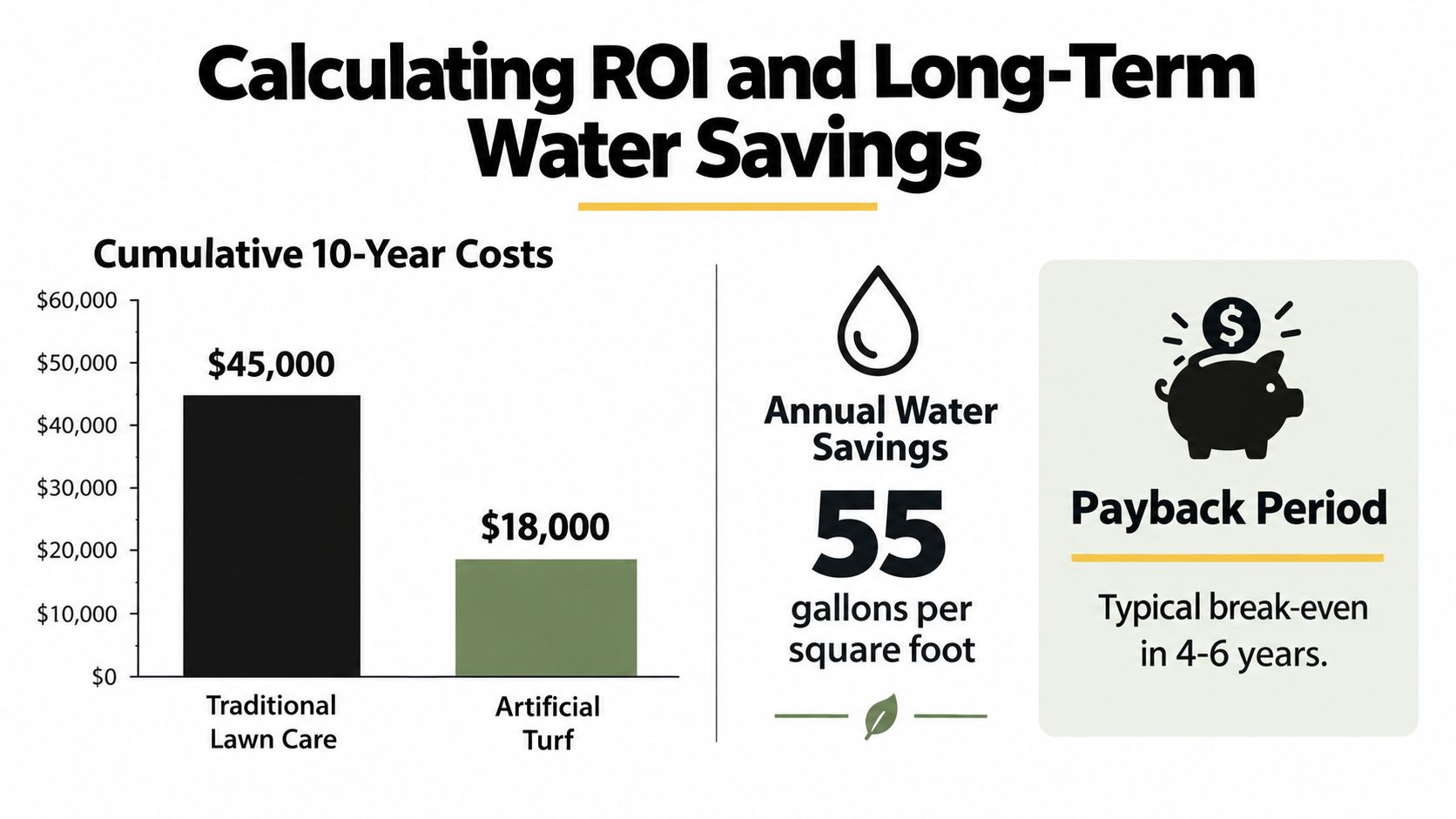
A commercial turf project should survive a finance review without relying on optimistic assumptions. The decision becomes clearer when the owner separates the initial installation from the recurring costs of keeping natural grass presentable.
Natural grass carries ongoing requirements for irrigation, mowing labor, fertilizers, treatments, seasonal reseeding, equipment, and weather-related recovery. Synthetic turf shifts the expense profile toward design, base preparation, material selection, installation, and planned upkeep. That doesn't make the initial investment irrelevant. It means the owner should compare total operating requirements instead of choosing the lowest installation price.
Water savings create a measurable baseline
Water conservation remains one of the strongest historical reasons for commercial artificial grass. The Synthetic Turf Council has cited estimates that a single synthetic turf athletic field can save 500,000 to 1 million gallons of water per year. It has also cited an estimate that an average 1,800-square-foot turf lawn can save about 99,000 gallons annually, potentially equaling roughly 70% of a homeowner's water bill. Over a turf lifespan of up to 20 years, that same installation could save more than 1.1 million gallons, according to the water-conservation report from Western Resource Advocates.
Those residential figures aren't a substitute for a commercial water audit. They do establish the mechanism clearly. A property that replaces irrigated lawn with synthetic turf can reduce demand on its irrigation system and become less exposed to drought restrictions or rising utility costs.
Build the financial model around the site
A useful ROI worksheet should include:
- Current irrigation consumption and maintenance labor.
- Mowing, fertilization, treatment, and seasonal replacement costs.
- Proposed excavation, base, drainage, edging, turf, infill, and installation costs.
- Routine synthetic turf cleaning, grooming, and drainage upkeep.
- Expected replacement planning based on the selected system and use.
Don't promise a payback period before the site is measured. Commercial acreage, access constraints, drainage work, hardscape integration, and traffic levels can change the financial outcome substantially. Use documented operating costs and a line-item proposal so stakeholders can see which savings are realistic for their property.
Realistic Maintenance and Longevity Expectations
Artificial turf is low maintenance, not maintenance-free. That distinction should appear in the owner's operating plan before installation, not after the first drainage complaint or flattened traffic lane.
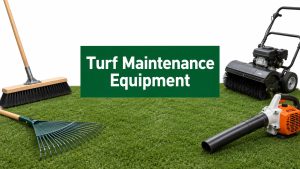
Routine care protects the appearance and function of the system. Remove leaves, litter, branches, and other debris before they settle into the fibers or cover drainage areas. Groom high-use zones so the fibers remain upright and the infill stays distributed. Inspect seams, edges, transitions, and drainage outlets as part of regular property rounds.
A practical commercial care routine
A responsible maintenance plan should address four areas:
- Surface cleaning: Remove debris and address spills using methods compatible with the turf and infill.
- Fiber grooming: Brush traffic lanes and gathering areas when the fibers begin to mat.
- Infill condition: Watch for displacement, low spots, and areas where repeated use has changed the surface feel.
- Drainage inspection: Keep inlets, channels, and outlet paths clear so the system can move water after storms.
Pooling deserves immediate attention. Standing water can indicate blocked drainage, settlement, compaction, or a problem outside the turf assembly. Waiting for the surface to “dry out on its own” can allow a correctable issue to become a structural or seam problem.
Practical rule: Treat drainage inspections as part of landscape maintenance, not as an emergency service reserved for visible failure.
Maintenance also supports warranty compliance. The product manufacturer may specify cleaning methods, grooming requirements, infill management, and prohibited chemicals. Give those instructions to the property team and document the work. A clear maintenance log helps the owner distinguish normal service from a workmanship concern.
The expected service life depends on product quality, installation, ultraviolet exposure, traffic, cleaning, and use. Some commercial systems can remain in service for many years, but no responsible installer should guarantee a universal lifespan without discussing the site. Ask for a written maintenance schedule tied to the selected turf system and the property's actual use.
Scheduling Your On-Site Property Consultation
A commercial turf quote based only on a phone call can hide the costs that determine whether the installation performs. A square-foot figure cannot reveal unstable soil, restricted access, blocked drainage, difficult transitions, rooftop limitations, or a base that needs complete reconstruction. Those conditions require an on-site inspection before anyone can price the work responsibly.
The quote also needs a clear scope. One contractor may include excavation, aggregate, compaction, edging, drainage connections, seams, and infill. Another may price only the visible turf and leave preparation, drainage, and transitions for change orders. The lower initial figure can become the more expensive project before tenants or customers use the space.
What a proper walkthrough should cover
A useful consultation produces the information required for a written, factors-based bid. The contractor should document:
- The intended use. A quiet courtyard, retail walkway, employee amenity area, and event space create different traffic and loading demands.
- Existing conditions. Soil, concrete, slopes, drains, irrigation, planting areas, and adjacent paving all affect preparation and water flow.
- Access and staging. Equipment routes, material storage, gates, elevators, loading areas, and work-hour restrictions can change the installation plan and labor requirements.
- Water management. The proposal should show where runoff goes, how the surface drains, and how new drainage work connects to the existing system.
- Material selection. The bid should identify the turf, backing, infill, edging, seams, and any specialized cooling or antimicrobial options.
- Ongoing care. The owner should receive maintenance expectations, warranty conditions, and a defined process for reporting concerns.
The right first step is a scheduled property walkthrough followed by a written bid. A phone price encourages comparisons based on appearance and square footage, even though drainage engineering, base compaction, and hardscape integration often determine service life. You can also review this SkipCalls guide for landscapers for background on handling inbound inquiries and keeping appointment workflows organized.
Fast lead response still matters after an inquiry arrives. A prompt acknowledgment should secure a qualified appointment with the person who can inspect the property, rather than produce a rushed promise or unsupported price. The scheduling process should collect the address, intended use, access constraints, known drainage concerns, and the decision-maker's availability before the visit.
“A clear scope is a trust signal. It tells the owner what the contractor has inspected, what the price includes, and where uncertainty still exists.”
A free, no-obligation consultation reduces buyer risk when it provides useful site information instead of a sales pitch. Ask the contractor to separate site preparation, drainage work, surface materials, installation, and projected maintenance in the proposal. That structure makes competing bids easier to compare and exposes low bids that omit necessary work.
For Austin property managers, request an on-site assessment and bring current maintenance costs, drainage concerns, access rules, and any planned changes to the property. Ask for a written scope tied to actual grading, drainage, use, and staging conditions. That gives ownership a stronger approval basis than a generic price per square foot.
Modern Yard Landscapes provides commercial turf design, installation, drainage-focused site preparation, and maintenance planning across the greater Austin area. Visit Modern Yard Landscapes to schedule a free, no-obligation on-site consultation and receive a proposal based on the property's actual requirements.