
You've got a backyard where a raised Ipe deck meets the area you want to turn green. The design looks simple on paper, but the first rain exposes the weak points. Water runs off the deck, collects at the turf edge, leaves and pet residue settle into the seam, and the dark boards throw heat back onto the grass.
That's why artificial grass with decking needs a different installation mindset from turf over ordinary soil. The turf is only one part of the system. The deck's fall, the drainage path, the edge restraint, the underlay, and the transition height all determine whether the finished space stays clean, comfortable, and stable.
Artificial turf has developed from a major sporting-venue installation at Houston's Astrodome in 1966, where ChemGrass was laid over compacted soil. A foam pad was added by the following year, and the surface soon became known as AstroTurf. By 2011, North America had more than 6,000 synthetic turf installations, with roughly 1,000 to 1,500 new installations added each year, according to Penn State's review of synthetic turf history. The technology is mature, but a deck still creates a specialized job-site problem.
Why Decking Changes the Whole Turf Project
Walk from the back door toward the deck edge and look down at the meeting point. Bare soil absorbs some rainfall and gives an installer room to shape a gradual grade. Decking doesn't. It acts more like a dam and a collection surface, sending water toward its low side and concentrating runoff precisely where the turf begins.
That changes the order of work. Before anyone unrolls a turf roll, the installer needs to answer three questions:
- Where does water leave the deck? Boards may shed water toward the planned turf, toward the house, or into a low corner.
- What holds the turf edge? Without a firm restraint, daily foot traffic can pull the edge away from the deck.
- How do the surfaces meet? A raised lip catches toes, while an unprotected gap collects grit, weeds, and moisture.
Decking also changes the heat profile. Wood, composite boards, and waterproofed hard surfaces absorb sunlight and release heat around the seam. A thick, dark, plush turf can feel unpleasant under bare feet in direct sun, particularly beside a pool or on a south-facing deck. Heat doesn't excuse poor drainage, and fast drainage doesn't guarantee comfort. The surface needs both.
Practical rule: Treat the deck edge as a structural joint, not as a finishing touch.
The transition deserves the same care as other premium outdoor living materials. Board direction, flashing, fastener placement, edge height, and turf clearance all affect the result. A clean installation also depends on understanding the layers beneath artificial turf, because the visible grass can't correct a weak or wet base.
The most reliable projects begin with a site conversation. An installer should inspect the deck frame, check the surface condition, trace runoff with a hose, and decide whether the turf will sit on the deck or beside it. Product selection comes after those decisions, not before.
Turf on Top of a Deck Versus Turf Beside a Deck
There are two very different ways to combine these materials. Turf on top of a deck covers an existing waterproofed or hard surface. Turf beside a deck uses the deck as one hardscape element and builds the turf area on a prepared ground base.
Turf on a deck is common on balconies, rooftop terraces, and concrete pads. The deck carries the entire drainage responsibility, so the surface must already have positive fall toward an outlet. A drainage mat can create a controlled path beneath the turf, while a bonded rubber underlay protects the waterproofing and softens movement. Full-surface adhesive may be appropriate on a suitable substrate, but board seams and movement can stress the bond. Infill is usually avoided on these installations because loose material can obstruct outlets and migrate into gaps.
Turf beside a deck is more common in residential yards. The turf sits on compacted decomposed granite or crushed aggregate, with the deck forming a firm boundary. This approach allows the base to be shaped and compacted independently, but it introduces its own problems, including edge creep, weeds at the seam, and ponding where the deck falls back toward the house.
| Factor | Turf on Top of Deck | Turf Beside Deck |
|---|---|---|
| Base | Waterproofed deck, concrete, or hard surface | Compacted granular ground base |
| Drainage | Depends on deck slope, mat, channels, and outlets | Depends on grading, base permeability, and edge detailing |
| Main risk | Trapped moisture, heat, and adhesive movement | Edge movement, weeds, and runoff collecting at the deck |
| Infill | Often omitted, subject to system requirements | Selected according to use, pets, heat, and fiber support |
| Best fit | Balconies, rooftops, and raised hardscape | Backyards where turf meets a deck at grade |
| Inspection priority | Waterproofing and outlet condition | Soil stability and transition restraint |
For a compact balcony, the guidance on fake grass for a balcony can help clarify the hard-surface approach. For an Austin backyard, don't price the project until you know which build path applies. Measuring the visible area alone won't reveal the drainage mat, edge plate, base excavation, or access work that the site may require.
Substrate Prep and Drainage Around Decking
A deck can send water toward the turf, trap it below the surface, or discharge it against the house. Check the existing structure before preparing the turf area. Stand at the low edge and follow the flow during rainfall or a hose test. Boards with open joints do not solve drainage if the structure is holding water or the outlets are blocked.
For turf beside a deck, build the base in a controlled sequence:
- Check the fall. A common design target for a flat artificial-grass surface is a 2% fall, equal to about 2.5 inches over 10 feet, as described in independent artificial grass installation guidance. The deck and turf base can use different materials, but both need a coordinated outfall.
- Separate unstable soil. Native clay can move and push the edge out of alignment. Austin's gumbo clay needs particular attention, so use a geotextile separation layer where the ground is expansive or drains poorly.
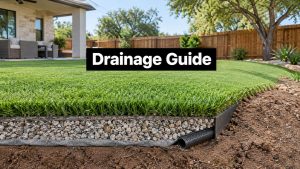
- Build the granular base. A practical residential target is a 3-inch compacted decomposed granite base, followed by a 1-inch fines layer for a smooth finish. Compact each lift with a plate compactor instead of trying to compact the full depth at once.
- Create the outlet. Send water to a low edge, channel, drain tile, or another approved discharge point. The turf should never be expected to correct a grade problem by itself. See our guide to artificial turf drainage systems for the full layout approach.
The deck edge also needs room for movement. Leave the required clearance around boards, posts, and fixed trim rather than packing the turf tightly against every obstruction. A compressed edge can restrict drainage and make later repairs harder.
For turf installed over decking, place a dimpled drainage mat first. Add a bonded foam pad where the system calls for cushioning and waterproofing protection. The mat provides a drainage path, while the pad accommodates minor movement. Neither component can correct a deck that holds water.

Before fixing the turf in place, run a hose over the deck for five minutes and watch the actual flow. Confirm that no standing water remains within 6 inches of the seam. Test drainage after subgrade completion and again before building the finished base. Professional patio laying advice for professionals also explains why falls, stable layers, and outlets must be resolved before surface finishes are installed.
Fast-draining turf does not guarantee a fast-draining installation. Research found that short and long artificial grass produced greater runoff than living grass, while living grass retained water and delayed drainage more effectively. Short artificial grass generally drained faster than long systems, a relevant distinction where turf meets a deck. The findings are discussed in research on runoff and water retention in artificial lawns.
Choosing Turf and Infill for Deck-Adjacent Installs
At a deck edge, turf must handle reflected heat, restricted drainage, and movement beside rigid boards. A showroom sample mainly shows color and fiber shape. It does not reveal how the backing will perform beside a hot surface or whether loose infill will migrate through deck gaps.
Start with pile height. A short 25 to 30 mm pile keeps the transition visually tight and is easier to groom near a threshold. A longer 35 to 45 mm pile looks softer and fuller, but may mat sooner in a busy strip and can retain more heat. Those ranges help you compare products, not guarantee performance in every install.
Backing needs the closest examination. Hole-punched latex systems can drain through their perforations. Polyurethane backing may form a more stable sheet when the product uses a permeable structure. Ask for the manufacturer's tested permeability instead of judging drainage from visible holes alone. Some specifications require permeable backing rather than perforations that may weaken tuft retention. Technical specifications commonly call for vertical drainage of at least 500 mm, or 20 inches, of precipitation per hour, without visible ponding, as stated in this synthetic turf specification.
| Product Type | Pile Height | Backing | Drainage Rate | Best Infill | Heat Behavior |
|---|---|---|---|---|---|
| Short transition turf | 25 to 30 mm | Permeable turf backing | Verify tested rate | Silica sand | Usually easier to cool and groom |
| Soft residential turf | 35 to 45 mm | Permeable backing with stable tuft support | Verify tested rate | Coated or specialty infill | Fuller fibers may retain more heat |
| Deck-overlay turf | Product-specific | Permeable backing over drainage mat | Depends on deck system | Often no loose infill | Heat depends heavily on shade and underlay |
| Pet-use turf | Short to medium pile | Permeable, odor-conscious system | Verify tested rate | Acrylic-coated or antimicrobial option | Cooling still requires shade or rinsing |
Silica sand is a practical lower-cost choice when basic fiber support is the priority. Acrylic-coated sand may suit some pet areas, while antimicrobial infill can be considered where pet runoff meets deck drainage. Containment still matters. Infill that reaches board gaps can obstruct drainage and make the edge untidy. Compare material types and containment considerations in this guide to sand infill for artificial grass.
Heat requires its own decision. Buying guidance for hot patios and poolside areas discusses low-pile, perforated turf, shade, and occasional hosing in guidance on artificial grass for hot patios and poolsides. A pale fiber, shade structure, and sensible pile height may improve comfort more effectively than selecting the thickest product.
Choose the shortest pile that meets your appearance and comfort goals. Specify documented permeable backing, then match the infill to pets, foot traffic, heat, and containment at the deck edge. A plush sample should never override the conditions on site.
Transitions, Edging, and Seam Details
The join between turf and deck boards is where a visually impressive installation can start to fail. The deck boards should generally run away from the turf edge so water sheds off the deck rather than being directed into the seam. If the boards run toward the turf, the edge needs additional drainage detailing to control that flow.
Two termination methods work well when selected for the site:
- Recessed composite edge plate: Fasten the plate to the deck frame so the turf ends against a firm, low-profile surface.
- Pressure-treated timber border: Bed the timber into the compacted sub-base, set it firmly, and use it as a contained edge for the turf system.
Galvanized U-pins can secure turf along a ground-side edge, while spikes may suit heavier soil or a timber perimeter. Adhesive can work on a clean wood rim, but it needs a compatible surface and proper curing conditions. At a back door or another busy threshold, use closer restraint and verify that the edge won't lift under repeated foot traffic.
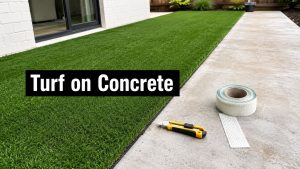
Cut the turf from the back with a fresh utility-knife blade. A straightedge helps with a long linear cut, while a careful template is better for a curved deck. Leave a small controlled gap between the turf fibers and deck boards. That clearance prevents the fibers from fraying against the wood and allows the boards to move without pinching the turf.

Seaming tape belongs on a firm, compacted base, never on soft soil. Brush the fibers away from the cut before applying adhesive so the seam stays hidden. Perimeter drains and lateral drains are standard elements in larger synthetic turf construction, and lateral drains may be spaced between 8 m and 15 m, depending on site conditions, according to the synthetic turf pitch performance standard. A residential deck edge won't necessarily need that layout, but the principle is relevant. Water needs a defined route, and silt traps can protect drains where loose infill or sediment may enter.
Maintenance When Turf Meets Decking
The two-foot strip where turf meets decking deserves more attention than the middle of the lawn. It receives foot traffic from the deck, catches leaves sliding off the boards, collects pet residue, and experiences the most concentrated heat. A maintenance routine built around that seam prevents visible problems before they become repairs.
The monthly seam routine
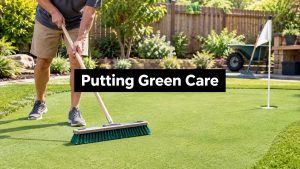
Brush against the grain near the deck to lift fibers that have flattened under traffic. Use a gentle hose stream to rinse grit away from the boards and toward the designed outfall, rather than blasting debris deeper into the joint. Blow or sweep leaves from the deck before they migrate into the turf, where damp organic material can interfere with drainage and create odors.
Pet areas need prompt cleanup. Use a turf-safe enzyme cleaner on the edge, rinse thoroughly, and check whether urine or cleaning water is wicking onto the deck boards. Inspect the board gaps for migrated infill, especially where runoff crosses the ledger or where the deck has open joints.
Seasonal checks that catch small failures
A pre-summer deep clean removes dust and residue that can increase the surface's uncomfortable feel in direct sun. Shading and occasional hosing remain useful cooling measures, even when the turf drains well. After a storm, inspect the edging for movement, look for new ponding, and clear any blocked outlet.
During a winter check, confirm that channels under the deck frame remain open. Leaves, soil, and loose infill can close a drainage path without changing the appearance of the turf above it.
Maintenance test: Every task should have a visible failure it prevents. Brushing prevents matting, rinsing prevents residue buildup, clearing leaves protects drainage, and checking fasteners catches edge movement.
Don't treat artificial grass as maintenance-free. It eliminates mowing and reduces routine lawn work, but the deck creates a concentrated maintenance zone. A short inspection at the seam is easier than repairing a lifted edge, stained board, or blocked outlet after the damage has spread.
Layout Ideas, Cost Drivers, and Next Steps
The layout controls the quote more than the turf color does. A narrow strip beside a deck may need little excavation but a long, carefully finished edge. A wrap-around design may use more turf while creating several corners, transitions, and drainage outlets. The right comparison is based on the complete installation system.
| Layout Pattern | Typical Sq Ft | Cost Drivers | Watch-Out |
|---|---|---|---|
| Turf strip beside a deck | Site-specific | Long edge profile, base preparation, narrow cuts, access | Runoff may collect along the full seam |
| Turf wrap-around with deck as a peninsula | Site-specific | Increased perimeter, corners, seams, edging, drainage detailing | More transition points mean more opportunities for movement |
| Raised deck over a turf bed | Site-specific | Deck modification, clearance, drainage access, hand work beneath structure | Hidden outlets can become difficult to inspect |
| Full backyard turf with a small deck pad | Site-specific | Total turf quantity, excavation, base depth, deck tie-in, access | The deck pad can concentrate runoff at one edge |
Square footage is only one line item. Deck demolition or modification can change the labor, while a turf-on-deck project may require drainage mat across the full covered area. Edge profile length matters because every linear foot needs a stable termination. Access matters just as much. A wheelbarrow-friendly side yard is different from a project where aggregate and tools must be carried through the house.
Austin sites add their own variables. Caliche subsoil may require more base preparation, HOA approval can affect the schedule, and irrigation stub-outs may need to be capped or relocated. These conditions should appear in a written estimate rather than emerging as surprises after demolition begins.
A trustworthy quote should show:
- Site measurement: Turf area, edge length, deck coverage, access route, and drainage outlets.
- Construction layers: Excavation, geotextile where needed, granular base, fines, drainage mat, underlay, and infill.
- Finish details: Edging type, seams, adhesive, fasteners, transitions, and cleanup.
- Schedule conditions: HOA timing, material availability, weather exposure, and any deck repairs.
A university research summary notes that there are no standard specifications for drainage gravel beneath an infill system, while an eight-year warranty is considered standard in the United States, as explained in Penn State's synthetic turf infill summary. Ask what the installer's warranty covers, how drainage is verified, and which components are excluded. Clear answers build more trust than a glossy product sheet.
For a deck project, the appointment should end with a measured plan, not a guess based on photos. A site visit can identify whether the turf belongs on the deck or beside it, where water will exit, and which edge detail will stay flush with the boards.
Modern Yard Landscapes provides artificial turf installation, drainage planning, base preparation, edging, seams, infill, and maintenance for Austin-area properties where decking and turf need to work together. Visit Modern Yard Landscapes to request an on-site measurement and schedule an appointment for a written, line-item quote.