
You step barefoot from the pool coping onto concrete in the Austin heat. The kids are dripping, the dog is tracking mud across the deck, and splash-out is running toward the house instead of away from it. That's when the surface stops being a background detail and becomes the problem.
Artificial grass by pool areas can make the space cleaner, softer, and easier to use, but only when the installer treats it as a complete drainage and surface system. A sample that looks good in a showroom won't solve chlorine exposure, direct sun, wet traction, trapped moisture, or failing edges by itself.
Why Poolside Turf Is Its Own Decision
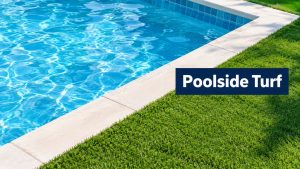
A pool surround lives through conditions a front-yard lawn rarely faces. Bare feet, splash-out, sunscreen, chlorine residue, reflected UV exposure, furniture, and regular cleaning all test the surface. Choose turf for the pool environment, not just for a convincing showroom color.
Synthetic turf's early milestones at the Moses Brown School in Providence in 1964 and the Houston Astrodome in 1966 helped establish the category. For a pool project, the useful lesson is performance. Poolside turf must bring together drainage, slip resistance, and durability. Domestic pool surrounds are commonly expected to provide a service life of about 12 to 15 years, and artificial grass can save as much as 40 gallons of water per square foot annually compared with natural grass, according to guidance on artificial grass around pools.
A pool quote is not a lawn quote
The installation specification starts below the blades. The base must be prepared for the site, the surface needs a deliberate slope, and the backing must move water through quickly. Edges should stay flush with the coping, seams need careful placement, and the turf face must withstand Austin sun and repeated chemical contact. Infill also needs enough stability to remain in place rather than washing toward the pool or its filtration system.
A contractor should inspect the coping, drainage path, slope, access, and surrounding hardscape before pricing the work. A small lawn sample cannot reveal how the full system will perform after heavy rain, daily splash-out, or years of traffic.
The practical test: If a contractor quotes your pool surround without discussing slope, drainage, coping, seams, and infill, you have not received a pool specification.
Choose the system by asking how it will handle wet feet, hot afternoons, chemical residue, and edge movement over time. Then schedule a site visit so the installer can measure the surround, confirm drainage, and recommend turf and infill for the actual property.
How Modern Poolside Artificial Grass Works
Pool-grade artificial grass functions as one coordinated system. The face fiber creates the visible surface and barefoot feel, the backing moves water through the turf, and the infill adds weight, supports the blades, and affects heat and traction.
For an Austin pool surround, specify the fiber construction rather than choosing by color or marketing label. UV-stabilized polyethylene or nylon fibers can be paired with a thatch layer for body and recovery. Polyethylene generally feels softer and more natural underfoot, while nylon offers added resilience in demanding areas. Tuft bind, pile height, fiber shape, and face weight determine how the surface feels when wet and how well it recovers from foot traffic.
The hidden layer controls the result
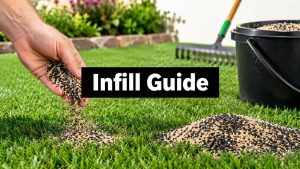
The backing should be perforated or otherwise highly permeable. Splash water and rain need a direct route through the turf, not a place to collect underneath it. Trapped moisture can contribute to odor, mold, and surface movement. Infill may consist of rounded silica, zeolite, or acrylic-coated sand, with the choice tied to stability, cooling, and maintenance needs.
A strong face fiber cannot compensate for restricted drainage. Good drainage also cannot correct an edge that lifts at the coping or infill that washes toward the pool and filtration system. New Jersey's environmental review identifies minimum drainage rates of 10 inches per hour for the turf, backing, and infill system, and 14 inches per hour for the base and finish stone. It also warns that synthetic turf can produce hotter local temperatures than natural grass during activity. These benchmarks and trade-offs appear in the New Jersey synthetic turf memorandum.
Judge the installation as one assembly. Face yarn, backing, base, slope, infill, seams, and edges must work together. Schedule a site visit before selecting a product, so the installer can assess chlorine and UV exposure, confirm drainage and slope, and detail the coping edges for your property.
The Four Technical Demands of a Pool Surround
A pool surround has four essential demands: water must leave quickly, feet must grip the wet surface, fibers must tolerate chlorine and UV, and the surface must remain usable in direct sun. If a quote only lists turf color and price, it leaves out the parts that determine performance.
Independent pool-turf guidance recommends a drainage benchmark of at least 30 inches per hour, along with a free-draining base of 3 to 4 inches of compacted open-graded aggregate and a 1% to 2% slope away from the pool. Use the artificial turf drainage systems guide to understand why the surface and the base need to be specified together.
| Demand | Target Benchmark | Why It Matters Poolside | What to Ask the Installer |
|---|---|---|---|
| Drainage | At least 30 inches per hour for poolside turf backing, based on independent installation guidance | Clears splash-out and rain before water remains under the surface | What drainage rate does the backing provide, and where does the base discharge? |
| Wet traction | Turf rated for wet traction and non-slip use | Wet blades, smooth textures, or clogged backing can increase slipping risk | Can you provide wet-traction documentation for this product? |
| Chlorine and UV tolerance | Documented resistance, not a verbal promise | Pool chemicals and strong sunlight can fade or weaken unsuitable fibers | Is the yarn UV-stabilized, and does the manufacturer document pool-chemical resistance? |
| Heat behavior | A design that remains usable in direct sun | Dark turf can become uncomfortable during hot Austin afternoons | What blade blend, infill, and shade plan do you recommend? |
A backyard lawn base may be adequate for ordinary foot traffic, but pool water exposes every weakness in grading and compaction. The surface also needs clean transitions at concrete, tile, pavers, or coping. Under a covered patio, ask about the product's fire classification if that application requires it, rather than assuming outdoor turf has the same rating everywhere.
The quote should identify the drainage class, pile height, face weight, infill type, base material, slope, and edge treatment. Those details let you compare systems instead of comparing samples.
How a Pool-Grade Installation Is Built From the Ground Up
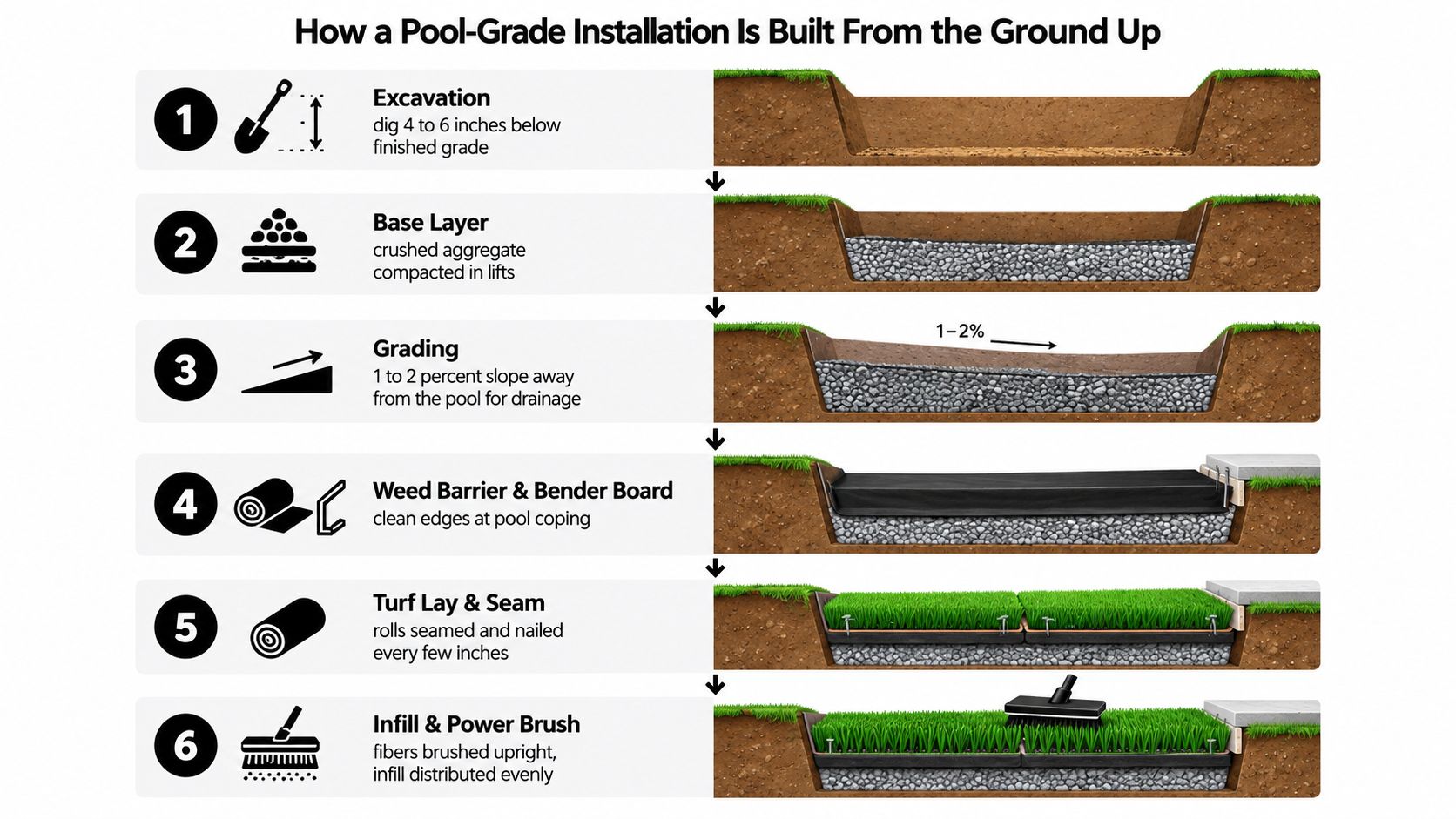
A pool-grade installation starts with the finished grade and drainage plan, not the turf roll. The crew excavates roughly 4 to 6 inches below finished grade when site conditions and the selected system require that depth. That space accommodates the aggregate foundation, turf, and clean transitions at the pool coping.
The base typically uses crushed aggregate or decomposed granite compacted in lifts. The installer shapes the base so water moves away from the pool at a 1% to 2% slope, then verifies the grade before laying the surface. Perimeter drains, catch basins, or a strip drain may be necessary when nearby concrete or pavers direct runoff toward the turf. Where the pool surround meets a concrete deck, review this guide to artificial grass drainage on concrete to understand how water is routed beneath the surface.
The sequence protects the finish
A weed barrier can separate the prepared base from unwanted growth. Some sites also benefit from an antimicrobial shock pad where comfort, impact absorption, or a more finished recreational surface matters. Choose that layer for the property and intended use, not by default.
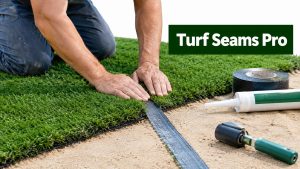
The crew lays the turf, aligns the grain, and prepares each seam. Seaming tape and polyurethane adhesive form a continuous joint when installed correctly. Nails or anchoring staples may secure selected edges, but the coping line requires a deliberate finish. Exposed fasteners and loose flaps have no place beside a pool.
Ask to see the edge detail before work starts. A well-built system still fails visually and functionally if the turf curls where wet feet enter and leave the pool.
Concrete coping, aluminum bender board, pavers, and tile each call for a different finishing method. The edge must stay flush, stable, and easy to clean. Water can enter beneath an unsealed poolside edge, while settlement beside the hardscape can disrupt the base and its drainage path.
The final stage covers infill distribution and power brushing. Brushing lifts the fibers, spreads infill evenly, and creates a consistent feel underfoot. Keep furniture and heavy traffic off the installation for two days of dry time so adhesives and finishing materials can set. Your quote should list excavation, base preparation, grading, drainage components, seams, edge treatment, infill, brushing, cleanup, and expected access restrictions. Schedule a site visit so the installer can assess slope, exposure, deck transitions, and the complete poolside system before recommending materials.
Managing Heat Around the Pool Without the Marketing Spin
A pool surround can feel hot enough to drive everyone back into the water. In a sunny Austin yard, direct exposure, blade color, infill, airflow, and nearby shade all affect barefoot comfort. Artificial grass is not automatically cooler than concrete, and broad cooling claims deserve product-specific proof. As noted earlier, synthetic turf can reach hotter local conditions than natural grass during activity.
Comparable peak-temperature data does not exist consistently across turf products, hardscapes, and climates. Treat that gap as a reason to request testing for the exact turf and infill proposed for your property, then judge the entire surround rather than one sample blade.
Build a cooling plan, not a slogan
Choose a lighter olive or tan-green blend instead of a very dark green face when heat is a concern. Tan thatch can also reduce the visual contrast between turf and hardscape. Cooling infill that holds moisture may slow heat gain, but it only works when the surface can be rinsed and water can move through the drainage system.
Shade usually delivers more practical relief than changing from one blade blend to another. A pergola, umbrella, shade sail, or well-placed tree can protect the spots where children and adults stand barefoot. Use this heat-resistant artificial turf guide to compare cooling approaches, then have an installer assess sun exposure, slope, drainage rate, and shade before selecting the system.
Ask for product-specific testing rather than accepting a generic temperature promise. Color, orientation, moisture, airflow, and shade can change how any surface feels, so a sample viewed indoors tells you little about the finished pool deck.
Use the barefoot test before opening the pool. Press the back of your hand to the turf for five seconds. If it feels too hot for your hand, it is too hot for children, pets, or guests to cross barefoot. Schedule shade and rinsing in the design, and book a site visit so the installer can match cooling infill, drainage, and edge details to the actual yard.
Chlorine, Saltwater, and Sunscreen What Your Turf Is Up Against
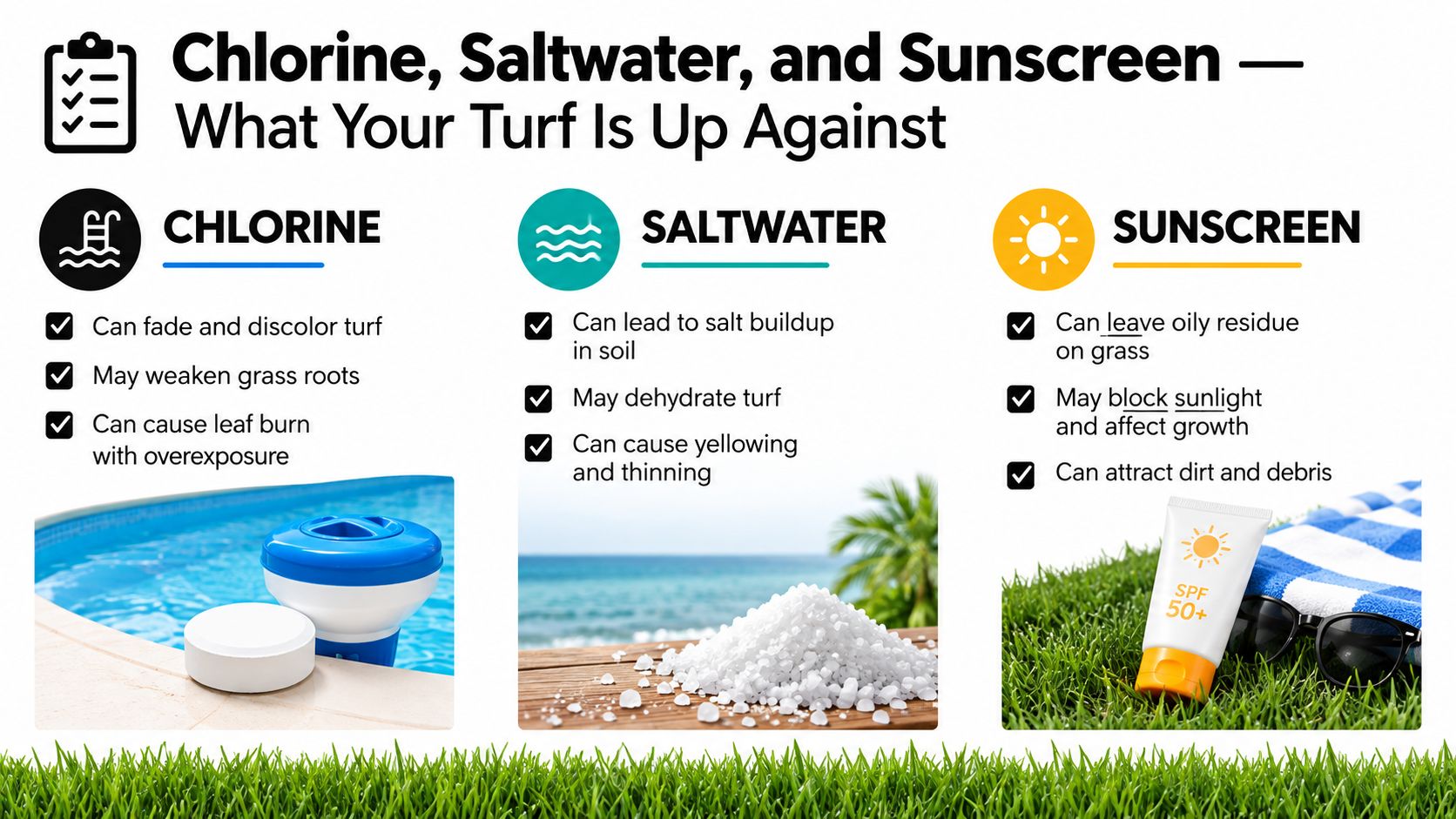
Poolside turf takes repeated exposure to substances that ordinary lawn turf rarely sees. Chlorinated splash-out, saltwater, sunscreen, drink spills, dust, and fallen debris can collect between fibers and reach the backing. The main concern isn't a single splash. It's residue that remains because the system isn't rinsed or the drainage path becomes obstructed.
Choose yarn with documented UV stabilization and pool-chemical resistance. A permeable backing reduces prolonged contact between residue and the underside, while appropriate infill supports stability and helps maintain the surface texture. Ask for technical documentation rather than accepting “pool safe” as the complete specification.
Maintenance is simple, but it isn't optional
Independent guidance recommends weekly rinsing in high-use areas, periodic brushing, and checking edges and seams every few months. Rinsing clears chlorine, salt, sunscreen, and dust before residue builds up. Brushing keeps fibers upright and helps prevent compacted debris from interfering with drainage.
The artificial turf cleaning guide can help you establish a routine, but the operating rule is straightforward:
- Rinse high-use zones: Pay particular attention to entry points, outdoor showers, and areas where swimmers sit or stand.
- Remove spills promptly: Pick up leaves, drinks, and pool-treatment materials before they stain or remain in contact with the fibers.
- Brush when fibers mat: Use a soft-bristle brush and work against the lay of the turf without damaging the backing.
- Inspect transitions: Look for lifted corners, open seams, or infill movement along the coping and drains.
A sanitary, functional pool surround depends on what happens after installation. Drainage that works on day one can perform differently if sunscreen, dust, and debris accumulate without routine rinsing.
Layout Ideas That Make the Whole Yard Feel Designed
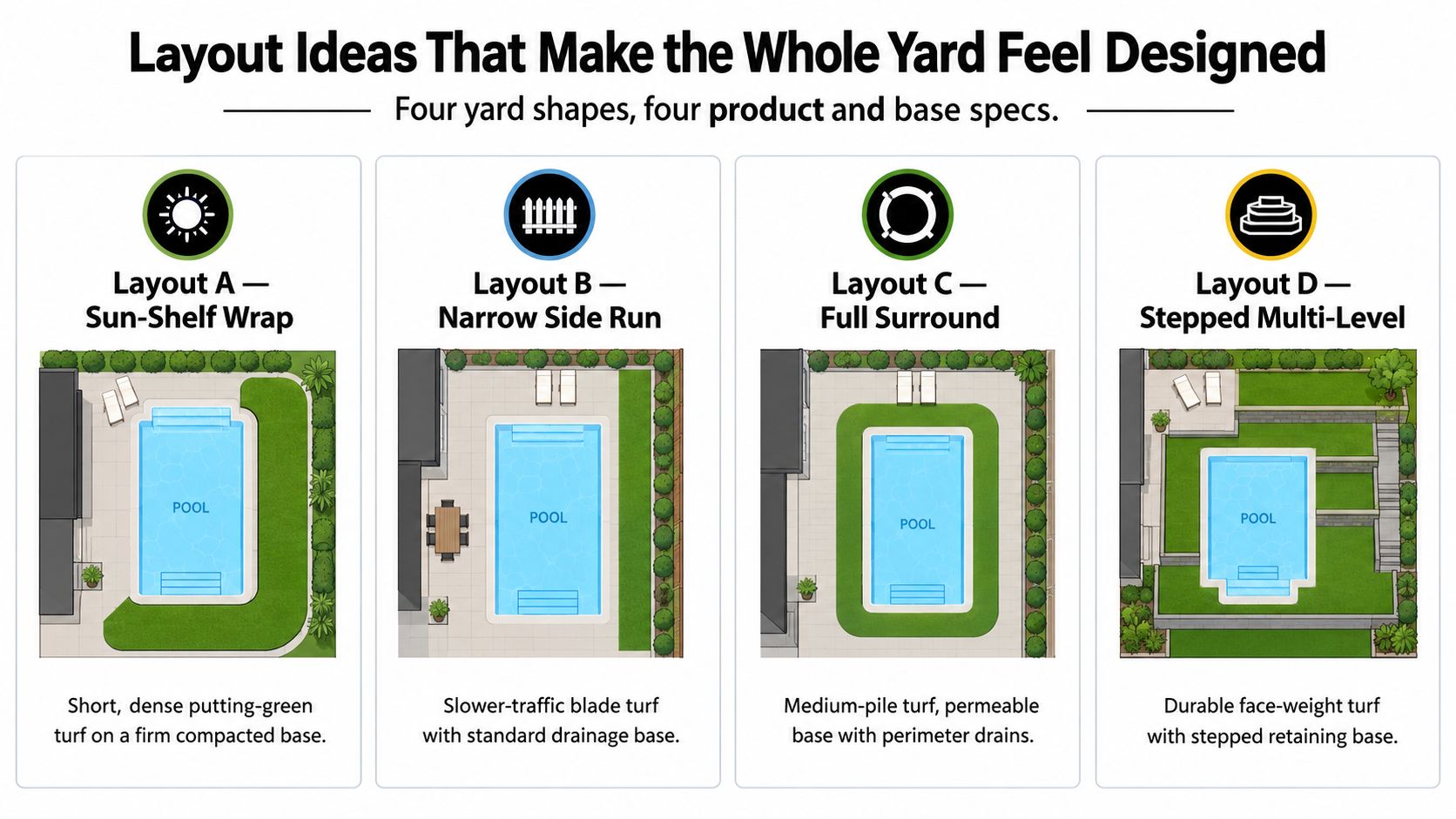
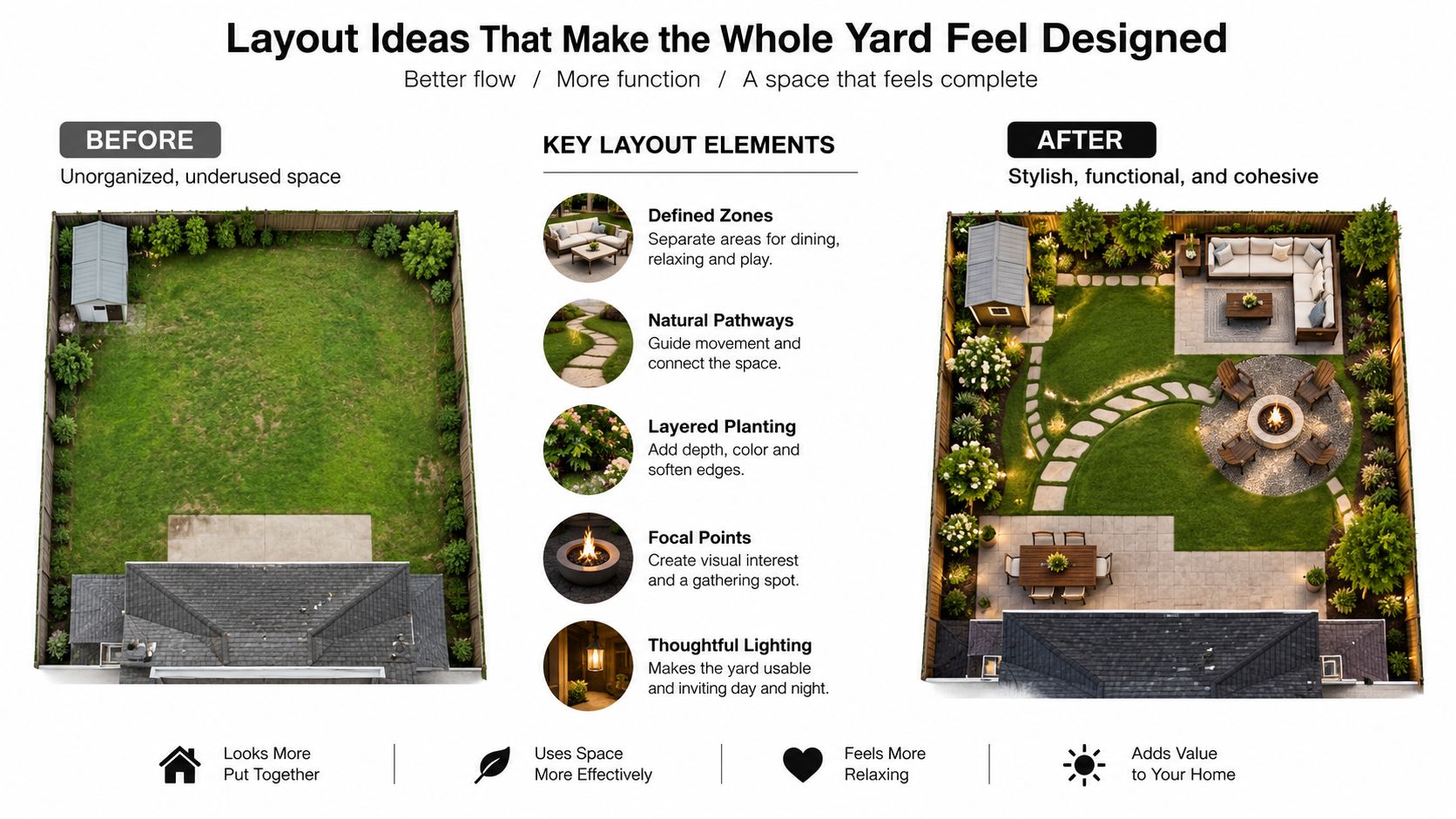
The best pool surround doesn't look like a rectangle of turf dropped beside the water. It creates deliberate zones for swimming, lounging, pets, circulation, and drainage. Start with the yard shape, then choose the turf and base system that supports how people use the space.
Four patterns that work
Sun-shelf wrap: Use short, dense putting-green-style turf near the waterline, then transition to a fuller turf farther out. A permeable base with a 2% slope toward a strip drain keeps the narrow water-facing zone intentional and easier to manage.
Lounge border: Frame a concrete or travertine pad with 6 to 8 feet of turf. A lighter face-weight blend can make the transition more comfortable under bare feet while visually separating furniture from the main walking route.
Full surround: Replacing the entire deck with turf requires the most disciplined drainage plan. Specify a minimum drainage rate of 30 inches per hour, then bond seams with marine-grade adhesive so the broad surface reads as one continuous field.
Pet and play perimeter: Choose antimicrobial infill where hygiene and animal use are priorities. Include a concealed irrigation sleeve so the surface can be rinsed without leaving hoses across the finished yard.
Each layout should have a product specification attached to it. Pile height affects feel and cleaning, face weight affects the amount of material in the surface, and backing determines how quickly water leaves the turf. Don't select from a sample square without seeing how the proposed product, base, slope, and drainage components fit your actual pool geometry.
A narrow side run beside a fence doesn't need the same design as a full surround. A stepped yard may need retaining work before turf. A high-use play area may justify different infill from a quiet lounge border. Good design makes those distinctions visible before installation begins.
Ready to See It on Your Property
After a heavy Austin storm, watch where water collects around the pool. That pattern, along with afternoon sun and splash-out, determines whether the turf system will perform or fail.
Before scheduling a consultation, gather three details:
- How does water move through the yard after rain?
- Is the pool finish plaster, pebble, tile, or another material?
- Does the proposed turf receive full afternoon sun, partial shade, or changing exposure?
Those answers guide the base, drain placement, edge transition, turf color, infill, and cooling plan. Require a site visit that includes a property walk, a laser check of substrate slope, and a written specification before signing. The document should identify the turf type, base depth, drainage route, seams, edge treatment, and infill.
Modern Yard Landscapes provides residential and commercial artificial turf installation, pool-surround design, drainage work, maintenance, and cooling or antimicrobial infill options across the Austin area. Its site preparation process addresses drainage, access, and topography, with material and labor estimates based on the actual project rather than a generic lawn price.
A properly specified and installed pool surround should serve as a 12 to 15-year surface, provided the drainage, chlorine and UV resistance, infill, slope, and edges match the property. Choose appearance after those performance details are settled.
Schedule a free on-site consultation with Modern Yard Landscapes to evaluate your pool's slope, coping, sun exposure, drainage path, and preferred turf feel. You'll receive a written poolside specification, giving you a clear plan instead of a sample-driven guess.