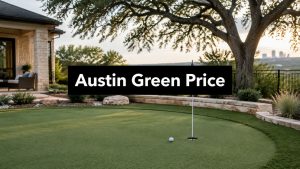

A typical residential backyard putting green commonly costs between $3,500 and $9,000 installed. Size and the condition of your yard move that figure once slopes, access, and drainage enter the quote.
The spread around that middle band is the part most ads skip. A 1917 industry report listed about $513.43 in materials and $507.08 in labor and overhead for two greens, $1,020.51 in total, so crew time and site work already matched the surface itself, according to that historical golf-course construction report. The same split still decides a backyard putting green price in Austin. The cheapest advertised rate per square foot often becomes the highest final bill after base preparation, drainage, and Central Texas clay are priced in.
Match your square footage to a size band first. Then add the site work your lot needs before you compare anyone's number.
Backyard Putting Green Price Ranges at a Glance
In the U.S. residential market, a backyard putting green commonly costs $3,500 to $9,000, while broader projects run from about $2,500 to $75,000 when design, landscaping, and accessories change, according to Angi. Custom builds more often sit at $15 to $40 per square foot. A loose planning band of $4 to $40 is too wide to budget from.
| Scenario | Size or type | Estimated range | What pushes it higher |
|---|---|---|---|
| Typical residential artificial green | Standard backyard | $3,500–$9,000 | Access, slopes, drainage fixes |
| Small green | Under 400 sq ft | $25–$40 per sq ft | Fixed setup spread over less area |
| Medium green | 400–2,000 sq ft | $20–$30 per sq ft | Grading and edging |
| Large green | Over 2,000 sq ft | $15–$25 per sq ft | Excavation volume and haul-away |
| Artificial green, all sizes (Homes.com 2025) | Kit to custom build | $1,500–$16,000 | Design complexity |
| Real-grass green, all sizes (Homes.com 2025) | Sod or bentgrass | $5,000–$25,000 | Irrigation and upkeep |
Read the rows as unit price, not as a finished invoice. Small greens under 400 square feet average $25 to $40 per square foot because excavation, base work, and edging are fixed and get spread over less area. Medium greens from 400 to 2,000 square feet average $20 to $30. Large greens over 2,000 square feet average $15 to $25. Angi notes that a 200-square-foot green can land around $5,000 to $8,000 in base construction, while a 1,000-square-foot project can run about $20,000 to $30,000 before unusual grading, walls, or accessories.
Artificial turf material itself is about $5 to $25 per square foot, against about $1 to $2 for natural sod. That turf line is not the project. Excavation, base, labor, drainage, cups, flags, fringe, and contours still sit on top.
In 2025, Homes.com put artificial backyard greens at $1,500 to $16,000 and real-grass greens at about $5,000 to $25,000. Find your size band, start from that range, then adjust for slope, gate width, and where water leaves the yard.
What Moves the Price and What Quotes Leave Out
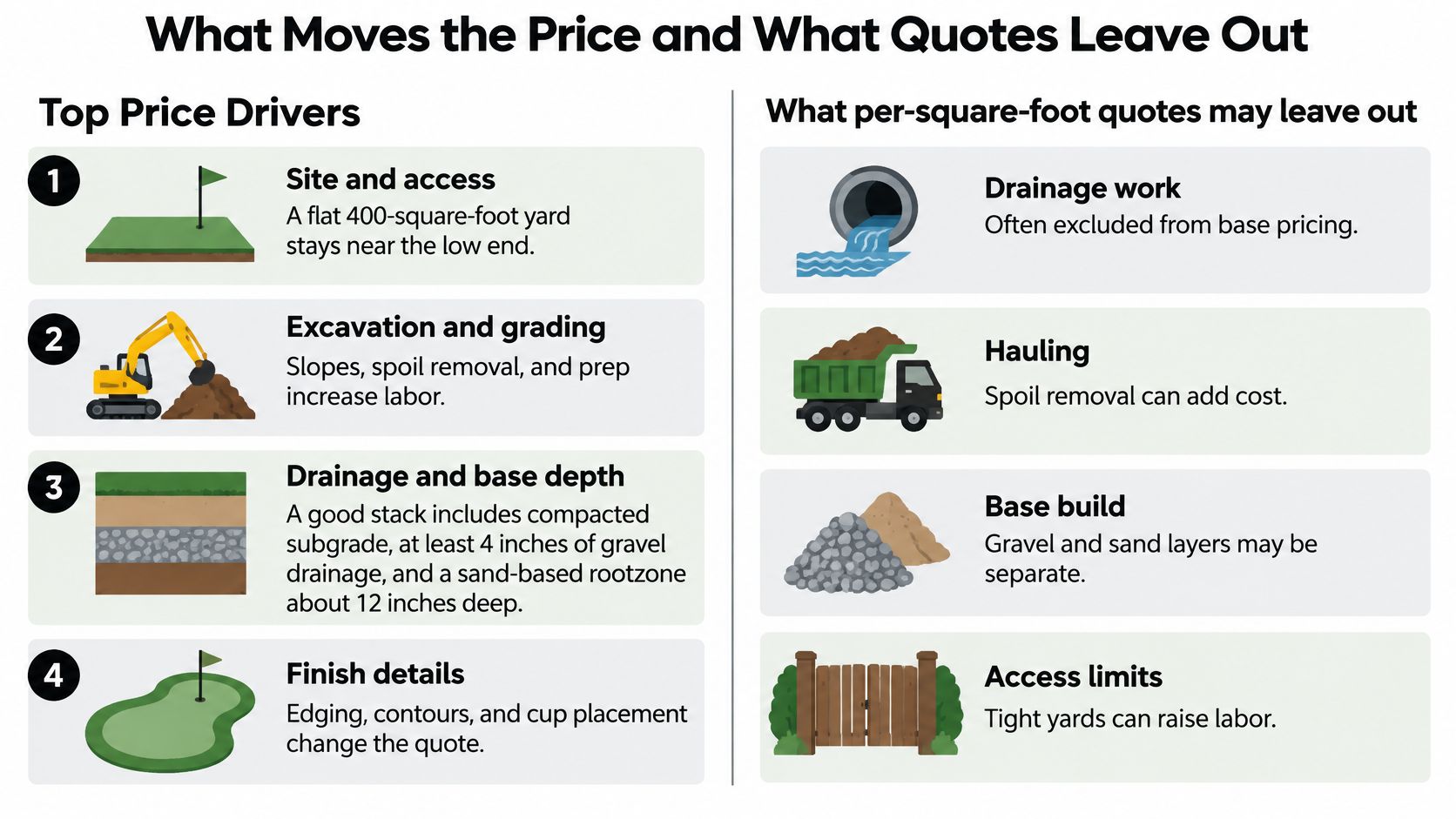
A flat 400-square-foot pad with an open gate stays near the low end of a band. The same area on a steep Austin grade, behind a narrow gate, or above a retaining wall does not. Haul paths get slower, equipment stays smaller, and labor hours climb before a roll of turf shows up.
Most price guides stop at a per-square-foot range and never price the yard. USGA Green Section guidance puts a properly built bentgrass green near $18 to $20 per square foot before irrigation, a synthetic green near $25 per square foot for the green and surround, and premium custom work sometimes above $30. That same guidance cites a wider installed band of $15 to $40 per square foot and typical totals of $3,500 to $9,000. The useful question is what your lot adds.
Five drivers, in the order they hit the invoice
Site and access come first. Expansive clay, a pronounced grade, a tight side yard, or tree roots change crew time more than fibre brand does. We bring professional-grade equipment for confined gates and tight backyards, but a wall or a long hand-carry still shows up as its own line.
Base and drainage come second. Excavation depth, soil export, aggregate, pipe, and outlets often pass the turf line. Turf material in the $5 to $25 range, or sod near $1 to $2, is only the surface.
Surface spec is third. We price fibre material, yarn denier, blade density and height, backing, durability, features, infill, and where the product is made. Putting greens use specialized sand infill so ball speed stays consistent. Polyethylene is the mid-range residential fibre. Nylon costs more and is usually reserved for heavy traffic.
Design is fourth. Cup count, contour complexity, a chipping fringe, and edging change both material and shaping time. Cleaning is included in our putting green package, so you should see that called out rather than assumed.
Later extras are fifth. Lighting and electrical, antimicrobial or cooling infill, root removal, and lawn restoration belong on the sheet if you want them. Leave them off and the "complete" bid is not complete.
Line the bids up before you pick a rate
Practical rule: If one bid is missing haul-away, drainage tie-ins, or the apron around the green, it is not the cheaper project. It is an unfinished one.
Ask for demolition, soil removal, drainage, access limits, retaining structures, edging, electrical, and surrounding areas as separate categories. Compare usable green area with the full covered footprint, including the apron. Then compare cups, flags, fringe, and edging one for one. Fibre choices are easier to judge once you see how turf types differ on denier, density, and backing. A thin base that ponds in a few seasons turns the low advertised rate into a rebuild.
Why Base Preparation Makes Up Much of the Cost
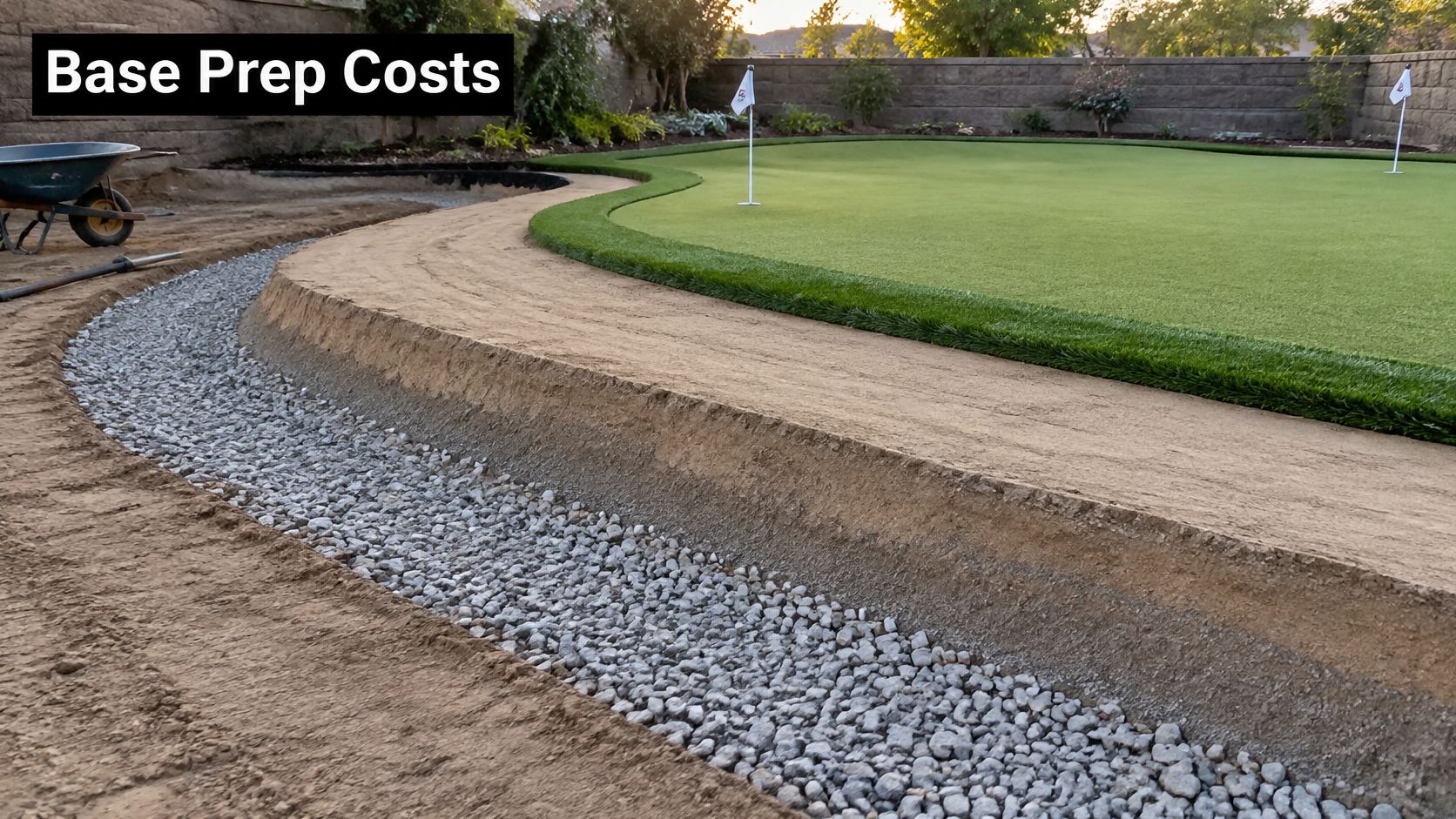
The price follows the stack under the turf, not the square footage printed on the invoice. USGA putting green construction guidance specifies a compacted subgrade, a gravel drainage layer of at least 4 inches, and a sand-based rootzone about 12 inches deep. Drainage pipes are generally spaced no more than 15 feet apart and set on a continuous slope of at least 0.5%.
What each layer costs you
Excavation has to make room for roughly 16 inches or more of layered structure. Imported gravel, rootzone material, pipe, geotextile or separation fabric, and disposal are direct material and hauling costs. A narrow gate or a sloped haul path multiplies labor and equipment time on every one of those loads.
Skip a layer and the first invoice drops. The green then risks differential settlement, low spots, ponding, and breaks that no longer match the design. That is a resurfacing job, not a maintenance visit.
For an Austin yard the pricing question is simple. Does this lot need a full engineered drainage assembly, or will a simpler compacted aggregate base hold grade and shed water? We install a professional sub-base built for rapid drainage in heavy rain across Austin, Round Rock, and Georgetown. The base materials under synthetic grass are what keep contours stable after the first big storm.
A useful quote names excavation depth, aggregate quantities, and drainage outlets on their own lines. One blended square-foot price hides all three.
Ask for those three items in writing. If the bidder cannot separate them, you cannot tell whether you are buying a green or a carpet over clay.
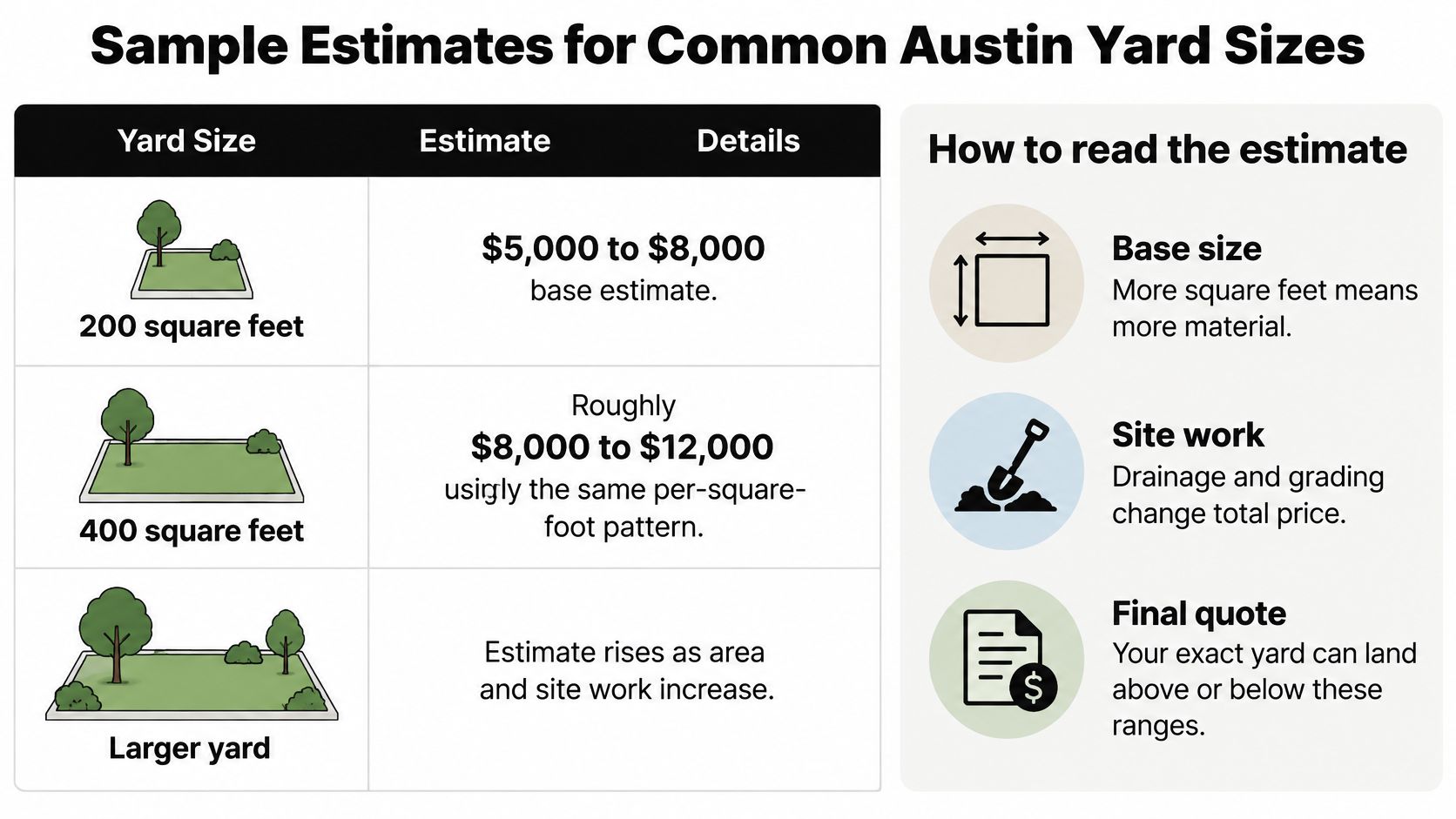
Sample Estimates for Common Austin Yard Sizes
Budget by size first, then adjust for the lot. Larger turf areas generally cost less per square foot, while installations under 500 square feet often have a higher per-square-foot rate because setup costs remain similar.
| Green size | Base estimate | What changes it |
|---|---|---|
| 200 sq ft putting green | $5,000–$8,000 | Simple access and a flat grade |
| 400 sq ft putting green | $8,000–$12,000 | Edging and one drainage outlet |
| 1,000 sq ft putting green | $20,000–$30,000 | Grading, drainage, and chipping fringe |
| 2,000 sq ft putting green | $30,000–$50,000 | Large excavation and multiple drainage lines |
| Steep 500 sq ft yard | Size-band price plus wall and haul-away | Retaining wall and haul-away |
How each sample moves
A 200-square-foot green at $5,000 to $8,000 assumes a flat pad and usable gate access. A slope or hand-carry can push the price toward the top of the range because setup costs are spread across fewer square feet.
A 400-square-foot green at $8,000 to $12,000 works out to about $20 to $30 per square foot. A single drainage outlet and straightforward edging fit that estimate. Another outlet, a fringe, or grade changes can raise it.
For a 1,000-square-foot project, $20,000 to $30,000 allows for grading, drainage, and a chipping fringe. Open access supports the lower end; a steep lot requiring a retaining wall adds cost.
At 2,000 square feet, budget $30,000 to $50,000, consistent with the large-green range of $15 to $25 per square foot. A steep 500-square-foot yard needs a separate allowance for its retaining wall and haul-away, so the size-band price alone is not a finished estimate.
Schedule and heat
Most residential turf installations take 2 to 5 days, depending on yard size. Plan gate access and pet routines around that work window. In Kyle, Lakeway, and Bee Cave, ask about shade, suitable infill, or cooling infill if the green gets full sun.
Record the area, slope, and access points before requesting a quote. Those details help you compare estimates on the same basis.
Warranty Terms That Protect Your Investment
Price without a readable warranty is only half a bid. The Federal Trade Commission says a written warranty must be available before you buy, in person or online, and coverage can run from broad protection to very limited protection.
A provider you can trust states four things before you commit.
- Warranty period. Name the years, not a slogan.
- What is covered. Split materials from workmanship. The mill covers the product. The installer covers how it was built.
- Exclusions. Improper maintenance and damage should be listed, not discovered after a call.
- How you request service. Who you contact, and what happens next.
Phrases like "lifetime warranty" or "total satisfaction" do not mean much until those four items are on paper. Federal rules only bind a business after it chooses to offer a written warranty. A verbal promise on a sales call is not that document.
Questions worth asking on the same call as the price
- What counts as a defect? Seam failure, edge lift, and a base that ponds are different from normal wear.
- How fast must you report it? A short window you miss is not coverage.
- Are repairs or adjustments included? Know whether a return visit is part of the price.
- Who pays for work outside the original scope? A new cup or a later light run should not hide inside a warranty claim.
On our quote form, Turf Repair sits beside install options, so ongoing support is a service you can select rather than a favor you hope for. Read the artificial turf warranty terms next to the installation charge and compare ownership cost, not just the day-one bid.
If a company will not show the warranty document before you schedule, treat that as a warning, not a detail to sort out later.
Whether a Putting Green Pays Off for Your Home
Set the install price next to how often the household will putt. An artificial green often lands between $1,500 and $16,000. A real-grass green runs about $5,000 to $25,000 before irrigation. A typical residential project is $3,500 to $9,000. A 1,000-square-foot custom build can reach $20,000 to $30,000 before walls or specialty contours.
Use is the first check. If you putt several times a week, divide the quote by the sessions you expect over five years and compare that per-use figure with drive time and a bucket of balls. One of our customers says his handicap dropped by four strokes after a green went in at home. If you are tuning equipment while you practice, it helps to compare golf ball options so the roll you train on matches what you play.
Upkeep is the second check. Natural bentgrass adds irrigation and maintenance that sit outside an $18 to $20 per square foot construction figure. Synthetic shifts spending into the base and the surface, near $25 per square foot, and drops most of the watering. Our typical turf jobs cut water bills 60 to 70%. A thin base that ponds can still force a resurfacing, so the low bid is not the low lifetime cost. Day-to-day care stays simpler when you follow a backyard putting green maintenance routine instead of a mowing and fertilizing calendar.
The property is the third check. Buyers can see a finished green. It only earns its keep when it matches how you use the yard. Weekly play, room in the budget, and drainage plus warranty written into the quote are the three yeses that matter. Miss one and wait.
Book a Free Austin Consultation for Your Exact Price
Modern Yard offers a free turf quote in Austin and a free turf consultation. Get a recommendation based on your budget, lifestyle, and how you use the yard.
Before requesting a quote, note your green's size, slope, access points, and any areas that hold water. List the features you want, such as a chipping fringe or cups. On the quote form, select Turf Install + Putting Green, Turf Repair, Retaining Wall, or Drainage Tile.
Ask for a quote that clearly shows what the project includes, so you can compare bids on the same scope. If you track practice results, handicap guidance for data-driven golfers can help you assess whether home sessions are improving your index. Bring the sample table and warranty checklist from this guide when you request your free quote or book a consultation.
Modern Yard builds custom putting greens with surfaces designed for both chipping and putting. Visit Modern Yard Landscapes to request a free Austin quote and get a price based on your yard.