

You walk outside after a few months of weekend practice and notice the putting green feels different. Leaves have collected around the cup, the turf looks flattened along your favorite putting line, and the ball no longer tracks as true as it did after installation. The surface may still look acceptable from the patio, but small maintenance problems often appear in the roll before they become obvious to the eye.
Backyard putting green maintenance isn't about making artificial turf look tidy. It protects the base, keeps fibers standing, preserves even infill, and helps drainage work after Austin storms. The right routine is manageable for many homeowners, but it requires more than occasional sweeping. Professional care adds another layer of value by identifying seam movement, drainage restrictions, and infill loss before those issues become repairs.
Preserving Your Putting Green Investment
A backyard putting green is easy to enjoy and easy to neglect. Weekend play concentrates traffic around the same cup, the same approach path, and the same place where players stand before addressing the ball. Over time, those areas can mat, lose infill, or develop a different ball response from the rest of the surface.
That decline usually starts without warning. A putt that once held its line begins to wobble. A low area collects water after a storm. Debris works into the fibers, and the surface loses the clean, consistent appearance that made the installation worthwhile. The financial cost of neglect isn't limited to appearance. Uneven edges can create trip hazards, while a damaged base or failed seam may require more intrusive work than routine grooming would have required.

What proper care protects
A sound maintenance program focuses on four practical outcomes:
- Consistent fibers: Brushing lifts flattened turf and helps the surface respond more evenly.
- Stable infill: Grooming redistributes infill instead of allowing traffic lanes to become noticeably depleted.
- Clear drainage: Perimeter drains and low points remain open to move stormwater away.
- Early detection: Small seam, edge, and cup problems are easier to correct than a deteriorated section of green.
Synthetic turf still needs care, even though it doesn't need mowing, fertilizing, or the irrigation routine associated with natural turf. The durability of artificial grass depends partly on how well owners remove debris, manage traffic, and respond to drainage or heat.
Practical rule: A green that looks clean isn't necessarily a green that plays correctly. Check the ball roll and the surface structure, not just the color.
Homeowners also benefit from thinking about the green as part of a larger outdoor space. If a putting area meets a deck, patio, or retaining edge, compatible decking and railing materials can help create a cleaner transition and reduce the chance that loose exterior materials migrate onto the turf. That detail matters because small stones, mulch, and sharp debris can damage fibers or interfere with a true roll.
Modern Yard Landscapes approaches maintenance as an inspection as well as a cleaning visit. That means checking traffic zones, cup areas, edges, infill, and drainage instead of treating the green as a surface that only needs sweeping. Homeowners can perform much of the routine work themselves, but knowing what to inspect is what separates useful care from cosmetic care.
Weekly and Monthly Grooming Tasks
The most reliable routine is simple enough to follow and disciplined enough to prevent avoidable wear. Start with a visual inspection, then remove debris, brush the turf, check the infill, and look at the cup and perimeter. The sequence matters because brushing debris deeper into the surface makes later cleaning harder.
A weekly surface routine
Use a soft leaf rake, a non-abrasive synthetic-turf broom, or a suction system designed for delicate surfaces. Avoid metal tines, aggressive rotary brushes, and heavy equipment that can catch fibers or disturb the backing.
- Remove debris first: Clear leaves, twigs, dirt, and pet waste before brushing. Organic material left in the turf can contribute to staining and unpleasant odors.
- Brush against the dominant traffic direction: Use a manufacturer-approved broom to lift fibers and redistribute infill. Comparable infilled synthetic sports surfaces use brush penetration of less than 5 millimeters, typically about 3 millimeters, to avoid excessive disturbance of the backing while still lifting fibers and moving infill. Research on infilled synthetic surfaces supports a light, controlled approach.
- Rinse only when the surface needs it: A light hose rinse can remove dust and pollen, but don't turn rinsing into an automatic watering schedule. Let site conditions guide the decision.
- Inspect the cup area: Check whether the cup liner sits flush and whether foot traffic has displaced nearby infill.
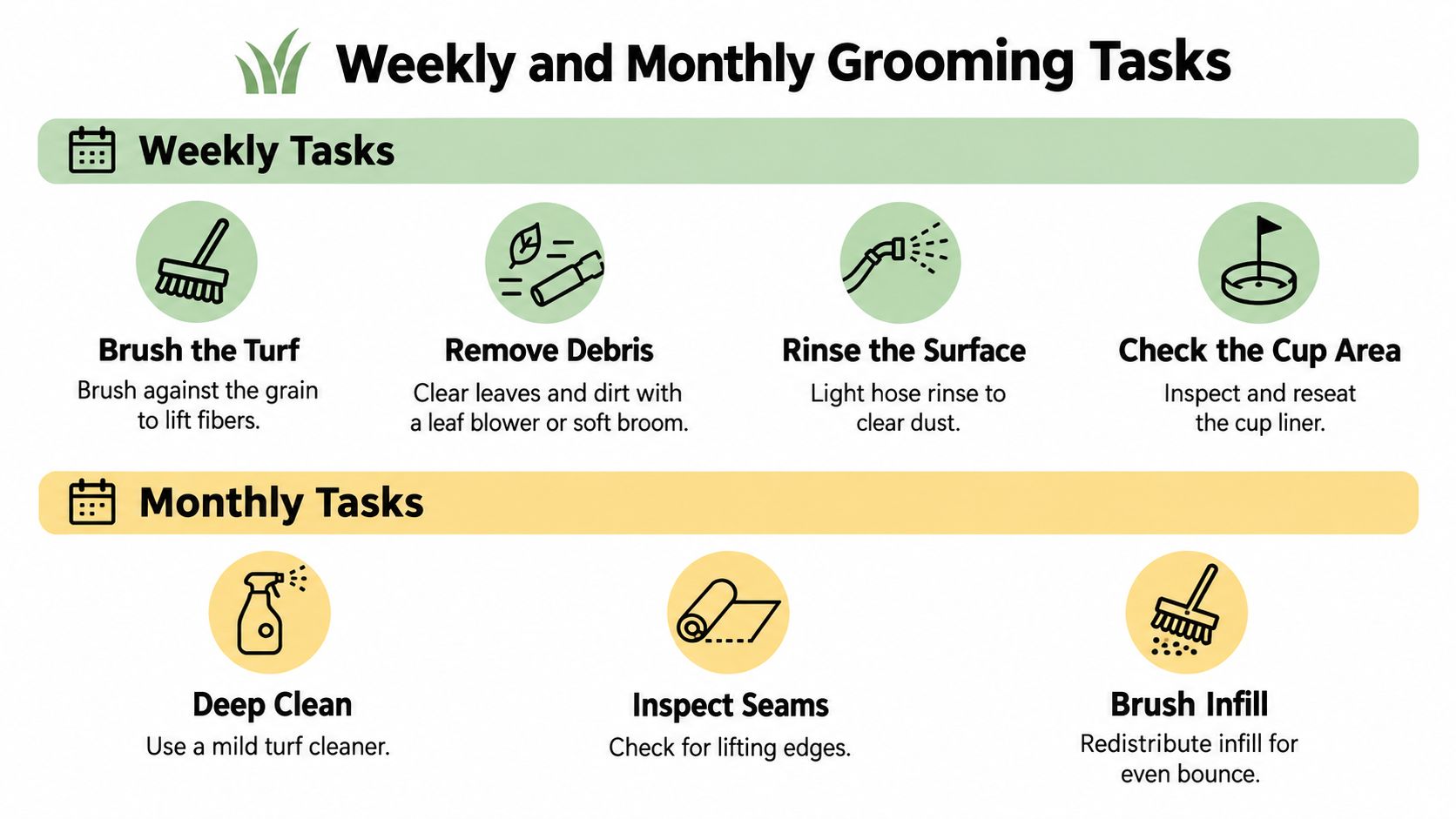
Light residential use generally calls for weekly inspection and brushing, or an additional visit after heavy play. High-use greens may need grooming several times each week. The correct interval depends on traffic, surrounding trees, pets, weather, and the turf manufacturer's requirements.
Monthly inspection points
Once a month, walk the perimeter and inspect areas that a quick playing session won't reveal. Look for lifting edges, shifting seams, exposed backing, low infill in standing zones, and debris trapped where the turf meets hardscape. Check drainage grates and outlets as well, particularly after strong weather.
A soft broom is safer than a household push broom with stiff or damaged bristles. If you need a cleaning solution, use a mild turf cleaner approved for the specific surface. Don't apply solvents, harsh degreasers, or unapproved chemicals because they can affect fibers, backing, or infill.
A professional brush can make a meaningful difference, especially when traffic has created directional matting. The artificial turf maintenance brush guide can help homeowners choose a tool that matches the surface rather than relying on a generic outdoor broom.
Seasonal Adjustments for Austin Climate
Austin weather changes the maintenance priorities throughout the year. Summer exposes the surface to intense solar loading, fall brings leaf accumulation, winter can reveal drainage weaknesses, and spring often exposes areas that settled or collected debris during the wet season.
Summer heat requires judgment
Synthetic turf can become considerably warmer than natural grass at midday. Shade is one of the more promising ways to reduce surface heat, while irrigation provides only brief cooling. A 2025 review from the New Jersey Department of Environmental Protection describes one cited study in which applying 0.75 inches of water twice reduced surface temperature, but the temperature recovered within an hour. The review also cautions that irrigation-based cooling may be unsuitable during drought conditions. Read the New Jersey synthetic turf review.
For an Austin green, check the surface before inviting children or guests to play during the hottest part of the day. Shade planning, earlier or later play, and an inexpensive surface thermometer provide better information than guessing from the air temperature. Don't repeatedly hose the green just because it feels hot. Cooling infill or rinsing the surface doesn't remove the underlying solar load.
Fall and winter preparation
Clear leaves promptly with a soft leaf rake or suitable blower. Wet organic debris is heavier, mats fibers, and can block low drainage points. Pay special attention to corners, cup areas, and the transition between putting turf and surrounding terrain.
Before winter weather, inspect seams, perimeter anchors, and drains. You don't need to overwork the surface when growth and use are low, but you do need to prevent blocked drainage from turning into standing water. After major storms, inspect low points once the rain has stopped and confirm that water is leaving the green rather than collecting at its edge.
Spring is the right time to review the entire surface. Look for changes in ball roll, softened edges, displaced infill, and areas where soil or mulch may have migrated onto the turf. A professional inspection is especially useful if a section remains wet longer than surrounding areas or if the green feels uneven underfoot.
Austin's watering rules also matter. The city currently restricts automatic and manual irrigation systems to one day per week, with the permitted day and watering window determined by the property's address. The listed windows are midnight to 10:00 a.m. or 7:00 p.m. to midnight, while hose-end sprinklers and drip irrigation may be permitted on additional days under the applicable schedule. Verify the current schedule through Austin's watering-day guidance before recommending irrigation or rinsing.
Troubleshooting Ball Roll and Drainage
Ball roll gives you useful diagnostic information. If a familiar putt starts breaking differently, first compare the affected line with a nearby line that receives less traffic. A change limited to one lane often points to matting or infill depletion. A change that affects a broad area may indicate movement below the turf, drainage trouble, or an uneven base.
Read the symptoms before reaching for equipment
| Symptom | Likely Cause | Immediate Action |
|---|---|---|
| Ball slows or hops in a traffic lane | Flattened fibers or low infill | Remove debris, brush lightly, and inspect infill depth |
| Putt changes direction near a seam | Seam movement or backing irregularity | Mark the location and avoid aggressive brushing until inspected |
| Water remains after nearby areas drain | Blocked perimeter drainage or a low point | Clear visible debris and monitor the area after the next storm |
| Surface feels hard underfoot | Compaction or restricted infiltration | Check drainage and arrange an evaluation if the condition persists |
| Cup area looks depressed | Concentrated foot traffic or local settlement | Compare the area with the surrounding grade and check the liner |
Infill depletion is common where players repeatedly stand, turn, and address the ball. Don't add material by eye. Compatible infill must be distributed correctly, and adding too much can alter surface response. A technician should also check whether the apparent low spot results from missing infill or from movement in the underlying base.
Drainage needs a site-based diagnosis
Watering should respond to actual conditions rather than a fixed calendar. In research covering five Central Florida golf courses, University of Florida researchers found that water application could be reduced by as much as 20% before visible turf-health deterioration occurred, while average irrigation-distribution uniformity on greens was only 60%. Although the study concerns natural golf-course greens, it reinforces an important maintenance principle: a schedule alone doesn't prove that water is reaching the surface evenly. Review the irrigation-distribution research.
For artificial turf, inspect where water collects, how quickly it leaves, and whether drains remain clear. A small amount of debris can combine with infill fines and restrict a perimeter outlet. If water repeatedly pools in the same location, brushing won't solve the underlying issue. The artificial grass drainage resource explains why surface symptoms can point to problems below the visible turf.
A useful test: Compare the same putt before and after grooming, then compare the surface again after rain. If the problem returns, treat it as a drainage or base question rather than a cleaning question.
DIY vs Professional Servicing Decision
Homeowners can handle routine debris removal, light brushing, cup checks, and visual inspections. The decision changes when the work involves powered grooming, infill calibration, seam repair, drainage diagnosis, or a surface that no longer responds consistently after basic care.
| Maintenance need | DIY may be reasonable | Call a professional when |
|---|---|---|
| Leaves and loose debris | You have a soft rake or suitable blower | Debris is embedded or mixed with infill |
| Light brushing | Traffic is light and fibers respond normally | Matting returns quickly or covers large zones |
| Infill checks | You understand the approved material and local low spots | Infill is depleted across traffic lanes or has become uneven |
| Seam and edge inspection | No lifting, wrinkles, or movement is visible | Edges lift, seams shift, or the surface creates a trip risk |
| Drainage review | Water leaves normally after storms | Pooling repeats or drains remain slow despite clearing |
| Deep grooming | You own suitable equipment and know the manufacturer's limits | The job requires powered brooms, controlled brush depth, or specialized spreading |
The equipment gap is practical, not theoretical. A homeowner may own a leaf blower and broom, but most don't keep a powered brush, specialized infill spreader, compatible replacement material, and the tools needed to assess a shifting base. Incorrect pressure can disturb the backing, while incompatible infill can change the way the ball rolls.
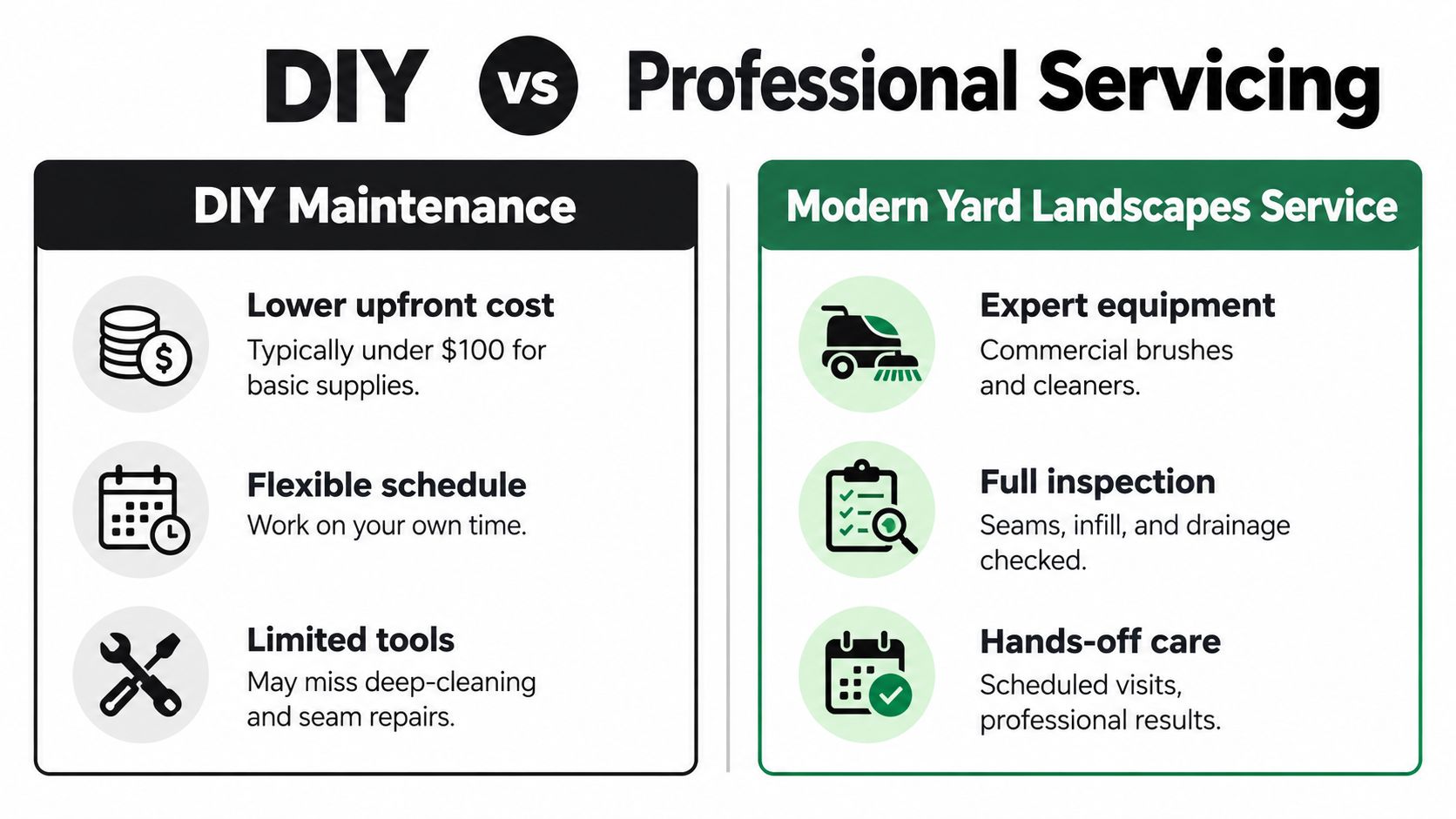
Professional service also creates documentation. A trustworthy provider should be able to tell you what was brushed, where infill was checked, whether edges and seams were inspected, and what drainage observations were made. Modern Yard Landscapes offers scheduled artificial turf and putting-green maintenance that can include brushing, debris removal, selective infill replenishment, edge cleaning, and post-storm checks.
The right provider won't claim that every issue requires a service call. If your green only needs a soft-bristle brushing and debris removal, do that yourself. Schedule an inspection when the ball roll changes repeatedly, standing water returns, or you can't identify why a section feels different.
Schedule Your Professional Green Care
A putting green lasts and performs better when maintenance matches the surface, traffic, weather, and drainage conditions. Weekly grooming can handle ordinary debris and light matting, but recurring roll changes, infill loss, seam movement, and pooling deserve a closer evaluation.
Modern Yard Landscapes serves Austin-area homeowners with artificial turf maintenance, putting-green care, drainage work, and landscaping support. The company is fully insured and offers a total satisfaction guarantee, but the most useful first step is a clear inspection that explains what the green needs and what it doesn't. Review the available artificial turf maintenance services and request an appointment when you want a documented assessment rather than a quick cosmetic sweep.

Modern Yard provides scheduled putting-green grooming, debris removal, infill checks, edge and seam inspections, and drainage-focused maintenance for Austin homeowners. Visit Modern Yard Landscapes to request an inspection and schedule care that keeps your backyard green playing consistently.