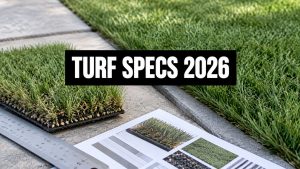

A green sample in a showroom is not a specification. FIFA's quality programme for football turf treats the installed field, not the roll in the warehouse, as the performance unit, and it sets a minimum critical fall height of 0.60 m for the relevant impact assessment. That number reframes the whole purchase. If a bid can't show how yarn, infill, shock pad, seams, and base work together under a named test, the color of the fiber doesn't matter.
Artificial turf specifications are the measurable values that let you compare two Austin bids on the same basis. Pile height, face weight, denier, tuft bind, backing, drainage rate, infill depth, and service life either show up with a method and a threshold, or they are marketing. A well-written sheet is the owner's best protection, because it is what you can hold a contractor to after the first summer, the first storm, and the first year of paws or cleats.
Use the chart below as a lookup, then demand the data sheet and the field test that override it. If a salesperson won't put the number, the test method, and the acceptance rule in the proposal, don't sign.
Core Artificial Turf Specification Numbers at a Glance
An artificial turf specification is a set of measurable values. Appearance alone says almost nothing about how the surface will stand, drain, or wear after years of use. Read the chart as a comparison tool, not a catalog. Each row is a starting range for three jobs that get mixed up on bids: a residential lawn, a pet run or putting green, and a high-traffic or sports area.
| Specification | Residential lawn | Pet run or putting green | High-traffic or sports | Explained in |
|---|---|---|---|---|
| Pile height | 1.25-1.75 in (32-44 mm) | 0.5-1.0 in (13-25 mm) | 1.0-1.5 in (25-38 mm) | Pile Height, Denier and Face Weight Explained |
| Face weight (oz/yd²) | 50-70 | 60-80 | 70-90 or higher | Pile Height, Denier and Face Weight Explained |
| Denier (yarn thickness) | 8,000-11,000 | 10,000-13,000 | 12,000-16,000 | Pile Height, Denier and Face Weight Explained |
| Tuft bind (lbf) | 8 minimum | 10 minimum | 12 minimum | Backing and Tuft Bind Specs That Keep Turf Anchored |
| Backing | Polyurethane primary, latex secondary | Reinforced polyurethane primary | Dual-layer polyurethane, reinforced | Backing and Tuft Bind Specs That Keep Turf Anchored |
| Drainage rate (in/hr) | 20 or more | 30 or more | 30 or more | Drainage Rates and Base Layer Build-Up |
| Infill depth (in) | 0.5-1.0 | 1.0-1.5 | 1.0-1.75 | Infill Compatibility and Summer Heat Performance |
| Expected service life (years) | About 8 | About 8 | About 8 or less under heavy traffic | Service Life Benchmarks and What Shortens Them |
How to read the ranges
Start at pile height, because it sets the look and the upkeep. Move to face weight and denier, which decide whether that height stays upright. Then check tuft bind and backing, which decide whether tufts stay in the cloth. Drainage rate and infill depth are system numbers. They fail when the base is thin, even if the turf roll tested well in a lab. Service life is a planning benchmark, not a promise printed on a brochure.
Practical rule: If the manufacturer's data sheet or an independent field test disagrees with this chart, the test wins. These ranges only stop you from comparing a show lawn to a dog run as if they were the same product.
Check three numbers first on any bid. Pile height, face weight, and drainage rate are the ones that most often separate a durable install from a surface that flattens, wears through, or ponds within two or three seasons. A tall, light face looks plush on day one and mats under a path to the gate. A heavy face on a base that doesn't pass water still smells and shifts. The same logic shows up when crews are managing drainage on school sports fields, where the surface spec is useless if the stone underneath can't move water. Ask for those three with units and a test method before you debate color.
Pile Height, Denier and Face Weight Explained
Pile height is the length of fiber above the backing, in inches or millimeters. A 1.5-inch pile feels plush underfoot and suits a residential lawn, but it traps more leaves, pet hair, and dust, and it needs more infill to stay upright. A 0.75-inch pile on a putting green gives a faster, truer roll and is easier to groom. Putting a lawn pile on a green, or a green pile on a play yard, is how bids look cheap and then disappoint.
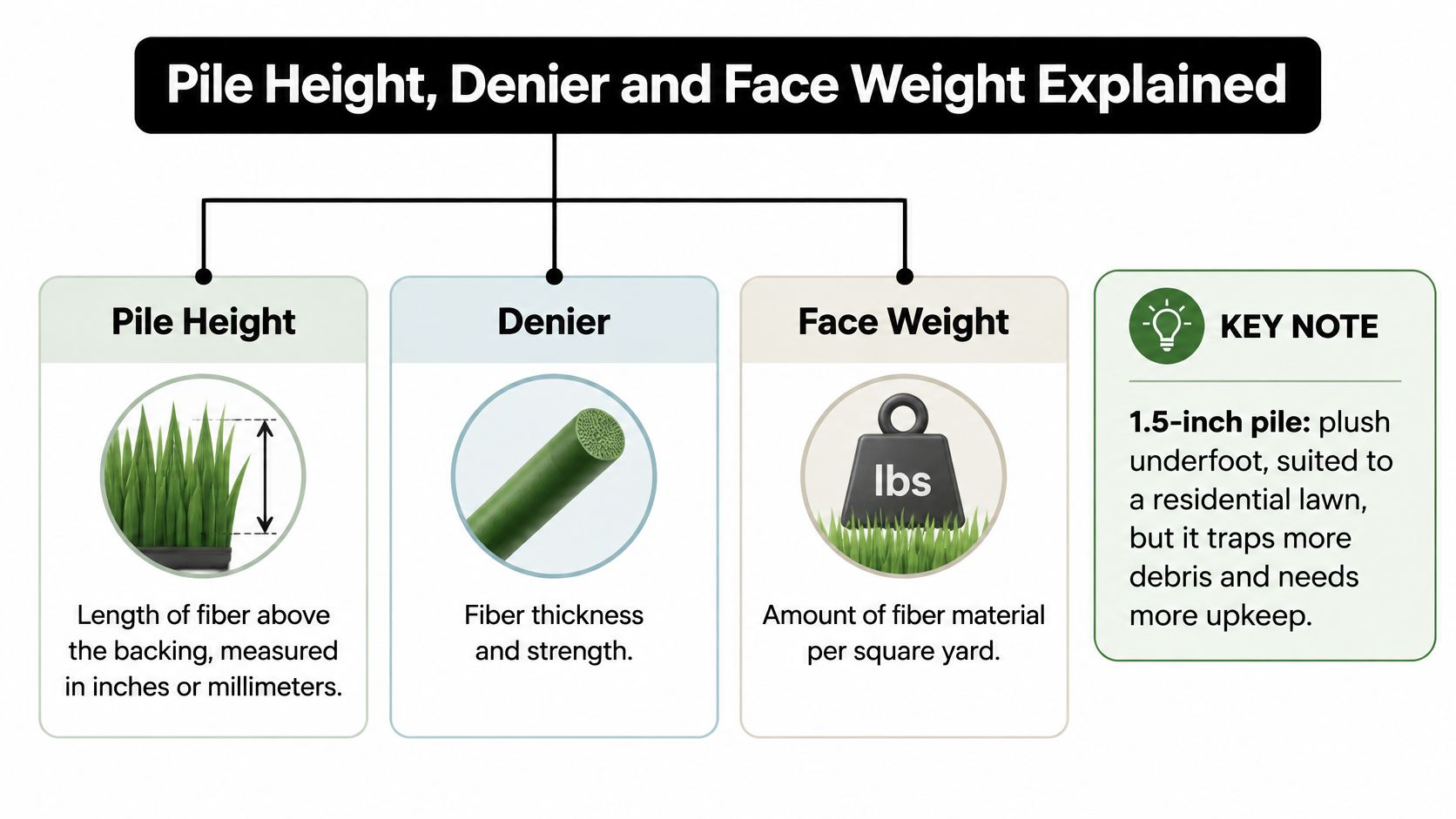
Face weight is the total yarn weight per square yard, in ounces, not counting the backing. Compare a 60-ounce face with a 90-ounce face on the same pile height. The heavier face has more fiber in the same footprint, so it holds its shape longer under foot traffic and dogs. It also costs more, and it needs a planned infill depth so the blades don't splay or stand in a stiff mat. A light face can pass a glance test in the driveway and still show a worn path by the second summer.
Denier and the trade-off
Denier is the thickness of a single yarn, measured as grams per 9,000 meters of fiber. Higher-denier yarns resist crushing and UV breakdown, which matters under Austin's hard summer sun. A dense, heavy, thick-yarn turf costs more and lasts longer. A light, low-denier product can look sharp on installation day and mature poorly, flattening in traffic lanes and fading on the south side of the yard.
That triangle is the whole purchase. You don't get plush height, low face weight, and thin yarn, then also get a surface that stays upright. Pick the job first. Lawns can spend some of the budget on height. Greens and pet runs should spend it on density, shorter pile, and yarn that doesn't mat when it's washed. The main artificial grass types differ in polymer and construction, so the bid should name polyethylene, nylon, or a blend, not just "premium grass."
Make the environmental claim testable
Each of these numbers should arrive with its measurement method, so two bids are comparable. The same standard applies to chemical claims. ASTM F3782-26 describes sampling synthetic-turf fiber and finished turf fabric at the manufacturing location, measures total fluorine by combustion ion chromatography to the parts-per-million level, and determines targeted PFAS through liquid chromatography/tandem mass spectrometry, with results reported at the parts-per-billion level.
A trustworthy sheet states whether testing covers the fiber, the finished backing, or both, names the testing location, and gives the units and method. That is how you separate a documented claim from an unsupported "PFAS-free" line.
If the bid cites performance tests for impact, drainage, or metals, ask for the full method name and whether the result is lab material or the installed field. A summary slogan is not a test report.
Backing and Tuft Bind Specs That Keep Turf Anchored
The backing is the structure that holds every tuft. If it is thin, soft, or poorly coated, no face weight will save the install. Read it from the cloth outward, and tie each layer to a failure you can see.
The primary backing is usually a woven polypropylene sheet. Yarn is tufted through it. On its own, that sheet does not lock the fibers. The secondary coating, usually polyurethane or latex, locks the tufts and seals the back. Polyurethane generally stays more stable in heat and moisture. A bargain latex coat can harden, crack, or let tufts loosen where the yard stays wet. For a lawn, a polyurethane primary with a latex secondary can be enough. Pet runs want a reinforced polyurethane primary. Sports and heavy commercial work want a dual-layer polyurethane backing. Put that construction in the spec, not "heavy-duty backing."
Tuft bind is a pull-out number
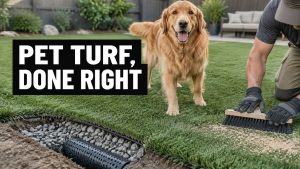
Tuft bind is the force, in pounds-force, required to pull a tuft out under a stated test method. A low number shows up as pulled or loose tufts in traffic lanes, dog runs, and corners where people turn. Say a dog run gets daily claw traffic. A weak bind can show loose tufts in the first year, often along the path from the door to the favorite spot. The same product with a tight bind and a reinforced coat can stay intact for the warranty term, provided the infill depth is maintained so claws meet fiber and infill, not a bare stitch.
Ask for tuft bind on the new roll and after simulated wear. A fresh-roll number that collapses after wear is a showroom number. On the chart, treat 8 lbf as a residential floor, 10 lbf for pet runs and greens, and 12 lbf where cleats, furniture, or constant turning are expected. Those are acceptance floors for comparing bids, and the lab method should be named beside them.
Holes and seams
Drainage holes in the backing, counted per square foot, let water leave the turf. They don't replace the base. A perforated roll over compacted clay still ponds. Seams are the other weak line. Seam tape, adhesive, and the stitch or glue pattern should be specified, and you should see a seam sample before you approve the bid. A poor seam splits along foot traffic as a pale line, then a gap, then a trip edge. Nail-only seams on a pet run are a shortcut. Adhesive rated for exterior heat, with the seam rolled while it cures, is the detail that holds.
Inspect the back of a sample with a light. You want an even coat, no bare tuft rows, and holes that are open rather than smeared shut by coating. If the installer can't show that sample next to the seam detail, the price isn't comparable to a bid that can.
Drainage Rates and Base Layer Build-Up
Drainage rate is the speed at which water passes through the installed surface, in inches per hour. For sports areas and pet runs, set 30 inches per hour as the common minimum on the bid. Residential lawns can start at 20 or more if the yard is sloped and the soil isn't tight, but don't treat a turf-only lab number as the installed rate. Infill, backing holes, and the base-stone layer all contribute. Clogged infill or a smeared coating can cut a roll that looked fast on paper.
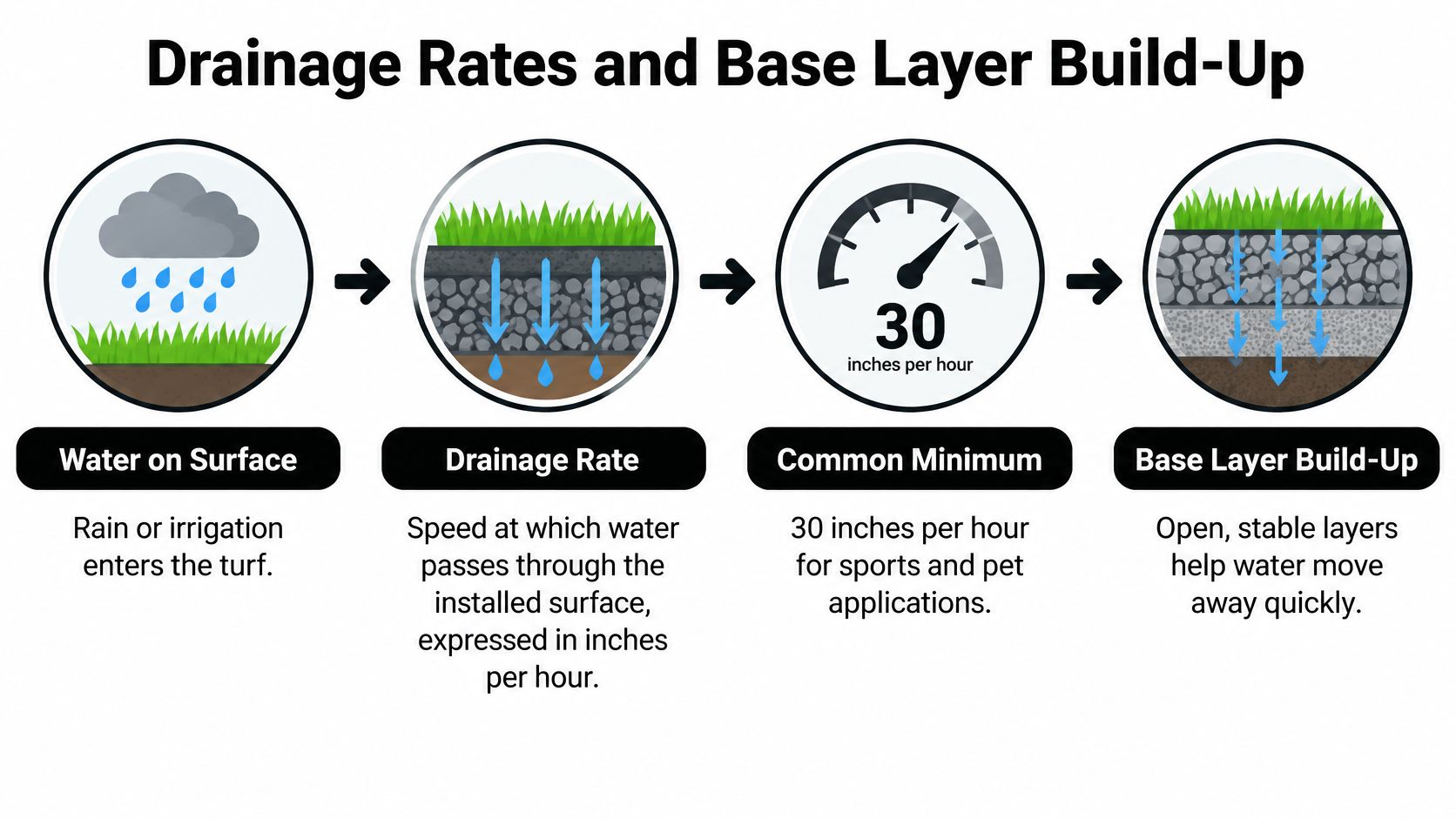
Build the base from the ground up, and write each layer into the proposal.
- Compacted subgrade. Scalp organics, shape the soil, and compact it. A soft subgrade pumps under the stone and prints as dips in the turf.
- Geotextile fabric. This keeps clay and fines from migrating into the rock. Plastic sheeting is the wrong product. It traps water.
- Crushed aggregate. Use about 3 to 4 inches for residential work and 4 to 6 inches for heavy-use or commercial areas, compacted in lifts. Open, angular stone, not uncompacted sand.
- Leveling layer. A thin decomposed-granite or fines layer lets you set grade without creating a buried bathtub.
- Optional shock pad. Add it where fall height or comfort is part of the spec, and include it in the impact test, not as an afterthought.
Austin's heavy clay holds water and swells in wet seasons. A base that looks adequate on a section drawing can still pond after a storm if the subgrade isn't graded and drainage tile isn't added where water has nowhere to go. Slope, tight side yards, and poor access change the design. A crew that can't get a compactor to the back corner shouldn't promise the same section as an open front yard. The base material for artificial turf has to match that access and that soil, or the drainage rate on the turf label never shows up in the yard.
A flood test on the finished surface belongs in acceptance. If water sits after a normal storm, the install isn't done, regardless of the brochure rate.
The base is the layer people cut to save money. Correcting a failed base means pulling the turf, the infill, and often the fabric. That cost lands far above the cost of specifying depth, fabric, compaction, and slope before anyone digs.
Infill Compatibility and Summer Heat Performance
Infill affects stability, drainage, and surface temperature. Specify its type and depth alongside the turf yarn, or bids cannot be compared on equal terms. Choose for the way the area will be used, then require a measurable heat check on the installed surface.
| Infill type | Heat behavior | Drainage and weight | Best fit |
|---|---|---|---|
| Silica sand | Runs hot in direct sun; cooler when watered | Heavy; drains with a suitable base | Residential lawns and putting greens |
| Crumb rubber (SBR) | Can run hot at the surface and 1 inch depth | Lightweight; odor and microplastic concerns noted by regulators | Sports fields with written heat protocols |
| Thermoplastic elastomer (TPE) | Moderate; varies by color and product | Lightweight; consistent granule size | Play areas and pet runs |
| EPDM rubber | Runs hot; color affects results | Moderate weight; stable under traffic | Commercial and athletic use |
| Cooling infill (coated or mineral) | Designed to reduce surface temperature | Lighter than sand; requires a permeability test | Hot-climate residential and commercial areas |
| Organic infill (cork or coconut) | Moderate; can break down over time | Light; needs replenishment | Short-term or low-traffic areas |
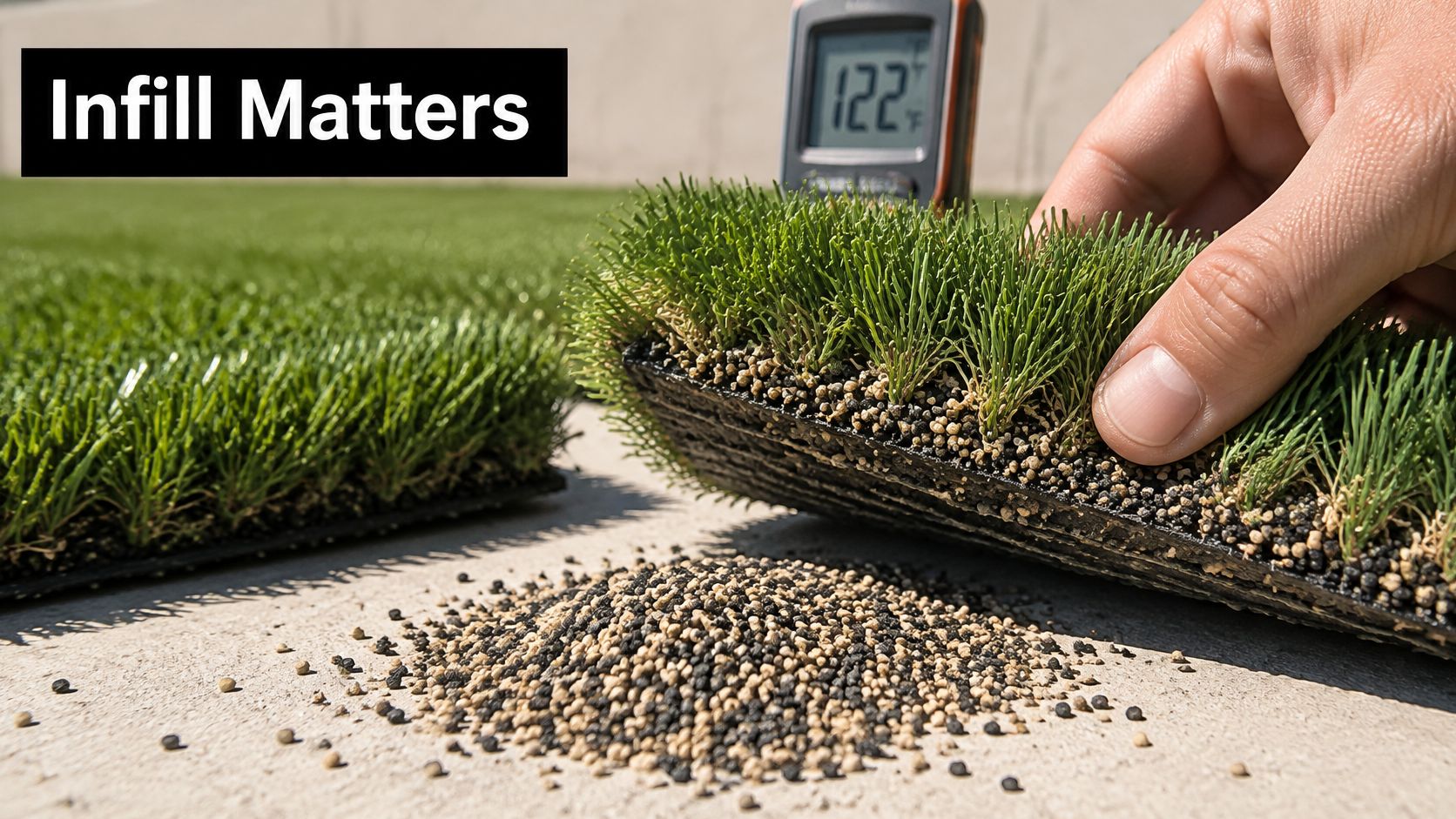
Silica sand is a practical default for lawns and greens: it ballasts the fibers and drains when the base is open, but it heats up in full sun until watered. Crumb rubber is lighter underfoot and can become especially hot, so specify it only where a heat protocol is in place and enforced. TPE suits play areas and pet runs when consistent granules matter. EPDM is used for commercial and athletic settings, but color affects heat performance, so specify the color rather than treating all granules alike. Cork and coconut can feel moderate, then break down. Choose them for low-traffic or short-term use, not a set-and-forget lawn.
Heat is a spec line, not a feature name
The New Jersey Department of Environmental Protection's 2025 review found that synthetic turf can create substantial heat exposure, and that cooling performance depends on design and operating conditions. Artificial surfaces in full sun typically run noticeably hotter than natural grass. Recycled-rubber play surfaces can become dangerously hot, so measure the actual site rather than assuming a product name guarantees a safe temperature.
A cooler-looking fiber or infill labeled “cooling” is not a complete solution. Cooling may require irrigation, which reduces the water-saving advantage. Shade, orientation, and maintenance also affect conditions. A west-facing dog run that feels comfortable in March may become unsafe in August.
Put four checks in the specification for each infill option: midday surface temperature, midday air temperature, cooling time after watering, and contact-burn risk for children, pets, and workers. Compare those measures with the infill options for artificial grass, using conditions at the specific yard. If a bid promises cooling but provides no measurable checks, it does not give you a usable heat specification.
Testing Standards Behind Performance Claims
A specification only protects the owner when its claims can be checked against the installed surface. Laboratory tests assess materials under controlled conditions. Field tests assess the finished system, including its infill, seams, pad, and base. Treat those as separate kinds of evidence, and require the proposal to say which one supports each claim. A passing lab report does not prove that the installed yard was built to the same conditions.
ASTM International's sports and recreation standards provide a reference point for performance and material testing. Use the relevant test method named in a proposal as a starting point, not as proof by itself. Ask for the report, the acceptance threshold, the sampling location, and whether the result applies to a laboratory sample or the installed surface.
| Standard | What it measures | Where it applies in a spec |
|---|---|---|
| ASTM F1936-19 | Impact attenuation of installed playing systems | Sports fields and play areas; field test after installation |
| ASTM F3189-20 | Force reduction, vertical deformation, and energy restitution | Athletic surfaces and playing performance |
| ASTM F2898-11(2019) | Permeability of surface and base-stone system | Drainage claims for all areas; non-confined flood test |
| ASTM F2765-14(2021) | Total lead in synthetic turf fibers | Composition claims for fiber |
| ASTM F3188-16(2021) | Extractable hazardous metals in infill | Infill selection and safety claims |
| ASTM F3782-26 | Targeted PFAS in fiber and finished turf fabric, with total fluorine screening | Composition claims; state fiber, backing, or both, plus location and units |
| ASTM F1551-23 | Characterization of turf surfaces and materials | Full-system specification beyond pile height or color |
What to write next to each standard
Do not accept a standards logo in place of a measurable requirement. For impact, force reduction, deformation, energy restitution, permeability, or material composition, specify the test method, the required result, and where the sample or field measurement must be taken. The table's references help identify what a bid is claiming to assess; request the applicable test documentation before treating any listed number or description as established.
For drainage claims, require the proposal to identify the surface and base conditions being tested and how the result will be checked after installation. For fiber and infill composition claims, require the report to identify the material tested and the sample location. For claims about PFAS, state whether the fiber, finished backing, or both were tested, along with the reported units. A “PFAS-free” banner is not a test report.
Consider a field whose lab sample passed an impact test at a specified infill depth. If the installed surface is dressed with less infill, the field no longer matches that tested condition. The product may be unchanged, but the assembled system is different. Require the contractor to document the installed infill depth and arrange field verification after construction. Apply the same rule to drainage, seams, and the base: compare the finished work with the conditions behind the performance claim, rather than accepting a sales sheet as evidence.
This is how a spec sheet becomes a connected system instead of a list of attractive numbers. Each performance claim needs a named method, a threshold, and a measurable check tied to the installed materials and conditions. If a bid names a standard but gives no acceptance criteria or verification plan, it has not made the claim useful to the owner.
Service Life Benchmarks and What Shortens Them
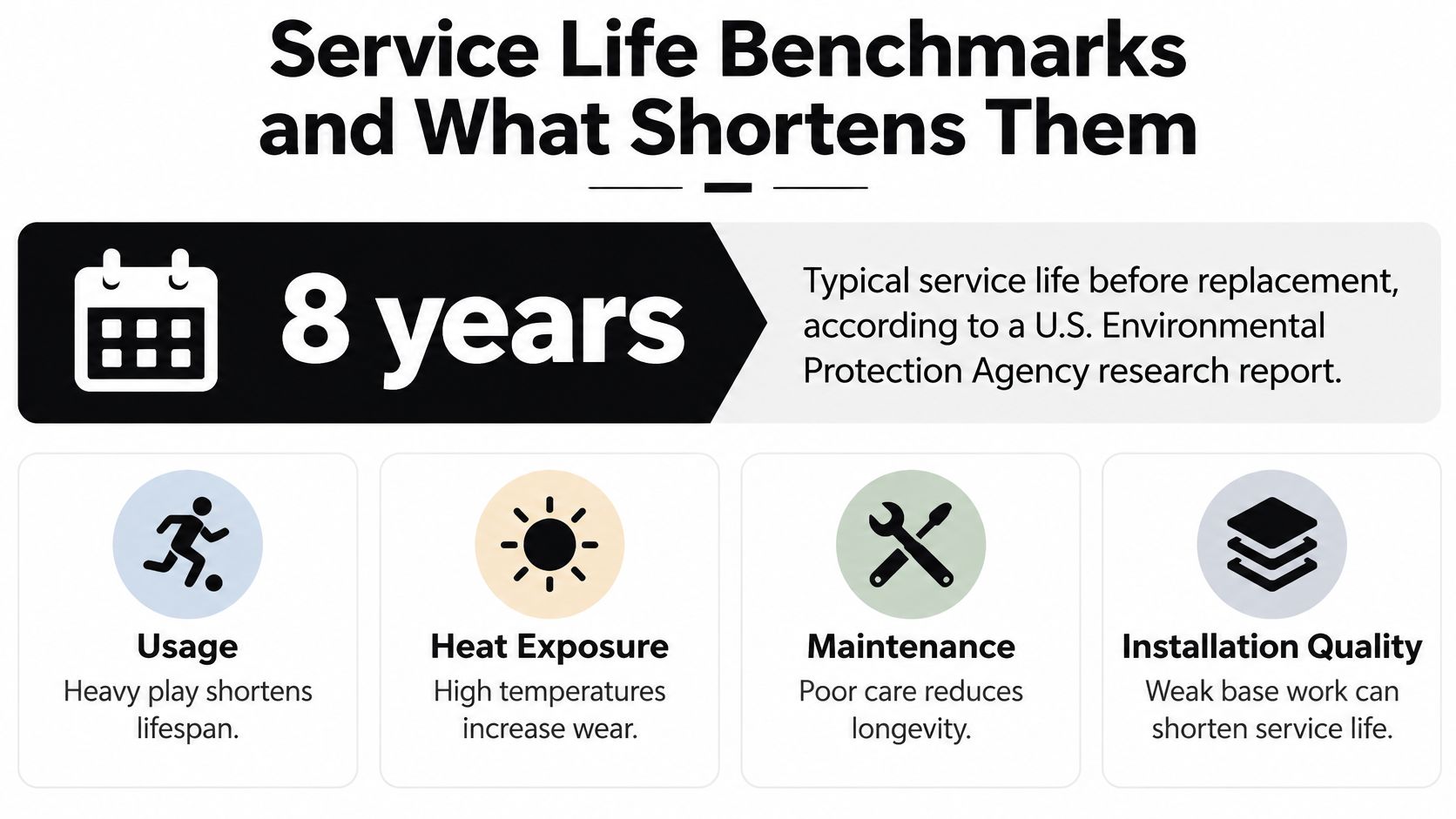
Synthetic turf typically lasts about eight years before replacement, according to the U.S. Environmental Protection Agency research report. Use that figure as a planning benchmark, not a warranty. The average eight-year service life shown in this infographic is only useful when you also examine exposure, traffic, infill displacement, ultraviolet radiation, seam quality, drainage, and maintenance. These factors work as a system: a weak base or neglected infill can shorten service life even when the turf itself meets its product specification.
Heat can put added strain on turf and affect how the surface feels. A single “field temperature” does not show conditions at different depths, so ask which location and material each temperature figure describes. In central Texas, account for shade, irrigation, infill type, and drainage in the design. EPA monitoring of tire-crumb fields found airborne particulate matter and lead concentrations well below levels of concern, while lead in sampled crumb rubber was generally tightly bound and unavailable for absorption. The findings were limited, so do not treat them as proof that every product or field has the same conditions. Get site-specific material details, and avoid relying on a blanket safety claim.
What moves the date
A dog run exposed to full sun, daily urine, and poor drainage can wear out sooner than the benchmark. Moisture and heat can linger, infill can migrate to the edges, and unsupported yarn can fold. A sports field with a heavy face, strong tuft bind, regular brushing, and infill top-ups may last longer because wear is spread out and the fibers stay supported. Maintenance needs to be written down, not left to guesswork. Use this guide to understand what affects artificial grass durability and compare the fiber, base, and care requirements in each bid.
Put measurable checks in the specification and maintenance plan:
- Brushing. Set the frequency, method, and direction. Check that brushing lifts the fibers without damaging them.
- Infill top-up. Set a schedule and record depth, especially at turns and along pet paths.
- Drainage. Record acceptance test results, then check performance after the first storm season.
- Seams. Set inspection intervals and a repair rule before gaps become a trip hazard.
- Traffic. Name permitted uses and high-traffic zones, and specify tougher turf for heavily used paths.
- Replacement criteria. Define the conditions that trigger replacement, so the eight-year benchmark becomes a budget tool rather than a guess.
Compare bids against the same checks. A written maintenance plan and clear replacement criteria give the owner a sound basis for managing service life.
Book a Specification Review Before You Sign
A specification protects you only when it is written into the contract and checked on site. Verbal assurances such as “commercial grade” or “the same turf we always use” do not let you compare bids or verify the installed product. Ask for the exact materials, measurements, and checks before signing.
Request these items:
- The product sheet. List yarn polymer, pile height, face weight, denier, backing, and tuft bind, each with units.
- Full test reports. Include the ASTM methods cited above, not just a summary sheet.
- Infill and heat. Name the infill type and depth, and provide the four heat measures for the yard's sun exposure.
- The base. Specify layer depths, fabric, compaction, slope, and the drainage test plan.
- Seams. State the seam method and adhesive, and provide a sample to pull on.
- Water. Give a project-specific estimate rather than claiming the whole property will use no water.
The EPA WaterSense guidance says low-water or drought-tolerant turfgrass decreases irrigation demand. It recommends using turf only where it has a function and grouping plants with similar watering needs. For a synthetic turf project, identify which irrigated areas will be removed, which beds and trees still need water, and whether drainage or irrigation changes are included in the price. That gives you a defensible estimate. A promise that the lot will need no water does not.
Warranty language you can enforce
The Federal Trade Commission's business guidance on warranty law says warranty advertising is subject to the FTC Act's prohibition on unfair or deceptive practices. It also says advertising should explain coverage and warranty terms. For products sold in stores for more than $15, the guidance says ads should tell consumers that a copy of the warranty is available before purchase.
Apply that discipline to the contract. Separate product defects from installation workmanship, state the duration of each promise, and list exclusions such as misuse or unusual wear. Explain how to file a claim, who pays for labor, and what happens if the installation crew and the mill disagree.
Modern Yard Designs is based in Austin and offers artificial turf installation, design, and maintenance for residential and commercial properties. Before committing, ask for proof of insurance, written warranty terms that state coverage and exclusions, and a line-item estimate showing how material quality, turf quantity, and labor complexity affect the price. Those items let you compare the bid with the specification and the work planned for your yard, putting green, or pet run.
Schedule an on-site specification review before you sign. Walk the sun exposure, slope, and traffic with a local installer, then leave with numbers you can compare. A sample can show appearance, but it cannot verify the complete installation.