
An average U.S. football field with artificial turf can avoid approximately 0.5 to 1 million gallons of irrigation water annually, according to a 2025 case study published in Sustainability. That saving is real, but it doesn't make the field maintenance free. You've traded mowing, fertilizing and watering for grooming, infill management, cleaning and inspection. Treat artificial turf field maintenance as a usage driven performance program. Measure the surface, act at clear thresholds, log every result and budget the hours. That's how you protect players, appearance and your investment.
Maintenance Schedule for Every Task and Frequency
Post this schedule where your crew can see it, then assign one owner to every row.
| Task | Frequency | Purpose |
|---|---|---|
| Visual check for tears, seams, inlays, foreign objects and liquids | Daily | Catches immediate hazards before play |
| Sweeping and debris removal | Daily to weekly, by use | Keeps the surface clean and drainage open |
| Rinsing with water | At least weekly where pets or heavy use occur | Removes dirt, pet hair and debris |
| Turf-specific brushing | Every 3-4 weeks in playing season | Restores upright fibers and redistributes infill |
| Infill depth measurement | Monthly, at least 20 points | Tracks infill level and trends |
| Grooming | At least monthly, more with heavy use | Keeps fibers upright and surface uniform |
| Deep grooming with infill replenishment | Annually | Restores long-term condition |
| Slicer or decompaction pass | No more than 2-3 times per year | Relieves compaction without disturbing backing |
| G-max hardness testing | Annually | Confirms impact safety |
| Drainage check | After significant rainfall | Confirms water moves through the system |
The Oregon public-agency quick-reference guide recommends daily inspection for tears, seam and inlay damage, foreign objects and liquids, grooming at least monthly, and deep grooming with infill replenishment once each year according to the manufacturer's instructions. Use that cadence as your floor, not your ceiling.
Frequency should follow usage intensity rather than a fixed calendar alone. A peer-reviewed 2018 review reported that brooming with nylon-bristled brushes and raking with spring-tooth tines lift matted fibers and redistribute infill, and that on fields receiving daily use these operations may be required as often as weekly. That same review placed deeper cleaning at sometimes only two or three times per year.
Adjust the Schedule to Your Field
If your field hosts daily practices, move grooming to weekly and sweep daily. If it's a lightly used residential lawn, you can stretch grooming and rinsing, but don't skip inspections. Foot traffic, sports, pets, weather and infill type all change the right interval.
Copy the table into a shared calendar today and assign one named owner to each row. Unassigned tasks don't get done.
Manufacturer instructions override any generic schedule because turf construction and infill systems differ. Keep the manual with the calendar.
Equipment and Seasonal Adjustments You Need
You don't need a warehouse of machines. You need the right tool for each scheduled task, kept ready and logged.
Match the Tool to the Task
- Stiff nylon-bristled broom or turf-specific brush: Use it for sweeping and the regular brushing pass that lifts fibers.
- Spring-tooth rake or towed groomer: Use it for grooming and infill redistribution. Choose a towed groomer on fields with daily practices so one session finishes the job.
- Debris blower or sweeper: Clear leaves, litter and pet hair before you brush.
- Slicer or decompaction tool: Reserve it for the limited annual passes and use only the manufacturer approved setting.
- Calibrated infill depth gauge and surface thermometer: Measure, don't guess. Book annual g-max testing with a qualified tester.
Our guide to artificial turf maintenance equipment helps you match each tool to your field size and use level. Log every gauge and temperature reading on one shared sheet so trends are visible.
Shift With the Seasons
In spring, inspect drainage and run a pre-season infill check. In summer, groom and schedule heavy play early or late, confirm surface temperature before play, and keep shade and water ready. In fall, clear leaves weekly and again before heavy rain so outlets stay open. In winter, skip brushing while the surface is frozen or saturated and keep drain outlets clear.
How to Groom and Redistribute Infill Step by Step
A consistent grooming sequence keeps fibers upright and infill where the field needs it. Reverse the order and debris gets pushed into the infill, making cleanup harder and potentially restricting drainage.
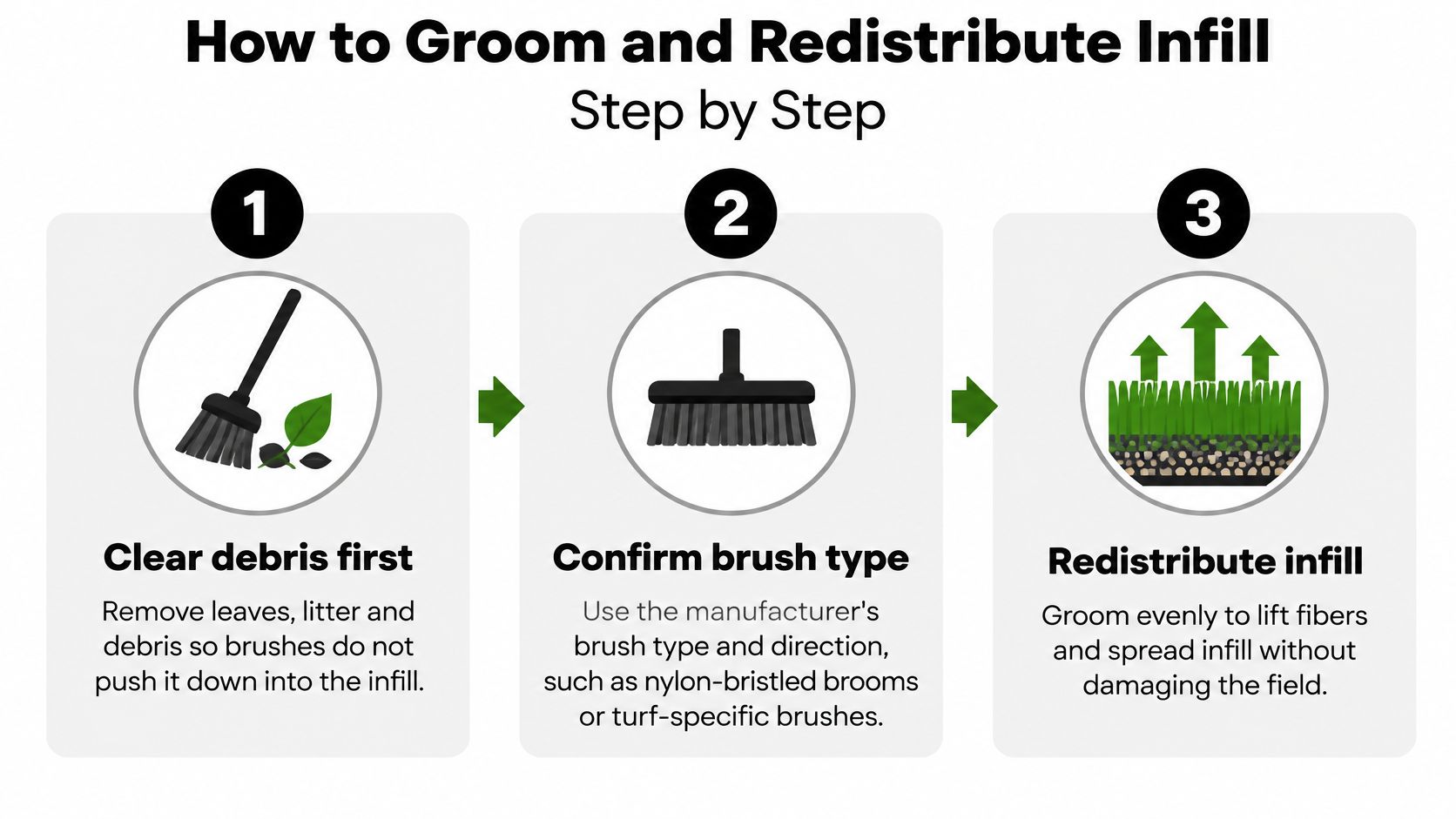
Clear debris first. Remove leaves, litter, pet hair and loose material with a blower or sweeper. Brushing debris into the infill makes it harder to remove and can interfere with drainage.
Confirm brush type and direction. Check the manufacturer's operations manual before starting. The Penn State synthetic turf best management practices guide recommends brushing with turf-specific equipment every three to four weeks during the playing season. It also warns that aggressive equipment or incorrect brush direction can damage fibers or disturb seams.
Brush in overlapping passes. Cover the field systematically so no strip is missed. Lift the fibers without scrubbing the backing.
Redistribute infill from high-traffic zones. Use spring-tooth tines to pull displaced material from goal mouths, penalty spots, sidelines and entrances toward thinner areas. Check depth at consistent points, concentrating more measurements in high-use zones.
Measure before topping up. Log each location, depth, date and corrective action. If readings remain below the manufacturer's specified range after redistribution, add only compatible material. Review the types and uses of artificial grass infill before selecting what to add.
Decompact sparingly. Use a slicer or comparable tool only when needed, generally no more than two or three times annually. Excessive passes can disrupt the backing and infill profile, so don't make decompaction part of routine grooming.
Close the loop in the log. Record zones treated, depths found, material added and any seam, weed or moss issues. Schedule annual g-max testing. If any location measures 200 g or higher, arrange remediation and keep the field closed until readings are below that level throughout.
Two Mistakes That Waste Money
Adding infill before redistributing it can lead to unnecessary purchases. Material often shifts rather than disappears. Brush and rake first, measure again, then buy only what the readings justify.
Brushing a dirty surface works leaves and grit into the infill, where they can reduce permeability and slow later cleaning. Clear debris before every brushing pass, even when time is tight.
Quick field check: After brushing, fibers should stand upright and infill should feel even underfoot. Measure any zone that still feels thin or hard.
Avoid wire brushes, aggressive power equipment and brush directions the manufacturer hasn't approved. Replace worn brooms before they pull at the fibers, and train operators to follow the same pass pattern. Inconsistent brushing leaves visible stripes and uneven infill that players can feel.
Check high-wear spots more often than the rest of the field. Redistribute first, then spot-dress small amounts if readings remain low. Keep compatible infill available so measured corrections can be made promptly instead of waiting for a larger top-up.
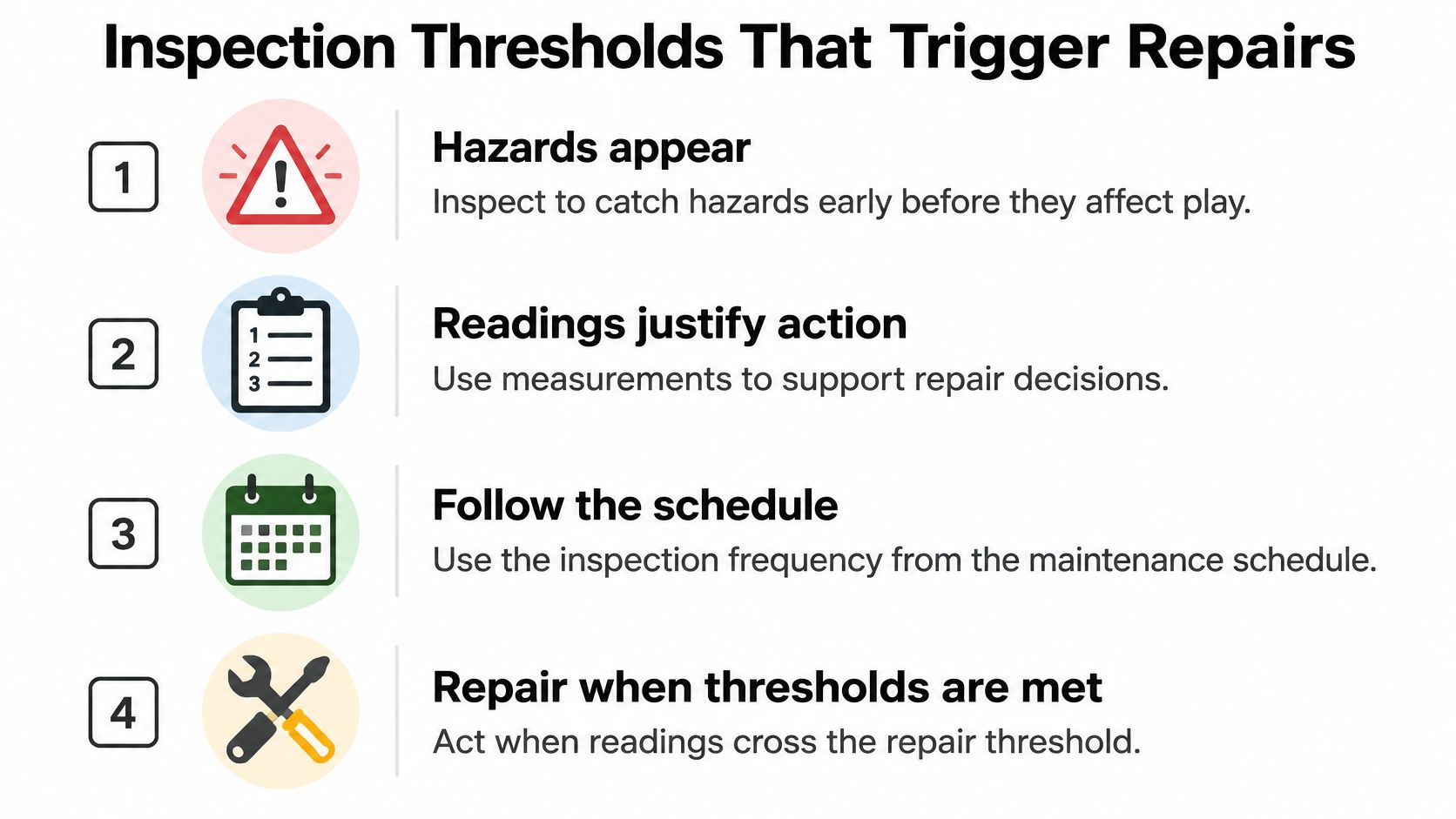
Inspection Thresholds That Trigger Repairs
Inspection isn't a walk for exercise. It's a decision system. Act when a threshold is crossed, not when a problem becomes obvious.
| Check | What Is Measured | Action Threshold |
|---|---|---|
| Infill depth | Depth at 20 or more points, weighted to high-use zones | Below manufacturer range, brush then add compatible infill |
| G-max hardness | Impact reading across the surface | 200 g or higher, remediate and keep field closed until below 200 g |
| Seams and inlaid lines | Lifting, gaps or open seams | Any opening, repair before next use |
| Tears and foreign objects | Surface condition | Remove or repair the same day |
| Weeds and moss | Presence in fibers and infill | Remove before roots reach infill |
| Standing water after rain | Drainage at outlets and basins | Brush and decompact first, excavate only if testing confirms base or drain failure |
Work in safety order. G-max comes first because a hard field is a closed field. Next come open seams and lifting inlaid lines, repaired before the next use. Then tears and foreign objects, handled the same day.
Infill depth is your most frequent trigger. Brush the zone first, add compatible material only if it's still below range, then record the new reading before reopening. If a seam or tear needs work your crew can't do correctly, book artificial turf repair before the damage spreads.
Record every reading by location, depth, date and action. Walk with the printed table and initial each row as you finish it. That paper trail shows trends early and gives you evidence when you request budget or warranty support.
Sanitizing, Deodorizing and Cleaning Pet Areas
Pet areas stay usable when you clean on rhythm, not when odor forces you to act. Build a weekly routine and stick to it.
The Weekly Routine
We recommend rinsing an artificial lawn with water at least once a week to remove dirt, pet hair and debris. Hose down dog runs occasionally, focusing on potty zones, entrances and shaded corners where moisture lingers. Remove solid waste first, then rinse so you're not spreading contamination across clean turf.
Use warm, not boiling, water, gentle cleaners or professional-grade maintenance methods. Boiling water and harsh products can damage fibers and backing. Our cleaning service includes rinsing and disinfecting turf with pet-safe solutions and treating odors, especially in dog runs and high-traffic spots. It also includes removing debris and stuck leaves, power brushing to lift blades, and checking seams and infill for wear.
Follow this sequence each week:
- Rinse: Wash dirt and pet hair through the surface, working from clean areas toward drains.
- Disinfect hot spots: Apply a pet-safe solution to potty zones and high-traffic areas.
- Deodorize: Treat odor after cleaning, not instead of cleaning.
- Log the products: Write down what you used, where and how much.
Our step-by-step guide on how to clean artificial turf for dogs walks through the same routine for home runs and commercial pet areas.
Deodorizing is the finishing step, not the main fix. Proper infill and maintenance do most of the work on pet odor.
What to Avoid
Don't use harsh solvents or strong bleach mixtures. Check manufacturer documentation before any cleaner, disinfectant or antimicrobial treatment touches the field. Keep cleaners and rinse water away from storm drains and stormwater pathways where possible, and pick up visible fiber and infill debris instead of washing it toward an outlet.
For weeds, we advise vinegar-based solutions for spot treatment, manual removal, or professional weed-prevention treatments designed for artificial turf systems. Pull weeds early, before roots work into infill and make removal disruptive.
Commercial-grade turf handles high pet traffic, drains efficiently and is easy to clean, but it still needs this weekly loop. Skip two or three weeks in Texas heat and odor becomes a complaint, not a maintenance task. Assign the rinse to a specific day and person, the same way you assign grooming.
Drainage Checks and Heat Control Through the Seasons
A field that drains poorly can lose playing time after rain. A surface that gets too hot can make sunny-day practice unsafe. Track both by conditions and thresholds, not just by the calendar.
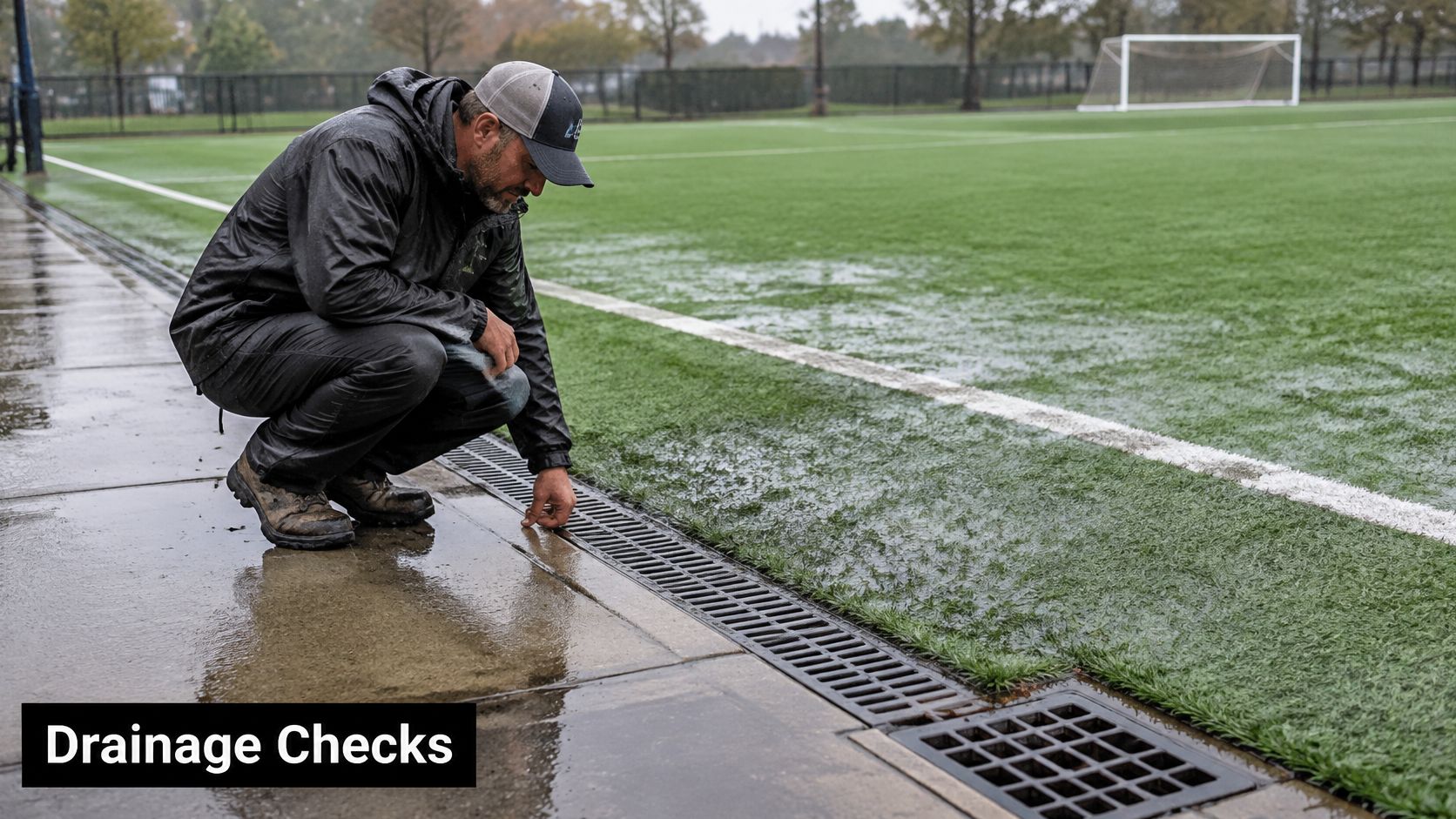
Diagnose Drainage Before You Dig
Inspect the field after significant rainfall. Check perimeter drains, catch basins and outlet flow. The Verona Centennial Field report notes that localized ponding can result from compacted or displaced infill rather than a failed drainage system. Start with brushing, decompaction and infill correction. Reserve excavation for cases where testing identifies a base or drain failure.
Check the surface and drainage path in order:
- Surface debris: Leaves and litter can block water from reaching the drainage layer.
- Displaced infill: Look for material gathered in low spots or washed toward the edges.
- Compaction: Hard, tight areas can shed water instead of letting it pass through.
- Outlets and basins: Remove obstructions that restrict flow.
Drainage checks also help limit material loss. A 2025 review of artificial turf identifies turf fibers and infill as sources of microplastics that can enter stormwater. After major storms, collect visible debris and inspect outlets. Handle captured sediment deliberately, and record cleaning products used near stormwater pathways.
Control Heat With Scheduling, Not Just Water
On sunny days, synthetic turf can become much hotter than the air. Watering may provide brief relief, but surface temperatures can rise again, so don't treat a hose-down as a heat plan.
Where practical, schedule intense activity outside peak sun. Provide shade and hydration, and measure surface temperature before play. If the surface is too hot for safe use, move or postpone the session.
Measure the surface before play. If the reading signals unsafe conditions, change the schedule rather than relying on a quick rinse.
The Seasonal Loop
In spring, inspect drainage and check infill before the field's busy period. In summer, adjust scheduling and hydration to heat conditions. Clear fall debris before heavy rain, and keep outlets free of obstructions in winter. Avoid moving equipment across saturated or frozen turf. Log findings and corrective work so the maintenance budget reflects actual field conditions.
Budgeting Hours, Materials and Annual Costs
If artificial turf field maintenance isn't in the budget, it won't happen consistently. Benchmark first, then build your own number from your schedule.
| Budget Line | Benchmark | What Changes It |
|---|---|---|
| Materials including infill, paint, paint remover, disinfectants and gum remover | $5,000-$8,000 per year for an average field | Visibility, number of sports, repainting frequency, repairs |
| Labor | 300-500 hours per year | Use intensity, repairs, repainting, field size |
| Recurring cost, synthetic field | $0.50-$1.90 per square meter per year, mean $1.00 | Climate, labor rates, infill type, drainage, resurfacing |
| Recurring cost, natural grass comparison | Average $3.80 per square meter per year in one study | Irrigation, mowing, climate and labor in that study system |
| Equipment purchases | Excluded from the materials benchmark | Field size, towed equipment, replacement cycle |
The Sports Turf Managers Association's fourth-edition guidance, reported in a peer-reviewed life-cycle cost analysis, puts an average synthetic athletic field at approximately $5,000 to $8,000 annually in materials and about 300 to 500 labor hours per year, excluding equipment purchases. That same analysis found annual synthetic-field maintenance of $0.50 to $1.90 per square meter, with a mean of $1.00, compared with an average of $3.80 per square meter for natural-grass fields in that study.
Those figures prove two things. Synthetic turf can cost less to maintain than natural grass in studied systems, and it still demands hundreds of hours and ongoing supplies. Anyone quoting you near-zero annual effort isn't being straight with you.
Build Your Own Budget
- List every scheduled task: Inspections, sweeping, rinsing, brushing, grooming, deep grooming, testing and drainage checks.
- Multiply frequency by crew hours: Use your actual use level, not the lightest week of the year.
- Add materials: Infill, paint, paint remover, disinfectants and gum remover.
- Add a reserve: Set aside money for infill top-up, seam repairs and annual deep maintenance.
Costs rise for highly visible fields, fields hosting multiple sports, frequent repainting and paint removal, and fields needing more repairs. Climate, size, labor rates, infill type, drainage performance and resurfacing schedules also move the total. Treat the benchmarks as a sanity check and compare any quote line by line against them.
Book a Turf Maintenance Assessment Before Peak Season
Start your first month with four moves. Copy the schedule into a shared calendar. Measure infill depth at 20 or more points. Log every reading by location and date. Set a budget line using the benchmarks you're comfortable defending.
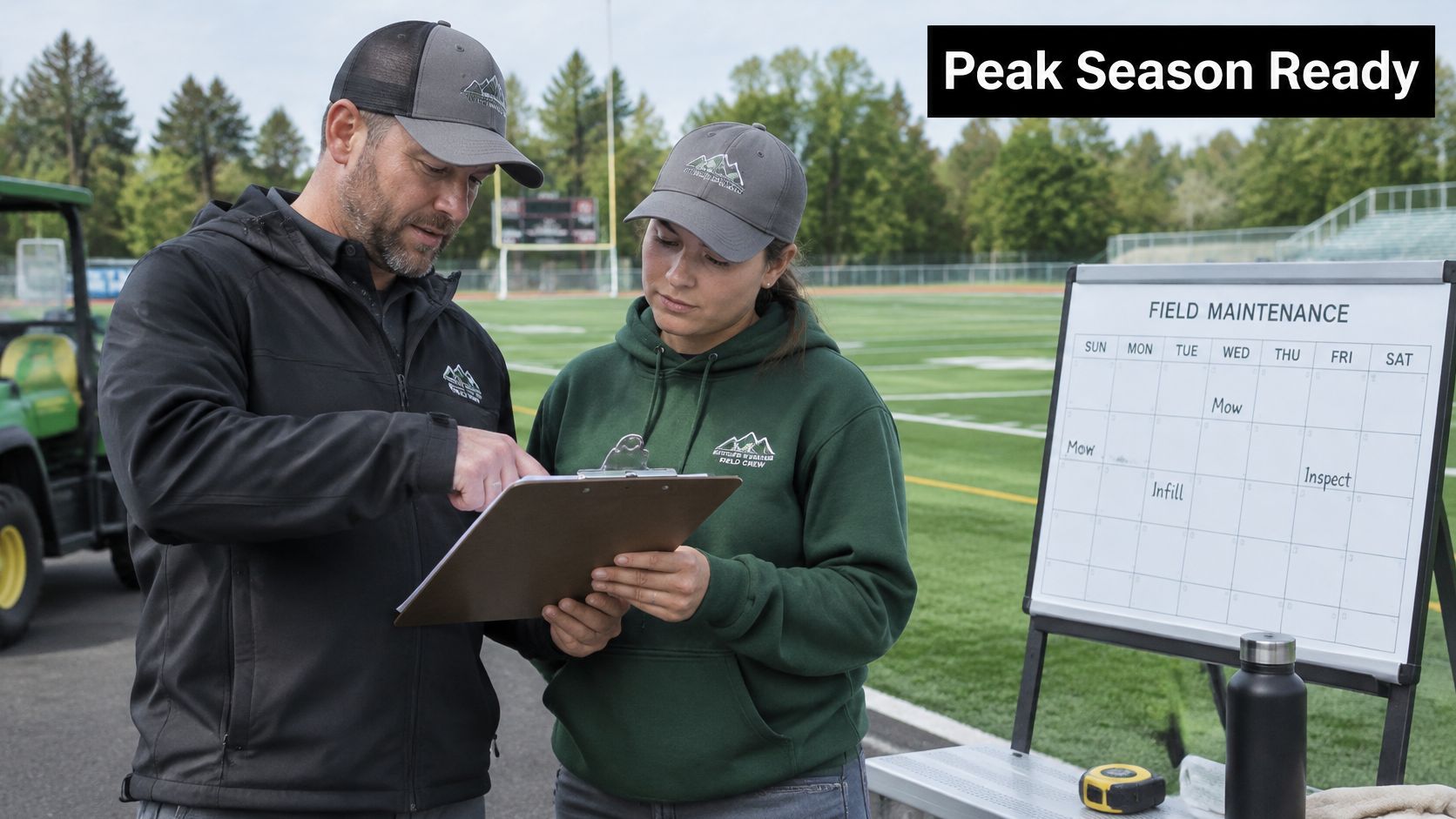
Most fields don't fail from one dramatic event. They decline through missed monthly measurements and deferred brushing until fibers stay flat, infill disappears from high-wear zones and hardness becomes a safety conversation. Consistency is the program's real value.
If your team can't keep that rhythm, bring in help before peak season. Our services include turf installations, putting green installations, dog run installations, drainage tile installations and turf cleaning, including grooming, infill and deodorizing. With proper installation and maintenance, commercial turf can last 15 to 20+ years, even under heavy foot traffic and Texas weather.
For a useful assessment, bring field dimensions, weekly use hours, your last g-max result, infill specifications, any drainage problems and your maintenance log. We'll review your field against the thresholds and budget in this guide and tell you plainly what needs attention first. Call us to book a free turf cleaning consultation so the first brushing pass and infill check happen before your busiest weeks.
Call Modern Yard today to schedule your turf maintenance assessment and get a clear, honest plan for grooming, infill, cleaning and repairs before peak season hits. We'll measure what matters, explain your options without pressure, and help you protect the field you've already paid for. Visit Modern Yard Landscapes to book your appointment.