
The first month after installation is deceptive. The ball rolls fast and true, the surface looks like a photograph, and you wonder why anyone warns you about upkeep. Then fall arrives, live oak leaves collect in the low corner, a putt from the same spot in the same direction needs a firmer stroke than it did in June, and the cup collar starts to feel soft underfoot.
Nothing has failed. An artificial putting green is a system of fiber, sand and base, and all three move. Foot traffic compacts the infill, debris blocks the path water takes off the surface, and flattened fibers change how a ball rolls. Your green doesn't need mowing or fertilizer. It needs surface care, and the gap between a green that plays like the day it was installed and one that plays like worn carpet is almost entirely a schedule.
Here's that schedule, the grooming steps that change roll, a way to measure whether any of it is working, and the storm and heat protocols most guides skip.
Putting Green Maintenance Schedule at a Glance
A green used several times a week needs a steady maintenance rhythm. Use this schedule as a starting point, then adjust it to the turf manufacturer's specifications and how often the surface is played.
| Task | Frequency | Tool or method |
|---|---|---|
| Remove debris and leaves | Daily to weekly, and after storms | Leaf blower or soft broom |
| Brush in multiple directions | Weekly for heavy use | Nylon-bristled brush or soft power broom |
| Rake to lift matted fibers | Monthly | Spring-tooth rake |
| Power-brush to control contamination | Monthly | Power broom on a low setting |
| Top up dry sand infill | Every 1 to 3 months, or where infill is displaced | Compatible dry sand worked between fibers |
| Check seams, edges and cup collars | Monthly | Visual check and hand pressure |
| Inspect drainage and low points | After each significant rain | Visual check of outlets and low spots |
| Test roll speed and trueness | Monthly and after infill work | Stimpmeter and maintenance log |
| Rinse the surface | Weekly | Garden hose with warm water and gentle cleaner |
The schedule controls play as well as appearance. Debris left in the pile can break down and contribute to contamination; infill that shifts or compacts can change roll and leave fibers matted. A monthly power-brushing pass helps limit contamination buildup.
Stretch or tighten it to match your traffic
A green used every evening needs weekly brushing. For occasional play, brushing every two weeks may be enough if the infill remains even. Follow the installer's written specifications where available, and adjust the schedule if the surface starts to roll differently or drainage slows.
The 2019 peer-reviewed review of synthetic turf research identifies nylon-bristled brushing and spring-tooth raking as standard methods for lifting matted fibers. In areas with daily use, those tasks may be needed as often as weekly.
A four-year field study of artificial turf maintenance practices reported that monthly power-brushing could reduce the rate of contamination buildup by more than 1% per year. The study also grouped maintenance into grooming, cleaning, decompaction and infill top-ups, and linked reduced maintenance with declining performance.
If you only check one thing this weekend, check the infill. At the cup and along the players' standing line, feel for exposed backing or hollow spots.
How to Groom, Brush and Top Up Infill
The weekly routine decides how your green rolls in August. Do the steps in this order and each one sets up the next.
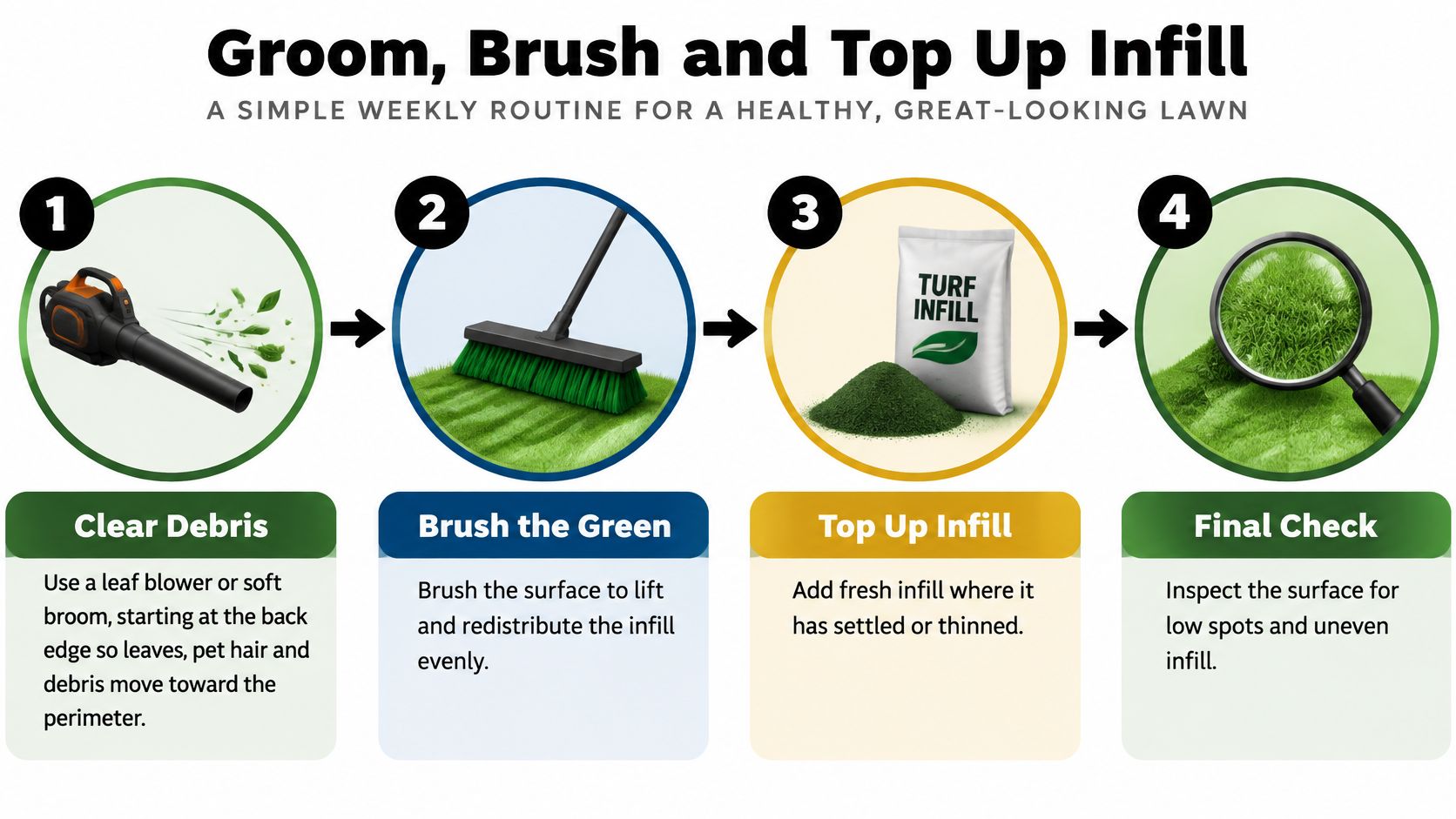
1. Clear debris from the back edge forward. Use a leaf blower on low or a soft broom, starting at the rear of the green so leaves, pet hair and seed heads travel toward the perimeter instead of into the cup area. Ten minutes covers a typical backyard surface, and doing it first means you're not brushing debris into the pile.
2. Wait until the surface is dry. Wet fibers lie flat and stay flat, and damp sand smears instead of settling between filaments. If dew is still sitting on the pile at 8 a.m., come back at 10. This single check prevents the most common grooming error, which is brushing a surface that looks dry on top and isn't.
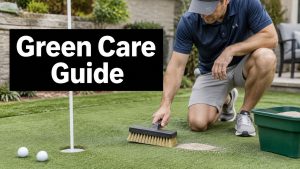
3. Brush in two directions. Work a nylon-bristled brush or a soft power broom across the grain, then with it, so fibers stand up rather than being laid one way. Choosing the right artificial grass maintenance brush matters more than how hard you push. Keep stiff rotary deck brushes off a putting surface; they grab fiber, throw sand toward the edges and leave you with a crowned, inconsistent roll.
4. Rake the traffic line. Spring-tooth rake, light passes, along the straight line from tee to cup where feet flatten the pile. Two passes, not ten. This is the step that recovers a slow spot without adding a grain of sand.
5. Check and top up infill. Part the fibers at the cup and where players stand. If you can see backing or the sand sits below the fiber base, add compatible dry sand, work it between the fibers, and brush again. The USGA's guidance on consistency over intensity describes natural-turf programs that topdress every seven to 14 days rather than loading the surface once a year. Different material, same logic: small amounts applied often hold a consistent roll. Overfilling is a real failure mode, because too much sand turns a quick green slow and blocks drainage.
6. Rinse weekly. We recommend warm water, gentle cleaners or professional-grade maintenance methods instead of boiling water and harsh chemicals. Rinse an artificial lawn with water at least once a week to flush out dirt, pet hair and debris.
A finished green tells you it's finished. Fiber lays evenly across the whole surface, there are no sand piles at the edges, no debris in the cup, and the collar feels firm under a thumb.
Skip the bleach, skip the pressure washer on a close setting, and skip anything with a rotary head that bites. Each one shortens the life of the surface you paid for.
Testing Roll Speed and Trueness Over Time
Appearance is a poor referee. A green can look perfectly uniform and still roll four feet slower down one line than the other, because sun angle, fiber lay and a slight crown all fool the eye while the ball tells the truth. Judge the work by roll, not by how green the pile looks.
Run the same audit every month
Mark three or four test spots and keep them: the middle of the green, one heavy traffic lane, one corner, one spot near a seam. At each mark, use a Stimpmeter in both directions, write down the number, note any visible curve and note where the ball checked up. Repeat the audit after brushing or an infill top-up so you can see whether the work changed anything instead of assuming it did.
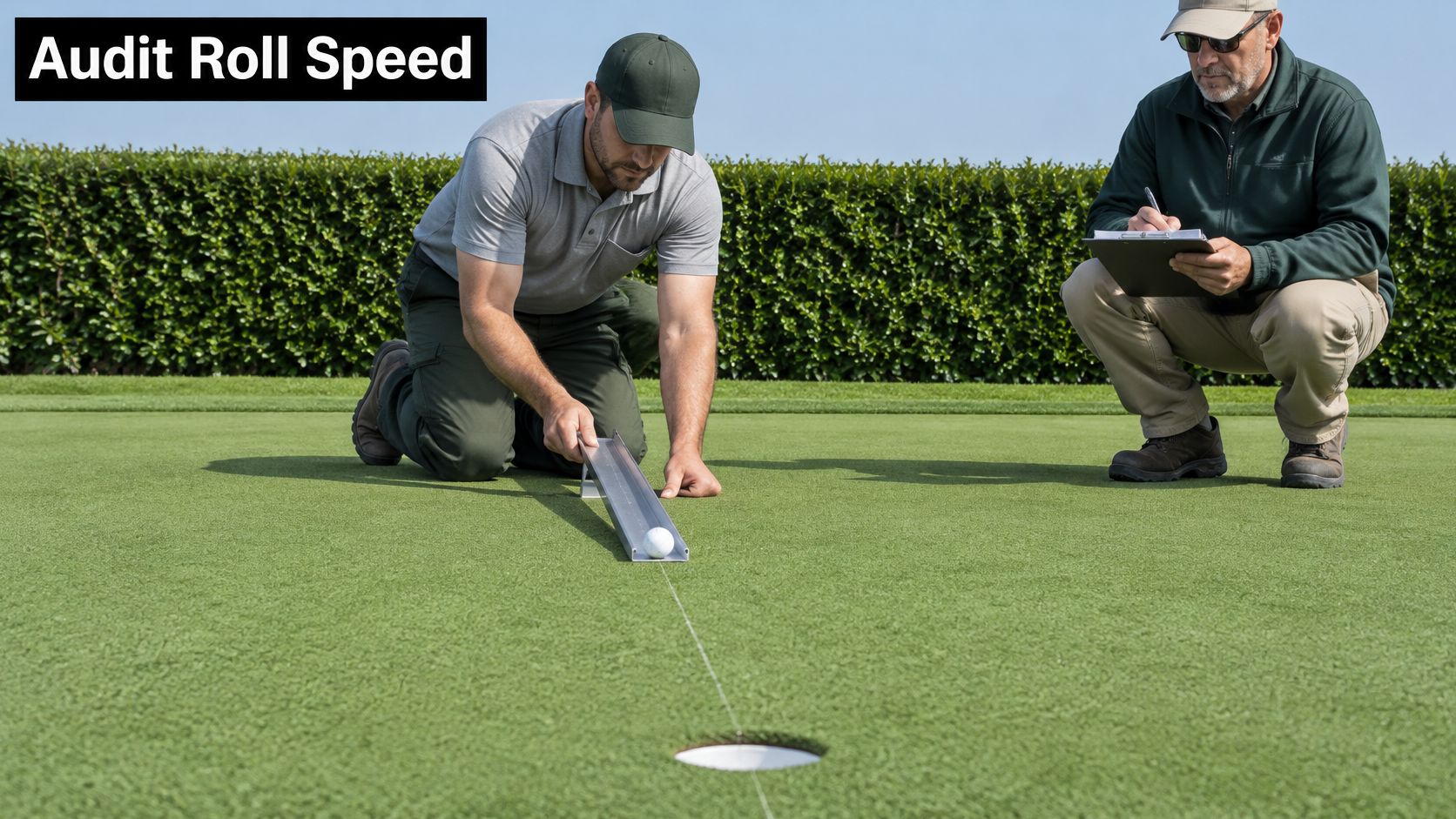
For a harder benchmark, the USGA's GS3 procedure uses six rolls, three in each direction, to quantify smoothness and trueness. Across tens of thousands of golf-course roll tests, average smoothness was 3.85 and average trueness 0.73. Those are reference points, not targets a backyard green has to hit.
Reading the numbers
| Measure | Reference value | What it means |
|---|---|---|
| Standard nylon green, Stimpmeter | 11 feet or less | Typical roll; compare to installation speed |
| Sand-filled nylon green, Stimpmeter | Up to about 13 feet | Typical upper range for sand-filled surfaces |
| GS3 smoothness, high quality | 0 to 5 | Minimal vertical deviation; no action needed |
| GS3 smoothness, outside normal range | 5 to 8 | Inspect infill, settlement and seams |
| GS3 smoothness, disruptive | Above 8 | Check for wear, contamination or over-brushing |
| Golf course average smoothness | 3.85 | Reference only, not a residential target |
| Golf course average trueness | 0.73 | Reference only, not a residential target |
The scale itself is blunt about problems. Values from 0 to 5 signal high-quality ball roll with minimal vertical deviation, 5 to 8 sits outside the normal range, and anything above 8 is commonly associated with disruptive surface practices.
Your own baseline beats every number in that table. USGA guidance on backyard putting greens puts a standard nylon green at 11 feet or less on a Stimpmeter and a sand-filled nylon green at close to 13 feet, but what matters is the figure your green posted when it was commissioned. Chase that, not someone else's.
Two pitfalls catch homeowners repeatedly. A one-way speed test hides defects, because slope and grain direction mask a slow spot, so always roll it back the other way. Over-brushing redistributes infill instead of correcting it, which makes a bad spot worse in a different place.
Keep a log: date, weather, use level, brush direction, infill added, speed and smoothness readings. Without it, every fix is a guess.
Fixing Problems and Post-Storm Checks
Rain is the honest test of a putting green. Twenty minutes of hard weather shows you where the surface sheds water, where infill has drifted and where the base has settled. Most homeowners read the result as bad luck and brush it back. Some of what you're seeing is maintenance and some is a defect, and telling them apart is the difference between a Saturday chore and a repair bill.
| Symptom | Likely cause | Fix |
|---|---|---|
| Ball rolls slow in one spot | Matted or compacted fibers | Brush and rake, then top up infill |
| Ball bounces or rolls unevenly | Uneven or settled infill | Redistribute sand and level the low spot |
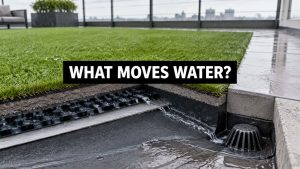
| Water pools on the surface | Clogged outlet or low point | Clear debris and check outlets; call a pro if it persists |
| Infill washes to the edges | Heavy rain or steep grade | Rebuild infill and correct the grade |
| Seam lifting or wrinkles | Seam or edge failure | Re-secure the seam; specialist repair |
| Weeds appear in seams | Debris and organic matter | Manual removal or vinegar-based solution |
| Musty or sour odor | Debris, pet waste or poor rinsing | Rinse, clean and refresh infill |
The post-storm protocol
- Let it dry completely before any brush touches it. Brushing a soaked green pushes wet sand downhill, which is exactly the problem you're trying to fix.
- Start at the cup collar. Lift the flag, check that the collar isn't soft or raised, and clear debris from around the hole so the edge doesn't deform.
- Walk the low points. Look for grit lines, leaf dams and any spot holding a film of water ten minutes after the rain stops.
- Inspect seams and the perimeter. Run a hand along each seam and the edge restraint. A lifted seam or a loose edge lets water underneath, and that's how a base fails.
- Check infill depth where water ran. Rain moves sand toward the edges and low corners, so the fibers it leaves exposed are the fibers that mat first.
- Write down anything that recurred. A ponding spot that appears twice in a season is a pattern, not weather.
Austin's own public review of synthetic turf notes that the surface still requires regular cleaning, drainage management, and eventual replacement as heat, sunlight and mechanical wear degrade the system, a point worth keeping in view whenever someone sells artificial turf as maintenance-free. The phrase is misleading in a specific way. Synthetic surfaces eliminate mowing and fertilizing, and trade those tasks for periodic grooming, cleaning, infill correction and drainage inspection.
A surface that recovers after one brushing is a maintenance matter. Water that comes back after you clear the outlets is a base or grade problem, and no amount of brushing fixes a base problem.
Weeds, odor and the small stuff
Weeds show up where organic matter collects, almost always along seams and edges. Pull them by hand while the root is shallow. For anything stubborn, we advise vinegar-based solutions, manual removal, or a professional weed-prevention treatment designed for artificial turf systems. We don't recommend RoundUp on artificial grass, because the damage it does to surrounding planting and to the surface isn't worth the trade.
Pet odor comes from the infill, not the fiber. Proper infill and maintenance minimize pet odor, so a rinse and an infill refresh do more than any deodorizing spray. Musty smells in shaded corners usually mean debris is breaking down underneath, which is a drainage and airflow problem before it's a cleaning problem.
Where do-it-yourself work stops
Some problems answer to a brush. Others don't, and knowing the line protects your warranty and your wallet. Call a specialist when ponding persists after you've cleared the outlets, when the base keeps settling in the same spot, when a seam lifts or wrinkles, or when infill repeatedly washes away from the same area. Those four symptoms point to base, grade or seam failure, and brushing can't solve any of them. The right next step is artificial grass repairs from someone who can inspect beneath the surface.
Three quick wins after any storm: clear the cup area, check one drain outlet, and log one speed reading. That's ten minutes and it tells you whether you have a maintenance week or a repair call.
Keeping Your Green Usable in Summer Heat
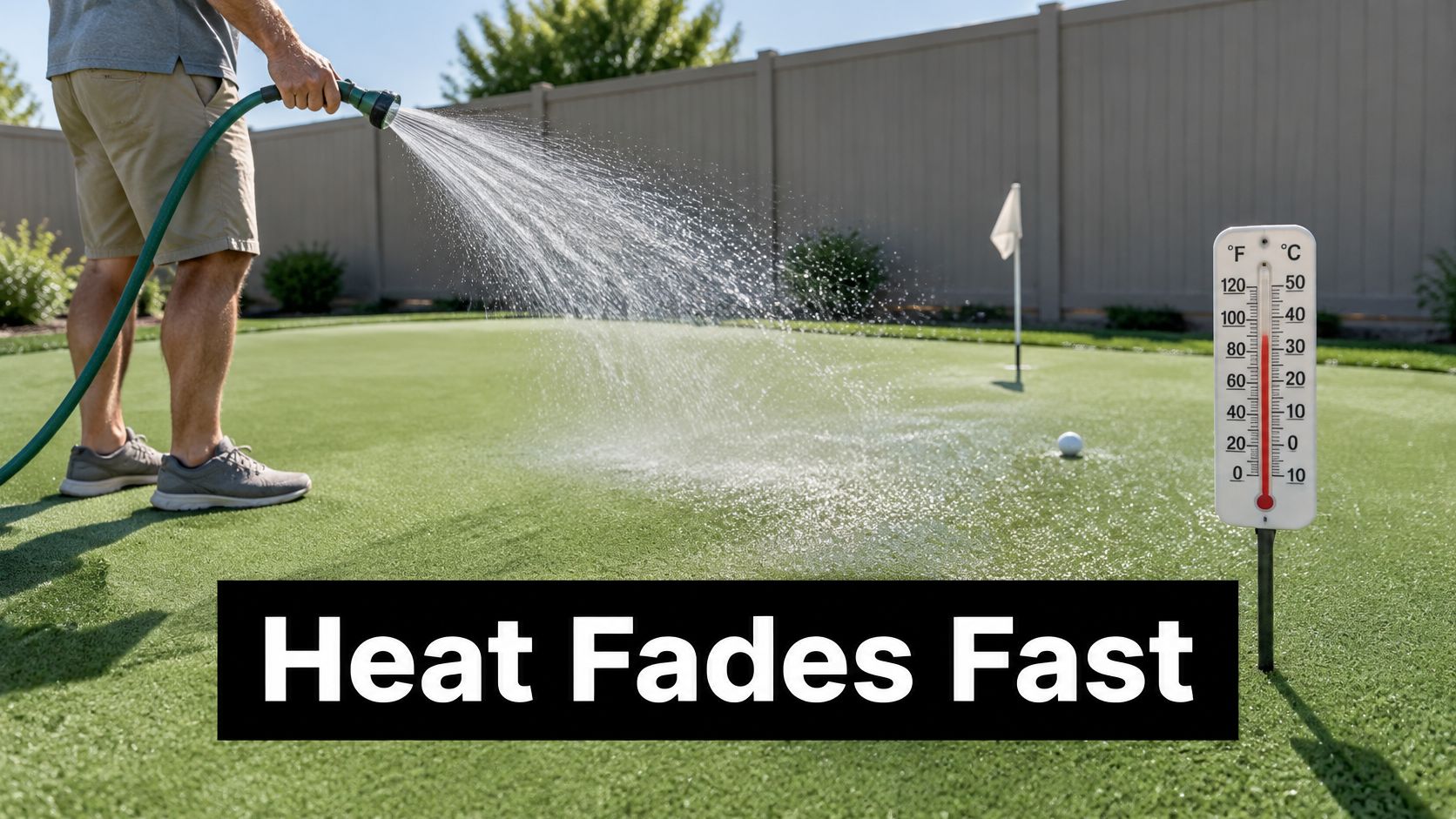
Hosing down a hot green is the most repeated summer advice and the least useful. Water does cool a synthetic surface, but the relief is short. A 2025 New Jersey scientific review of synthetic turf found that watering can reduce surface temperatures, yet the effect may disappear within about an hour; one cited experiment that applied 0.75 inches of water twice during the afternoon measured a temporary drop before temperatures rebounded. The same review notes that municipal materials in Austin warn artificial turf can become as hot as or hotter than concrete and lacks the evapotranspiration cooling a living lawn provides.
What actually cools a green
Rank the options by what they deliver, not by how easy they are. Measure the surface temperature with an infrared thermometer before you water, so you're treating a real number instead of a habit. Then work down this list.
- Shade first. Trees, an umbrella or a shade structure over the putting surface, since shade is identified in that review as one of the most promising heat-mitigation measures.
- Move the session. Play before 10 a.m. or after 7 p.m. instead of at midday.
- Treat rinsing as a short-term intervention. Useful before a game, not a cooling strategy for the season.
- Consider infill choice. Lighter or lower-heat infill may affect comfort, but nothing eliminates heat, and any product claiming otherwise is overselling.
The water-saving goal and the comfort goal conflict in a drought-conscious city, and pretending otherwise doesn't help anyone. Understand how hot artificial turf gets before you decide how to handle July.
A family putting contest at 7:30 p.m. on the same green is a different evening from a noon session. The surface has been shedding heat for hours, the ball rolls closer to your baseline, and nobody is standing on hot fibers in bare feet.
Booking Professional Putting Green Maintenance
Once you've run the routine for a month, you'll know exactly what's wrong and roughly what it will cost to fix. That's the right moment to book an inspection, because the visit should answer specific questions rather than start from zero.
A proper visit covers seams, edges, drainage outlets, infill distribution and roll speed, and it ends with a documented maintenance log you keep. Lifting seams, persistent ponding and a settling base are specialist work beyond brushing, and they're the three items worth paying for early.
Ask for the guarantee terms in writing before anyone schedules. The Federal Trade Commission's guidance on warranty law is clear that deceptive warranty advertising is unlawful and that warranty advertising falls under the FTC Act's prohibition on unfair or deceptive acts or practices. In practice, a satisfaction guarantee should name what's covered, the period for requesting corrective work, exclusions such as pet damage or misuse, and the remedy offered. Routine maintenance records should be kept separate from installation or material warranties.
Compare the cost against the alternative. In 2024, GOLF reported that a modest public golf course can spend more than $10,000 per year maintaining each natural-grass putting green. A maintenance visit on a synthetic green that drains well, stays level and rolls true costs a fraction of that, and cleaning is included as part of our putting green package.
Consider what a maintained green does to a household. A Steiner Ranch client's backyard green stayed in such good shape after regular turf cleaning that his friends began hanging out at his house instead of the club. If the surface has aged past grooming, we build custom putting greens designed for both chipping and putting, with an optional fringe area for chipping practice.
Modern Yard team handles artificial putting green maintenance across the Austin area, from debris removal and cross-brushing to infill top-ups, cup and seam inspections, and Stimpmeter checks that tell you whether the work changed your roll. If your green has slowed down, developed a soft collar or started pooling after rain, an inspection with a written maintenance plan is the cheapest way to find out whether it needs grooming or repair. Visit Modern Yard Landscapes to schedule that inspection, and bring your log and your most recent speed reading so the first visit starts with answers instead of questions.