
Your dog comes in from the yard with mud between every toe, and you're wiping the same tracks off the floor again. Outside, the route to the gate is bare, the favorite bathroom corner is yellow, and the grass you keep trying to save never gets a chance to recover.
Artificial turf for pets can solve the worn-lawn problem. It won't solve a poorly drained yard or make an exposed dog run safe in summer. In Central Texas, buy the drainage assembly and the heat plan first. Choose the green fibers after that.
Austin Lawns That Lose to Dogs
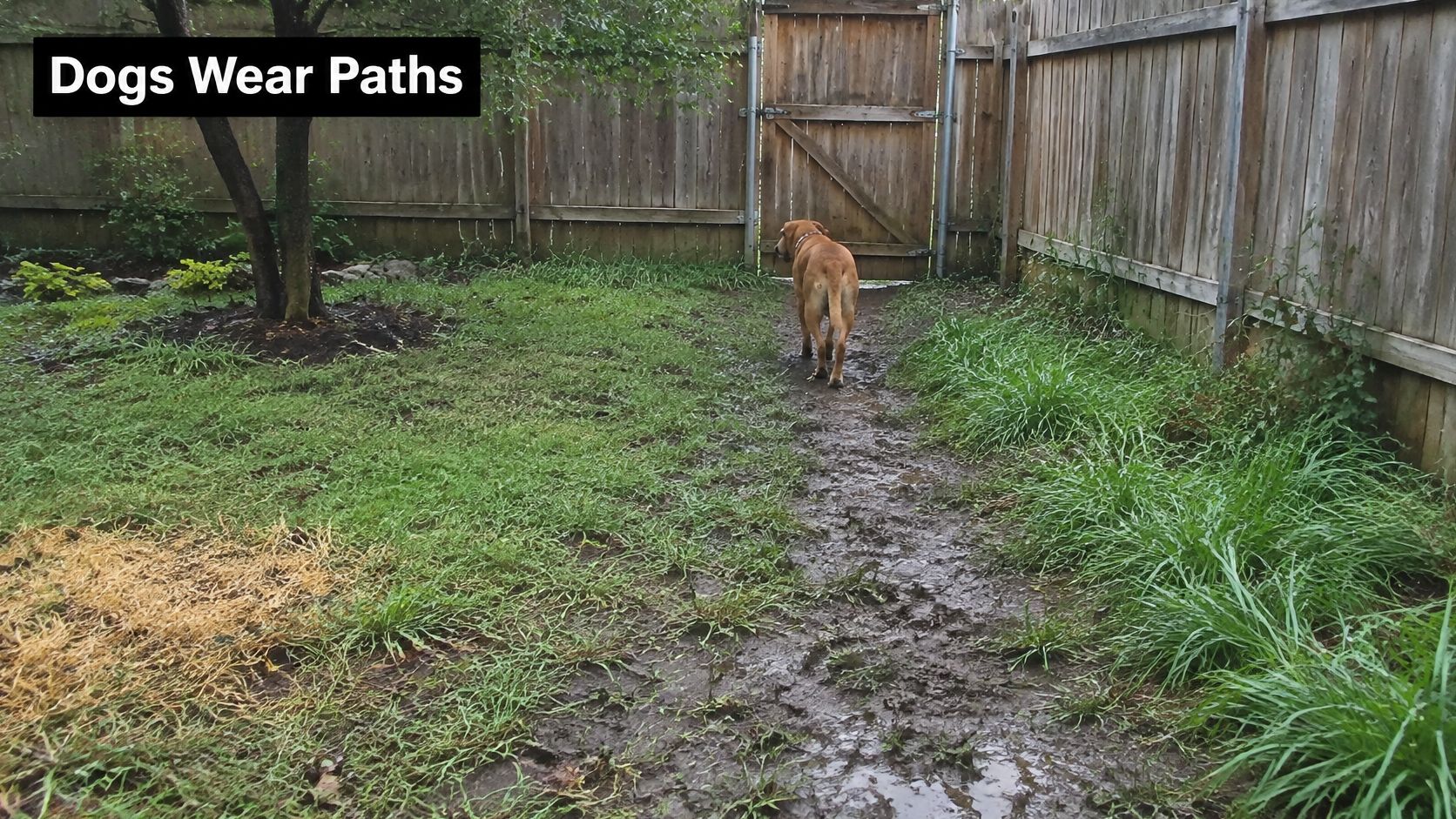
Say it's a muddy afternoon after rain. Your dog follows the same gate path across Austin clay and caliche, pivots at the fence, then stops in the same bathroom corner. You've reseeded that route before. The dog hasn't changed routes to accommodate your gardening.
The failures are familiar: urine-burned patches, puddles and mud, and pests in grass that never recovers. The unmowed edge can still shelter fleas even while the middle of the yard looks bare. Replacing the lawn without addressing those conditions just changes what you're standing on.
Buy what's underneath the green
Think of the fibers as roof shingles, the crushed base and slope as the gutters, and the infill as the filter that holds ammonia. Attractive shingles don't help much when the gutters have nowhere to discharge. Pet turf works the same way: every part needs a job.
Summer adds another test. A green surface that burns paws isn't a win, however tidy it looks through the kitchen window. Skipping lawn irrigation is a side benefit only after you've solved drainage and shade, and pet cleanup will still need water.
Start with the yard's failures, not a sample's color. Mark the muddy path, bathroom corner, standing water, and afternoon sun before discussing turf.
A useful buying decision connects the specification sheet, the liquid's exit route, practical paw-heat rules, sanitation evidence, and the layout you can maintain. The right outcome might be a compact dog run rather than a full-yard replacement.
Book a measured site visit when you're ready to make heat, drainage, and cleaning part of the purchase, not surprises after installation.
The Pet Turf Spec Sheet
Pet turf spec for an Austin dog yard
| Component | Specification | Why dogs need it |
|---|---|---|
| Face fiber | Soft, non-toxic synthetic face | Daily lying, running, and paw contact |
| Backing | Permeable so liquid passes through | Urine must not sit on the surface |
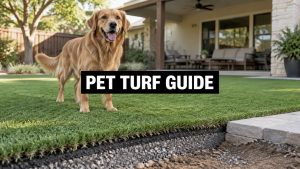
| Aggregate base | Compacted 3–4 inch crushed aggregate | Carries fluid down and away |
| Slope | At least 1%, about 2% preferred | Positive drainage to an outlet |
| Clay or flat yards | French drain or perforated pipe | Stops a saturated, smelly sub-base |
| Infill | Zeolite-based or antimicrobial-treated, not plain silica alone | Zeolite adsorbs ammonia from urine |
| Wash-down | Hose or nearby water access | Rinsing is part of the system |
| Heat plan | Shade, drinking water, exit to a cooler surface | Austin sun can overheat paws |
Read this as a system specification, not a shopping list for green carpet. Face fiber, backing, infill, aggregate, and the discharge route must work together. Our artificial turf specifications guide gives you a place to organize the product details beside the site requirements.
Start with the face. Dogs lie on it, turn sharply on it, and press their noses into it, so specify a soft, non-toxic synthetic surface and obtain the selected product's documentation. Softness is a contact requirement, not proof of cooling or sanitation.
Next, look underneath. Liquid must pass through the backing rather than linger against it. A sample that feels comfortable in your hand tells you little about how the installed backing will handle the bathroom corner.
Give each layer a measurable job
The aggregate row describes an installed, compacted layer. Loose material dumped into an excavation isn't the finished base, and the proposal should distinguish excavation depth from compacted depth. Ask us to explain how the base will remain stable while allowing liquid to reach its exit.
Slope belongs on the drawing, with a destination. A surface can look level and still drain properly, but an installer should be able to identify the high side, low side, and discharge point. On clay that already holds stormwater, adding permeable turf above the problem isn't enough.
Infill needs equally clear language. Zeolite-based and antimicrobial-treated products aren't interchangeable claims: zeolite is selected for ammonia adsorption, while an antimicrobial treatment needs its own product-specific explanation. Plain silica alone shouldn't be sold as a complete urine-odor strategy.
If a quote only names a brand of grass and skips base, slope, infill, and shade, it isn't a pet system.
Put upkeep and heat on the drawing
Locate the wash-down point before committing to the layout. Check whether the hose reaches the actual bathroom corner without dragging through furniture, planting beds, or a locked gate. A theoretically washable surface isn't convenient if you avoid rinsing it.
The heat row is just as important as the backing row. Specify where shade falls during dog-use hours, where drinking water sits, and how the dog reaches a cooler resting area without crossing more hot turf.
Keep this sheet beside the drainage and heat requirements when comparing proposals. A missing component needs an explanation, not a reassuring adjective.
Tracing Urine Through the Yard
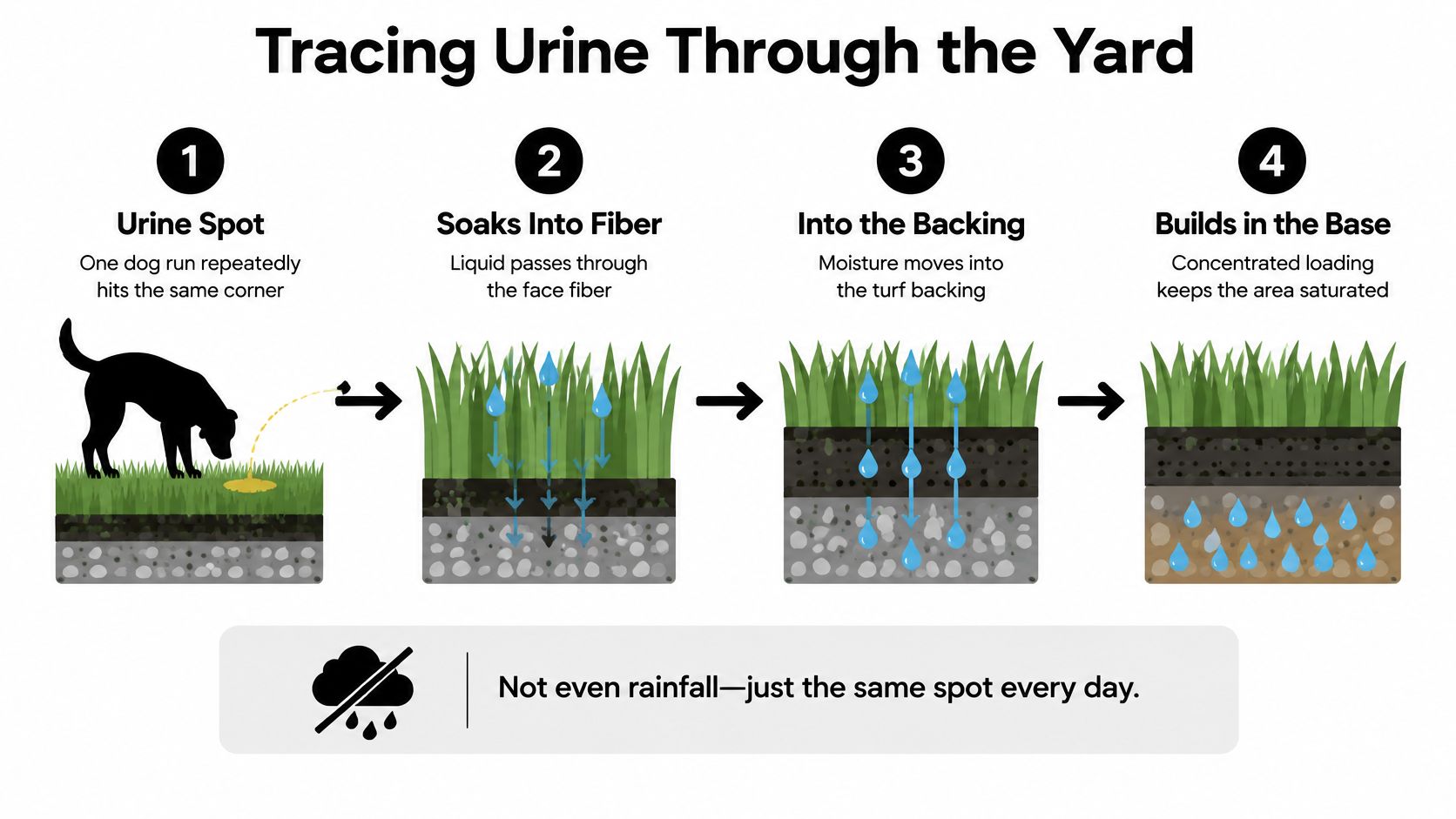
A dog run doesn't receive urine like evenly distributed rainfall. The same corner gets repeated use, often while the rest of the yard stays dry. That concentrated loading is why the drainage assembly matters more than the visible grass.
Follow a urine spot from the surface. Liquid passes between the face fibers and through the infill, reaches the permeable backing, then moves into the aggregate. From there, it must enter suitable underlying soil or leave through a designed drain outlet.
Follow the liquid to an actual exit
The FieldTurf Landscape contractor guide identifies a compacted 3–4 inch crushed-aggregate base, a slope of at least 1%, with approximately 2% preferred, and supplemental drainage where clay-heavy soil would otherwise remain saturated. The practical requirement is continuous flow through the assembly, not merely fast passage through a turf sample.
If a layer or outlet stops passing liquid, moisture can spread sideways beneath the surface. More hose water then enlarges the wet area instead of flushing it away. Our guide to whether dogs can pee on artificial turf addresses that distinction between a usable bathroom surface and a complete waste-management system.
Read the failure signs
- A sweet-ammonia smell after a dry day: Treat this as a reason to inspect the backing and base for retained waste. Don't assume another deodorizer will fix the route out.
- A soft or spongy patch: Investigate saturation, base stability, and the discharge point. A yielding spot deserves attention before more traffic disturbs it.
- Rinse water that pools for hours: Check for a blocked outlet, inadequate grade, or a restriction within the assembly. Repeated hosing isn't a repair.
Infill sits directly in the urine path. Plain silica helps support the blades but offers little ammonia control; zeolite-based material can adsorb ammonia compounds associated with urine odor. Antimicrobial-treated alternatives should be evaluated against their technical documentation, not treated as equivalent because both carry a pet label.
Before approving a proposal, have us show where water daylights or reaches its approved discharge, the intended fall at the bathroom corner, the compacted base depth, and the exact infill product. Those answers are more useful than comparing shades of green.
Odor-control claims only mean something alongside a maintenance routine that removes waste and keeps that exit working.
Heat Limits for Austin Dogs
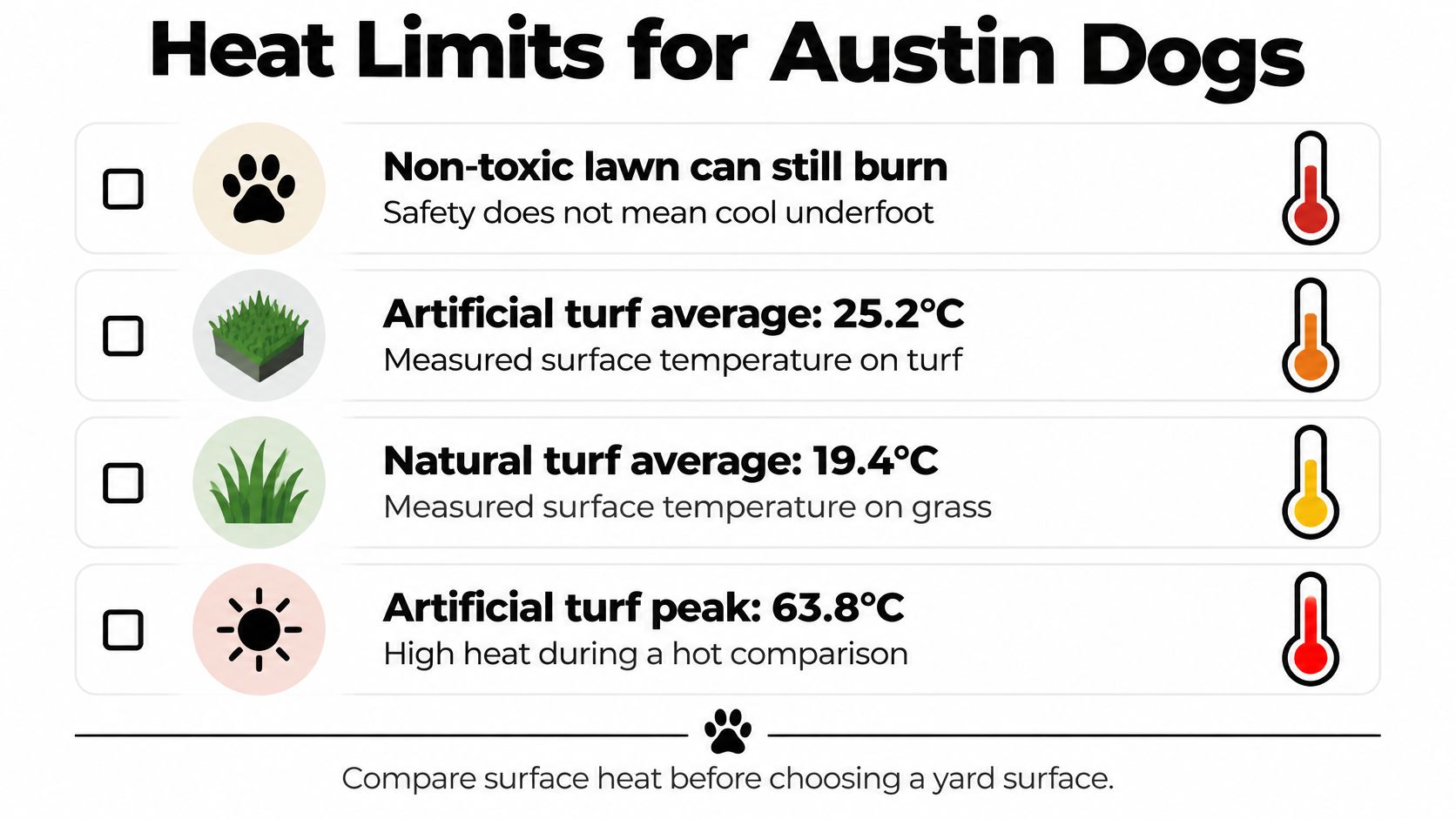
A non-toxic lawn can still burn. Chemical suitability and paw-temperature safety are separate questions, and a pet-friendly label answers neither question by itself.
In a controlled comparison of artificial and natural turf, artificial turf averaged 25.2°C versus 19.4°C for natural turf and reached 63.8°C, while natural-turf treatments stayed below 40°C; artificial turf also warmed approximately 1.67°C per 1°C increase in ambient temperature, compared with 1.05°C for natural turf. Those measurements describe the tested conditions, not a forecast for your backyard.
Make heat an operating rule
A review of 23 publications from the National Collaborating Centre for Environmental Health found artificial turf surfaces 9.4–33.7°C hotter than natural turf and discusses medical warnings that surfaces can exceed 160°F, with risks including burns, dehydration, heat stress, and heat stroke. The review's temperature range isn't a shade-specific measurement or a universal threshold for injury.
When Austin pet turf is too hot
| Situation | What research shows | Owner action |
|---|---|---|
| Direct midday sun | Tested synthetic surfaces can become substantially hotter than grass | Take an infrared reading at paw level; keep dogs off hot turf |
| Rising air temperature | Synthetic surface temperature can rise faster than natural turf temperature | Don't use the weather app as a paw test |
| Shade | The broader comparison favors grass, but it doesn't establish a shade-specific temperature guarantee | Provide partial shade plus a cooler off-turf rest spot |
| Hose-down | Cooling is temporary; the surface can reheat | Rinse, recheck, and don't treat water as all-day protection |
| Vulnerable dogs | Surface readings don't establish each dog's heat tolerance | Use shorter sessions, water, and a free exit to a cooler area |
Synthetic fibers and backing absorb solar energy without the evaporative cooling provided by living vegetation and moist soil. That's why an air-temperature reading can feel reassuring while the surface underneath the dog isn't.
Use an infrared thermometer aimed at the surface where the paws will land. Check exposed patches as well as shaded ones, especially where a dog must cross turf to reach the gate. Our explanation of how hot artificial turf gets helps frame that surface-first decision.
Design for the dog who actually lives there
Puppies, seniors, brachycephalic or flat-faced breeds, overweight dogs, and dogs with heart or lung disease need particular caution. Discuss individual restrictions with your veterinarian rather than treating a material label as medical advice.
Provide shade or a partially shaded run, accessible drinking water, and an unrestricted exit to a cooler non-turf resting surface. Check that alternative surface too; an exposed patio isn't automatically cool.
Cooling infill or a sprinkle is a pause, not a promise that the product stays cool. The controlled study didn't count paw injuries, so its readings establish a heat-risk mechanism, not an injury rate or a universal safe-use cutoff.
If the surface is too hot for the back of your hand, it's too hot for that dog. A comfortable hand check, however, doesn't replace temperature monitoring or watching the dog.
Germs and the Self-Cleaning Myth
Reject both easy claims: artificial turf isn't automatically dirtier than grass, and it isn't sterile. Neither material removes the need to manage dogs, waste, and shared exposure.
A 2016 study in the Journal of Veterinary Internal Medicine examined 300 dogs at three Northern California dog parks, one with artificial turf and two with natural grass, and detected at least one enteropathogen in 114 dogs, or 38% of the sample, with no statistically significant difference among the parks. The organisms considered included Salmonella, Campylobacter jejuni, Giardia, and Cryptosporidium.
What the park comparison actually tells you
The turf location didn't show a higher measured prevalence of pathogen carriage. That is useful evidence against declaring synthetic surfaces more infectious by default. It isn't evidence that the artificial surface disinfected itself or protected every dog.
The study measured organisms carried by dogs attending the parks. It didn't establish where each dog acquired them, and it didn't turn a surface comparison into a guarantee about your pet's health. Dog-to-dog contact and shared environmental exposure remain relevant.
Surface brand doesn't replace picking up stool and moving liquid.
The geographic scope matters too. A regional park comparison doesn't cover every backing, infill, climate, or cleaning schedule, and it isn't a residential trial in Austin. Don't stretch a finding about measured prevalence into a claim that a particular backyard installation prevents disease.
Sanitation is management, not a material feature
Modern permeable systems can move water into the soil or a drain, but moving waste isn't the same as biologically disinfecting it. Urine residue and fecal material can remain within the assembly when owners don't remove them or when drainage fails.
An antimicrobial label also needs a defined scope. Ask what the treatment acts on, where it is present, and what testing supports the claim. A product's ability to limit certain microorganisms doesn't mean the entire yard becomes sanitary without cleaning.
The practical response isn't fear of turf or faith in it. It's prompt waste removal, a working liquid route, and cleaning suited to actual use.
For a homeowner deciding whether to call, the strongest reassurance is a drainage plan you can inspect and a maintenance routine you can follow. A veterinarian's favorable impression or a marketing label is weaker evidence than a properly interpreted study paired with that visible plan.
Routine Upkeep That Keeps Odor Down
Replace lawn chores with a waste-management routine, not with nothing. Remove feces promptly, before a dog tramples it into the infill. Use a scoop or bag to lift solids rather than blasting them apart with the hose.
Rinse urine spots instead of waiting for rain. Work water through the used area and check that it reaches the intended discharge route; pushing a shallow stream across the top isn't the same as flushing the assembly.
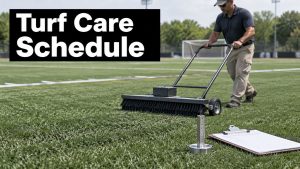
Pet turf upkeep routine
| Task | Timing | Why it matters |
|---|---|---|
| Remove feces | Promptly, before it is trampled in | Synthetic turf does not biologically disinfect waste |
| Rinse urine spots | Rinse rather than waiting for rain | Keeps ammonia from building up in infill |
| Check drain outlet | Weekly and after storms or heavy rinsing | A blocked outlet traps rinse water |
| Infrared paw check | Before midday play | Air temperature does not show surface heat |
| Deep clean | When smell returns | Vacuum or replace affected infill and use a urine-breaking cleaner |
Know when rinsing isn't enough
Keep the outlet visible and accessible. Clear leaves, sediment, and debris from the discharge area, and investigate any change in how the yard drains. Don't cover the outlet with mulch or a planter because it looks unfinished.
When odor returns despite rinsing, inspect before adding more cleaner. A urine-breaking cleaner can address residue, but it can't correct standing liquid beneath the backing.
For persistent contamination, arrange a controlled deep clean. That may involve vacuuming or removing affected top infill, accessing and rinsing the underlying area where appropriate, and replenishing the specified infill afterward. Don't pull up seams or wash out the base without an installation-specific plan.
Make the routine easy to keep
Choose a cleaner formulated for synthetic turf and pet urine, follow its dilution and contact-time directions, and keep dogs away until the labeled re-entry conditions are met. Never mix cleaning chemicals.
Record the affected location, cleaning product, rinse behavior, and whether the smell returned. That simple log helps us distinguish recurring residue from an infill problem or restricted drainage.
Include the heat check before daytime use. Move the dog to the shaded, cooler rest area whenever the surface fails the hand check, even if you've just rinsed it.
Two Yards and What Changes the Price
A side-yard run and a shared backyard solve different problems. The right comparison isn't which one looks more impressive. It's which layout gives your dogs usable space that you'll clean.
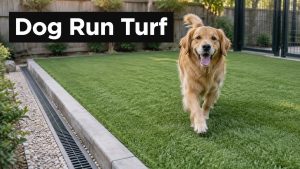
For a hypothetical side-yard run serving a pair of large dogs, turf the traffic lane rather than every unused strip. Put the bathroom corner within hose reach, carry the specified aggregate and positive fall through to a daylight outlet, use pet infill, and provide shade at the far end. Secure edging can define the digging boundary, but it doesn't make a determined digger impossible.

A shared backyard needs more than extra turf
A full backyard accommodates gatherings as well as dogs. Keep the same permeable assembly, provide a cooler off-turf resting patio, and place a hose bib near the run. More green space doesn't justify promising that every corner will remain odor-free.
The Fraser municipal review summarizing Colorado State University PlantTalk guidance explains that contemporary carpet-and-topdressing systems can allow infiltration but don't biologically disinfect pet urine and feces; accumulated waste can require rinsing, infill removal or vacuuming, and specialized cleaning. That's the meaningful difference between an engineered pet surface and a no-maintenance sales pitch.
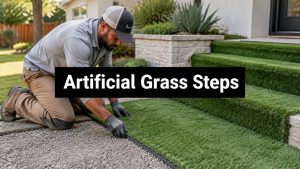
A sensible build sequence is:
- Strip failing sod and establish the intended grade.
- Place and compact the specified crushed-aggregate base.
- Verify positive fall to the discharge point.
- Add a French drain or perforated pipe where clay and ponding require it.
- Lay permeable turf and the selected pet infill.
- Secure the edges and confirm wash-down water reaches and drains from the bathroom area.
Compare cost drivers, not slogan prices
What moves an Austin pet turf price
| Driver | Why the price moves | Austin pet note | Price direction |
|---|---|---|---|
| Square footage | Turf, base, and labor scale with area | A defined dog run is smaller than a whole-yard replacement | Rises with area |
| Aggregate base | Crushed rock, excavation, and soil haul-off | Skipping the drainage layer leaves the underlying problem unresolved | Rises with depth and haul-off |
| Extra drainage | Drain pipe, trenching, and an outlet | Existing stormwater ponding needs investigation | Rises with added drain work |
| Infill | Zeolite or antimicrobial infill versus plain sand | Repeated-use corners need deliberate odor management | Usually rises with specialized infill |
| Shade and edging | Shade structures, steel edges, and gates | Heat exposure and digging affect scope | Rises with added structures |
| Access and grade | Hand carrying, slopes, or walls | Tight side yards can add labor before turf is laid | Rises with difficult access |
Our artificial grass for dogs cost guide explains the factors worth comparing in an estimate. A municipal dog-park project isn't a credible backyard price benchmark, and a square-foot headline doesn't tell you what drainage work is included.
Price the run you'll maintain, not the largest green rectangle that fits. Review the cleaning commitment before signing.
Book a Measured Pet Turf Visit
Make the purchase conditional on clear answers. Liquid needs a properly built aggregate base and a real slope or drain. Infill needs an ammonia-management purpose rather than plain sand alone, and dogs need shade, drinking water, and a way off hot turf.
If any answer is missing, don't buy on a fiber sample. Call Modern Yard to schedule a measured walkthrough, with the bathroom corner and afternoon sun exposure treated as design inputs.
Bring questions that produce useful answers
We build turf dog runs with proper drainage and deodorizing infill. Dog urine doesn't break down the fibers of the artificial grass we install or affect the lawn's appearance over time, but that durability doesn't remove the cleaning requirement.
Use the walkthrough to assess slope, clay, sun exposure, access, and where your dogs urinate. Our factors-based estimate should make area, base preparation, drainage, infill, and access understandable rather than compressing them into a slogan price.
- Confirm protection: We're fully insured and offer a total satisfaction guarantee. Review the insurance documentation and guarantee terms in writing before signing.
- Review relevant work: Request project photos and genuine feedback about dog runs, drainage, and cleanup, including concerns and how they were resolved.
- Separate impressions from proof: A local veterinarian reports seeing a noticeable decrease in certain skin issues and parasites in pets living with synthetic turf. That observation isn't a controlled finding or a promised health outcome.
The FTC endorsement guidance requires testimonials to reflect honest experience and performance claims to have adequate substantiation. Identical praise and promises of never needing to clean shouldn't replace documented installation details.
Bring the spec sheet to the appointment. A useful consultation ends with a clear design and maintenance decision, not pressure to choose a color.
Modern Yard Landscapes offers pet turf dog runs with drainage and deodorizing infill, supported by site preparation and factors-based estimates. Visit Modern Yard Landscapes, then call to schedule a measured walkthrough of your yard's clay, drainage, sun exposure, and dog-use areas. Bring your spec sheet so we can work through the installation and upkeep requirements before you commit.