
Search whether artificial grass drains and the internet answers in one voice. Yes, the turf is permeable, water passes straight through, nothing to worry about. That sentence has probably caused more rooftop leaks than any bad tube of adhesive. A permeable surface on a roof that can't move water sideways only gives the water somewhere to sit.
The honest version is narrower and far more useful. Artificial grass is a porous finish. The roof drains because of the stack of layers beneath it, and every one of those layers has a job the turf cannot do for it. Get the stack right and a turf deck will shed a Central Texas downpour without drama. Skip one layer and the surface still looks perfect while water works at the membrane underneath.
What follows is how that stack behaves on a real roof, the benchmarks a reviewer checks before approving an assembly, the failure case almost nobody plans for, and the verification steps that protect your roof, your warranty and your weekend.
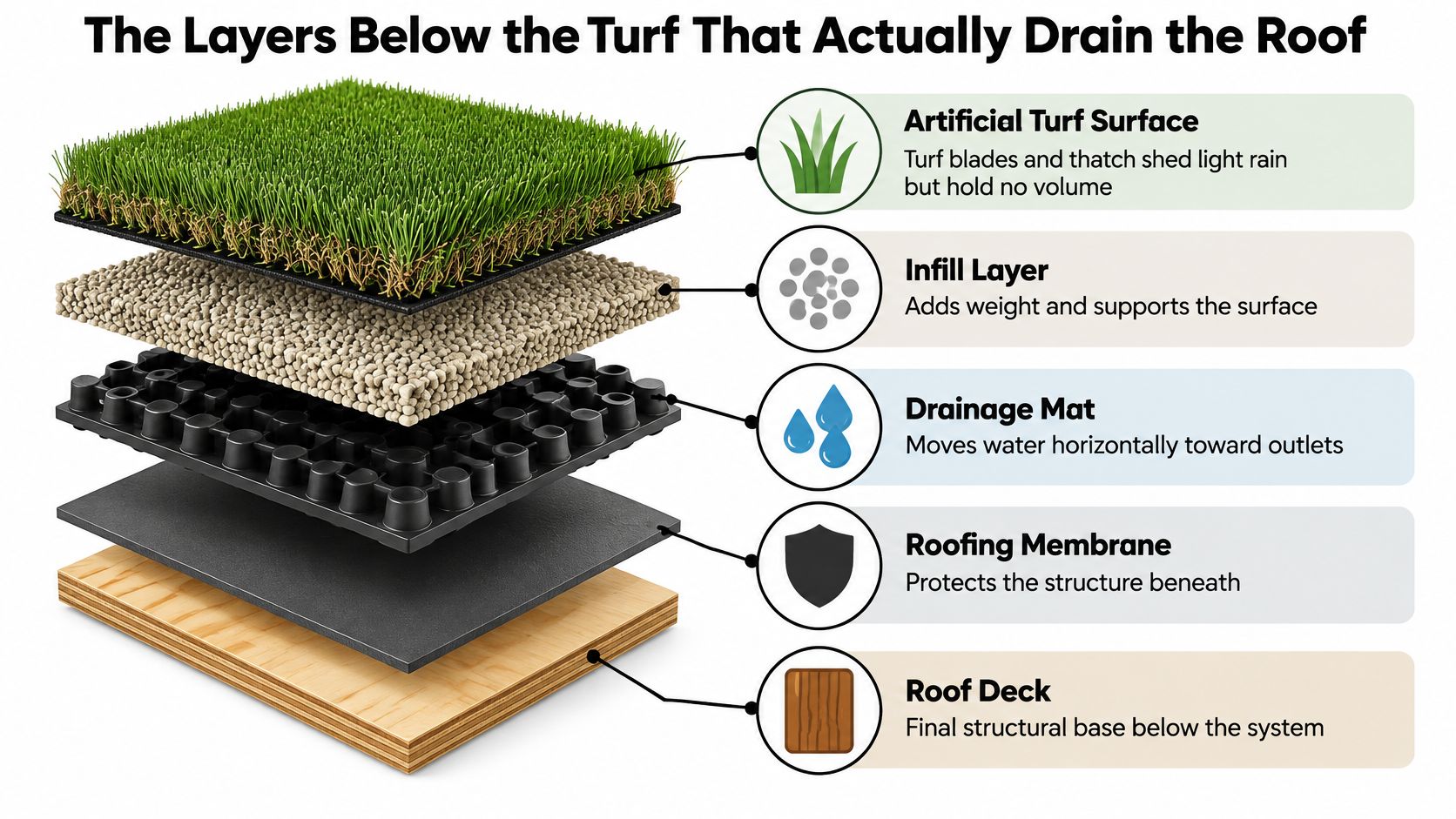
The Layers Below the Turf That Actually Drain the Roof
Artificial grass does not drain a roof. Water passes through the turf and base, then reaches the waterproofing membrane, which keeps it out of the structure. From there, the roof's slope and drainage path must carry it sideways to an outlet before more rain arrives.
That makes the layers beneath the turf perform the essential work. The drainage course conveys water, while the layers above it pass water down and help keep debris from clogging the flow path.
What each layer is responsible for
Seven components carry the load. Each has a specific job and a failure mode.
| Layer | Job it does | What fails without it |
|---|---|---|
| Turf blades and thatch | Forms the surface and carries foot traffic | Debris can collect among the fibers |
| Infill | Supports the blades and allows water to pass through | Compacted infill can slow drainage and trap fines |
| Permeable backing and base | Moves water from the turf into the drainage course | Water can stall, leaving the surface soft |
| Drainage mat, geocomposite or granular course | Collects water and conveys it to the outlets | Water can pond against the membrane |
| Filter fabric | Stops fines from migrating into the drainage path | Flow paths can clog and capacity can drop |
| Waterproofing membrane and protection layer | Keeps water out of the structure and protects the membrane | Leaks or hidden damage can develop |
| Drains, scuppers and overflow | Discharges water off the roof | Water can pond or overflow at vulnerable edges |
The diagram shows the assembled stack, from the turf pile down to the structural deck.
Why a turf deck is not a green roof
A turf roof and a vegetated roof may look alike from the street, but they manage water differently. The U.S. Environmental Protection Agency's green roof guidance describes green roofs as systems that use growing media and vegetation to absorb rainfall and release stored water through evapotranspiration. Their typical layers include vegetation, engineered planting medium, filter mat, drainage layer and moisture barrier.
Artificial turf has no growing medium and does not release stored water through vegetation. It is a surface finish, so water must drain through the assembly beneath it. Roof slope, drainage design and protection at parapets, edges, flashing, vents and skylights all affect where water travels and whether it reaches an outlet.
Before signing: Ask the installer to identify every layer in the proposal and explain its role.
Then check the written scope for the membrane, protection layer, drainage course, filter fabric, base and turf. Ask who specified the roof falls and outlet positions, and request that responsibility in writing. For a closer look at how artificial turf system layers fit together, review the layer-by-layer guide.
Design Benchmarks Engineers Check Before Installation
Turf permeability is not a roof drainage rating. Engineers check whether water can pass through the surface, move through the assembly, and reach an outlet without backing up.
Washington, D.C.'s green roof chapter calls for drainage to convey flow to an outlet or overflow without backing water into upper layers. It also specifies drain openings beside growing media be boxed and protected with flashing that extends at least 3 inches above the media surface. The detail helps keep fill and infill out of the drain opening. The chapter cites NJDEP's figure of approximately 10 inches per hour for turf, backing and infill tested under ASTM F1551 or EN 12616.
| Source | Benchmark | Why it matters for turf |
|---|---|---|
| Washington, D.C. guidance | Drain openings boxed and protected by flashing at least 3 inches above the media | Keeps fill and infill out of the drain opening |
| Nashville guidance | Drainage layer conveys flow to an outlet without backing water into upper layers | Keeps water moving through the assembly |
| NJDEP | Turf, backing and infill about 10 inches per hour under ASTM F1551 or EN 12616 | Measures the surface rate, not roof discharge |
| Vermont manual | At least two outlets, or one outlet plus an overflow, with excess runoff conveyed safely away | Plans for failure containment |
| Maryland draft | Overflow structures provide a route for water beyond the design capacity | Requires a plan for larger storms |
| Philadelphia guidance | Synthetic turf is excluded from the green roof definition and must be paired with other practices | Turf alone is not a stormwater system |
The surface rate is not the roof's discharge capacity
The 10-inches-per-hour figure measures water crossing the turf under a lab test. It does not measure how quickly water leaves the building. Seams, geotextiles, crushed base, drainage mats, drain inlets and sediment sit downstream of the surface, and any one of them can restrict flow.
A turf surface can pass that test while water ponds below it. The limiting point may be elsewhere in the assembly.
Before installation, calculate the area draining to each outlet and the peak flow it produces. Check that the drain and strainer can accept that flow, including with partial blockage. Then identify a secondary overflow route and where it discharges. The benchmark is only useful when the roof-specific calculations and outlet details support it.
Drainage Mats, Slope and Outlet Layout in Practice
Turf lets water through; it does not carry water off a roof. The drainage path beneath it must stay continuous, protected from fines and clear to the outlets. Philadelphia's stormwater guidance treats synthetic turf as a porous finish, not a complete green-roof stormwater system. Its assembly includes a waterproofing membrane, protection layer, drainage course and positive routing to roof drains or scuppers (Philadelphia Water Department green roof manual).
On a low-slope roof, the drainage course must carry water at least as efficiently as the permeable fill above it. Otherwise, water backs up and the turf can feel spongy. Place filter fabric where fines could enter the flow path, and keep access clear around each drain. A blocked outlet, inadequate fall or compressed sub-base can create a pond beneath turf that looks dry. The trapped water adds load and keeps the membrane wet.
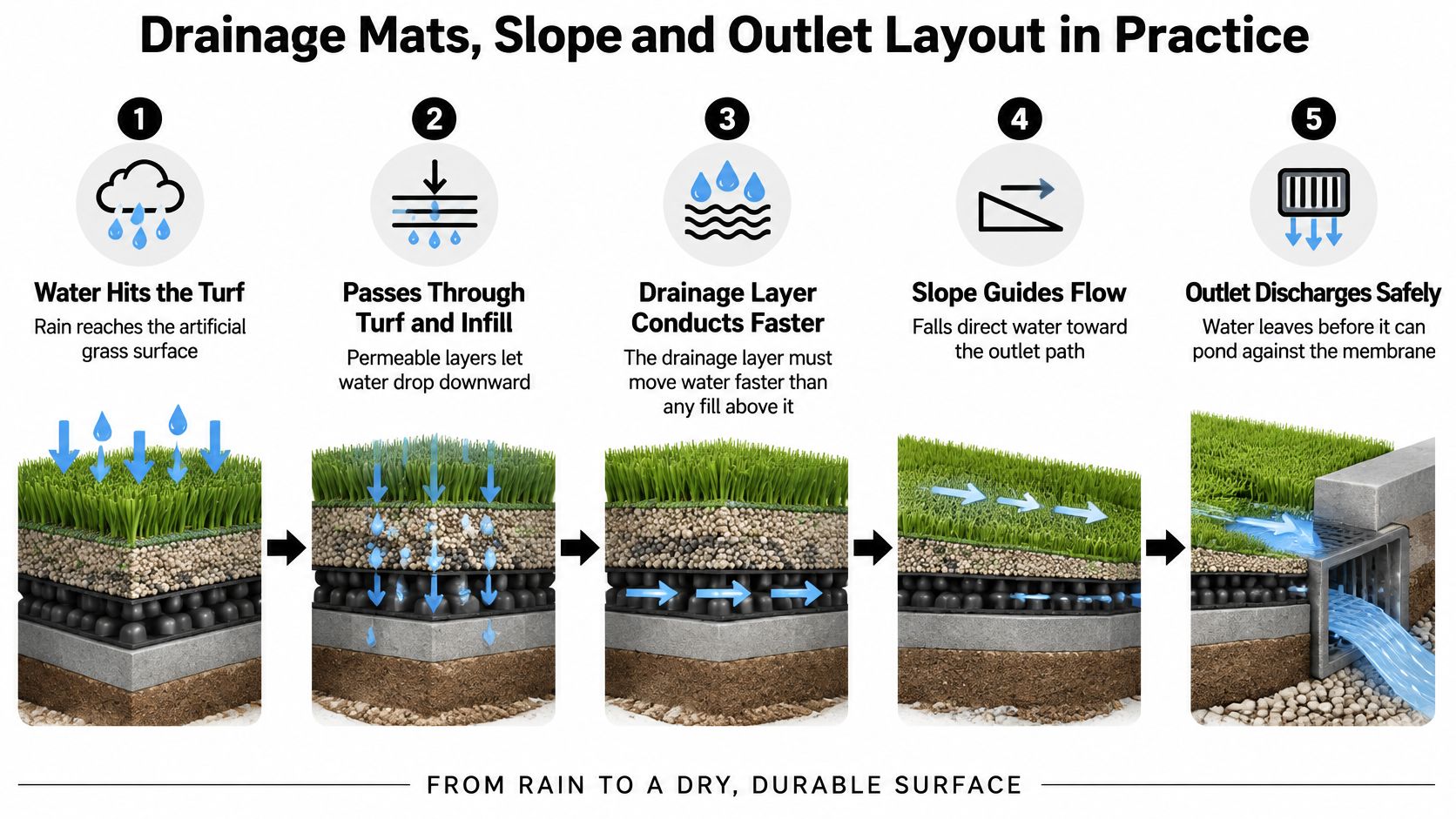
The order of work that keeps water moving
- Confirm the falls to each drain. Check low points with a level before covering the deck. A depression in the substrate remains a depression beneath the finished turf.
- Install the membrane protection layer. It separates the waterproofing from abrasion caused by tools, fasteners and infill.
- Place the drainage mat. Overlap seams in the direction of flow so they do not obstruct water.
- Add filter fabric where needed. Keep base material and fines out of the drainage path.
- Set and compact the sub-base evenly. Uneven compaction can create soft spots and shallow areas that hold water.
- Install turf and infill without covering outlets. Turf edges or infill at a scupper can restrict discharge.
Choose the drainage course for its ability to convey water, its protection of the assembly and the roof's structural limits. Do not select a thickness from a generic range without checking the roof design.
Outlet position also affects how water moves through the assembly. A 2024 comparison of drainage arrangements across 48 artificial-rainfall experiments reported runoff retention of 61.82% for upper drainage and 23.94% for lower drainage, a difference of 37.88 percentage points (study of drainage arrangements and stormwater retention). For a 1,200-square-foot deck with two drains, each drain serves roughly 600 square feet. Grade the area toward each outlet rather than forming a dish around it, and verify the fall with a level. If the surface beneath the turf is concrete or paving rather than a membrane, see this guide to artificial grass drainage on concrete for surface-preparation considerations.
Where discharge enters a gutter, confirm that the receiving path can accept the flow. You can compare local gutter material suppliers when selecting gutter materials.
Planning for Storms Larger Than the Design Capacity
The instinct is to make a roof drain as fast as humanly possible. That instinct creates its own failures. Push water off too aggressively and the base under the turf stays dry, loose and unstable, so the surface shifts and the seams work. Retain too much and you add weight, lift edges and keep the membrane wet. The target is controlled release, not maximum speed.
The design input that matters most is the one the benchmark table already lists: two outlets, or one outlet plus an overflow, and overflow structures sized for a storm beyond the routine design event. Vermont's stormwater manual requires exactly that arrangement and requires excess runoff from a 100-year storm to be safely conveyed away from the building, while Maryland's 2025 draft guidance recommends overflow structures able to handle storms larger than the one-year, 24-hour design storm and notes that flat roofs may need perforated internal drainage networks (Vermont Stormwater Management Manual).
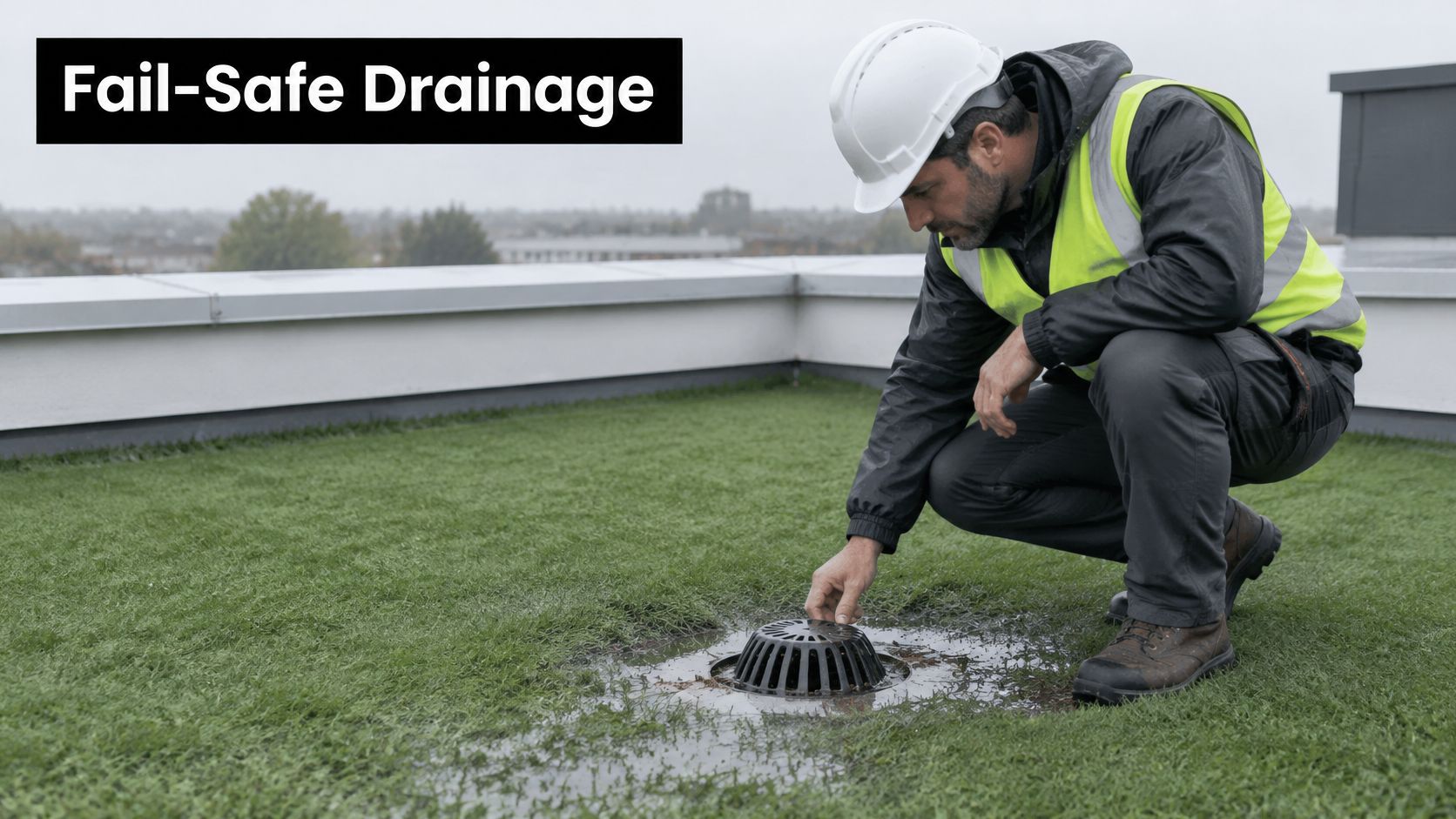
So the question to answer in writing is not whether the roof drains in normal rain. It's what happens when the primary drain is blocked by leaves, fibers and infill during a storm that exceeds design capacity. A blocked outlet is the most common route to overflow damage, and it's the one nobody models.
A roof with one outlet and no overflow has already decided how it will fail.
For Central Texas, plan for both routine rain and the fast, high-intensity cells that arrive in spring and fall. Then hand the property over with a sheet the manager signs:
- Outlet count, with each one numbered on the roof plan.
- Overflow location and its discharge point, confirmed clear of walls, walkways and neighboring surfaces.
- Cleaning interval, tied to the maintenance routine rather than to good intentions.
- First post-storm inspection date, so the system gets checked while the evidence is still on the roof.
Structural Load and Membrane Protection on Turf Roofs
Dry turf and infill weigh very little. Saturated base, standing water and a maintenance crew weigh a lot more, and the structural engineer should be assessing the second number.
Take a 1,200 sq ft deck that holds an inch of water across a third of its area. That's 400 sq ft at one twelfth of a foot, about 33 cubic feet of water, and at 62.4 pounds per cubic foot that's roughly 2,080 pounds sitting in one corner. Add saturated base and you have a load the dry-weight calculation never saw. Run the same arithmetic with the retained depth your roof could hold when a drain blocks, and show that number to the engineer.
On a deck with limited load margin, turf doesn't go down until a structural engineer signs off. That's especially true of small structures and conversions, where artificial grass on a balcony often sits on a joist layout designed for people, planters and not much else.
Rules that keep the membrane intact
The membrane is the only thing between your living room and the weather. Protect it with a dedicated protection layer against fasteners, tools and infill, and detail every penetration, parapet, edge, vent and skylight to the manufacturer's published detail, not to what's convenient on the day.
Two habits matter more than any product choice. Keep turf edges and edging off membrane terminations, so nothing mechanically abrades the seam that keeps you dry. And refuse any fastener that passes through the waterproofing; if a fixing needs a hole, the fixing is wrong.
Record the warranty status before turf is adhered or weighted. Once the surface is down, an inspector can't see what was done underneath, and a membrane manufacturer will ask.
Request in writing: a load assessment that includes saturated base and retained water, plus a membrane detail sign-off from the party who installed or warrants the waterproofing.
Those two documents do more for you than any verbal assurance at handover.
Diagnosing Ponding, Soft Spots and Slow Drying
Most turf roof problems announce themselves the same way: water where it shouldn't be, long after the rain stopped. Standing water after a storm is the commonest call, and it almost always traces to an outlet, a fall or a base that has compressed.
| Symptom | Likely cause | Fix |
|---|---|---|
| Standing water after rain | Blocked drain, inadequate fall or compressed sub-base | Clear the outlet, correct the grading and re-compact the sub-base |
| Slow drying with an odor | Clogged infill or fines in the drainage path | Replace contaminated infill and flush the drain |
| Soft or sinking spots | Saturated or compressed base | Re-level the surface and check the drainage course |
| Water at parapets or edges | Flashing or perimeter not detailed to the membrane | Re-flash to the membrane manufacturer's detail |
| Overflow discharging in moderate rain | Undersized primary drain | Add an outlet or a secondary overflow path |
| Leaks below the turf | Membrane damage at penetrations | Inspect and repair the membrane, then retest the drainage |
Some of these are an afternoon. Clearing a blocked drain, flushing an outlet and lifting a lap of turf off a scupper are same-day jobs. Others run weeks: replacing contaminated infill, re-compacting a sub-base, re-flashing a perimeter, or repairing a membrane at a penetration and then retesting the whole drainage path. Sorting a one-hour fix from a three-week one is mostly a matter of looking at the right things in the right order.
A fifteen minute inspection you'll actually repeat
Walk the deck within a day of real rain, while the evidence is still there. Check every drain for blockage and look inside the outlet for fiber, infill and grit, not just at the grate. Follow the edges and parapets for water lines and staining. Photograph each drain before and after cleaning, so the next conversation about a recurring problem has a record behind it.
If you'd rather have a reference for the full set of causes, common artificial turf drainage problems covers the same ground from the surface side.
Two symptoms mean stop cleaning and call a licensed roofer or structural engineer: a sag that has developed rather than settled, and any leak appearing inside the building below. Both point at the deck or the membrane, and neither gets better with a hose.
Book a Drainage Assessment Before You Install Turf

A drainage plan earns its keep before a single roll of turf is ordered. A sound one proves, in writing, on your roof's own numbers.
Every layer is named. Membrane, protection layer, drainage mat or granular course, filter fabric, compacted base, turf, and the outlets that receive the flow. Nothing is left as "standard preparation."
The benchmarks are checked against your roof. Tributary area per drain, peak flow, drain capacity with the outlet partly blocked, and an overflow path that discharges somewhere safe. Not a catalog infiltration rate standing in for the whole system.
The falls are surveyed, not eyeballed. Each low point checked with a level, each drain confirmed as the low point rather than a high one, and the sub-base compaction specified so no bowl forms later.
The overflow is mapped. Where it is, where it goes, and what it must not flood.
We offer a free drainage tile consultation, and the installations we run include the groundwork that makes the rest work: extensive soil preparation and compaction, precise grading toward outlets, professional seaming, correct infill application and distribution, and properly secured perimeter edges. Our sub-base is built to keep water moving even through the heavy rain that hits Austin, Round Rock and Georgetown.
The sequence is simple. Call or visit modernyardlandscapes.com to book the free consultation. Have the roof plan, the drain locations and the membrane warranty to hand. You get a written drainage and load plan back before you spend anything on materials, and installation is scheduled once you approve that plan.
The difference between a turf deck that drains and one that ponds isn't the grass you choose, it's the plan behind it: a continuous waterproofing membrane, a drainage layer sized for real flow, filter fabric, surveyed falls toward working outlets, and an overflow path that handles the storm your design storm couldn't. Modern Yard builds that stack into every artificial grass installation across Austin, Round Rock and Georgetown, from subgrade preparation and compaction through grading, seaming and infill, and offers a free drainage consultation so the design is settled before you order a single roll. Call this week and book yours, and let's get your roof ready for the rain that's already coming.