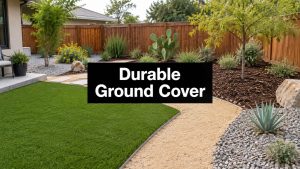

If you're staring at a lawn that turns patchy in the heat, muddy after a hard rain, and expensive to keep alive in between, you're not alone. Austin homeowners deal with a rough combination of long hot stretches, sudden downpours, and clay soil that doesn't forgive shortcuts.
That's why artificial turf needs to be understood as a built system, not a roll of green carpet. The part you see matters, but the layers underneath decide whether the lawn drains cleanly, feels comfortable, and stays flat year after year. When those layers are designed for Central Texas conditions, turf performs like an upgrade. When they're generic, problems show up fast.
Beyond Green Blades The System Beneath Your Feet
A lot of homeowners start with the visible goal. They want a lawn that stays green, doesn't need mowing, and won't collapse into mud after a storm. That's reasonable. The mistake is assuming the turf product itself is the whole solution.
It isn't.
Modern synthetic turf became far more advanced over time. The early carpet-style systems were short, dense, and simple compared with what installers use now. As the history of artificial turf systems shows, third-generation turf added infill such as crumb rubber and silica sand between longer polyethylene fibers, with modern pile fibers under 70 mm, replacing the short nylon style associated with early systems first made widely visible by the 1966 Houston Astrodome installation.
Why Austin changes the conversation
Austin's climate exposes weak installs quickly. Heat dries and hardens poorly prepared surfaces. Heavy rain tests whether the base was graded and compacted correctly. Clay soil expands, contracts, and holds water in ways that generic national advice usually ignores.
That's why the right question isn't “Which turf looks best?” It's “What's under it, and was it built for this yard?”
If you want a deeper look at what sits beneath the surface, this guide on synthetic grass base material is a useful starting point.
A turf lawn succeeds from the ground up. If the lower layers are wrong, the top layer can't save it.
Turf is a construction project
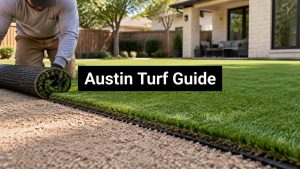
The best installs treat turf more like hardscape than landscaping. You're building a finished surface over a prepared foundation, with each layer assigned a job. Some layers manage drainage. Others stabilize the blades, soften the feel, or protect the shape of the lawn along edges and seams.
That's the big shift homeowners need to make. Artificial turf isn't just purchased. It's engineered into the site.
Anatomy of a Perfect Lawn The 8 Essential Turf Layers
A good way to think about artificial turf layers is to compare them to a house. The paint color matters, but the slab, framing, waterproofing, and finish details decide whether the house ages well. Turf works the same way.

A turf system isn't just visible grass. It's a layered assembly of fibers, backing, infill, and sub-base, and each layer controls a different performance variable. As explained in this turf system overview, even a high-quality turf product can fail if the base is poorly compacted or the infill doesn't fit the traffic and use case.
For homeowners planning a project, this article on how to prepare ground for artificial turf helps show why prep work drives the final result.
The top layers you feel first
Artificial grass blades
These are the visible fibers that create the lawn's look. Blade shape, density, and resilience affect whether the yard reads as natural or flattened. In Austin, this layer also takes intense sun, foot traffic, and day-to-day wear.Thatch layer
This lower fiber mix adds body and helps the surface avoid that stiff, shiny look people dislike in cheaper turf. It also supports the upright appearance of the main blades and softens the step.Primary backing
This is the structure the blades are tufted into. If the backing is weak or poorly matched to the site, seams and stability suffer over time.Infill material
Infill sits between the blades to keep them standing, add ballast, and shape how the lawn feels underfoot. Too little infill leaves turf flat and loose. The wrong infill can make a yard feel harsher than it should for the way the space is used.
Practical rule: If the blades don't recover well after traffic, don't blame the fiber first. Check the infill choice and distribution.
The lower layers that do the heavy lifting
Not every project uses the exact same configuration, but these are the core support layers professionals evaluate on most residential installs.
| Layer | What it does in the real world |
|---|---|
| Secondary backing | Locks the turf structure together and adds stability beneath the primary backing |
| Drainage layer | Moves water away so rain doesn't sit under the turf |
| Aggregate base | Creates the stable, permeable platform the whole lawn depends on |
| Geotextile fabric | Separates native soil from the base and helps control migration and weeds |
| Edging | Holds the perimeter clean and secure so borders don't creep or lift |
Why all eight matter together
Homeowners sometimes focus on one feature. A softer blade. A nicer color. A premium sample. Those things matter, but no sample board shows what happens after a rainy week or a summer of traffic.
The right layered build solves several problems at once:
- Drainage control so water moves through the system instead of pooling.
- Surface stability so the lawn stays level instead of developing waves.
- Comfort underfoot so the turf feels intentional, not hard and hollow.
- Edge retention so borders look crisp instead of separating.
A finished lawn only looks effortless when each layer underneath is doing its job.
The Unseen Hero Your Turf's Foundation
Most turf failures don't begin at the blade. They begin underneath, in the part homeowners rarely see after installation. In Austin, that hidden foundation matters more because clay-heavy soil and strong rain events punish weak prep work.

Independent Austin-area guidance points out that drainage under artificial turf is a major design problem, especially on sloped or clay-heavy sites. It also notes that the base determines whether turf “drains, stays level, and feels underfoot,” and that shallow or poorly prepared bases can lead to sinking, wrinkles, and edge uplift, as described in this discussion of what goes under artificial turf.
What goes wrong with generic installs
A lot of broad online advice treats every yard like it has the same soil, the same runoff pattern, and the same clearance. That's not how Austin properties behave.
Common problems usually start with one of these:
- Poor grading that leaves water looking for the lowest spot under the turf
- Base material mismatch for clay soil that expands and contracts
- Shallow prep that looks fine at first and then settles unevenly
- Weak edge support that lets the perimeter lift over time
A homeowner may only notice the symptom. A low corner that stays wet. A seam that starts to telegraph. A soft spot near a downspout. The underlying issue is usually lower in the stack.
Weed barrier and separation matter more than people think
A weed barrier isn't the star of the project, but it does have a job. It helps separate layers and reduces the chance that native material migrates into the base. On projects where homeowners are comparing options, this overview of best artificial turf weed barriers is a helpful reference for understanding what these materials can and can't do.
On problem yards, the base isn't a commodity. It's a site-specific drainage decision.
If you've already seen puddling, wrinkling, or soft spots in an older install, this guide to artificial turf drainage problems can help you identify where the system may be failing.
The Austin-specific standard
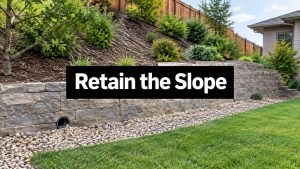
On a stable site, a base can be straightforward. On an Austin site, the installer has to read the yard. Soil behavior, elevation change, hardscape transitions, roof runoff, and usable clearance all affect the build.
That's why a professional approach doesn't start with turf samples. It starts with drainage paths, compaction strategy, and how the lower layers will behave after the first serious storm.
How Professionals Build a Lawn That Lasts
A turf lawn in Austin gets tested fast. One hard rain can find every low spot in the yard, and a stretch of summer heat will expose any weak compaction or sloppy seam work. If the system under the turf was rushed, the surface starts showing it long before the grass fibers wear out.

A lasting install comes from controlling the parts homeowners rarely see. The crew has to cut to a consistent depth, shape the grade so water has somewhere to go, compact the base without choking off drainage, and finish seams and infill so the lawn stays stable through heat, rain, and regular foot traffic. In Central Texas, that process matters more because clay soil expands, contracts, and holds water in ways that punish shortcuts.
The steps that separate careful work from rushed work
Technical guidance on sub-base design makes the basic principle clear. Thickness and compaction have to work together. One specification recommends a 50 mm compacted sub-base over geotextile with about 25 mm of grit sand above it to create a level, porous surface, and it warns in these sub-base installation specifications that overly deep layers can compact too tightly and slow drainage.
That shows up on the job in very practical ways.
- Excavation has to stay uniform. Inconsistent cut depth usually turns into visible highs and lows in the finished lawn.
- The grade has to be intentional. Austin storms dump water quickly, and clay soil does not forgive flat spots near patios, fences, or downspouts.
- Compaction has to be tuned to the site. Too loose, and the surface settles. Too tight, and water can hang in the upper layers longer than it should.
- Seam work has to hold up in heat. A seam can look clean on install day and still become visible later if the joining work or edge restraint was careless.
- Infill has to be spread evenly. Uneven infill changes how the turf feels underfoot and causes traffic lanes to show up sooner.
The details are connected. A crew cannot fix poor grading with better infill, and a premium turf product will not hide a base that moves after the first wet season.
What homeowners actually feel and see
Homeowners usually notice performance before they notice construction quality. They feel a surface that stays firm instead of spongy. They see rain clear instead of sitting in a corner. They look across the yard from the back door and do not catch a seam line or a dip telegraphing through the turf.
That result comes from the build sequence, not just the material choice.
In Austin, the hardest part is often balancing drainage with stability. The lawn needs enough permeability to handle heavy rain, but it also needs enough structure to resist movement as the underlying soil cycles through dry heat and sudden moisture. That balance is one reason professional installation is worth it on problem yards. The crew is not just laying turf. They are adjusting the lower system to the property.
Experience matters more on tricky lots
Flat, open yards are straightforward. Yards with runoff from the roof, tight side access, existing concrete, tree roots, or noticeable slope changes are where installer judgment starts to matter.
On those jobs, the best crews treat the site as a drainage and foundation project first. Some companies, including Modern Yard, also handle grading and turf installation as part of the same scope. That matters because transitions, elevations, and water flow need to be solved together if the lawn is going to stay clean, drain well, and feel right for years.
Custom Turf Layers for Pets and Putting Greens
Not every turf system should be built the same. A front lawn, a dog run, and a backyard putting green may all use synthetic grass, but they ask different things from the layers below.

That's where many one-size-fits-all bids fall short. They treat specialized projects like standard lawns with a different surface product. The better approach is to change the layer strategy to match how the space will be used.
Standard lawn compared with pet turf
A general residential lawn aims for balanced performance. It needs to look natural, feel comfortable, and handle regular family traffic. The layer choices usually prioritize appearance, drainage, and long-term shape retention.
Pet turf shifts the priorities.
| Application | What the lower layers need to do |
|---|---|
| Standard lawn | Balance comfort, drainage, appearance, and everyday wear |
| Pet-friendly turf | Move liquids through faster, reduce odor retention, and support frequent cleaning |
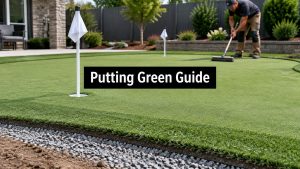
| Putting green | Stay firm, smooth, and consistent for a reliable roll |
For pet areas, the key issue isn't just the top fiber. It's permeability and cleanup. That often means favoring a more drainage-focused build, a backing that allows water to move through efficiently, and infill selected for easier maintenance and odor management.
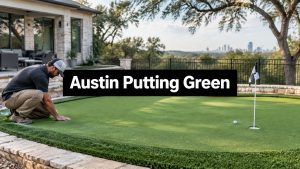
Putting greens require a different mindset
Putting greens are less forgiving than lawns. Homeowners may not care if a lounge area has a bit more softness. They absolutely notice if a golf ball tracks inconsistently.
That's why putting green layers usually lean toward a firmer, more precisely leveled foundation. The surface pile is different, the tolerance for waviness is lower, and infill selection has to support speed and consistency rather than just soft footing.
A lawn can hide small imperfections. A putting green exposes them immediately.
Choosing the right build for the way you live
A useful way to think about turf design is by asking what the yard has to do every day.
For families with dogs
Prioritize washability, drainage behavior, and surfaces that won't trap mess in the system.For entertaining spaces
Focus on comfort underfoot, visual realism, and clean transitions against patios and pool decking.For golf use
Demand precision in the base. Ball roll depends on flatness and firmness more than homeowners expect.
The right custom build usually costs less frustration than trying to make a standard lawn system serve a specialized job it wasn't designed to handle.
Your Long-Term Investment Cost Maintenance and Warranty
Homeowners usually ask about cost early, and they should. Turf is an investment. But the more useful question is what you're buying with that investment.
You're not just buying green color. You're buying a lawn that doesn't need the cycle of mowing, edging, fertilizing, and trying to recover from weather stress. You're also buying the hidden work that prevents repairs later.
What quality layers protect you from
A cheap install can look acceptable at turnover and still become expensive afterward. Once the base settles or drainage problems appear, repairs are disruptive because the issue often sits under finished turf.
A properly built layered system helps avoid:
- Surface distortion such as ripples, dips, and shifting edges
- Drainage-related repairs after storms or runoff events
- Premature wear patterns caused by poor infill support
- Higher maintenance effort trying to correct problems that should never have been built in
For routine care after installation, homeowners can learn a lot from a practical guide on how to clean artificial turf.
Durability is the point of the system
Artificial turf layers are designed for heavy use. One widely cited comparison says a professionally installed field can support about 3,000 hours of use per year, while a natural grass field handles about 700 hours, which is more than 4 times the use capacity according to this history and safety overview of artificial turf.
That figure comes from athletic field context, but the takeaway applies to residential thinking too. Layered turf systems are built to absorb repeated use without asking the surface to recover the way natural grass does.
Cost is shaped by the site
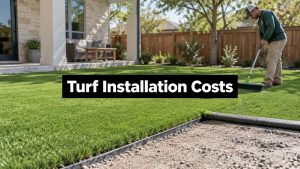
The final price on a residential project usually changes based on practical factors, not a single per-foot shortcut. Access to the yard matters. Drainage challenges matter. Edging detail matters. Specialized builds for pets or golf matter.
That's also why warranty confidence usually follows prep quality. A contractor can stand behind a project more comfortably when the foundation, drainage plan, and finish details were handled correctly from the start.
Get The Perfect Austin Lawn Done Right The First Time
A good turf lawn is built, not just installed. The blades on top matter, but the result you live with comes from the artificial turf layers underneath. In Austin, that matters even more because heat, intense rain, and clay soil don't give second chances to weak prep.
Homeowners usually call after they've already spent too much time fighting a lawn that won't cooperate. Some are tired of mud and dead spots. Others are replacing older turf that looked fine at first but failed because the foundation was generic. In both cases, the solution is the same. Read the site correctly, build the layers to match it, and finish the lawn with the level of care the surface demands.
That's why professional installation isn't an upgrade item on an Austin turf project. It's how you protect the investment from the beginning.
If you want a lawn that drains well, stays level, feels right underfoot, and fits the way your family uses the yard, schedule a consultation and get a site-specific plan before any turf goes down.
Stop battling your lawn and start enjoying it. Contact Modern Yard Landscapes for a free, no-obligation consultation and get an Austin-specific turf plan built for your yard, your drainage conditions, and the way you use your outdoor space.