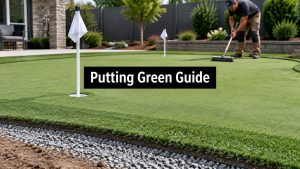

You're standing at the back door, looking at a bare patch of yard and imagining a putting green. Somewhere to practice after work, let friends putt while dinner's on the grill, and replace an awkward corner with something you'll use. Then the estimates arrive, and every installer seems to be selling a different version of the same green carpet.
Before you compare turf samples, make someone explain what happens beneath them. Artificial grass putting green installation is a drainage and foundation project first. The putting surface deserves attention, but it shouldn't be the first decision you make.
Why a Backyard Putting Green Is a Bigger Decision Than It Looks
The finished green is easy to picture. The excavation, drainage outlet, compacted stone, and carefully shaped base aren't. That's why homeowners can spend an entire appointment discussing fringe color without learning whether the contractor has a workable construction plan.
My recommendation is straightforward: buy the underlying construction before you buy the appearance. A decorative green and a serious practice surface can look similar in a photograph. Ask a golf ball to cross them, and the difference becomes much easier to judge.
Think like a green builder
Golf construction has a long engineering history. The USGA first published scientifically based putting-green specifications in 1960, and its traditional natural-grass profile includes underground drains, a minimum 4-inch gravel blanket, and approximately 12 inches of sand-based rootzone, according to its history of putting-green construction standards.
That isn't a backyard synthetic-turf recipe. You don't need to copy a natural-grass rootzone underneath artificial grass. The useful lesson is that professional green construction starts with water movement and structural stability, not the surface material.
Your motivations still matter. Tell the installer whether you want casual entertainment, focused putting practice, or room to chip. If resale appeal is part of your thinking, treat it as a personal design consideration, not a guaranteed return on your investment.
Before signing: Ask the installer to describe the finished green without mentioning the turf brand. You should hear a clear explanation of excavation, drainage, base construction, and testing.
Don't confuse a lower price with a better deal
A less expensive proposal might reflect a simpler design or better access. It might also leave important work outside the contract. You can't tell from the total alone.
- Compare the scope: Look for named materials and defined construction work, not just a turf allowance.
- Separate promises from specifications: “Built to last” doesn't tell you how the base will be accepted.
- Challenge lifespan language: Ask what the warranty covers rather than accepting an unsupported promise about how long everything will perform.
Don't pay extra merely because someone sounds technical. Pay for a plan you can understand and workmanship you can verify.
Reading Your Site Before Anyone Starts Digging
A useful site visit begins with the yard, not a sample book. Walk the property with the installer and describe what happens during rain. Point out soggy corners, water crossing the patio, and places where previous landscaping has settled.
Expect actual investigation. I'd want soil probes, elevation readings with a laser level, and a conversation about where runoff can legally and practically leave the project. A square-foot measurement alone isn't a site assessment.
Follow the water before drawing the green
Austin's clay soils, intense rain events, and constrained lots deserve particular attention. The USGA's putting-green construction guidance calls for a firm subgrade without water-holding depressions and recommends lateral drains no more than 15 feet apart, with a minimum continuous pipe slope of 0.5%.
Those are useful engineering references, not instructions to install identical drainage in every backyard. Have the installer explain which principles apply to your property and why.
Use this decision path during the walkthrough:
- If the soil holds water: Ask whether a subsurface collection system and gravel drainage blanket are needed rather than relying only on surface contour.
- If the proposed green occupies a low point: Identify incoming runoff before deciding how the green itself will drain.
- If there's an outlet with available fall: Ask the installer to show the proposed route and elevations.
- If a wall or neighboring property blocks discharge: Resolve the outlet before approving the layout. Don't accept a plan that moves your problem elsewhere.
- If access limits excavation: Ask how the crew will remove soil and deliver aggregate without reducing the construction scope.
Our explanation of drainage for artificial grass can help you prepare questions for that conversation.
Check the constraints that change the design
Ask the installer to mark tree root zones, existing irrigation, and areas requiring utility location before digging. Discuss equipment access, material staging, and protection for the driveway or side yard. These belong in the planning conversation, not in a surprise change order.
Sun and shade deserve a separate look. Tell the designer when you expect to use the green, where you'd like seating, and whether children or pets will share the space.
A contractor doesn't need an instant answer to every site condition. But they should recognize unresolved conditions and explain how they'll investigate them before asking you to commit.
Building the Base That Decides Everything
Once the crew covers the base, you lose the easiest opportunity to inspect it. Ask for a construction checkpoint before turf installation. Photos help, but seeing the prepared surface and discussing the acceptance checks is better.
The excavation depth should follow the design and soil conditions. If separation fabric is proposed, ask what problem it solves. If perforated drains are included, confirm their route and outlet before the crew buries them.
Learn the vocabulary that matters
A lift is a layer of aggregate placed and compacted before the next layer goes in. Fines are the smaller particles within a material. Permeability describes how readily water passes through the assembly, while contour tolerance describes how closely the finished shape matches the intended design.
Independent synthetic-surface drainage guidance identifies approximate minimum permeability targets of 10 inches per hour for turf, backing, and infill, and 14 inches per hour for base and finish stone; it also recommends at least 95% of Standard Proctor density while warning that over-compaction can reduce permeability.
Those benchmarks belong in a discussion about the complete system. They aren't a reason to compact blindly or assume every aggregate behaves alike.
- Specify the aggregate: Ask for clean, low-fines material suited to the drainage design, rather than accepting “road base” as a complete specification.
- Build in controlled lifts: Have the contractor explain how they'll achieve uniform compaction and verify it.
- Evaluate the finish layer: If decomposed granite or another screening material is proposed, ask how it fits the required drainage performance.
- Protect unfinished work: Agree on inspection and repair procedures if rain disturbs the prepared base before turf goes down.
Inspect shape and drainage separately
A smooth surface isn't automatically a draining surface. Ask the crew to demonstrate water movement before covering the work, then inspect for soft areas, unintended depressions, and abrupt elevation transitions.
A break should be something the designer intended, not something the installer discovered after the first putt.
Our guide to base material for artificial turf provides useful background for comparing proposed materials. Use it to ask better questions, not to prescribe the same build for every lot.
I'd also request base photographs showing the drain layout, material placement, and completed contours. Keep them with your contract. If someone later needs to investigate a problem, a record of what's underground is more useful than another photograph of the finished fringe.
Choosing Turf, Infill, and Edging Without the Marketing Fog
Don't buy a putting surface by rubbing a sample between your fingers. Bring a putter and golf balls to a completed installation that uses the proposed system. You're buying ball response, not just softness.
For nylon versus polypropylene, resist blanket claims based on fiber name alone. Ask the supplier to substantiate statements about fiber recovery, feel, heat behavior, and price for the actual products under consideration. My preference is to compare complete installed systems rather than declare a winner from a catalog label.
Compare documented systems
| Choice | What to examine | What I'd ask |
|---|---|---|
| Nylon or polypropylene | Ball roll, fiber recovery, texture, product documentation | Can I putt on this exact system? |
| Short putting turf with taller fringe | Transition detail and intended use | Is the fringe designed for the shots I want to practice? |
| Rounded silica or coated sand | Manufacturer compatibility and maintenance instructions | What does the coating do, and what documentation supports that claim? |
| Rubber or EPDM alternatives | Golf-specific suitability and material composition | Why is this appropriate for a putting green? |
| Steel, composite, or plastic edging | Anchoring, curves, exposed edges, warranty | How will this border retain the finished shape? |
Request the product's denier, pile height, face weight, tuft-bind information, UV warranty terms, and specified infill application rate. Don't turn any single specification into a quality score. Ask the installer to connect it to your intended use.
For edging, I'd put commercial-grade steel on the shortlist and consider buried composite where the transition calls for it. If someone proposes plastic benderboard, ask them to explain the anchoring and support details rather than accepting “it's all the same.”
Ask harder questions about heat and environmental labels
“Pet-safe,” “eco-friendly,” and “non-toxic” aren't substitutes for product documentation. Request fiber and backing composition, recycled-content information, UV testing, support for antimicrobial claims, and disposal options.
The New Jersey Department of Environmental Protection's 2025 synthetic-turf review examined heat, chemical exposure, stormwater, particle migration, and disposal concerns, while finding evidence limited or inconclusive across several topics. That supports a product-specific conversation, not blanket reassurance or alarmism.
Ask for a hot-weather use plan, including shade options, surface checks, and hydration. Keep loose infill away from storm drains and waterways, and require evidence before paying for a cooling or antimicrobial upgrade.
Installation Day and the Quiet Details That Decide Performance
A controlled installation shouldn't feel improvised. The crew should know the material layout, seam locations, cup positions, and manufacturer requirements before opening adhesive.
Keep the agreed layout available during the work. A reference image can help communicate appearance, but your construction drawing and product specifications should govern the installation.
Watch the sequence, not just the finish
I'd expect the crew to stage and relax the turf according to the manufacturer's instructions before final fitting. They should trim selvedges cleanly and use compatible seaming tape and adhesive under the specified conditions. Ask them to explain seam placement relative to your main putting lines and intended breaks.
Cup locations should be agreed upon after the final contours are established, with the assembly method coordinated around turf fitting and tensioning. Don't let the crew casually relocate a cup after the surface has been secured.
Infill should go down progressively, with power brushing that distributes it evenly and raises the fibers. The acceptance point is consistent performance, not merely using every bag delivered to the driveway.
Understand changes before approving them
Putting-Green Cost Drivers at a Glance
| Cost Driver | Why It Moves the Price | Typical Impact |
|---|---|---|
| Restricted access | Changes excavation and material-handling methods | More labor or different equipment |
| Drainage infrastructure | Adds collection, piping, and outlet work | Expanded site-work scope |
| Retaining structures | Creates or supports the required pad | Separate structural work |
| Complex contours and cup layout | Requires more shaping and detailing | Additional installation work |
| Specialty infill | Changes the specified material system | Product-dependent allowance |
Treat that table as a scope checklist, not permission for open-ended charges. Any proposed change should identify the work, reason, and price before you approve it.
Before handover, putt from different positions and in different directions. Look for repeatable pace, clean transitions, and no unexplained kicks across seams or near cups. Record anything that needs adjustment.
Ask for a water test and a clear arrangement for checking performance after rain. Get written care instructions covering debris removal, brushing, infill checks, and whom to contact if a seam or edge changes. A walkthrough should be an acceptance process, not a hurried photo opportunity.
What a Putting Green Actually Costs in Austin
Don't mistake a national benchmark for an Austin bid. It's useful for setting expectations, but your property still needs an inspection.
The USGA's 2024 backyard putting-green guidance gives an indicative installed price of approximately $25 per square foot for the green and surrounding area, with regional variation; at that benchmark, 200 square feet is about $5,000, and 500 square feet is about $12,500, before unusual site or specialty requirements.
That same guidance identifies avoided natural-grass requirements such as specialized maintenance equipment, chemical applications, and irrigation-system repairs. It doesn't mean a synthetic green needs no care or that every homeowner will achieve a particular financial return.
Make the estimate readable
Use the cost drivers above to compare proposals, then insist on enough detail to understand what you're purchasing. Our explanation of artificial-turf putting-green cost can help organize that comparison.
- Define the measured area: Clarify whether the price includes the putting surface, fringe, and surrounding turf.
- Name the materials: Record the turf product, infill, edging, and base specification.
- Separate site work: Identify excavation, haul-off, drainage connections, retaining work, and access-related labor.
- Explain optional features: Price specialty treatments, additional cups, and elaborate contours separately.
- State exclusions: Require a written process for unexpected underground conditions and changes.
Spend on function before decoration
If the budget needs trimming, simplify the shape or reduce the footprint before removing necessary site work. I'd rather recommend a smaller, predictable practice green than a larger installation with unresolved ground conditions.
Budget rule: Reduce optional complexity before reducing the construction standard.
Also ask who handles reinstatement outside the work area. A proposal should explain responsibility for disturbed irrigation, access routes, surrounding planting, and cleanup. Otherwise, you're comparing a finished project with an incomplete one.
Read the payment schedule alongside the scope. Tie progress discussions to visible work and agreed checkpoints, and understand the cancellation and change-order terms before paying a deposit. A transparent estimate should make the decision easier, not require you to guess what's missing.
How to Choose an Installer You Can Actually Trust
Trust shouldn't depend on how confidently someone presents a turf sample. It should come from verifiable work, clear paperwork, and a willingness to answer uncomfortable questions.
Start with people you know. In Nielsen's global Trust in Advertising study, 88% of respondents trusted recommendations from people they knew more than any other advertising channel.
That's a reason to seek genuine referrals, not to skip your own checks. A neighbor can tell you how a contractor communicated and handled concerns, but you still need to evaluate your project's scope.
Verify the work behind the review
Ask permission to speak with customers whose projects resemble yours. A recently finished green can show appearance and workmanship; an established installation gives you different questions to ask about service and performance.
- Request relevant examples: Look for putting greens, not only broad turf installations.
- Ask about follow-through: Find out how the company responded when something needed attention.
- Check project photographs: Ask whether the images show the contractor's own completed work.
- Read warranty language: Separate material coverage from labor coverage, and identify exclusions and claim procedures.
- Verify business protections: Request insurance proof and clarification of any licensing or permitting applicable to the work.
The FTC's Consumer Reviews and Testimonials Rule guidance explains that the rule took effect on October 21, 2024, and addresses deceptive review practices and material connections. Treat undisclosed relationships or suspiciously scripted praise as reasons to investigate.
The FTC's final-rule announcement also identifies prohibitions on fake reviews and incentives conditioned on positive or negative sentiment. An authentic reference doesn't need a required rating.
Choose the conversation you want during construction
Use the same interview standards with every company you consider. Our information on artificial grass installers provides a starting point, but an on-site conversation should determine whether the proposed approach fits your yard.
Notice how the contractor handles uncertainty. A trustworthy answer might be that an outlet needs further checking or a material requires documentation. Pretending every condition is straightforward isn't expertise.
Before scheduling construction, make sure you know who supervises the crew, who approves changes, and who returns if something needs correction. Choose an installer willing to put those answers in writing and walk the completed green with you.
Modern Yard Landscapes offers custom putting-green design and installation in Austin, including site preparation, drainage planning, base construction, and finished-surface testing. Visit Modern Yard Landscapes to request a site appointment, and bring your practice goals, budget, and questions about how water moves through your yard. Let's establish what your property needs before you commit to a turf product or sign a construction agreement.