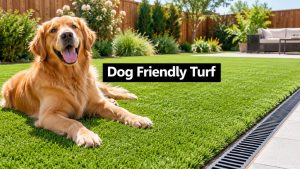

Your dog is standing at the back door, staring at a yard that's half yellow spots, half mud, and entirely embarrassing when guests come over. You've searched for fake grass dog friendly options because you're tired of reseeding, wiping paws, and apologizing for the smell. Don't buy a label. Buy a system that handles heat, urine, and hard play in Austin, or keep your natural lawn and save the money.
When a Backyard Becomes a Hot Problem
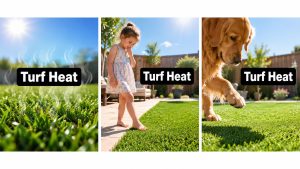
It's a weekday afternoon in Austin, the new turf looks perfect, and the dog won't cross it. She dances at the edge, lifts one paw, then retreats to the patio shade. The owner laughs at first. Then he steps on it barefoot and stops laughing.
I've seen that moment undo a lot of expensive installs. The turf wasn't defective. The yard had no shade plan, no cool escape zone, and no guidance on peak sun. The sales sheet said pet friendly, so nobody asked what happened at midday in August.
The Three Failures That Show Up First
- Heat refusal: Your dog avoids the surface, seeks concrete shade, or only uses the run in the morning.
- Urine odor: The smell is faint at first, then it lives in the base and greets you after every warm rain.
- Worn traffic lanes: Fibers mat where your dog sprints, turns, and digs at the fence line.
None of those problems start with color or blade shape. They start with site decisions. Slope, sun orientation, native soil, dog count, and bathroom habits determine whether fake grass works.
If an installer quotes you without walking the yard at the hottest part of the day and asking where your dog actually urinates, he's selling square footage, not a dog run.
Ask better questions before you schedule anyone. How will liquid leave this yard? Where will your dog cool her paws? What will you clean, how often, and with how much water? If the answers are vague, don't book the install. A good consultation should sometimes end with advice to fix drainage first, plant shade, or keep natural grass. That's not a lost sale. That's the trust test, and it's why you should call an installer who's willing to talk you out of the wrong build.
What Dog Friendly Really Means on a Turf Spec Sheet
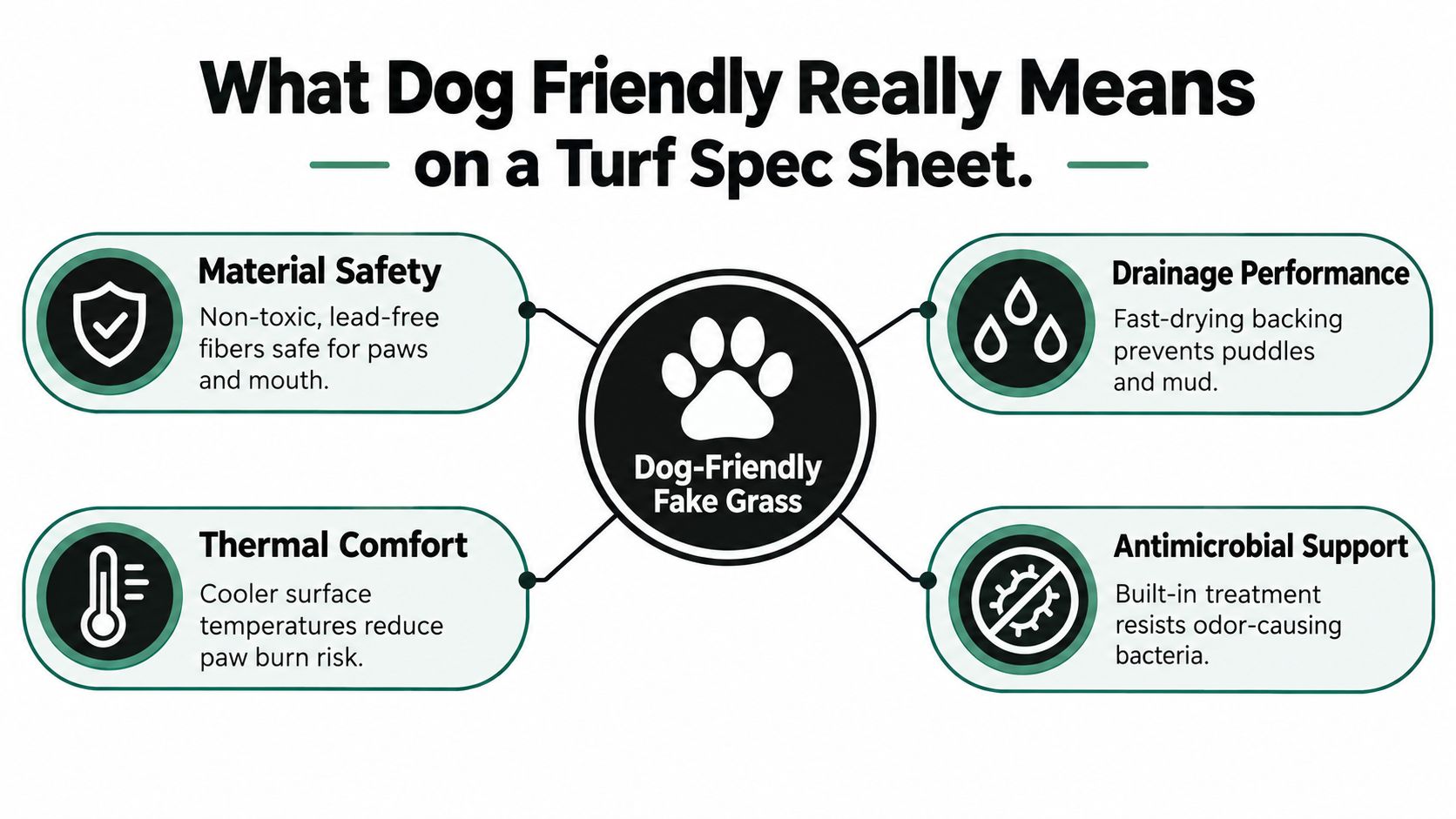
Stop reading pet-safe as one claim. Split it into four separate tests and make the spec sheet prove each one.
Four Criteria, Four Different Jobs
Material safety covers what touches paws and mouths. You want non-toxic, lead-free fibers and clear documentation. The U.S. Environmental Protection Agency review reported dermal-contact and ingestion test results below levels of concern for the materials evaluated, as detailed in the EPA review of synthetic turf and playground exposures. That's useful, but it doesn't tell you if the surface is comfortable at noon.
Drainage performance is the next test. A perforated backing alone isn't a drainage system. Urine has to move through fibers, infill, aggregate, and soil without pooling.
Thermal comfort is where most Austin yards fail. Lighter, UV-stable fibers help, but shade and timing matter more than a cooling claim printed on a sample card.
Antimicrobial support comes last, not first. Treatments can inhibit growth on fibers or infill. They don't remove urine, feces, or salts trapped below.
- Ask for the backing type: Is it fully permeable and flow-through, or just punched with holes?
- Ask for infill specifics: Is it silica sand, coated sand, or zeolite, and why does that fit your dog count?
- Ask for heat data: Has anyone tested this exact product in full Texas sun, not in a showroom?
Indoor pet messes follow the same logic. Products only work when you remove the source first, which is why guidance on safe carpet cleaning for pets stresses pet-safe chemistry plus actual extraction, not fragrance cover-ups. Apply that skepticism outdoors. A credible dog run is a layered system, not a roll of green plastic with a paw print on the brochure.
Heat Is the Safety Limit for Austin Yards
A turf sample that feels fine in the morning can become too hot for paws by afternoon. Heat sets the hours your dog can safely use the yard, so test the site before you call an installer.
In a controlled study of structured play sessions, artificial turf averaged 25.2°C, compared with 19.4°C for natural grass. Dogs also spent more time on natural surfaces, according to the controlled study comparing artificial turf with natural and stabilized grass. In the same research context, artificial turf reached 63.8°C under mild conditions while natural turf stayed below 40°C. Those readings do not predict every backyard. They show why a product label is no substitute for testing the actual site.
Design for 3 p.m., Not 9 a.m.
Put samples in full sun where the turf would go. Check them barefoot in the afternoon and see where your dog chooses to stand or lie down. Test the hottest part of the yard, not a shaded sample by the garage.
Plan shade before installation. A pergola edge, shade sail, mature tree canopy, or covered patio strip gives your dog a cooler escape zone. Keep fresh water outside, and move summer fetch to morning or evening. If shade cannot fit the yard, keeping natural grass may be the better call.
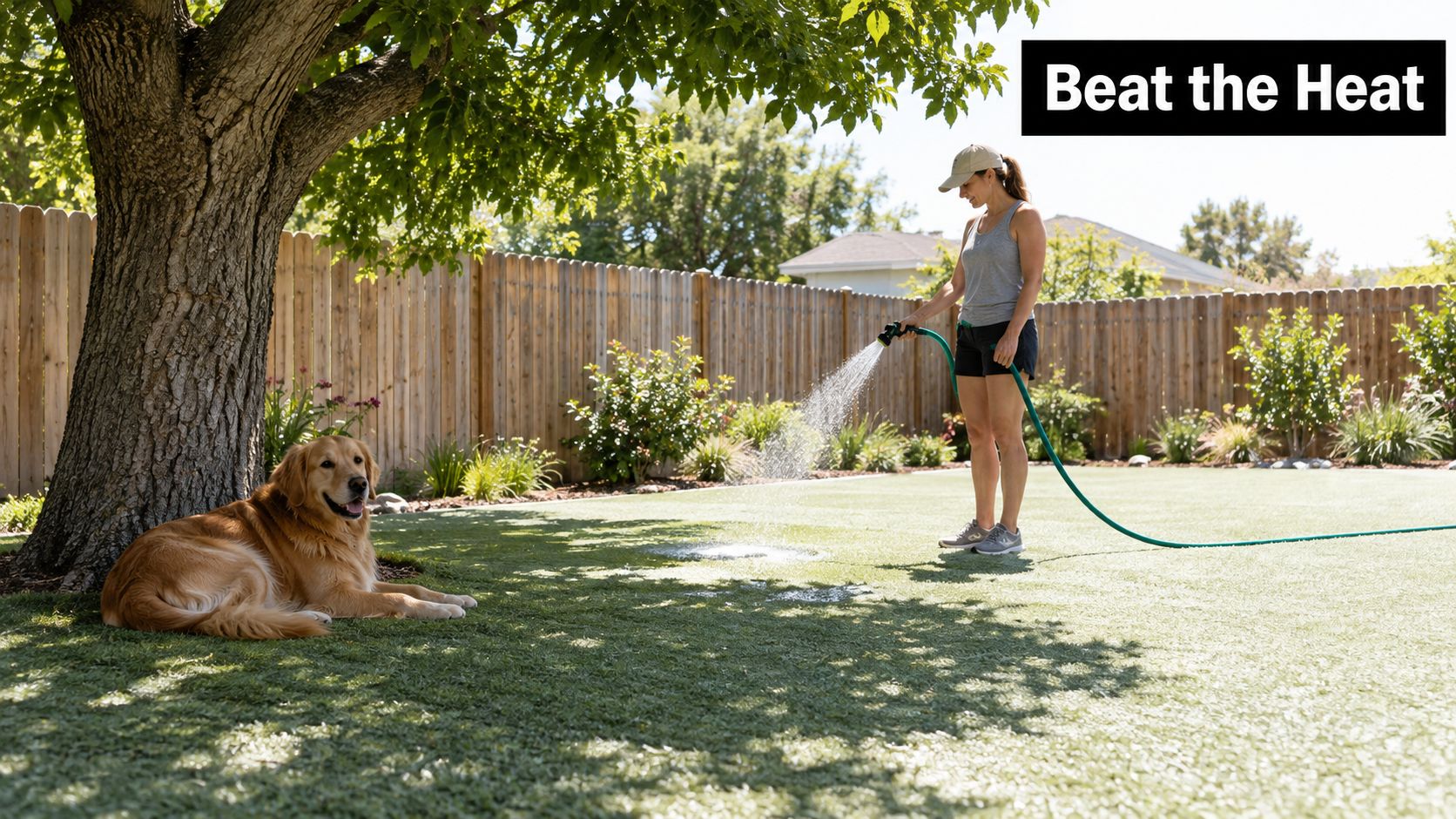
A hose can cool turf through evaporative cooling, but the effect is temporary. Provide hose access and make sure the water drains away instead of sitting below the surface. That is the trade-off behind heat-resistant artificial turf options for hot climates. Lighter fibers and cooling infill can help, but they do not replace shade, sensible play times, or testing.
Take extra care with puppies, senior dogs, flat-faced breeds, and dogs recovering from illness. For a south-facing yard with no shade and no budget to add it, do not install turf for unsupervised daytime use. Fix the site first, or keep a natural lawn.
Drainage Is the Real Fix for Odor
Odor isn't mysterious. Urine contains urea and salts. When liquid lingers in backing or infill, bacteria convert urea into ammonia, and your yard starts smelling like a kennel that nobody cleaned.
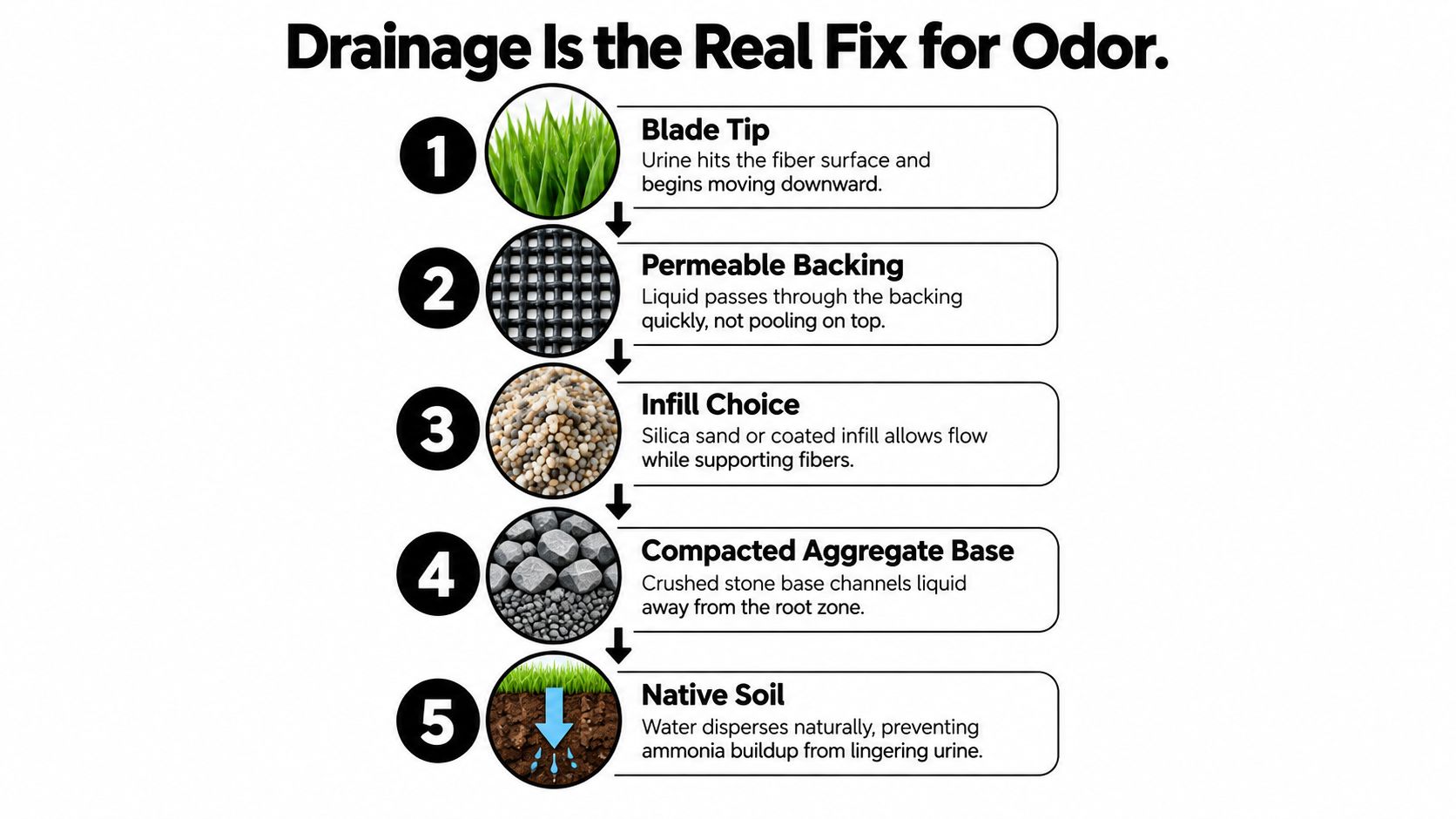
Follow the Liquid Down
- Blade tip and infill: Urine should move down immediately, not bead on matted fibers.
- Permeable backing: A flow-through backing passes liquid across the whole surface, not only through sparse holes.
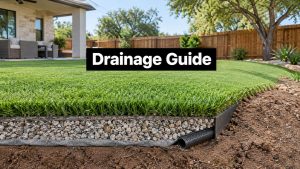
- Compacted aggregate base: Crushed stone, graded and compacted with slope, channels liquid away instead of holding it.
- Native soil or drain connection: Soil must accept the flow, or drainage tile must carry it to an approved outlet.
Break any link and the chain fails. I've pulled up turf with excellent backing sitting over compacted clay that held contaminated water for days. The product did its job. The subgrade didn't. That same trapped-moisture principle is why outdoor textiles develop mildew when water can't escape, a problem covered in practical advice on how to stop rug mildew in Birmingham. With turf, the trapped load includes urine, so the penalty is worse.
Verify the full path before you sign. Review the complete drainage approach for artificial grass installations and ask how slope, soil permeability, and edge detailing work on your lot. Independent pet-care guidance in the TurFresh guide to synthetic grass disinfection for pet owners supports routine rinsing and enzymatic cleaners, but both only support drainage. They can't rescue a base that stores waste water.
Practical rule: If you can't explain where a gallon of rinse water goes after it leaves the turf face, you don't have a drainage design yet.
Antimicrobial Infill and Cleaning Routines That Actually Help
Antimicrobial infill is useful insurance. It is not a cleaning crew. It can inhibit bacterial growth, but it can't physically remove urine salts, feces, hair, or organic residue.
Compare the tools. Zeolite infill can help absorb odor compounds. Coated antimicrobial infill supports hygiene and stands fibers up. Enzymatic cleaners break down remaining organic compounds after you've picked up solids and rinsed. A hose dilutes and moves residue through a working drainage path. Each tool does one job, and stacking them beats trusting any single product.
Austin adds a constraint many generic guides ignore. Current restrictions limit automatic and manual irrigation to one day per week in specified schedules, so routine frequent washing may be impractical or noncompliant depending on your property and restriction stage, as stated in the Austin water restriction document for irrigation schedules. Plan your rinse rhythm around the rules you'll live under.
| Household | Good Drainage | Average Drainage | Poor Drainage |
|---|---|---|---|
| One dog | Spot rinse bathroom areas, enzyme treat as needed | More frequent spot rinsing, regular enzyme use | Fix the base, cleaning alone won't hold |
| Two dogs | Scheduled rinsing, routine enzyme rotation | Frequent rinsing and deodorizing | Expect persistent odor until rebuilt |
| Multi-dog | Frequent planned rinsing, professional deep cleans | Heavy routine, monitor hotspots daily | Don't install until drainage is corrected |
Use the detailed steps for cleaning artificial turf used by dogs to build a routine you can sustain. Homeowners who already rely on scheduled help, such as trusted house cleaning in Leon Valley, understand the pattern. Systems stay clean because someone follows a calendar, not because a product promised odor-free forever. If you won't rinse hotspots or pick up solids promptly, choose a smaller dedicated dog run. A compact area you maintain beats a whole yard you neglect.
Designing a Custom Dog Run That Lasts
A lasting dog run starts below ground, with excavation, grading, and a base built for your soil. On a typical Austin build, the crew removes failed grass and organic material, corrects slope away from the house, and installs a compacted aggregate base that drains and stays level under sprinting turns.
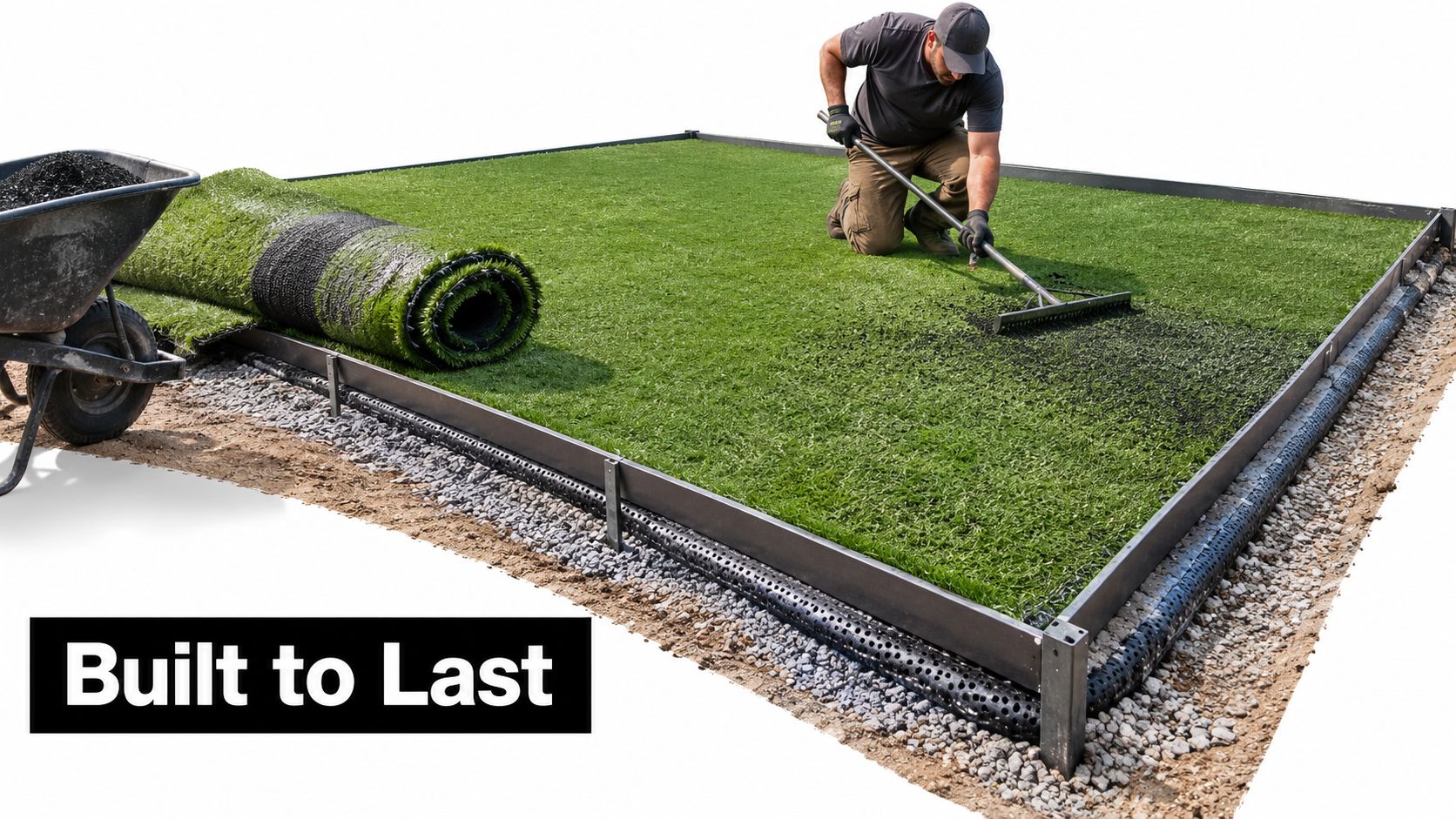
Where clay or low spots slow percolation, drainage tile carries water to a proper outlet instead of letting it sit under the run. Edges get secured so digging and zoomies don't lift corners. Commercial-grade steel borders hold the perimeter clean and stop aggregate migration into beds.
Fit the Build to the Dog
A digger needs reinforced edges and a designated digging alternative. A fence runner needs dense, resilient fibers where the traffic lane forms. An older dog needs easy gate access, shade within a few steps, and no steep transitions. Two large dogs need more bathroom-area drainage capacity than one small dog, even on the same footprint.
Surface specs should match that use. Look for UV-resistant, high-denier fibers, strong backing, and pet-appropriate infill spread evenly and brushed in so blades stand up. Seams belong away from the heaviest turn points where possible, and gates should swing without dragging fibers.
Browse backyard dog run layout ideas that fit different yards for shapes, but don't copy a rectangle from a photo. The right outline follows shade lines, hose access, drainage fall, and the path your dog already runs. Modern Yard Landscapes is one Austin installer that builds custom pet runs with site preparation, drainage work, and factors-based estimates, and you should compare any bidder against that full scope, not just price per square foot. The cheapest quote usually deletes the invisible layers you'll smell later.
Why Honest Answers Build the Call
You shouldn't have to decode marketing to invite someone into your backyard. The fastest trust test is simple. Does the installer show real dog projects, explain limitations, and answer drainage questions without changing the subject?
Review research backs that instinct. BrightLocal's 2025 survey used a representative panel of 1,026 U.S. adults to examine how consumers find, read, and write local reviews, as reported in the BrightLocal 2025 Local Consumer Review Survey. That research also reports consumers have become more forgiving about total review count and recency. Translation for you, a smaller set of specific, verifiable reviews about dogs, odor control, and cleanup beats a wall of vague five-star praise.
What Credible Proof Looks Like
- Named project context: Dog count, yard problem, drainage fix, and result after real use.
- Photos with permission: Prep and base work, not only the finished green surface.
- Honest limitations: Heat guidance, rinse expectations, and cases where turf wasn't recommended.
- Professional responses: A clear reply explaining corrective action when something went wrong.
Federal rules raise the bar further. The Federal Trade Commission's Consumer Reviews and Testimonials Rule took effect on October 21, 2024, and prohibits fake or false reviews and testimonials, as explained in the FTC guidance on the Consumer Reviews and Testimonials Rule. Businesses can be liable for testimonials on their own websites, and incentives can't be conditioned on positive sentiment.
That matters when you choose who to call. Ask for dog-specific references. Ask how estimates are built, what the guarantee covers, and who returns if drainage underperforms. Watch out for guaranteed odor elimination or claims that every dog will love the surface at every hour. An installer who tells you the hard parts upfront is the one more likely to still answer the phone after installation. That's the reason to schedule, not a discount banner.
Decide Whether to Call an Installer This Week
Spend ten minutes in your yard before you spend anything on turf. Walk the route your dog runs, note where she urinates, check where water stands after rain, and stand in the sun at midafternoon.
Call This Week If These Sound Familiar
- Mud and dead grass are constant: You're reseeding and still wiping paws after every rain.
- You have a defined run area: A side yard or fenced zone can get proper base, edges, and drainage.
- You can maintain it: You'll pick up solids, rinse within Austin rules, and use enzyme treatment when needed.
- You can add shade or timing rules: Your dog won't be locked onto hot turf at peak sun.
Water savings can support the decision, but don't oversell them to yourself. Converting an average 1,800-square-foot lawn could save up to 99,000 gallons annually, according to the UCLA water research report on artificial turf conservation. You'll still use some water for rinsing and cooling. An Austin city document notes that perceived conservation benefits may be reversed by the need to clean and cool artificial turf, as covered in the Austin artificial turf water quality document. Also note that artificial turf may not qualify for local incentives, so ask before assuming a rebate.
Bring four questions to the call. Where does drainage exit? How will you test heat on my lot? Which infill fits my dog count and why? What maintenance will I owe in a drought stage? Walk away from anyone who answers with only a product name.
If your answers point to a fixable site and a routine you'll keep, schedule the consultation now while you're comparing complete systems, not after another summer of mud, odor, and dead grass.
Modern Yard designs and installs custom dog runs in Austin with site-specific drainage, durable pet turf, and transparent factors-based estimates backed by a total satisfaction guarantee. If you want an honest assessment of heat, drainage, and whether fake grass fits your dog at all, visit Modern Yard Landscapes and schedule your consultation this week.