
A backyard putting green in Austin usually lands around $14 to $40 per square foot installed, but that number by itself can mislead you because the smallest projects often cost the most per foot. Budget depends on how much grading, drainage, and contour work your yard needs, not just how much turf goes on top.
You can stand in the backyard with a tape measure and still miss the part that drives the final number. Two greens with the same square footage can price very differently if one sits on flat, accessible soil and the other needs excavation, compaction, slope correction, and drainage to play properly.
What a Backyard Putting Green Costs in Austin
An Austin homeowner usually starts with the same question, how much turf do I need, and the wrong assumption is that square footage alone tells the whole story. It doesn't. A compact green can carry a higher unit cost because the crew still has to mobilize equipment, cut out existing soil, build a stable base, and finish the edges whether the area is small or not.
The better way to think about artificial turf putting green cost is as a bundle of fixed and variable work. Fixed work includes excavation, base prep, and layout. Variable work includes the turf quantity, the number of cups, and any contouring or drainage upgrades.
Size sets the floor, site conditions set the ceiling
For small backyard artificial turf putting greens, installed pricing often falls in the $14 to $40 per square foot range, and the smaller the project, the more likely that figure climbs because fixed labor and prep are spread over fewer square feet. That is why a tidy practice strip can still surprise homeowners on price, even before they add breaks, fringe, or a more demanding cup layout.
Practical rule: if two quotes look similar, the one with more detail usually tells you more about what the green will do over time.
Austin yards add their own complications. Access can be tight, some lots hold water after heavy rain, and sloped backyards usually need more shaping before the surface can roll true. When a contractor skips those steps, the quote looks cleaner, but the finished green usually doesn't.
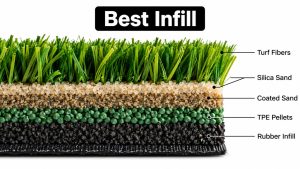
The smartest first budget is a range, not a single number. For most homeowners, that means planning for the installed green, the prep work underneath it, and enough flexibility for the site to be more complicated than the original measuring tape suggested. A close look at Modern Yard Landscapes artificial turf layers shows how those layers stack up before the first shovel hits the ground.
The Anatomy of a Putting Green Price Tag
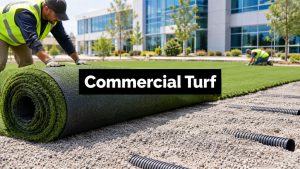
A putting green is expensive for the same reason a good driveway is expensive, the top layer only works if the foundation underneath is built right. Turf is visible. The base, grading, and drainage are what let the surface keep its roll and hold up after weather and use.
The biggest mistake homeowners make is assuming turf is the whole product. It isn't. The turf is one line item, but the price tag also includes excavation, aggregate, compaction, grading, infill, edging, and sometimes drainage corrections. Each layer changes both playability and lifespan.
What each layer usually covers
A detailed cost breakdown shows typical line items of $4 to $8 per square foot for excavation, haul-off, and base aggregate, $2 to $4 per square foot for compaction and laser grading, $7 to $14 per square foot for putting turf material, and $1 to $3 per square foot for infill used to tune putt speed, with drainage upgrades added on top, according to the Turf Network cost calculator.
| Typical Putting Green Cost Components | Typical Range per Sq Ft | What It Covers |
|---|---|---|
| Excavation and haul-off | $4 to $8 | Soil removal, base aggregate, site clearing |
| Compaction and laser grading | $2 to $4 | Surface shaping, leveling, surface stability |
| Putting turf material | $7 to $14 | The actual play surface |
| Infill | $1 to $3 | Putt speed tuning and performance feel |
That table explains why the lowest quote often leaves out the hard parts. If a bid looks unusually thin, ask what's missing from the base work and whether drainage is included or just assumed.
A green that rolls well in month one usually rolls well because the installer spent time on the hidden layers, not because they bought a fancy turf roll.
Turf quality matters, but it's only one piece of the total. The difference between a clean practice surface and a green that feels dead or uneven is the precision underneath. Homeowners who compare quotes line by line usually see the gap very fast.
Real Budgets by Project Size in Austin
The most useful pricing conversation is tied to a real backyard shape, not a generic national average. In Austin, a small practice strip, a mid-size par-3 green, and a larger training layout all behave differently because the base work scales differently than the surface area.

Three project sizes most Austin homeowners actually consider
A 2026 cost guide breaks pricing out by size: 150 to 300 square feet basic practice greens typically run $2,200 to $4,800 total, 300 to 500 square feet par-3 backyard zones commonly cost $4,500 to $8,500 total, and 800 to 1,200 square feet training layouts run $10,000 to $18,000 total, according to the Mighty Grass guide. Those ranges map well to how Austin homeowners use the space.
| Austin Putting Green Budgets by Size | Total Installed Cost | Resulting Cost per Sq Ft | Best Fit |
|---|---|---|---|
| Small practice strip, about 200 sq ft | Around the lower end of the small-project range | Usually highest on a per-foot basis | Casual practice, tight side yards |
| Mid-size backyard green, about 450 sq ft | Mid-range residential budget | Lower than a tiny green, still shaped for practice | Serious short game work, family use |
| Larger training layout, about 1,000 sq ft | Falls into the larger-project range | Often lower per foot because scale helps | Multi-cup practice, undulations, full short game |
The pattern is simple. Smaller greens can look affordable at first glance, but they often carry the highest unit cost because the crew still has to do the same essential prep work. Larger greens cost more in total, yet the per-square-foot number usually softens because the fixed work gets spread out.
If you're comparing options, look at the value of the play you're buying, not just the footprint. A 200-square-foot area can be enough for a neat putting lane. A 450-square-foot build usually gives you far more shot variety. For design ideas that fit different backyards, Modern Yard Landscapes best backyard putting greens is a practical place to start.
Why the Cheapest Quote Is Rarely the Best Deal
A low quote is easy to like because it seems to fix the budget problem on day one. In the field, that number often pushes cost into the future through puddling, weak ball roll, seam problems, or repair work that shows up after the first season. The proposal price matters, but so does what the crew leaves out.
The biggest warning signs are usually the quiet ones. Thin base prep keeps the bid low up front. No drainage work keeps the bid low up front. Low-grade turf keeps the bid low up front. The homeowner pays later when the green does not perform the way it should.
What lowball estimates usually skip
Residential putting greens often start with a simple-looking price, then climb once the build calls for better grading, drainage, and play surface quality. That gap is why a quote can look attractive while still leaving out the parts that control how the green rolls and drains.
- Thin base work: The surface can look finished, but settling shows up later.
- Weak drainage planning: Water has nowhere to go, so the green can stay wet or soften underneath.
- Cheap turf and light infill: Ball roll becomes inconsistent, and the surface can wear faster.
A good quote should spell out the build instead of hiding it. If the number is low because the contractor did not include grading corrections, drainage details, or enough labor to finish the surface properly, that bid is not really cheaper. It is incomplete.
For a clear example of how scope changes the final price, see the Modern Yard Landscapes turf contractors near me page, which helps homeowners compare crews before they commit to a build.
The right question is not “Who is cheapest?” It is “Which bid shows me how the green will still play well after the first season?”
If a contractor cannot explain the difference between the visible turf and the support system underneath it, keep asking. The long-term cost usually shows up in the places the cheapest estimate tried not to mention.
How to Read and Compare Putting Green Quotes
A solid quote should read like a build plan, not a guess. You want to see scope, materials, and site work separated clearly enough that you can tell where the money goes and what changes if your yard turns out to be trickier than expected.
Start by comparing the same items across every proposal. One company may quote a full excavation and base package. Another may lump site prep into a vague line and leave drainage unresolved. Those are not equivalent bids.
Questions worth asking before you sign
Residential greens of about 500 square feet commonly land in the $7,500 to $20,000 range, and one 2026 guide estimates DIY material-only costs at around $6 to $12 per square foot versus $14 to $22 per square foot installed by a pro, showing that most of the cost is base, grading, labor, and performance features rather than the turf itself, according to the HomeAdvisor cost guide.
| What to Verify | Why It Matters |
|---|---|
| Scope line by line | Prevents hidden omissions and scope creep |
| Base depth and compaction method | Determines whether the surface stays stable |
| Turf type and face weight | Affects ball roll, feel, and durability |
| Drainage design | Critical on sloped or water-prone sites |
| Warranty terms | Shows who stands behind the work |
A contractor's answer should be specific, not vague. Ask how they handle slope, how they confirm the base is compacted, and what happens if the yard reveals soft soil or drainage trouble once excavation starts. If they dodge those questions, the price probably isn't as complete as it looks.
For homeowners comparing multiple installers, turf contractors near me from Modern Yard Landscapes is the kind of search that should lead to direct, scoped conversations, not just the fastest callback. The better quote is the one that explains the work in plain language.
Lifetime Cost, Maintenance, and What You Stop Paying For
The upfront price gets all the attention, but the long-term cost picture is often where artificial turf makes sense. A quality putting green isn't just a backyard feature. It's an asset you use for years, so the question becomes what you spend over time, not just on day one.
In Austin heat, a well-installed green should be chosen with durability in mind, because replacement is where cheap decisions hurt most. Better face weight and better infill help the surface hold shape longer, and that matters more than cosmetic detail at install.

What the green costs after installation
A pricing benchmark for artificial turf putting greens in major residential markets is roughly $15 to $40 per square foot installed, with simpler backyard greens at the low end and performance greens reaching $40 to $60+ per square foot when contour shaping, drainage, edging, and multi-surface integration are required, according to the Turf Network pricing benchmark. That range reflects the fact that more realism usually means more engineering.
Artificial turf also changes the maintenance bill in practical ways. You're not mowing a putting surface, and you're not trying to keep natural grass uniform through heat, shade, and heavy use. The upkeep is lighter, but it still exists, mainly brushing, debris removal, and occasional infill care.
If you want a better sense of how material choice affects lifespan and service needs, Modern Yard Landscapes artificial grass durability is worth reviewing before you compare products. A thicker, better-built surface usually costs more up front, but it's the safer long-term buy.
Bottom line: the cheapest green to install is not always the cheapest green to own.
That's the financial lens. Homeowners who play regularly and want predictable roll usually get more value from a better build than from a bargain surface that starts to show age too soon.
A Sample Estimate From Modern Yard Landscapes
A real estimate should feel like a field report, not a guess pulled from a chart. For a typical Austin backyard green, a crew starts with the site visit, checks the slope, looks at access, and then prices the base work before turf is even selected. That's how you avoid surprise costs later.
Modern Yard Landscapes is a fully insured, full-service Austin turf installation company that builds transparent, factors-based cost estimates considering material quality, turf quantity, labor complexity, and specialized features such as antimicrobial treatments and cooling technologies, according to the company's official site. That matters because a clean estimate should explain exactly why one yard prices differently from another.
What a real estimate usually includes
For a hypothetical 500 square foot backyard green, the estimate should reflect these moving parts, each one checked against the yard itself, not a template. Soil condition, drainage, base depth, turf choice, cup layout, and contouring all affect the total.
- Site review: Confirms access, slope, and drainage challenges.
- Excavation and base plan: Sets the foundation for stable roll.
- Turf selection: Matches surface feel and durability to the homeowner's use.
- Infill choice: Tunes how fast the green plays.
- Cups and shaping: Adjusts practice variety and visual finish.
A fair proposal doesn't hide the variables. It shows them. That's the difference between a lump sum and a professional estimate.
If you're ready to price your own yard, schedule a site visit, ask for a line-item breakdown, and compare the build details as carefully as the total. Visit Modern Yard Landscapes to talk through your space, your practice goals, and the right way to turn a backyard into a green that plays well for years.
If you want a backyard putting green quote that's built around your actual yard, your soil, and the way you plan to use it, Modern Yard Landscapes can walk the site and price it line by line. Their Austin team builds transparent estimates for putting greens, turf installs, and the drainage details that make a green play right long after install day.