
Your lawn looked promising in spring. By August, you're looking at bare patches beside the patio, a worn track along the fence, and another decision about watering. Then a hard rain arrives, and the same backyard becomes muddy where you need to walk.
You don't need another surface that looks good only when nobody uses it. You need durable ground cover matched to your yard's traffic, sun exposure, and drainage, with a maintenance routine you'll realistically follow.
Choosing the Right Durable Ground Cover for Austin
Start with the places where your current yard fails. The strip beside the gate, the dog's fence-line route, and the open area outside the back door probably need different solutions. Treating them as one continuous lawn is often the wrong starting point.
My recommendation for Austin homeowners is straightforward: design around use before choosing materials. Reserve greenery for places where people will enjoy it, build deliberate circulation routes, and investigate wet areas before covering them.
Match the surface to the job
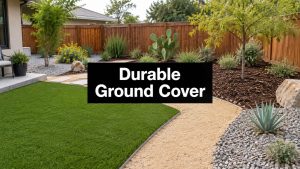
The main choices are artificial turf, gravel, decomposed granite, mulch, and low-maintenance plants. Each deserves consideration, but none belongs everywhere.
- Artificial turf: Shortlist it when consistent green coverage and repeated use matter more than having a living lawn.
- Gravel: Consider it for utility areas and informal circulation, with material selection based on footing rather than appearance alone.
- Decomposed granite: Evaluate it for defined paths and usable outdoor spaces where a compacted aggregate finish fits the design.
- Mulch: Keep it on the shortlist for planted beds and lower-use areas, not as a permanent substitute for every walking surface.
- Low-maintenance plants: Prioritize them where you want living coverage without turning the space into a daily traffic corridor.
Your maintenance preferences matter just as much. Someone comfortable tending plants may prefer a living ground cover; someone seeking a predictable recreation area may accept artificial turf's cleaning and heat-management requirements instead.
Practical rule: Choose the surface for the hardest day it needs to handle, not the photograph you want on installation day.
Before requesting an estimate, mark the walking routes, sunny sitting areas, pet zones, and places where water collects. Include access constraints, such as a narrow side gate, because installation logistics belong in the discussion.
A good recommendation should explain why a material fits your property, where it won't work, and what preparation it needs. If the conversation starts and ends with a sample board, keep asking questions.
Why Water Use Makes Ground Cover an Infrastructure Decision
Water demand belongs in the ground-cover decision from the beginning. Replacing a struggling lawn without reconsidering irrigation changes the appearance of an ongoing maintenance problem.
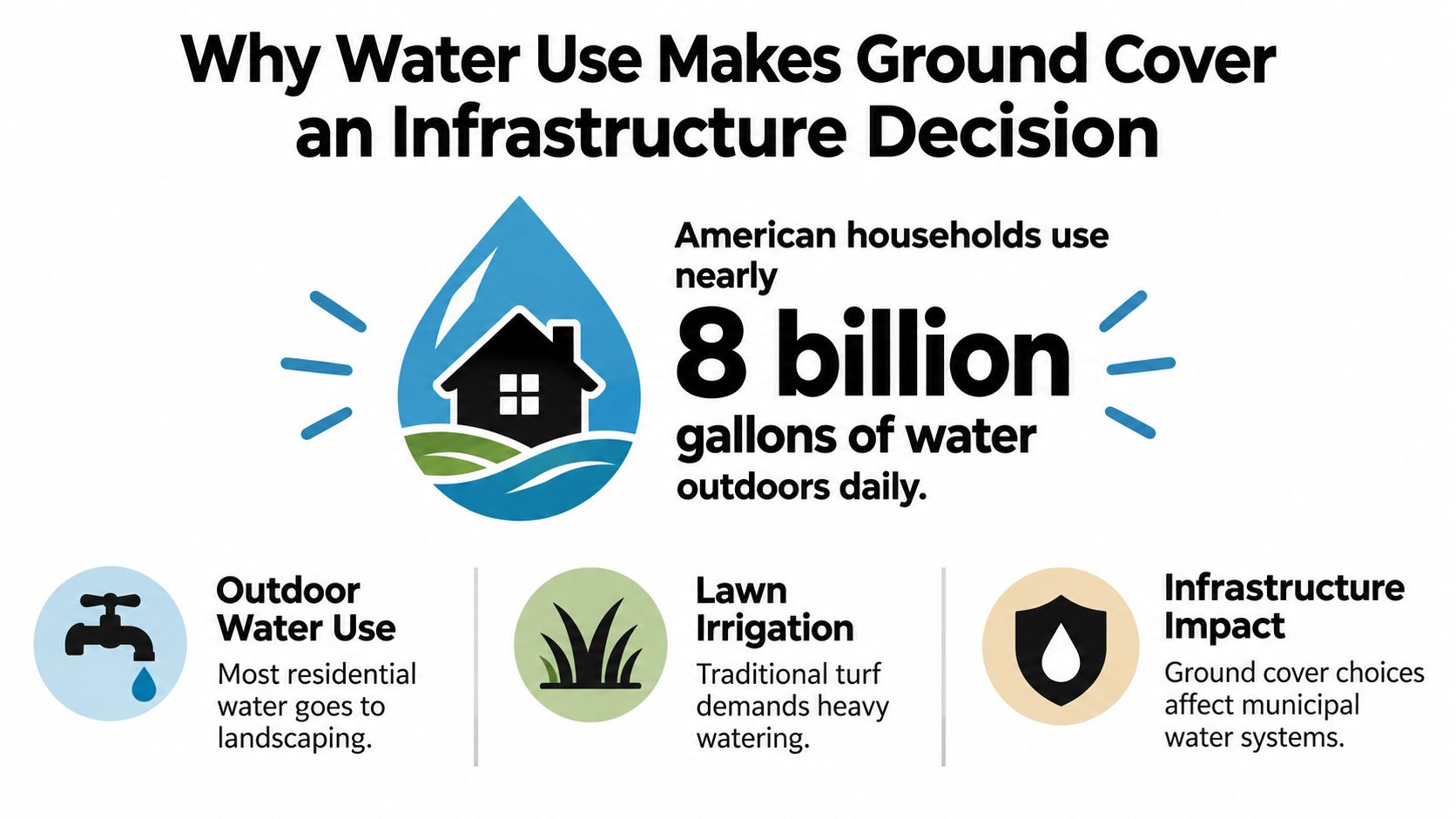
The U.S. Environmental Protection Agency estimates that American households use nearly 8 billion gallons of water outdoors daily. Outdoor use averages more than 30% of household consumption nationwide and can reach 60% in arid regions such as the Southwest; the agency also reports that turf-dominated residential grounds used 54% more water than mixed grounds, while water-efficient ground cover used 76% less water per unit area than turfgrass in a cited comparison (EPA WaterSense statistics and facts).
Reduce demand without losing useful space
Those comparisons aren't a promise about your future bill. They're a reason to question how much irrigated lawn your property needs.
I'd rather see a smaller, intentional recreation area surrounded by appropriate planting than a broad lawn maintained mainly to fill space. The useful question is whether each area earns the water, labor, and attention you give it.
- Keep functional space: Identify where children play, guests gather, or pets need a usable surface.
- Reconsider decorative lawn: Evaluate areas that receive irrigation but little actual use.
- Plan establishment care: Don't mistake a low-water planting plan for permission to neglect new plants.
- Separate irrigation needs: Ask how the design will accommodate areas with different watering requirements.
For a practical starting point, use this guide to reducing landscape water usage to organize questions before your appointment.
A water-conscious yard should still be comfortable and useful. Replacing everything with a surface you dislike isn't a successful conversion.
Think of ground cover as part of your property's infrastructure: something you'll operate, maintain, and eventually repair. Evaluate recurring irrigation alongside cleaning, drainage, and seasonal care.
That approach also prevents an oversimplified sales pitch. Artificial turf, aggregate, mulch, and planted areas have different resource requirements. Ask for an honest maintenance plan, not a blanket promise of a maintenance-free yard.
Comparing Five Durable Ground Cover Options
My default recommendation is a mixed planting scheme, not a property covered entirely in one material. Use the following comparison as a shortlist, then confirm performance against the proposed installation details.
Durable Ground Cover Options at a Glance
| Option | Wear Resistance | Heat Performance | Drainage | Maintenance | Lifespan |
|---|---|---|---|---|---|
| Artificial turf | Strong candidate for repeated use | Requires explicit heat planning | Depends on the complete assembly | Cleaning, grooming, seam checks | Plan for eventual system replacement |
| Gravel | Durable particles, but footing can shift | Evaluate exposed surfaces and shade | Assess soil, base, and outlet | Raking, weed removal, edge upkeep | Maintainable through replenishment |
| Decomposed granite | Useful for defined routes when properly specified | Consider exposure and intended contact | Depends on mix, compaction, and grading | Surface repair and re-leveling | Renew the wearing surface as needed |
| Mulch | Better suited to beds than busy routes | Assess the chosen material and location | Must fit the site's water movement | Redistribution and replenishment | Treat as a replenished layer |
| Low-maintenance plants | Limited by species and traffic | Match plants to site exposure | Requires suitable soil conditions | Establishment care, pruning, weeding | Depends on plant health and suitability |
Artificial turf needs a heat specification
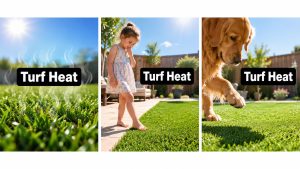
Don't judge artificial turf solely by softness or color. A National Collaborating Centre for Environmental Health review found synthetic surfaces generally 9.4–33.7°C hotter than natural turf in published comparisons; it also summarizes Penn State findings of surfaces approximately 23–32°C above air temperature, plus testing in which irrigated plots averaged 14 degrees lower than non-irrigated plots at the measurement period's end (artificial turf heat evidence review).
Ask for UV-stabilized fibers and measured evidence behind cooling-infill claims. Those specifications deserve scrutiny, but neither should substitute for shade, monitoring, or a hot-weather use plan.
Aggregate, mulch, and living coverage
For gravel and decomposed granite, specify edging and surface containment. Don't accept drainage benefits as an automatic property of the visible material; the underlying design matters.
Mulch is my choice for finishing planting areas when the owner accepts replenishment. I wouldn't choose it as the primary finish for a heavily traveled gate route.
Living coverage is my preferred starting point for low-use outdoor areas. Review drought-tolerant ground-cover plants with the installer, then narrow choices by sun, soil, and actual pedestrian use rather than a photograph.
Commercial owners should also consider who will maintain each surface after installation. Facility Management Insights landscaping advice offers a supplementary resource for that broader management discussion. Ask your contractor to translate the selected design into specific maintenance responsibilities.
Cost Analysis and Lifecycle Considerations
Compare complete installed systems, not material prices. A turf sample, a load of aggregate, and nursery plants don't include the same work, so comparing their purchase prices tells you little about the finished project.
For budgeting, I'd normally put artificial turf in the higher-upfront-investment category and mulch in the lower-entry-cost category. Gravel and decomposed granite belong between those starting points in many comparisons, while planted ground cover depends heavily on selection, coverage, and establishment requirements. Treat those as budgeting priorities, not fixed price rankings.
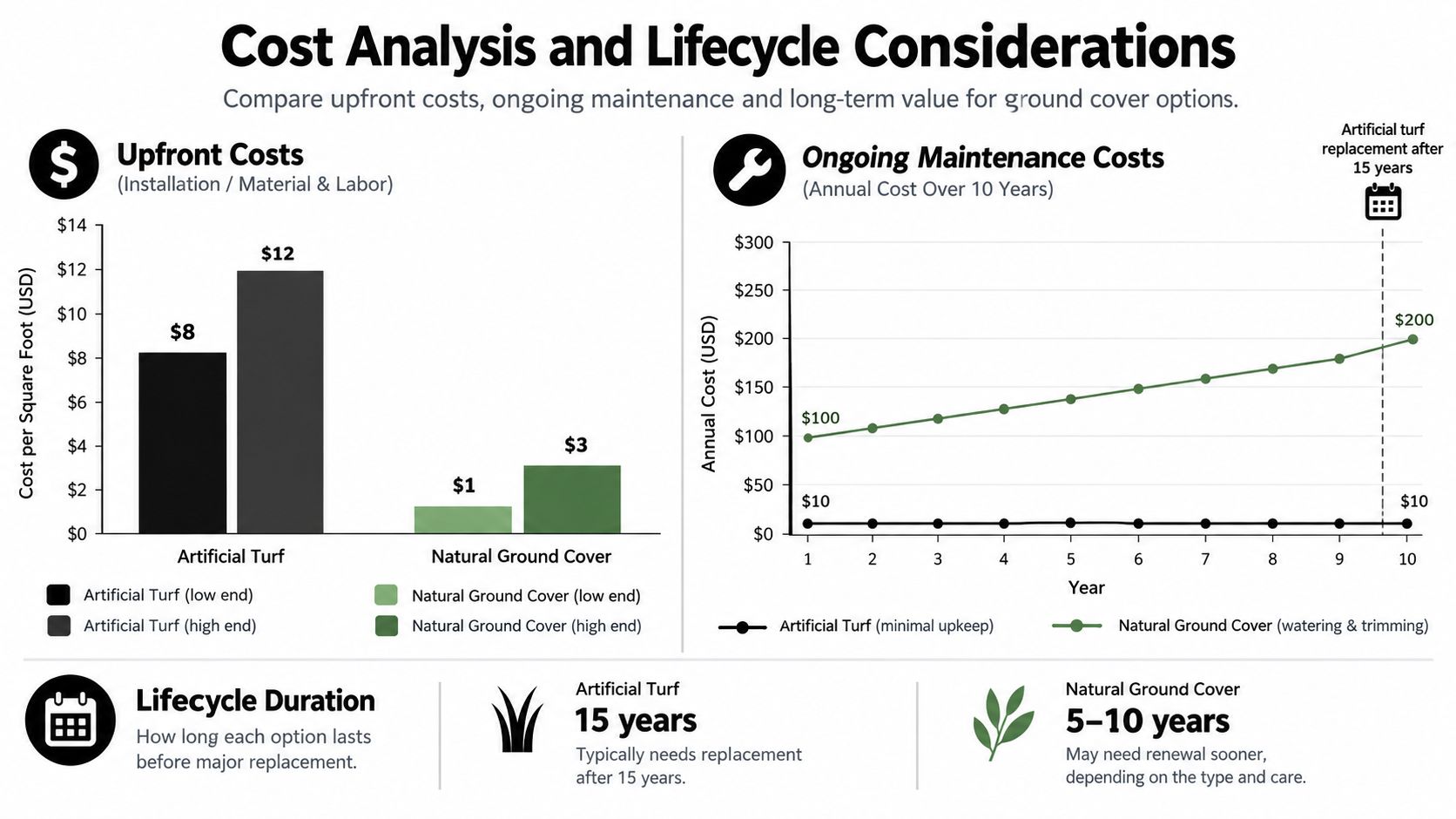
Use the illustration to organize cost categories, not as a verified Austin price schedule or replacement guarantee. Your estimate needs to reflect the property and specified materials.
Ask for the work behind the surface
A useful proposal separates the items that can otherwise disappear inside a single total.
- Preparation: Removal, disposal, access, excavation, and any necessary soil or base work.
- Installation: Surface materials, labor, edging, transitions, and specialized features.
- Ongoing care: Cleaning, replenishment, irrigation, pruning, and likely repair tasks.
- Eventual renewal: Removal, replacement, disposal, and the condition of reusable components.
Turf budgeting should include pet-cleaning requirements and the proposed infill. Aggregate estimates should address containment and future surface correction. Planting proposals should explain establishment care, while mulch proposals should make replenishment expectations clear.
Calculate ownership cost honestly
Use this framework: installation plus expected maintenance, repairs, and replacement, divided by the ownership period you're comparing. Apply the same period and scope to every option.
Lifecycle thinking applies to other outdoor improvements, too. Connecticut Fence Works, LLC's discussion of vinyl fence lifespan in Connecticut is a separate reference for fence planning, not evidence for Austin ground-cover longevity.
For turf-specific estimate questions, consult the guide to artificial turf cost factors. Bring competing proposals to the same scope before choosing. A cheaper estimate that excludes necessary preparation isn't necessarily a cheaper project.
Best Ground Cover for Pets, High Traffic, and Slopes
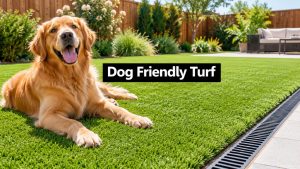
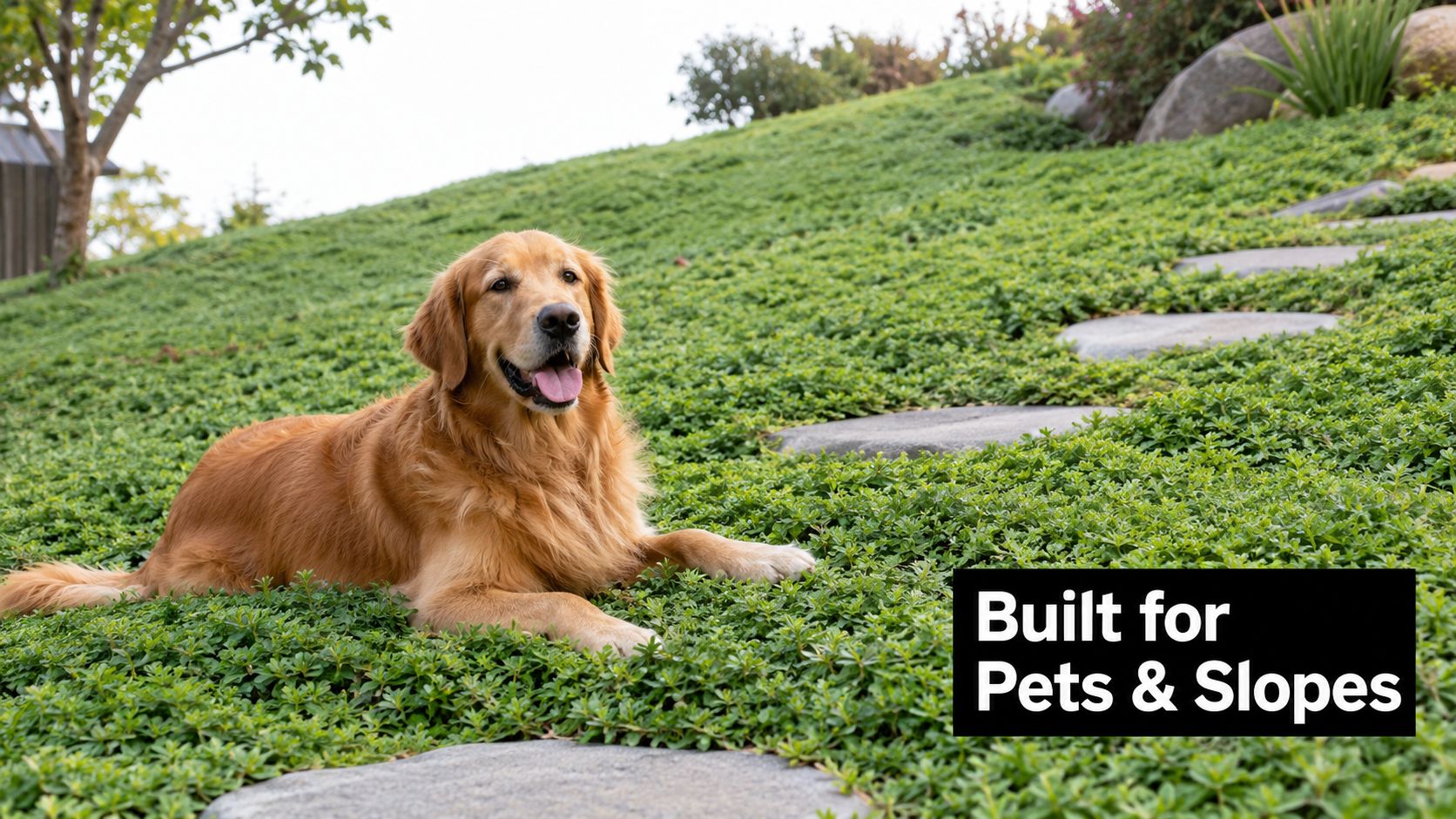
For a dog run, I'd consider artificial turf only after discussing drainage, cleaning access, and summer use. For a busy walkway, I'd start with a reinforced route. For a slope, I'd investigate water movement before recommending a finish.
Those are different problems. Don't let a contractor sell the same answer to all of them.
Pet areas need an operating plan
A pet-focused turf proposal should identify the backing, infill, cleaning procedure, and route for rinse water. If an antimicrobial treatment is offered, ask what it addresses and what maintenance remains necessary. Don't interpret that feature as a replacement for waste removal.
Given the heat evidence above, a sunny dog run also needs an alternative resting area and a plan for restricting access when the surface is unsuitable. Choose the layout before choosing the turf color.
- Frequent running: Keep the route open and inspect transitions where a dog changes direction.
- Cleaning access: Confirm that you can reach the entire area with the intended cleaning equipment.
- Supervised use: Reassess conditions during hot weather rather than relying on the morning's surface condition.
Daily footsteps belong on a path
Colorado State University Extension advises that most ground-cover plants don't tolerate excessive foot traffic and recommends establishing a walkway before planting regularly traveled areas (ground-cover plant selection guidance).
For the route from the driveway to the back gate, my preference is a deliberately built path using suitable pavers, gravel, or decomposed granite. Select the finish around stability, accessibility, and the way people walk. Plants beside that route can remain part of the design without being asked to function as paving.
Don't plant over a shortcut and expect everyone to stop taking it. Build the shortcut properly.
On slopes, I favor a site-specific planting and stabilization plan over spreading loose material and hoping it stays put. Ask the installer to distinguish ordinary surface erosion from concentrated runoff. Where water cuts a channel, redirecting or managing that flow comes before selecting decorative ground cover.
Drainage and Austin's Changing Rules for Artificial Turf
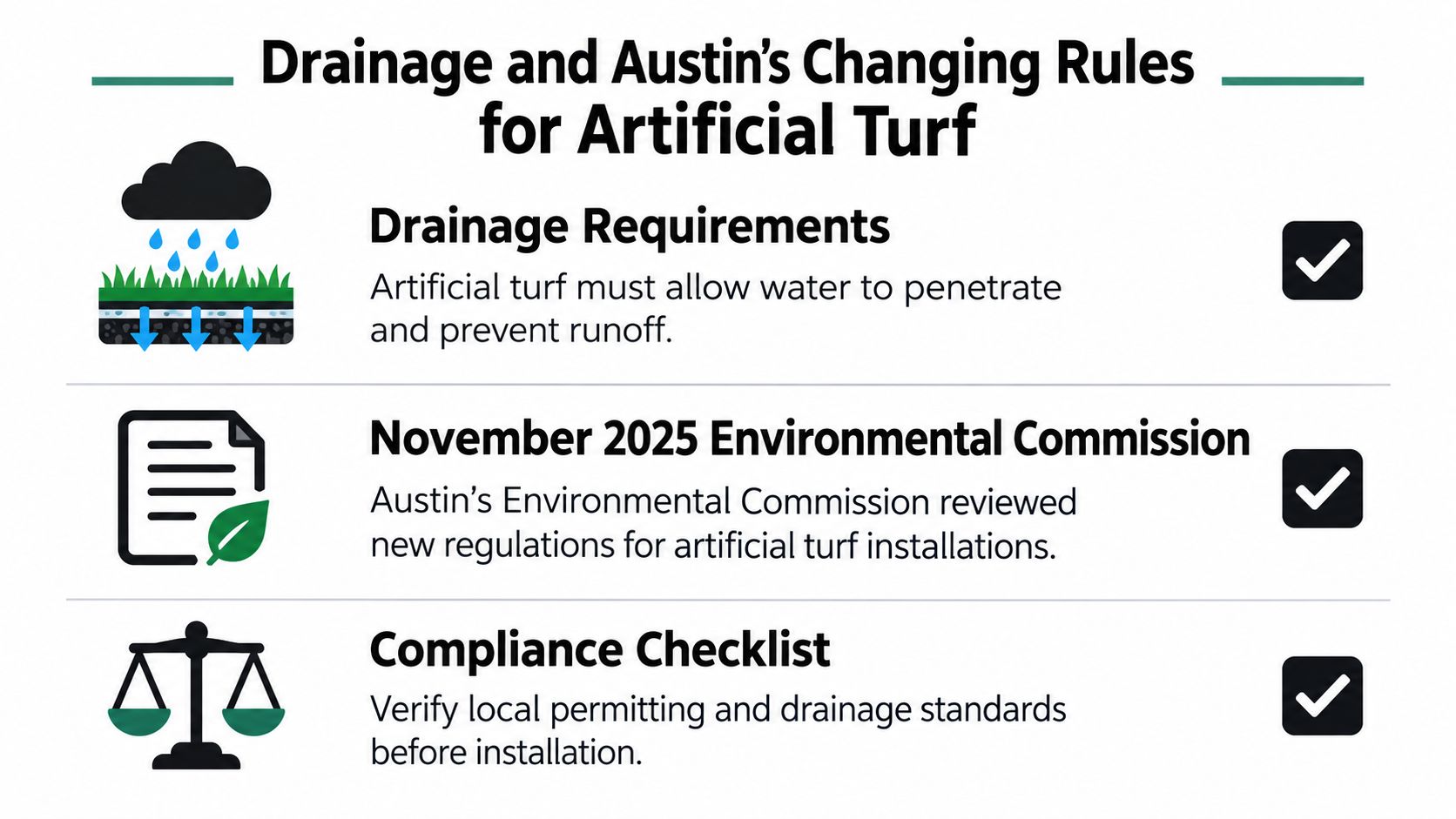
A permeable-looking surface isn't proof of a well-drained installation. Before approving artificial turf, require an explanation of where water enters the assembly, how it moves through it, and where excess flow goes.
In November 2025, Austin's Environmental Commission recommended exploring code changes that would define artificial turf as impervious cover and supported further work on exceptions and environmental conditions. The city materials identify infiltration, runoff, heat, microplastics, and PFAS or metal concerns for evaluation (Austin Environmental Commission recommendation).
That recommendation isn't itself a citywide prohibition. It also isn't permission to assume every proposed installation meets current requirements.
Complete the pre-installation checks
- Confirm current rules: Ask the appropriate city reviewer how the proposed assembly affects the property's impervious-cover calculation and whether review or permits apply.
- Document existing conditions: Record pooling, downspout discharge, nearby structures, and water entering from adjoining areas.
- Specify the assembly: Require excavation depth, subgrade preparation, base materials, and compaction requirements in writing.
- Show drainage routes: Identify slopes, low points, outlets, and any proposed drainage tile.
- Detail the perimeter: Explain how edging contains the installation without unintentionally obstructing water movement.
- Retain material records: Keep documentation for backing, infill, treatments, and maintenance products.
- Plan removal: Establish how worn turf and infill will be handled at the end of service.
Review the system, not just the backing
A salesperson may demonstrate water passing through a turf sample. That demonstration doesn't answer what happens after water reaches the base or underlying soil.
Ask for a site-specific explanation using a sketch or marked-up plan. Include an overflow route for conditions beyond the system's normal operation, and don't accept a proposal that transfers a drainage problem toward a neighbor.
Use this guide to drainage for artificial grass to prepare for that conversation. Keep stormwater performance and material documentation as separate approval questions. A satisfactory answer about one doesn't resolve the other.
Making the Final Choice and Getting It Installed Right
Choose the smallest combination of surfaces that meets your needs. For many properties, that means a usable activity area, a defined walking route, and planted space, rather than a blanket conversion.
Your shortlist should follow your priorities. If consistent green coverage matters most, investigate turf. If movement through the yard is the main problem, prioritize a path. If the area is primarily viewed rather than walked on, start with planting and mulch.
Bring useful information to the appointment
Tell the installer who uses the space, what currently fails, and which maintenance tasks you won't do. Include photographs after rain, views of access points, and the locations where pets or people repeatedly travel.
- Ask for alternatives: A credible installer should explain when another material is a better fit.
- Compare scope: Review preparation, drainage, edging, cleanup, and exclusions.
- Request documentation: Examine relevant project examples, insurance, written warranty terms, and aftercare instructions.
- Clarify accountability: Know whom to contact if a seam, edge, or drainage issue needs attention.
Look for evidence rather than polished promises
Customer feedback can help, but read for details about the process and follow-through. In a survey of 6,283 North American consumers, 83% considered a business trustworthy when its landing page displayed user-generated reviews; 74% said they would contact a business with reviews, compared with 62% without them (BrightLocal research on reviews, trust, and contact intent).
Those findings measure respondents' perceptions and intentions, not guaranteed installation quality. Check whether the contractor's documented work resembles your project.
Before signing: You should understand what will be installed, what's excluded, and what you'll need to maintain.
The appointment should leave you with a defensible recommendation, not pressure to commit immediately. Ask the installer to explain the trade-offs clearly enough that you can describe the choice yourself.
Frequently Asked Questions About Durable Ground Cover
Will artificial turf get too hot for my dog?
It can, particularly in direct sun. Use the heat findings above as a reason to require a practical access and shade plan, not merely a cooling-product upgrade. Ask your veterinarian for pet-specific guidance, and don't rely on air temperature alone when deciding whether your dog should use the surface.
How often should I replace mulch?
Use condition rather than a fixed calendar. Inspect for exposed soil, displaced material, and areas where the layer no longer performs its intended role. Ask the installer how to replenish it without burying plant crowns or repeatedly raising the bed level.
Can I install decomposed granite myself?
A straightforward decorative area may be a reasonable DIY project if you understand the preparation and containment work. Get professional input where accessibility, significant grading, drainage, or structural transitions are involved. Spreading material is only part of building a dependable walking surface.
What should I choose for a sloped backyard?
Start by identifying where water comes from and how people cross the slope. Then evaluate suitable planting, stabilization, and a separate route for foot traffic. Don't choose from a material sample before someone assesses the grade and any concentrated water flow.
How do I evaluate a cooling-infill claim?
Request the test method, comparison surface, weather conditions, and maintenance needed to reproduce the claimed benefit. Ask whether the results apply to the complete system being proposed. A product label alone isn't enough to decide whether a sunny area will remain suitable for direct contact.
What should I have ready when I call?
Have your priorities, approximate project boundaries, access concerns, and photographs ready. Mention pets, recreation needs, existing irrigation, and any pooling. You don't need to select a product first; the appointment should help you make that decision.
Modern Yard Landscapes offers Austin-area artificial turf installation, garden design, pet-friendly dog runs, putting greens, and drainage work. Visit Modern Yard Landscapes to call and schedule an appointment to assess your yard's traffic, heat exposure, and drainage, then request a factors-based estimate for the ground cover that fits.