
You've probably seen it already, a dog run that looked great in spring, then started holding onto a sour smell after a few storms and a few hot afternoons. The turf still looks green, but the corner by the fence tells the truth, especially when shade, pet waste, and slow drying all pile up in one place. That's where antimicrobial artificial grass earns attention, not as a miracle surface, but as one more tool in a system that has to manage water, waste, and heat the right way.
What Antimicrobial Artificial Grass Actually Is
A lot of homeowners hear “antimicrobial” and assume it means the turf kills everything on contact. It doesn't. In plain terms, antimicrobial artificial grass is synthetic turf built with chemistry that helps slow bacterial growth, plus mold and mildew pressure, on part of the system, usually the fibers, backing, or infill.

Where the chemistry actually lives
There are four places the treatment can show up. It can be embedded in the yarn during extrusion, put on as a topical coating, built into the backing, or added through antimicrobial-coated infill. That matters because a turf system is only as clean as the part that keeps staying wet and trapping debris.
A good way to think about it is a cutting board with built-in antimicrobial protection versus one you have to spray after every meal. The built-in version gives you continuous support, while the spray is temporary and depends on constant reapplication. The same logic applies here.
If you want a practical cleaning companion, this guide on clean artificial grass sanitize bacteria is worth keeping handy, because antimicrobial treatment still works best when the turf is rinsed and brushed on a normal schedule.
Practical rule: treat antimicrobial turf like a backup layer, not a replacement for rinsing, drainage, or good install work.
The big takeaway is simple. Antimicrobial is a layer inside the system, not a magic surface. If the base holds water, the infill packs down, or pet waste sits too long, the chemistry can help, but it can't do all the work.
The Four Antimicrobial Technologies and Where They Live
Buyers get tripped up because every supplier talks about antimicrobial turf like it's one thing. It isn't. The chemistry can sit in the fiber, on the surface, inside the backing, or in the infill, and those placements behave differently once rain, UV, traffic, and pet use start beating on the lawn.
Fiber, coating, backing, and infill
Antimicrobial-infused fibers are built by putting the active agent into the polymer before the blade is formed. The common chemistry families people see in specs include silver-ion, zinc, and other embedded systems. The selling point is durability, because the protection isn't just sitting on top waiting to wash away.
Topical coatings are different. They're sprayed or rolled on after manufacturing, which makes them easier to apply but easier to wear off. If a manufacturer leans heavily on this kind of treatment, ask what happens after repeated rinsing, pet traffic, and summer sun.
Backing treatments live in the polyurethane or latex layer. That placement helps when moisture reaches the underside of the turf, which is exactly where odor problems like to build. Quaternary ammonium and isothiazolinone families are the kinds of chemistries buyers may see associated with these treatments.
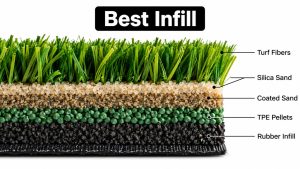
Antimicrobial infill is often the most practical for pet and outdoor installs. Turf Network describes Envirofill as an acrylic-coated silica sand infill with Microban antimicrobial protection, and it gives an installation ratio of 3/8 inch to 1/2 inch of Envirofill for every 1 inch of pile height, which works out to roughly 2 to 3.5 pounds per square foot for each 1 inch of pile height (Envirofill installation guidance). That is a useful reminder that antimicrobial performance is a system property, not a fiber-only feature.
If you're comparing products, the placement of the chemistry matters more than the marketing copy on the roll.
The durability trade-off is straightforward. Infused fibers and coated infill tend to outlast topical sprays, while backing treatments sit somewhere in the middle. The best spec sheet doesn't just say “antimicrobial,” it tells you where the treatment resides and how the whole system keeps that treatment exposed, dry, and useful.
Antimicrobial Turf vs Standard Turf
You can talk chemistry all day, but most buyers want one question answered. Is the upgrade worth it in a real yard? The honest answer is that it depends on moisture, traffic, and how often the turf gets used by pets or kids.
| Criterion | Antimicrobial Turf | Standard Turf |
|---|---|---|
| Odor control | Built to reduce odor risk, with SmartTurf stating a 99% reduction in bacteria and odor for its Microban-infused blades (SmartTurf claim) | Can stay low-odor when drainage is strong and maintenance is consistent |
| Bacterial load | Designed to slow microbial growth on treated surfaces and infill | McNitt and Petrunak found no S. aureus in 20 third-generation synthetic turf fields, and overall microbial load was generally lower than natural grass (reviewed in field microbiology literature) |
| Heat retention | Still heats up in sun, because antimicrobial chemistry doesn't cool the blade | Same basic heat behavior |
| Drainage | Works best when paired with fast-draining backing and infill coverage | Performs well when the base is built right |
| Expected lifespan | Depends on how the chemistry is placed and how the system wears | Depends on fiber quality, UV load, and install quality |
| Typical installed cost | Higher because you're paying for added chemistry and often better system engineering | Lower, with less emphasis on added hygiene features |
The standard-turf side gets dismissed too easily. It isn't automatically dirty or unsafe. The review literature notes that even on synthetic turf, microbial load can be lower than natural grass, and the absence of S. aureus in that 20-field survey matters because it keeps the conversation grounded in actual field results instead of marketing noise (field review).
For most Austin backyards, I'd make it simple. If you've got pets, kids, shade, or a corner that stays damp, antimicrobial turf is usually the better buy. If it's a front yard in full sun with light foot traffic, standard turf with a strong drainage base often performs just fine.
Why Antimicrobial Is a Layer, Not a Fix
The first mistake is treating antimicrobial chemistry like a cure for smell. It is not. The stink usually comes from trapped urine, organic debris, and slow drainage, which means the core problem is how the turf system handles moisture, not whether the blades got a special coating.

What actually drives odor
Turf Network says it straight, antimicrobial protection mainly slows microbial growth and does not replace drainage or maintenance (Turf Network guidance). That matches the jobs I've done on bad pet runs around Austin.
A problem yard usually has the same ingredients, a shady corner, a compacted sub-base, a backing that moves water too slowly, and infill that has settled below the pile. Once those pieces line up, urine and residue stay in the system longer, and the smell follows the moisture.
Direct truth: if water stays in the turf, the chemistry is working uphill.
That is why antimicrobial treatment only helps when the whole build is already set up to dry quickly. Rinsing matters. Brushing matters. Enzyme cleaners matter. If the install is sloppy, the odor comes back anyway.
Learn more about turf layers here: https://modernyardlandscapes.com/artificial-turf-layers/
For buyers trying to avoid another swampy pet patch, the right move is to treat antimicrobial turf as one line item in a larger moisture-control plan. Spend as much attention on drainage, edge detail, and cleaning habits as you do on the antimicrobial claim itself. If you also want a pad that helps the base stay stable, see help choosing a pad from Firm Foundations at https://shedpads.com/gravel-vs-concrete-which-foundation-should-you-get-in-2023/.
Specifications That Matter for Austin Installations
Austin yards don't fail because of one dramatic mistake. They fail because several small ones line up, like heavy clay soil underneath, a base that doesn't move water fast enough, and a turf face that gets hammered by sun and pet traffic. That's why I look at specs before I look at adjectives.

The numbers that matter on the quote
One useful example is a residential product that lists permeability above 800 inches per hour, a 50 oz face weight, a 1 3/8 inch pile height, grab tear strength above 200 lbs, and tuft bind above 8 lbs (SynLawn product data). Those specs tell you the system can shed water quickly and resist fiber loss when dogs and people keep crossing the same path.
Another product lists a 55 gallons per hour per square yard drainage rate and a 15-year warranty, which is the kind of benchmark that makes sense for pet-heavy residential use in Austin (SynLawn product data). Fast drainage is a key hygiene feature, because dry turf is harder for odor and mildew to exploit.
Installer rule: if the base can't move water, antimicrobial turf turns into expensive damp carpet.
How to read a product sheet
Use this short checklist when you're staring at a quote:
- Drainage Rate: look for fast water movement, because standing moisture is the enemy.
- Face Weight: denser turf usually handles traffic better, but too much density can hold debris.
- Pile Height: shorter blades rinse easier, taller blades can trap more organic matter.
- Tuft Bind: stronger bind helps fibers stay put under pet use.
- Grab Tear Strength: higher numbers matter at seams and transitions.
- Infill Ratio: ask how much material is used and whether it's designed to stay stable under traffic.
If you're comparing base systems too, this guide on help choosing a pad from Firm Foundations is useful because the foundation affects how fast the whole system dries. For heat concerns, the practical follow-up is here: heat-resistant artificial turf.
Safety Questions Smart Buyers Ask Before Signing
A lot of turf pages talk about “lifetime” antimicrobial protection like that ends the conversation. It doesn't. Most of those claims are tied to manufacturer testing, not long-term independent field exposure after UV, pet use, heavy rain, and years of cleaning.
Ask what's actually in the product
The cleaner question is simple. What antimicrobial is being used, where does it sit in the system, and what test supports the claim? If a seller can't answer that without dancing around the issue, keep moving.
Environmental-health conversations around artificial turf have also raised buyer concerns about PFAS, heavy metals, PAHs, and other additives. Antimicrobial coatings add one more material variable to that picture, which is exactly why you should ask what changes in the product once the treatment is added.
A smart installer should also be ready to answer these without getting defensive:
- Which antimicrobial chemistry is used?
- Is it infused, coated, backed, or in the infill?
- What ASTM or ISO test supports the performance claim?
- How does the treatment hold up after UV and pet use?
- What's the end-of-life recycling path?
For maintenance expectations, this step-by-step cleaning guide on how to clean artificial turf belongs in your bookmarks before you sign anything.
The right Austin installer won't dodge these questions. They'll walk you through the product sheet, the base design, and the cleaning plan like all three belong in the same conversation, because they do.
Your Buyer and Installer Checklist
A turf purchase gets smarter when you stop thinking in terms of a product and start thinking in terms of a system. The antimicrobial label matters, but it only works if the base drains, the infill stays put, and the yard doesn't turn into a damp mess every time the dogs race through it.
The quick pre-install review
Use this before you approve an install:
- Subsurface inspection: confirm the existing base is built for drainage, not just level looks.
- Antimicrobial proof: ask for the material data sheet that names the active ingredient and where it lives in the system.
- Maintenance plan: get the rinsing and deep-clean schedule in writing.
- Warranty coverage: make sure seam failure and edge lifting are covered.
- Heat mitigation: ask what infill is being used and how it behaves in full sun.
- Pet use: tell the installer exactly how many dogs use the area and how often.
That checklist is what separates a clean install from a smelly one. You don't need fancy language, you need a base that drains, a turf system that dries, and a maintenance plan you'll follow.
What homeowners usually ask on the phone
How often does antimicrobial turf still need rinsing? Regular rinsing still matters, especially in pet zones and shaded areas. Antimicrobial protection helps slow growth, but it doesn't replace cleaning.
Is it safe for pets and children? The right answer is product-specific. Ask for the chemistry, the test support, and the intended use before you buy.
What's the realistic price premium? It depends on the system, the infill, and the install complexity. In Austin, I'd rather quote the whole package correctly than promise a cheap turf roll that creates odor problems later.
If you're shopping for an installer, this page on artificial grass installers is the right place to start. Ask for the drainage plan first, the antimicrobial spec second, and the maintenance plan third.
If you want a straight answer for your yard, not a sales pitch, visit Modern Yard Landscapes and schedule a site visit. They can look at your drainage, sun exposure, and pet traffic in person, then quote a turf system that fits the way your Austin property gets used.