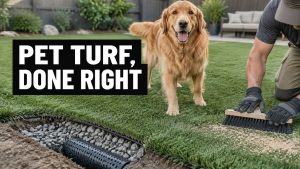

Your two dogs have worn the side yard into a brown trench, and by July the gate smells before you open it. Hosing the mud just shoves it toward the fence. A pet friendly artificial grass installation can stop that cycle, but only if you treat the run as a drainage system and a heat problem first, and as a green surface second.
Most failed dog runs look fine on day one. Urine sits under the backing, wash water has nowhere legal to go, and the surface cooks in full Austin sun while the air still feels tolerable. I would not order turf until the base, the outlet, and a hot-weather rule are settled.
Choose Turf, Backing and Infill for Pets
Picture a two-dog household whose old sod turned to mud and smelled by July. Pet turf is judged on four things: how fast urine moves through the backing, how the infill holds odor between rinses, how hot the surface gets in full sun, and how hard it is to clean.
Fibers and backing
Ask for UV-stabilized, high-denier fibers. They resist fading and matting when dogs sprint the same path every morning. A shorter pile hoses out faster than a long blade that hides solids. The backing has to stay porous. A sealed or cheap coated back turns the lawn into a shallow pan, no matter how pretty the blades look in the showroom.
How the infill choices compare
Infill supports the blades, and it is also where odor lives or leaves. Particle size changes drainage, abrasiveness, and traction. Fine material packs and slows flow. Coarse material can feel sharp on paws and migrate. Heavy rain can flush infill that was never brushed in or held at the edges.
| Infill option | Odor handling | Heat in full sun | Cleaning effort | Best fit |
|---|---|---|---|---|
| Silica sand | Odor builds quickly if urine is not rinsed | Hot | Moderate | Light use on a tight budget |
| Zeolite blend | Holds urine odor better between rinses | Hot | Moderate | Multi-dog runs with regular rinsing |
| Cooling infill | Odor depends on rinsing; ask for test data | Lower surface temperature, verify before buying | Low to moderate | Sunny Austin yards with dogs on the surface daily |
| Antimicrobial-treated infill | Treats the product only, not waste or urine | Hot | Moderate | Owners who want a documented hygiene claim |
| Rubber crumb | Holds odor in the pores and rinses poorly | Very hot in full sun | Low | Shaded areas only, not recommended for dog runs in full sun |
The EPA guidance on treated articles draws a hard line. A treated product may say the antimicrobial is built in to inhibit bacteria that affect the product itself. It may not claim it fights germs, controls fungus, or protects your dog unless it is registered for that public-health use.
Decision rule: Multi-dog or heavy-use runs should prioritize odor handling and a cooler surface. One dog on light use can accept a lower-cost infill, provided the drainage is built correctly.
Compare those trade-offs on artificial grass infill for pets before you lock a spec. A brochure that says "pet safe" without naming backing, infill, and a rinse path is not a specification.
Heat Limits and Hot-Weather Use Rules
Owners judge heat by the air. Paws meet the surface. Artificial turf can run far hotter than the air around it, and a pleasant morning does not predict noon.
A controlled study published via PMC found artificial turf averaged 25.2°C versus 19.4°C for natural turf, and it reached 63.8°C when the air was only 25–28°C. The artificial surface rose about 1.67°C for every 1°C rise in air temperature, compared with 1.05°C for natural turf. That steeper climb is why a warm afternoon becomes a paw problem fast.
| Surface | Average surface temperature | Surface rise per 1 degree C air rise | Peak reading |
|---|---|---|---|
| Artificial turf | 25.2 C | 1.67 C | 63.8 C at 25-28 C air |
| Natural turf | 19.4 C | 1.05 C | No peak stated for natural turf |
Build for shade, then measure
Map sun and orientation through the day before you dig. Put the run where the house, a fence, or a tree throws shade at midday. Keep a cooler permeable strip, such as mulch or shaded soil, beside the turf so a dog can step off.
Check the surface with an infrared or contact thermometer at midday in direct sun, and log several days, not one mild morning. A hose cools the fibers only briefly, so watering cannot be the operating plan.
Write a use rule you will actually enforce. Set a surface-temperature threshold, close the run at midday when readings pass it, and post that rule at the gate.
The readings behind that rule are explained in how hot artificial turf gets. If an installer promises the surface will "stay comfortable" and will not name a threshold, keep looking.
How to Build a Base That Drains Pet Waste
The pet area is a drainage system. Turf, backing, infill, base stone, and drains have to work as one assembly, or urine and rinse water stay trapped under a product that looked permeable in the sample.
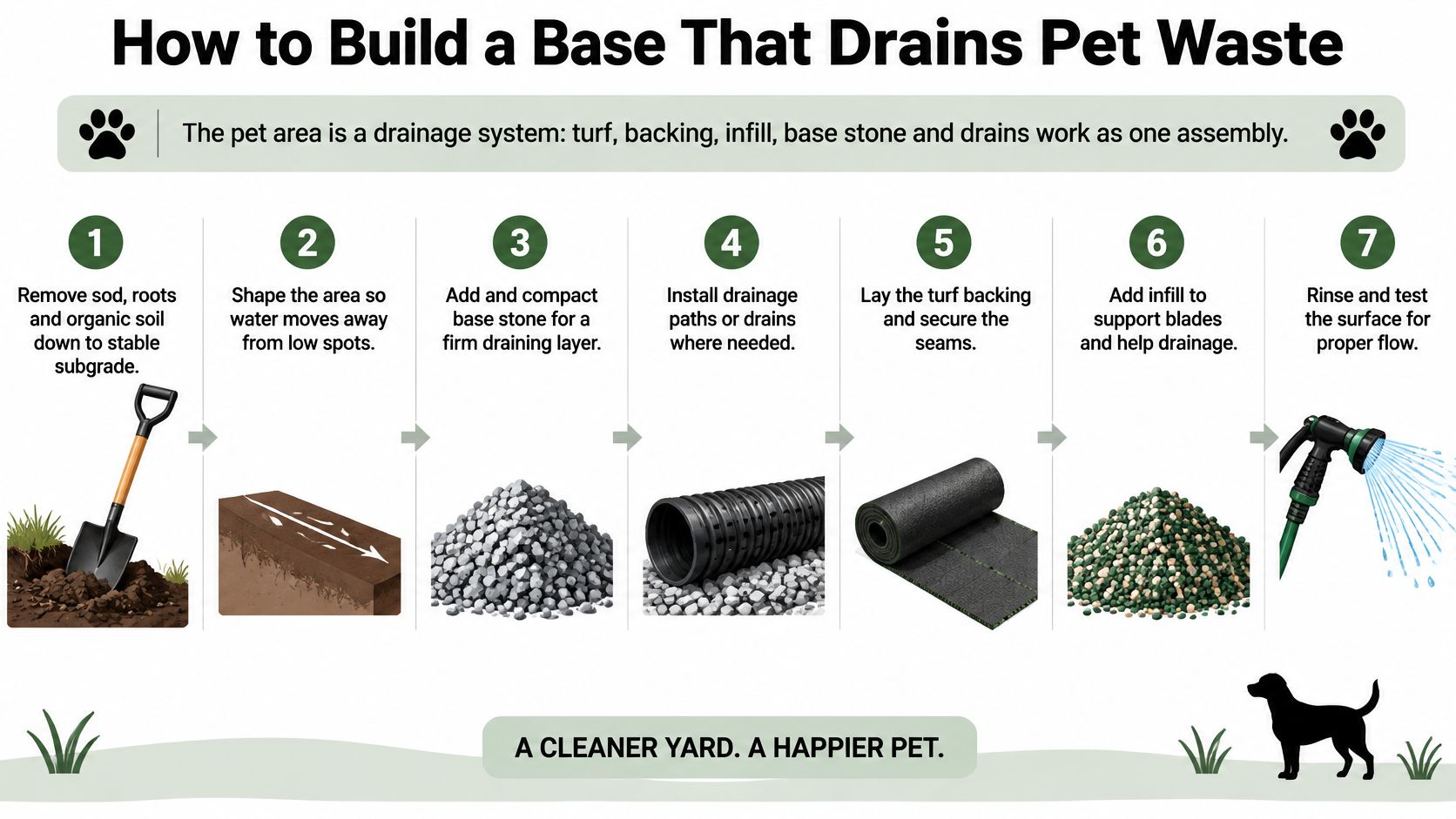
The ASTM note on field drainage checks points to a practical test under ASTM F2898: time a measured five-gallon container, apply that flow on the test area, and mark where water migrates and where it ponds. Dog runs need that check because urine and rinse water must move down and sideways, not sit under the backing.
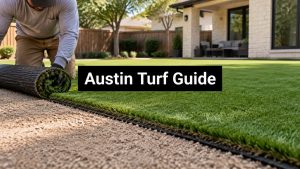
The build sequence
- Strip to stable soil. Remove sod, roots, and organic soil down to firm subgrade, commonly several inches, deeper where the topsoil is soft. Organic matter compresses later and creates a bowl.
- Compact, then walk it. Mark every soft spot and repair it before stone goes down. A hollow you can feel with your boot becomes a puddle after the first storm.
- Set slope away from the house. Grade a consistent fall, typically about 1 to 2 percent, away from the foundation, fences, and gates. Water should not collect at a door or a neighbor's side.
- Place crushed aggregate in lifts. Compact lifts of about two to three inches and keep the drainage layer continuous under the whole run. A gap at the edge is where odor starts.
- Add a collector where soil will not take water. Use perforated pipe or a drain to a daylighted outlet or an approved drain on clay, in low spots, or anywhere infiltration is poor.
- Run the five-gallon saturation test. Pour on a representative patch, mark the wet line, and mark every pool. Do this before turf goes down.
- Leave the edge open to wash-through. Do not seal the perimeter so tight that rinse water cannot exit, and set one low point for flushing.
A permeable turf roll laid over untreated clay is the usual failure. You get odor, muddy edges, and standing water even though the product sheet looked fine. Some assemblies also shed water more like pavement once the base is tight, so the outlet has to be real.
In Austin, confirm easements before you build. Austin's technical review of artificial turf notes that an exemption from impervious-cover math does not automatically exempt a surface from drainage rules, and owners must not block natural or designed flow. Work in a drainage easement can need authorization.
If you want the outlet options laid out before a site visit, start with drainage for artificial grass. Frequent rinsing moves dissolved urine off the fibers. It does not make that water disappear.
How to Lay, Fasten and Infill the Turf
Laying turf for a dog run is sanitation work. The base should already have passed a saturation test, with slope checked by straightedge or laser and soft spots repaired. Fastening turf over a base you only looked at builds odor in from day one.
The ASTM discussion of turf material tests notes that particle size affects abrasiveness, drainage, and traction. Heavy rain can wash loose infill off the surface, so depth and even coverage matter before the first storm hits. Record the infill type and backing chemistry before installation, so a warranty question later has an answer on paper.
Sequence that protects the base
- Relax the rolls. Unroll the turf and let it sit about a day so the backing settles before you cut seams.
- Join seams with the specified tape and adhesive. Keep pile direction the same on every piece, or the run will show a dark stripe and wear unevenly where dogs turn.
- Cut service panels. Around gates, water bowls, and the usual elimination zone, plan sections you can lift later. Those spots take the abuse.
- Fasten the perimeter. Use commercial-grade steel edging or nails spaced tight enough that the edge does not lift when a dog runs the fence line. Leave a path for wash water to the low point, drain, or daylighted outlet.
- Infill in two passes. Broadcast, brush into the fibers, then repeat and check depth across the whole area, not just the middle.
- Rinse a test section before you call it done. Water should leave through the drain, not sheet across the surface or bead on the backing. If it pools, stop and fix the base or the infill depth. Do not bury a bad test under more sand.
Infill depth is a drainage decision. Thin infill lets the backing show and holds urine against the coating. Thick infill slows drainage and feels like a wet sponge underfoot. A perimeter glued or nailed into a solid dam blocks wash-through even when the center drains.
Antimicrobial labeling does not replace that outlet. Trapped urine still smells. Route the hose so dirty water reaches an approved point, not the neighbor's soil or a storm inlet you have not cleared with the city.
Odor Control and Maintenance Routine
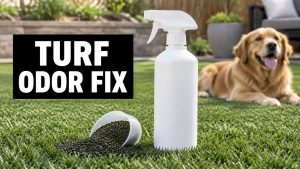
Odor comes from three places: dried urine residue in the fibers, solids left on the surface, and wash water sitting in a low spot or a clogged drain. Turf does not cancel any of those. It only makes them easier to reach if the base was built to move water.
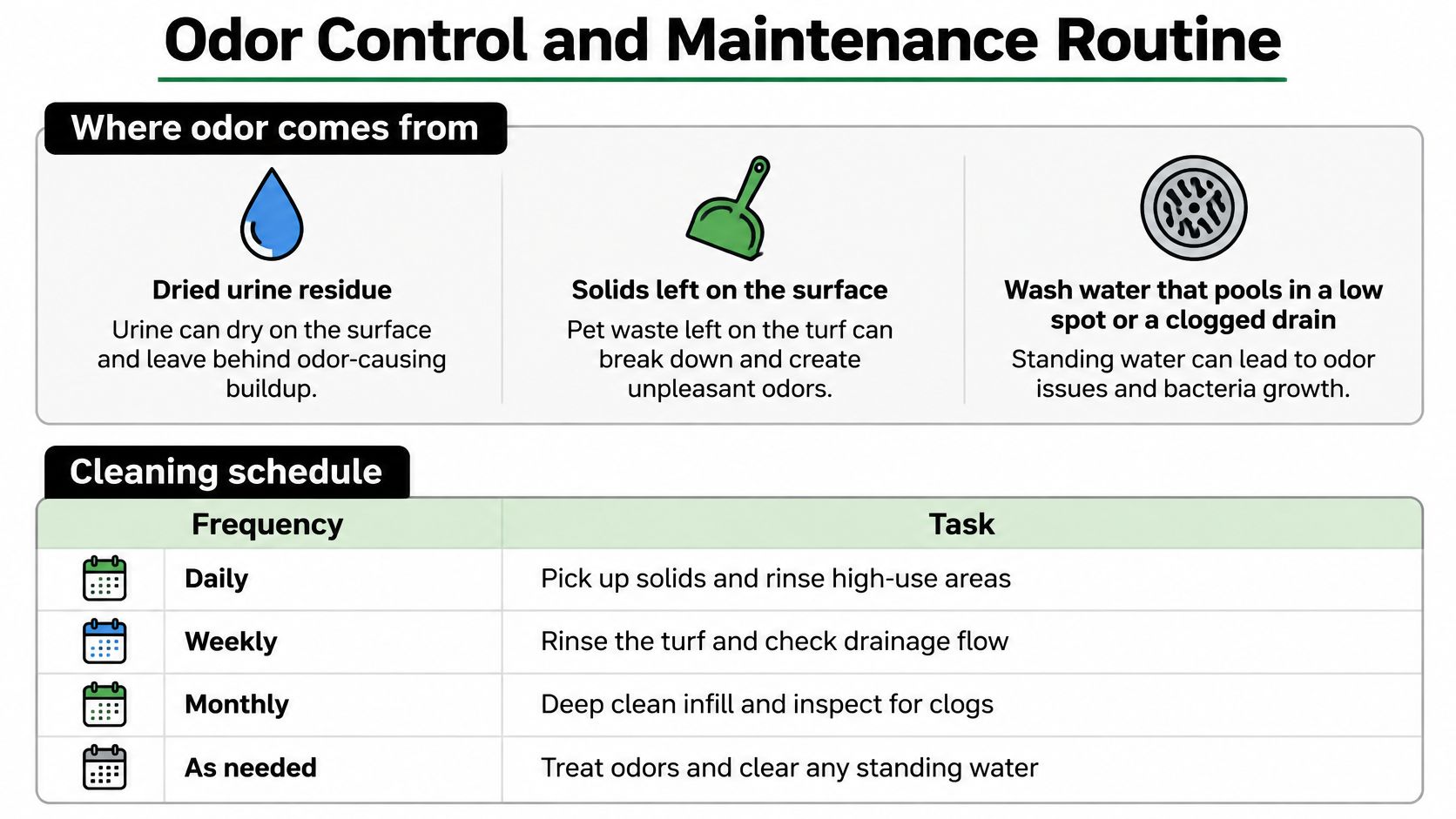
The CDC's guidance on dogs says feces should always be picked up, even in a private yard and especially where children play, because dog and cat feces can carry parasites and germs. Bag solids and throw them out properly. Clean urine, feces, or vomit right away, disinfect the spot, and wash your hands. An antimicrobial infill does not replace that pickup.
| Frequency | Task | Why it matters |
|---|---|---|
| Daily | Pick up and bag all solid waste | Stops bacteria and odor from building |
| Daily or after heavy use | Rinse urine zones with a hose | Flushes urine residue off fibers and infill |
| Weekly | Check drains and low points for clogging | Keeps wash water moving out of the run |
| Weekly | Brush infill back to level | Keeps fibers upright and drainage even |
| Monthly | Clean with a pet-safe enzyme cleaner, then rinse thoroughly | Breaks down residue that rinsing misses |
| Quarterly | Check infill depth and top up | Protects cushioning and drainage |
| Seasonal | Inspect seams, edges and the perimeter | Catches shifting before it causes ponding |
A three-way smell check
- Smell returns within a day of rinsing: Check the drain and the low point first. Water is sitting somewhere.
- Smell lingers after a full rinse: Check infill depth, then clean the infill. Residue is still in the fill, not just on the blades.
- Smell stays in one corner: Check slope in that corner. A dip you cannot see will hold urine every time.
A seasonal walk of seams, edges, and the perimeter catches lift and settlement before the next storm ponds there. The day-to-day method is spelled out in how to clean artificial turf for dogs.
Book a Site Assessment Before You Dig
A pet turf job is only as good as the site assessment behind it. Before you call, write down the run size, the slope, whether the soil is clay, where water pools now, sun through the day, the number and size of dogs, and any drainage easement or runoff aimed at a neighbor.
A useful visit covers base depth, the drainage outlet, a shade plan, the infill choice, and the hot-weather rule. Walk the outlet path yourself during the visit and confirm wash water leaves the run without crossing a property line or collecting at the low edge of the yard. Ask for the written warranty before you schedule. Federal warranty advertising rules say terms should be available before purchase, a satisfaction guarantee should match the remedy you will get, including a full refund where that wording implies one, and a "lifetime" claim has to say whose lifetime. Confirm whether coverage includes materials, workmanship, drainage, seams, and pet-related wear, plus how you file a claim.
PetGrows estimated $10,000 for a 1,000-square-foot artificial-grass installation in March 2024. Use that as a budget checkpoint while you collect an itemized quote that separates base, drains, and infill. Sketching the yard first in landscape design software for homeowners makes that conversation faster.
Modern Yard Designs in Austin is fully insured, offers a total satisfaction guarantee, and builds custom dog runs, including drainage tile when the site needs it. I would not schedule the dig until the written guarantee states the coverage period, the remedy, and whether a full refund applies, and until proof of insurance is available on request. Call and book the site visit with those notes in hand.
Modern Yard designs and installs pet-friendly dog runs in the Austin area, with drainage, infill, and shade planned before the turf goes down. If your yard has mud, odor, or midday heat, a measured site visit is the right first step. Visit Modern Yard Landscapes to schedule that assessment.