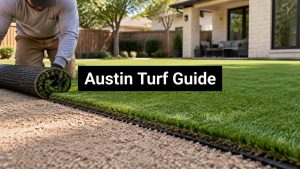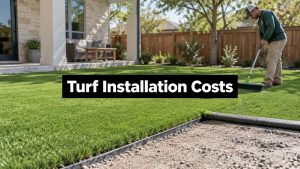

You're probably reading this because your lawn has become one more thing Austin makes you fight for. The grass cooks in summer, turns patchy where the dog runs, and drinks water even when restrictions make you feel guilty every time the sprinklers kick on. Then a hard rain hits, and the yard you tried to save turns into slick mud.
That's usually the moment homeowners stop thinking about turf as a cosmetic upgrade and start looking at it as a practical fix. They want a yard that stays usable, looks clean, and doesn't demand constant rescue. They also want to know what goes into the cost, because artificial turf can look simple from the street while hiding a lot of bad work underneath.
Most of the problems people blame on “fake grass” aren't turf problems. They're installation problems. Bad grading. Weak compaction. Cheap seams. The wrong infill. No plan for Austin clay soil. That's where projects go sideways.
Tired of a Thirsty, Patchy Austin Lawn?
A common Austin scenario goes like this. The front yard gets blasted by sun all afternoon. The side yard stays thin because the soil compacts hard, then cracks when it dries. The backyard looks acceptable for about six weeks in spring, then slides back into brown spots, weeds, and bare traffic lanes where kids and dogs cut the same path every day.
Homeowners usually try the reasonable fixes first. More watering. A different seed blend. Fertilizer. Sod replacement in the worst areas. Shade adjustments. Irrigation repairs. None of that feels unreasonable until you realize you're repeating the same cycle every season and still not getting a lawn you can count on.
Artificial turf has moved well beyond being a niche product for sports fields. The global artificial turf market was valued at USD 7.3 billion in 2025 and is projected to grow to USD 13.7 billion by 2033, and adoption in residential developments rose to 49% between 2023 and 2025, according to Grand View Research's artificial turf market analysis. That matters because it reflects what homeowners are already deciding. For a lot of properties, natural grass no longer makes practical sense.
Why Austin homeowners start making the switch
The appeal isn't complicated:
- Water use becomes less stressful because you're not trying to keep living turf green through punishing heat.
- The yard stays visually consistent instead of cycling between lush, thin, and dead.
- Maintenance gets simpler because mowing, reseeding, mud control, and many chemical treatments leave the picture.
- Usability improves for families who want a surface that looks finished all year.
A good turf lawn doesn't win because it's trendy. It wins because it removes recurring problems that never really got solved with grass.
The real question isn't whether turf works
The critical question is whether the installation underneath it was done correctly.
That's what separates a lawn that still looks clean years later from one that ripples, puddles, smells bad, or lifts at the edges. If you understand the important artificial turf installation details before you buy, you'll know what to ask, what to avoid, and why a professional estimate should talk more about base prep than blade color.
The Anatomy of a Perfect Artificial Turf System
Think of a turf installation like a house. Homeowners see the paint, windows, and roofline first. But if the foundation is wrong, the nice finishes don't matter for long. Turf works the same way. What looks like “green grass” from the top is really a layered system designed to stay stable, drain well, and hold up under use.

What sits under the surface
A professional build usually includes these components:
Subgrade
This is the native soil after excavation and shaping. In Austin, this layer deserves respect because clay can expand, shrink, and hold water differently across the yard.Base layer
This is the structural platform. It creates stability and gives water a controlled path to move through the system instead of sitting under the turf.Weed barrier or separator fabric
This layer helps separate materials and reduce weed intrusion. It isn't a magic shield, but it's an important part of a clean build.Artificial turf backing and fibers
The visible product matters, but the backing is just as important as the blades. If the backing isn't suited to the project, the lawn may not perform the way the homeowner expects.Infill
Infill adds weight, supports the blades, and affects how the surface feels underfoot. It also changes how the lawn handles pets, heat, and traffic.Perimeter edging and fastening
Edges keep the field of turf from drifting, fraying, or lifting. A lot of failed installations start showing problems right here.
For a more visual breakdown of how each layer works together, this guide on artificial turf layers is useful.
Why each layer has a job
People sometimes assume they can save money by simplifying the build. Skip the separator. Thin out the base. Use whatever infill is cheapest. That thinking usually creates hidden failures.
A turf system works because each layer solves a different problem:
| Layer | Main job | What goes wrong if it's weak |
|---|---|---|
| Subgrade | Supports the entire system | Settlement, low spots, uneven finish |
| Base | Adds stability and drainage | Puddling, shifting, soft areas |
| Weed barrier | Separates materials and limits intrusion | Weed breakthrough, contamination between layers |
| Turf | Provides appearance and wear surface | Matted look, poor drainage, short lifespan |
| Infill | Supports fibers and improves performance | Flat blades, lighter movement, poorer feel |
| Edging | Locks perimeter in place | Curling edges, seam stress, trip hazards |
Practical rule: If a contractor spends most of the conversation talking about how realistic the blades look and very little time talking about the base, you still don't have the important answer.
The system mindset changes buying decisions
This is why two turf quotes for “the same yard” can feel far apart. One may price the visible material. The other may be pricing the engineering required to keep that material performing. Homeowners usually don't regret paying for the layers they can't see. They regret skipping them.
Why Professional Site Preparation Is Non-Negotiable
Austin soil doesn't forgive sloppy prep. Clay-heavy ground can get hard as concrete in dry weather, then turn sticky and unstable when rain comes through. If the crew treats that like a flat, easy surface and rushes straight to laying turf, the project may look fine on day one and fail gradually after that.
Site prep is where the job is won or lost.

Drainage has to be built in from the start
A turf lawn doesn't fix drainage by itself. Water still has to go somewhere. One critical specification is a minimum 1% slope in the compacted sub-base so water can run off properly. That condition is achieved by excavation and by installing 2 to 3 inches of Class II road base compacted to 90% density, as outlined in this artificial turf installation specification document.
Those numbers matter because they translate directly to what a homeowner sees later:
- Without the right slope, water sits instead of shedding.
- Without proper compaction, the base settles after installation.
- Without both working together, the turf can develop dips, soft pockets, and recurring wet zones.
For a closer look at what proper prep should involve before turf goes down, review this page on how to prepare ground for artificial turf.
What bad prep looks like in the real world
A bad install rarely announces itself all at once. It starts with symptoms.
The seam in one corner starts showing. A spot near the downspout feels softer than the rest. Water lingers after storms. A section by the patio edge settles enough that you notice it underfoot. Then the homeowner starts cleaning, brushing, and troubleshooting a problem that was baked into the groundwork from the beginning.
Here's what cutting corners usually causes:
- Shallow excavation leaves organic material underneath, which can break down and create sinking.
- Lazy grading creates hidden bowls where runoff collects.
- One-pass compaction hardens the surface without creating consistent support below.
- Weak edge restraint allows the perimeter to move as the ground cycles through heat and moisture.
When a yard puddles after rain, the issue usually isn't the turf fiber. The issue is the grade underneath it.
Austin clay makes precision more important
Clay soil changes the margin for error. It doesn't drain like freer soils, and it can shift enough to expose every shortcut. That's why experienced crews don't just “level the yard.” They evaluate where water enters, where it wants to travel, how the yard ties into patios and foundations, and whether extra drainage measures are needed before the turf ever arrives.
Sometimes a simple lawn install is straightforward. Sometimes access is tight, old irrigation has to be capped, or the grade near the house needs careful correction. Those aren't upsells. They're the difference between a yard that performs and one that becomes a callback.
What a homeowner should expect from a pro
A professional site prep process should feel methodical, not vague. The contractor should be able to explain:
What gets excavated and why
Surface removal isn't enough if unstable material stays in place.How the grade will move water
“It drains through” is not a complete drainage plan.What base material is being used
The base should match the site and intended use.How compaction is handled
Compaction isn't just driving over rock and calling it done.How edges and transitions are secured
Turf has to terminate cleanly against beds, concrete, fencing, and structures.
That level of clarity builds trust for a reason. When a contractor can explain the why behind each step, you're far more likely to end up with a lawn that doesn't need excuses later.
A Guide to Turf Materials and Infill Choices
Good site prep gives you a stable foundation. Material selection decides how that finished yard feels underfoot in August, how it looks after foot traffic, and how much maintenance it needs to stay presentable. This is also the stage where sales language can hide weak products.
Homeowners hear a lot of terms here. Pile height. Face weight. Denier. Stitch rate. Backing. Specialty infills. Those specs matter, but only if they connect to actual use in an Austin yard with heat, sun, clay movement, kids, dogs, or all of the above.
What turf specs mean in plain language
A sample board in a showroom can be misleading. A turf product that feels soft in your hand may not be the one that performs best once it is installed across a full yard.
Here is what the common specs usually tell you:
Pile height
Blade length. Taller turf can look lush, but extra height is not always a benefit. If the fiber is too soft or the yard gets steady traffic, taller blades can mat down faster and show wear sooner.Face weight
The amount of fiber in the product. Higher face weight can help with fullness, but it does not guarantee a better install or a better-looking lawn over time. Fiber shape, backing quality, and support from the infill all matter too.Denier
The thickness of each blade. Thicker fibers tend to hold up better in active areas, though they can feel less soft than lighter fibers.Stitch rate
How closely the fibers are tufted together. A tighter stitch pattern usually gives the turf a denser, more finished appearance.Backing
The layer that holds the turf together and affects drainage. Backing quality matters more than many homeowners realize, especially in pet areas and anywhere water needs to move through the system reliably.
Different yards need different material packages. A front lawn meant to look clean from the street is one job. A backyard with dogs and daily play is another.
Infill affects more than homeowners expect
Infill is one of the details that separates a surface that stays upright and usable from one that starts looking tired early. It supports the blades, adds ballast, influences surface temperature, and changes how the turf handles pet use.
A lot of bids reduce that conversation to one vague line item, usually “sand infill.” That is not enough information. Contractors should be able to tell you exactly what infill they are using, why they chose it, and what trade-offs come with it.
Installers should also provide Safety Data Sheets for every layer, including fiber, backing, and infill. Terms like “Eco” are unregulated, while “organic” labels do not guarantee the absence of unregulated chemicals like flame retardants or antimicrobials, according to Safe Healthy Playing Fields guidance on questions to ask installers.
If a company cannot show you what is going into the system, you are being asked to make a material decision without the basic paperwork.
Ask this plainly: “Can you show me the SDS for the turf backing and the infill you want to use on my project?”
If you want a better sense of how one of the most common options behaves, this guide to sand infill for artificial grass is a useful starting point.
Comparing common artificial turf infill options
| Infill Type | Key Benefit | Best For | Consideration |
|---|---|---|---|
| Silica sand | Adds weight and helps blades stand up | Standard residential lawns | Can hold more heat and does little for pet odor control |
| Coated sand | Similar support with a modified outer surface | General residential use | Performance varies by manufacturer and coating quality |
| Pet-focused infill | Built for better odor control in dog areas | Dog runs and pet yards | Costs more and still depends on proper drainage below |
| Cooling infill | Intended to reduce surface heat buildup | Sunny lawns and play areas | Higher cost, and results depend on the specific product and site conditions |
What works and what does not
The best choice usually comes from matching the turf and infill to how the yard will be used. Dense fiber, a backing suited to the application, and an infill that supports that use case will usually outperform the softest or greenest-looking sample in a sales kit.
Problems start when material selection is based on one marketing label. “Premium.” “Natural.” “Eco.” “Pet safe.” Those words do not tell you enough. Trust comes from documentation, clear trade-offs, and a contractor who can explain why a given product fits your yard instead of reciting a brochure.
Specialized Installations for Pets and Putting Greens
A yard can look great on day one and still fail fast if the surface is built for the wrong job. I see that a lot in Austin. A homeowner wants one turf product across the whole property, but a dog run and a putting green ask for completely different construction below the surface.

Pet turf needs drainage and sanitation first
Pet areas fail for predictable reasons. Urine sits in the system, low spots hold rinse water, and edges start lifting once dogs begin pacing the perimeter. In Austin, clay soil makes that worse because water does not move through native ground the way many homeowners expect after a heavy rain.
A pet setup has to be built like a working surface, not a showpiece. That usually means:
- Permeable backing so liquid can pass through instead of pooling near the surface
- Pet-specific infill chosen to help with odor control and cleanup
- Tight edge restraint because dogs will claw at weak borders and exposed corners
- Base grading that directs water out instead of letting it settle over hard clay
The mistake is usually below the turf. If the base is flat where it should pitch, or compacted poorly, deodorizer becomes a temporary cover for a drainage problem. A professional build costs more because it addresses the cause, not just the smell. If you want to see how specialty work affects pricing, this breakdown of artificial turf installation cost factors gives useful context.
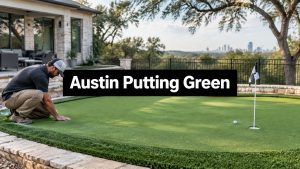
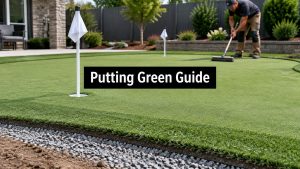
Putting greens are precision projects
Putting greens expose every shortcut. A standard lawn can hide a little wave or a slightly soft area. A golf surface cannot. If the sub-base is inconsistent, the ball will show it right away.
Good greens are built from the ground up with shape, speed, and drainage in mind. The breaks have to be intentional. The cup areas have to stay firm. The turf has to match the kind of roll the homeowner wants, and the infill has to support that performance instead of fighting it. On Austin clay, that also means controlling movement after rain, because even minor settling can change how a green plays.
A putting green is really a grading project with turf on top.
One yard can have multiple systems
Some properties need three different answers in one install. A front yard may call for a clean, natural-looking turf. The side yard may need a wash-friendly dog run. The backyard may need a true putting surface with shaped contours and tighter tolerances.
Modern Yard handles those kinds of mixed-use turf projects in the Austin area. What matters is not the brand name on the sample board. What matters is whether the installer adjusts the base, drainage, turf style, and infill to fit each zone instead of forcing one build method across the entire property.
Understanding Your Investment Timeline Labor and Costs
Homeowners almost always ask the same question first. “What does this cost?” That's a fair question, but the better one is, “What is driving the quote?”
Two estimates can look similar on square footage and still represent very different scopes of work.

What changes the estimate
A professional quote usually reflects a mix of site conditions and material decisions:
- Square footage affects labor, material quantity, seam planning, and waste.
- Access matters because a wide gate and easy equipment access make a very different job from hauling everything by hand through a narrow side yard.
- Demolition and haul-off can add serious labor if old sod, rock, irrigation, roots, or damaged hardscape are involved.
- Topography changes the prep work when slopes, drainage issues, or retaining transitions exist.
- Turf selection and infill choice shift the material package depending on durability, softness, heat management, or pet use.
- Specialty features such as putting green shaping, drainage tile, or custom edging add complexity.
If you want a more detailed overview of what goes into pricing, this page on artificial turf installation cost breaks down common estimate factors.
A simple example of how a quote is built
Take a rectangular backyard with decent access and no major drainage issue. That project may be fairly straightforward because excavation, base movement, and turf layout are simple.
Now compare that with a side yard dog run that has poor drainage, tight gate access, old sprinkler lines, and a fence line with multiple turns. It may be smaller on paper but more labor-intensive in practice. The smaller job can demand more hand work, more cuts, more edge detailing, and more planning.
Timeline matters too
Most homeowners also want to know how disruptive the work will be. A clean site with easy access usually moves faster than a yard with demolition, grading corrections, and specialty features. Weather can slow things down, especially if rain affects excavation or compaction conditions.
Good contractors don't pretend every job takes the same amount of time. They explain what the crew will be doing, what could change the schedule, and when the yard will be ready for normal use.
The cheapest quote often gets cheap by shrinking the part of the job you can't inspect later. That's usually site prep, edge work, or material quality.
A trustworthy estimate should leave you feeling informed, not pressured. If the contractor can explain the labor, materials, and timeline clearly, you're much closer to making a decision you won't regret.
Austin Artificial Turf FAQs
Will turf get too hot in Austin?
It can get warm in direct sun. That's the honest answer. Material choice, color blend, infill type, and how much afternoon exposure the yard gets all affect surface comfort. In some spaces, adding shade, selecting a different infill, or choosing a turf built for general purpose areas instead of sport use can improve the experience.
Does turf work on Austin clay soil?
Yes, if the site prep respects the clay. That means excavation, correct grading, and a properly compacted base. Clay soil is exactly why professional groundwork matters so much here. If someone installs turf like they're working on easy, forgiving soil, the yard may settle or hold water.
Will weeds still come through?
A well-built system greatly reduces weed problems, but no contractor should promise a yard that will never see a weed again. Most weed issues show up at the edges, through neglected seams, or from airborne seeds settling in debris on top of the turf. The difference is that weeds become far more manageable when the installation is done correctly.
Is artificial turf a good option for dogs?
Yes, when the system is designed for pets instead of treated like a standard lawn. The key issues are drainage, rinseability, odor control, and edge security. If you have multiple dogs or a dedicated dog run, say that early in the estimate process so the build matches the use.
How long does the installation process take?
That depends on access, weather, demolition needs, drainage work, and the complexity of the layout. A simple open yard is different from a tight urban lot with grade issues and multiple hardscape transitions. The right contractor should give you a project-specific timeline, not a one-size-fits-all answer.
What should I ask before hiring an installer?
Ask questions that reveal whether they understand the hidden parts of the work:
- How will you handle drainage on my property?
- What base material are you installing, and how will you compact it?
- How are seams and edges secured?
- What turf and infill are you recommending for my specific use?
- Can you provide documentation for the materials being installed?
When is it time to call instead of keep researching?
It's time when you've looked at enough photos and still don't know what your own yard needs. Every property in Austin behaves a little differently. Sun, slope, access, drainage paths, clay movement, pets, kids, and how you use the space all shape the right solution. A site visit clears up what internet advice can't.
If you want straight answers about your yard, Modern Yard Landscapes can evaluate the site, explain the prep work, and walk you through the material and installation choices that fit your property. If you're ready to stop fighting a patchy lawn and want a clear plan before spending money, schedule an appointment and get a project-specific recommendation.