
You know the feeling. You want to work on your short game, but getting to the course means finding a free afternoon, fighting traffic, and hoping the practice green isn't packed. Meanwhile, there's a patch of yard outside that could be doing a lot more than growing grass you have to mow.
That's why so many Austin homeowners are looking seriously at home practice greens. The category isn't a novelty anymore. The backyard putting green market reached $101-110 million in 2023-2024 and is projected to grow at a 7.1% CAGR through 2030, outpacing the broader landscaping industry's approximate 4% annual growth, according to Turf Factory Direct's market overview. That tells you something important. Homeowners aren't treating this like a gimmick. They're treating it like a real outdoor upgrade.
The catch is simple. A putting green can look great in photos and still putt terribly in real life. In Austin, that gap gets wider because heat, UV exposure, clay-heavy soil, and drainage issues punish shortcuts fast. The best backyard putting greens don't happen because someone rolled out turf. They happen because the design, base, surface, and drainage all work together.
Your Private Course Awaits
At 7:30 on a Tuesday night in Austin, the sun is still up, the patio is shaded, and you have 20 minutes before dinner. That is enough time to hit putts, work on speed control, and chip a few balls without loading the car or driving across town. For the homeowners who use their green regularly, that convenience is the whole point.
I've found the best projects start with a simple question. Will this get used, or will it sit there as an expensive yard feature? If you play often, have kids who like to compete, or entertain outside, a backyard green usually earns its keep. If you only golf a few times a year, the money may be better spent on a larger turf area, shade, or a hitting setup.
Austin makes this decision more practical than a lot of cities. You can use an outdoor practice area in every season, but the build has to suit local conditions. Heat, hard sun, and clay soil expose weak installation work fast. A green that looks sharp on day one can end up slow, wavy, or soggy after a summer and a few heavy rains.
Practical rule: If you'd use a practice green a few times a week, it becomes one of the hardest-working parts of the yard.
The homeowners happiest with these projects understand what they are buying. A good putting green is a constructed playing surface. It needs honest ball roll, reliable drainage, stable edges, and contours that are fun without turning gimmicky. It also needs to fit the rest of the outdoor layout so it feels intentional instead of dropped into open space.
Style still matters. Looking through backyard turf ideas for Austin homes can help you sort out shape, edging, and how the green relates to a patio, pool, or lounge area. But the part that determines whether you love it a year from now is the work underneath. Base prep, grading, and drainage decide how it plays in August and how it holds up after a Texas downpour.
Anatomy of a Pro-Quality Putting Green
A high-performing putting green works a lot like a performance car. The paint matters, but the suspension, tires, and chassis decide how it drives. With a green, the visible turf matters, but the hidden layers decide whether the ball rolls cleanly or hops all over the place.

The layers under the turf
At the bottom is the excavated subgrade. In Austin, this matters more than many homeowners realize because soil movement and drainage challenges can ruin a surface that looked perfect on install day. Above that comes the structural base, which creates stability and lets water move away instead of collecting under the green.
Next comes the shaping layer. Subtle breaks, tiers, and fall are built during this stage. Good contouring gives you a green that's fun and realistic. Bad contouring gives you gimmicky slopes that look dramatic but don't produce honest putts.
A pro-quality build usually includes these components:
- Subgrade preparation: The native soil is cut, cleaned up, and set to support the layers above it.
- Drainage-ready base: This keeps the green from turning into a sponge after rain.
- Contoured intermediate layer: The installer creates breaks that are playable, not random.
- Putting surface turf: This determines roll, speed, and how consistent the green stays under use.
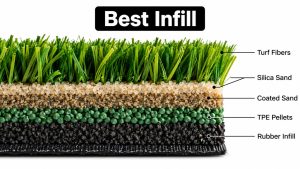
- Infill and finishing details: These fine-tune speed, support the fibers, and help the surface wear evenly.
The parts homeowners notice later
Initial focus often rests on turf color and cup placement. Over time, the subtle details that distinguish premium craftsmanship from a disappointing installation become more apparent.
Those details include fringe transitions, cup setting, edging, and how the green meets nearby patios, pavers, or lawn areas. A clean edge does more than look nice. It keeps the shape crisp, protects the perimeter, and helps the whole feature feel integrated instead of dropped into the yard.
A putting green should look like it belongs to the property, not like it arrived in a box.
The cup layout matters too. One or two well-placed holes can be more useful than a crowded layout that forces awkward putts. If you want a green that improves your game, the design should create repeatable practice from different angles and distances, not just visual drama.
What “best” actually means
The best backyard putting greens aren't all built the same size or with the same speed. “Best” depends on how you'll use it.
A homeowner who wants casual family play may prefer a forgiving surface with moderate contour. A serious golfer may want a firmer, faster roll and fringe space for short chips. The right answer comes from matching construction choices to use, not copying a photo from another climate or another lot.
Choosing Your Playing Surface Turf and Infill
If the base is the skeleton of the green, the turf is the playing personality. Homeowners make the choice here that most affects ball roll, speed, and long-term consistency.

Why nylon leads for performance
For homeowners who care most about realistic putting, nylon is usually the benchmark. According to Premier Turf Greens' putting green design guidance, nylon-based synthetic turf with a pile height of ½ inch to ¾ inch and face weight of 50oz+ delivers true ball roll and stimp speeds of 10-13 feet. That's why nylon is often the recommendation when the goal is a more serious practice surface.
Nylon's key advantage is structural memory. Its fibers stay upright well, which helps the ball track more cleanly. It also doesn't rely as heavily on infill just to keep the surface standing and playable.
Polypropylene, often called PP, has a place too. It can be a practical choice for homeowners who want a more budget-conscious project or a softer-feeling surface. But there's a trade-off. It generally won't deliver the same level of consistent, high-end roll as a properly specified nylon green.
For homeowners comparing products, this overview of artificial grass types is a useful starting point because it helps separate garden turf from true putting surfaces. Those are not interchangeable products.
Comparison table
| Feature | Nylon Turf | Polypropylene (PP) Turf |
|---|---|---|
| Primary strength | High-level ball roll and resilience | Lower-cost entry point |
| Typical use case | Serious practice greens | Budget-focused or lighter-use greens |
| Fiber behavior | Stiffer fibers that stay upright well | Softer feel, but less performance-focused |
| Speed potential | Can reach 10-13 stimp when properly specified and installed | More limited for premium-speed performance |
| Infill dependence | Less dependent on heavy infill to hold structure | More sensitive to system design and setup |
| Best for | Golfers who want realism | Homeowners prioritizing cost over tour-like play |
Infill changes how the green feels
Infill is where the installer fine-tunes performance. It affects pace, firmness, heat behavior, and how the surface responds under foot. That means the same turf can play very differently depending on what goes into it and how it's distributed.
Here's the practical view:
- Sand-based infill: Often used to sharpen firmness and support a quicker roll.
- Cooling infills: Helpful in hot climates where surface comfort matters.
- Odor-control or specialty infills: Worth considering for homes with pets or mixed-use areas.
A common mistake is chasing speed alone. Homeowners ask for the fastest green possible, then end up with a surface that's less enjoyable for everyday use. Unless you're trying to build a demanding training green, a slightly more forgiving setup often gets used more often.
Fast isn't always better. True is better.
What works and what doesn't
What works is pairing your surface to your habits. If you practice often and care about distance control, nylon is usually worth the premium. If the green will double as a family feature and budget is the priority, PP may be enough.
What doesn't work is using standard landscape turf and hoping it plays like a golf surface. It won't. The fiber shape, density, and finish are different, and the ball tells on that shortcut immediately.
Designing for Performance Site Prep and Layout
Most putting green problems start below the surface. If the site prep is careless, no turf on top can save the project. That's especially true in Austin, where hard soil, drainage swings, and seasonal weather changes expose weak construction fast.

The base is the project
According to The Motz Group's guide to artificial grass for putting greens, professional greens need a 2-4 inch gravel base topped by 6-8 inches of compacted angular sand to achieve drainage rates exceeding 900 inches per hour. That kind of drainage is what keeps a green playable after wet weather instead of forcing water to sit under the turf.
Compaction matters just as much as the material itself. Poorly compacted layers shift. Once they shift, the surface changes. And once the surface changes, the ball starts wandering on putts that should be straight.
That's why homeowners should pay attention to excavation and base prep, not just turf samples. A lot of disappointing greens look impressive for a short time because the top layer was installed neatly. The problem shows up later, when edges settle, dips appear, and putts lose consistency.
For anyone researching this stage in more detail, proper turf ground preparation gives a good sense of how much work has to happen before the turf is ever laid.
Layout decisions that improve practice
A putting green should challenge you without becoming repetitive. Good layout planning does that through shape, cup position, and approach angles.
Strong design usually includes a mix of these elements:
- Subtle contours: Enough break to build feel, but not so much that every putt becomes a novelty.
- Smart cup spacing: Holes should create different lines without crowding each other.
- Useful fringe zones: These make the green more versatile by allowing chips, bump-and-runs, and recovery shots.
- Clean integration: The green should meet surrounding outdoor features naturally.
Realism beats gimmicks
Homeowners sometimes ask for dramatic tiers or severe side slopes because they look impressive in a rendering. In practice, those greens get less enjoyable. You end up with a backyard feature that's visually loud but hard to use in a meaningful way.
A good home green should teach touch and start line. It shouldn't feel like a mini-golf obstacle.
The best designs are often quieter. They use modest undulation, smart orientation, and enough variety to keep the green interesting week after week. That's what creates a practice surface you'll return to.
The Austin Advantage Why Local Climate Matters
Austin isn't a neutral environment for synthetic turf. It's a stress test. Summer heat, strong UV exposure, clay-heavy soils, and sudden heavy rain all put pressure on materials and installation methods. A green that might survive in a milder region can struggle here if the build wasn't customized for local conditions.

Heat changes the rules
A generic guide might tell you to pick the turf you like best and move on. That's not enough in Central Texas. Heat affects surface comfort, wear, and long-term appearance. UV exposure can fade or weaken lower-grade materials faster than homeowners expect, especially on lots with all-day sun.
According to StarPro Greens' product and climate notes, site-specific base preparation using crushed rock and permeable fabrics can extend lifespan by 40-50% in high-heat regions, and adoption of silica-infused cooling turfs has risen 35% in Southern markets, reducing surface temperatures by 20-30°F. Those are the kinds of details that matter in Austin because they change whether the green stays comfortable and stable through summer.
Drainage is local, not generic
Austin yards vary a lot. Some are flat and tight. Some are sloped. Some hold water because of soil composition. Others shed water too aggressively and need better control around the green perimeter. The best backyard putting greens in this market are engineered for the property they're built on, not copied from a standard template.
That can mean:
- Permeable support layers to move water effectively below the surface
- Retaining solutions or edge control where grade changes affect stability
- Material choices with strong UV resistance for long daily sun exposure
- Cooling-focused infill strategies where comfort is a priority
Why local experience matters
This is one of the few outdoor projects where invisible mistakes show up in play. If the installer doesn't understand Austin soils, drainage behavior, and thermal stress, the project may still look finished. It just won't perform the way it should.
A local builder sees the warning signs before construction starts. That's the advantage. Not a sales pitch. Just fewer assumptions, fewer shortcuts, and a better chance that the green still rolls properly after years of Texas weather.
Budgeting Your Project Real Costs and Long-Term Value
Cost matters. It should. A putting green is a specialty outdoor feature, and homeowners deserve a straight answer about pricing instead of vague “it depends” language.
The broad install range for backyard putting greens is $10-20 per square foot, according to Tour Greens' outdoor putting green information. That's the starting frame, not the whole story. A simple, compact green on an easy-access lot sits in a different category than a heavily contoured design with fringe, drainage work, and challenging access.
What pushes price up or down
A bid usually moves based on a handful of practical factors:
- Size of the green: More square footage means more material and more labor.
- Complexity of contouring: A flat practice pad is simpler than a shaped green with realistic breaks.
- Site access: Tight side yards, elevation changes, and limited equipment access add labor.
- Drainage requirements: Some Austin properties need more prep below grade to avoid future problems.
- Surface specification: Premium performance turf and specialty infills cost more than entry-level systems.
Homeowners get into trouble with bargain quotes. A low number on paper often means something was removed from the scope, usually below the surface where you won't notice until later.
Cheap putting greens rarely stay cheap. They just postpone the cost.
Think in ownership, not just install
The more useful way to budget a green is to look at ownership over time. The same Tour Greens source notes that total 10-year ownership averages $12-20 per square foot when factoring in Austin water savings of $1,000+ per year versus natural grass and a potential property value uplift of 3-5%. That doesn't make every project an automatic financial win, but it does change the conversation.
A quality green can replace a patch of lawn that would otherwise need water, mowing, feeding, and repair. It also adds a distinctive feature that many buyers remember when the home eventually goes on the market.
A practical budgeting mindset
If you're comparing proposals, don't ask only, “What's the cheapest way to get a green?” Ask better questions:
- What materials are included in the putting surface?
- How is the base being built for drainage and stability?
- Is the quote detailed enough to show what's happening below grade?
- Will this design still make sense for how we'll use the yard in a few years?
The best project usually isn't the cheapest bid. It's the one with the clearest scope, the best fit for the property, and the fewest hidden compromises.
How to Hire a Putting Green Installer in Austin
The installer matters as much as the design. You can choose strong materials and still get a weak result if the crew cuts corners on grading, compaction, or finishing. In Austin, where climate and soil add another layer of difficulty, vetting the contractor is part of protecting the investment.
Questions worth asking
Use a short checklist when you talk to any company:
- Are you insured? You want a company that can clearly explain its coverage and jobsite process.
- How do you build the base? If the answer is vague, that's a warning sign.
- What turf products do you recommend for putting greens specifically? General use turf and putting turf are different categories.
- How do you handle drainage on clay-heavy or sloped lots? Local experience should show up in the answer.
- Can you show local projects? Photos are useful, but recent Austin-area work matters more.
- What does the warranty cover? Materials and labor aren't always treated the same.
A reputable local company should be able to walk you through process, materials, timeline expectations, and likely trade-offs without getting defensive. If you want a benchmark for what a local specialist should offer, review an Austin turf installer with dedicated putting green experience.
Red flags to take seriously
Some warning signs are easy to miss because the quote still sounds appealing.
- Pressure to decide fast: Good installers don't need urgency tricks.
- No itemization: If everything is wrapped into one vague line item, comparison gets hard.
- Overpromising surface performance: Every yard and every design has limits.
- No discussion of drainage or base prep: That usually means the company wants you focused on the visible layer only.
The right installer should make you more informed by the end of the conversation, not more confused.
Frequently Asked Questions About Backyard Greens
Can a putting green hold up to pets and kids
Yes, if the design accounts for mixed use. The key is choosing a durable turf system, building stable edges, and being realistic about how the space will be used. A green meant for daily golf practice may be specified differently than one expected to handle family traffic all week.
How long does installation usually take
It depends on site access, size, weather, and how much prep the yard needs. A straightforward project moves much faster than one that requires major grading, drainage correction, or hardscape integration. The best answer comes from an on-site visit, not a guess over the phone.
Should a backyard green be as fast as a tournament green
Usually not. For most homeowners, a true and moderately quick roll is more enjoyable than an ultra-fast surface. If the green is too demanding, many people end up using it less.
What should a warranty cover
At minimum, ask whether the material warranty and labor warranty are separate and what exclusions apply. You also want clarity on seam work, edge stability, and any specialty components used in the installation.
If you're thinking about building one of the best backyard putting greens for your Austin home, Modern Yard Landscapes can help you evaluate the site, explain the actual trade-offs, and design a green that fits your yard, your game, and the Texas climate. Schedule a consultation and get a clear plan before you spend a dollar on the wrong setup.