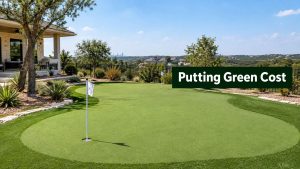

Most Austin homeowners pay $15 to $40 per square foot for a professionally installed backyard putting green, and true performance builds usually land at $40 to $60+ per square foot when contouring, drainage, edging, and multi-surface work get involved. If you're pricing a small simple green, that can mean roughly $2,200 to $4,800 for a basic 150 to 300 square foot install, while a serious training layout can move into the $10,000 to $18,000 range for 800 to 1,200 square feet.
If you're reading this, you've probably already done what most Austin homeowners do first. You searched a few per-square-foot numbers, got three wildly different answers, and now you're trying to figure out whether one contractor is overpriced or another one is cutting corners.
Here's the honest answer. Artificial putting green cost is not really a turf number. It's a build-spec number. In Austin, the difference between a green that rolls clean for years and one that puddles, settles, and gets blamed on the turf usually comes down to the stuff under the turf. Rock base, caliche removal, drainage tile, edging, access, slope, haul-off. That's where quotes separate.
I've seen flat yards in Westlake that go in clean and fast. I've also seen Hill Country lots outside Dripping Springs where caliche, slope, and tight access turn a “simple” green into an excavation project. Same square footage. Completely different labor and material reality.
If you want a quote that means something, stop asking only, “What's your price per foot?” Start asking, “What are you building under it, and why?”
What Actually Drives Artificial Putting Green Cost in Austin
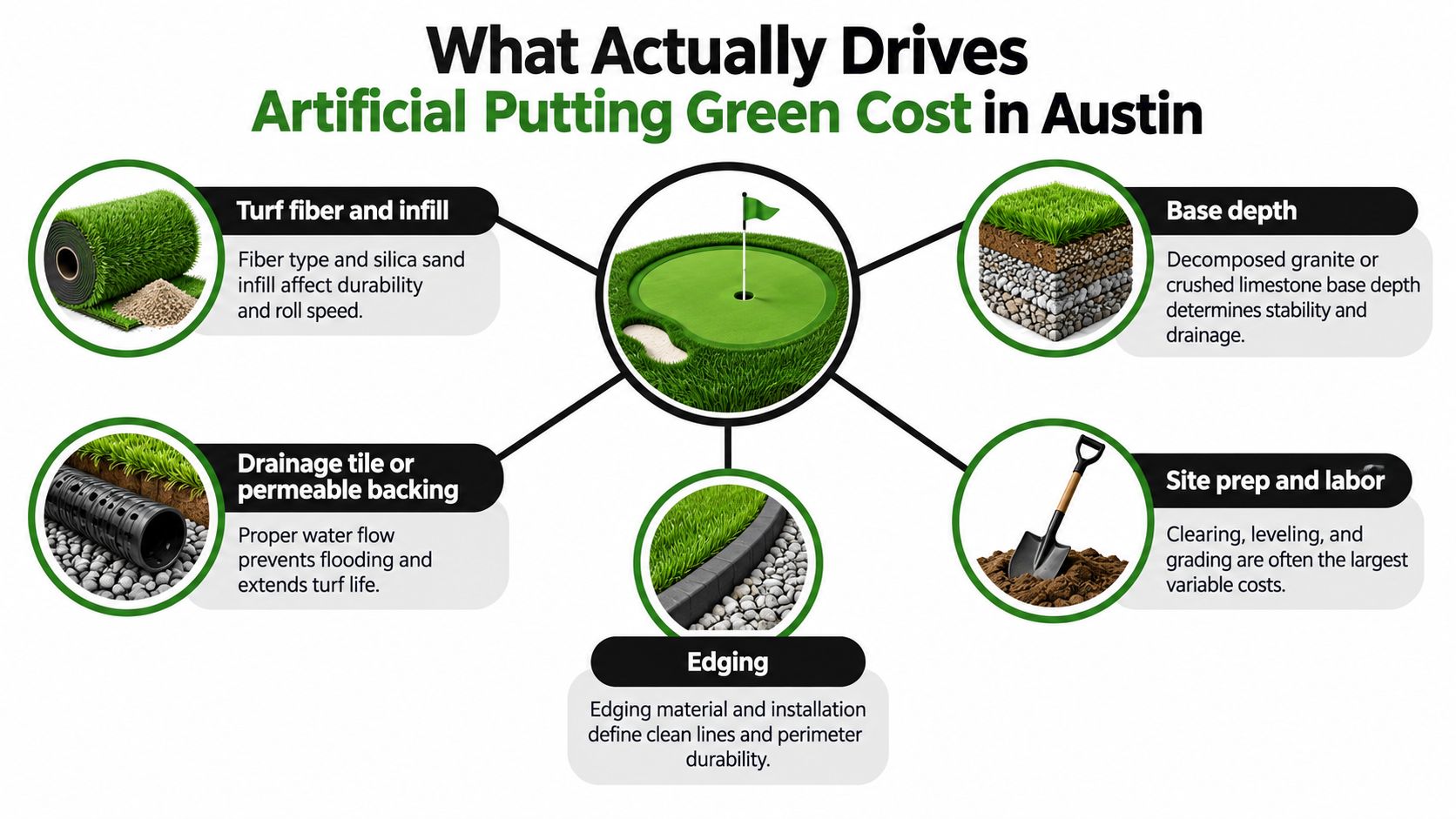
The fastest way to understand your quote is to ignore the big total for a minute and look at the five parts that create it. In Austin, those five parts decide almost everything.
Turf is only one piece
People fixate on turf first. That's understandable, but it's not where most bad decisions happen. Turf fiber, backing, and infill matter because they change ball speed, heat response, and how well the surface keeps its shape under use. Penn State's Sports Surface Research Center found that infill systems generally outperformed traditional Astroturf in playing quality, which is exactly why modern greens are built around the whole system, not just the carpet itself (Penn State Sports Surface Research Center findings).
If you're building for real practice, don't cheap out on the putting surface spec. If you're building for looks and occasional putting with friends, you can stay simpler.
Base depth, drainage, edging, and labor decide the real number
Austin soil doesn't care what your quote said. Clay expands. Caliche fights excavation. Slope changes how many compaction passes a crew needs and whether a mini-excavator can even get where it needs to go.
These are the five cost drivers I tell homeowners to focus on:
- Turf fiber and infill: Better fibers and the right infill hold roll more consistently.
- Base depth: Decomposed granite or crushed limestone depth controls stability and drainage.
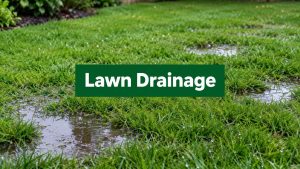
- Drainage system: Permeable backing alone isn't enough on every lot. Some yards need tile or directed water movement.
- Edging: Cheap perimeter work is where seams creep and edges fail.
- Labor and access: A flat open lot installs faster than a steep yard with gates, roots, and caliche.
Practical rule: If two quotes are far apart, the difference usually isn't “better turf.” It's base work, drainage scope, or labor reality.
There are also line items you can control and line items you can't. You can adjust cup count, fringe width, and turf spec. You usually can't do much about haul-off, imported base material, or freight on rock in Central Texas.
If your project also has drainage issues around the patio or side yard, get those looked at before the green goes in. A local directory like book a plumber in Austin can help if water movement problems extend beyond the scope and into drains or runoff around the home.
Austin examples that change the quote fast
A flat lot with sandy soil in Westlake is easier. A sloped Dripping Springs yard with shallow rock and caliche is harder. That's not a sales line. That's labor.
One independent pricing guide makes the broader point well: professionally installed synthetic putting greens commonly run about $15 to $40 per square foot, with more complex performance-focused builds reaching $40 to $60+ per square foot once contouring, drainage, edging, and multi-surface integration are added (synthetic putting green cost calculator benchmarks).
That range is real. But in Austin, the reason you land at one end or the other is usually buried underground.
Breaking Down the Line Items in Your Putting Green Quote
A putting green quote should never be one lump number. If a contractor hands you a total with no breakdown, you're being asked to trust what you can't see. Don't.
Where the money usually goes
National pricing benchmarks show two things clearly. First, professionally installed synthetic putting greens often average $14 to $22 per square foot, while DIY materials run about $6 to $12 per square foot, which tells you labor, grading, and drainage often make up a large share of the total (Angi putting green cost guide). Second, the hidden cost center is often the base and drainage package, with site-dependent drainage and base work commonly adding about $2 to $5 per square foot (synthetic putting green pricing and drainage guide).
That's why I tell homeowners to read quotes in buckets, not blurbs.
| Sample 400 sq ft Austin Putting Green Line-Item Breakdown | Typical Cost |
|---|---|
| Turf material and putting surface system | Varies by spec |
| Base rock, decomposed granite, and compaction | Varies by depth and freight |
| Drainage components and water management | Varies by yard conditions |
| Edging and cup hardware | Varies by perimeter detail |
| Labor and equipment | Varies by access, slope, and excavation difficulty |
| Haul-off, caliche removal, and tight-access adders | Site-specific |
The line items that get padded most often
On real Austin bids, two numbers get rounded in ways homeowners don't catch.
- Base depth: A quote may assume a lighter base than the site really needs.
- Infill quantity: Some installers under-spec infill on paper, then the surface loses performance sooner.
Those aren't small details. They're the difference between a green that stays true and one that gets soft spots.
Ask how deep the base will be, what material is going in, and whether drainage is included or treated as an add-on later.
How to spot a clean quote
A useful quote separates these categories:
- Excavation and haul-off
- Base and compaction
- Drainage components
- Turf and infill system
- Edging and cups
- Labor and equipment access
If one contractor gives you one bundled number and another breaks it apart, the second one is usually easier to evaluate. That doesn't guarantee better work. It does make padding harder to hide.
And if someone says your yard “probably won't need much prep” before they've checked slope, drainage, and subsoil, that's a red flag.
Real Cost Ranges by Backyard Putting Green Size
Square footage matters, but not in the way you might think. Small greens often feel overpriced because fixed labor and prep costs get spread over fewer feet. Bigger greens can look expensive in total, but the unit cost often makes more sense once the crew, equipment, and base work are already mobilized.
What smaller installs really cost
Independent benchmarks show that 150 to 300 square foot basic practice greens are often estimated at $2,200 to $4,800 total, while another guide places 200 to 300 square foot compact backyard greens at about $3,500 to $9,000 installed (TurfNetwork cost calculator ranges, FusionTurf backyard green cost ranges).
That spread makes sense. A one-cup practice strip on a flat lot is one thing. A small green with curves, fringe, and drainage in a tricky yard is another.
Side-by-side Austin project ranges
| Austin Putting Green Installed Cost by Project Size | Low Estimate | High Estimate | Effective $/sq ft |
|---|---|---|---|
| 200 sq ft practice green | $3,500 | $9,000 | $17.50 to $45.00 |
| 500 sq ft family green | $7,500 | $20,000 | $15.00 to $40.00 |
| 1,000 sq ft performance layout | $22,000 | $42,000 | $22.00 to $42.00 |
The 500 square foot category is where a lot of Austin homeowners land. A mid-size green of that size is frequently cited in the $7,500 to $20,000 range, which is exactly where projects start splitting into either practical backyard upgrades or premium builds depending on contours, site conditions, and short-game features (mid-size putting green pricing reference).
What pushes each size higher
A 200 square foot green climbs fast when you add contouring, premium edging, or difficult excavation.
A 500 square foot green gets expensive when homeowners want it to look like part of a full design, not just a practice surface.
A 1,000 square foot layout moves into another category entirely when you add chipping lanes, multiple pin locations, rough transitions, or bunker-style features. One benchmark estimates 1,000 to 1,200 square foot greens with chipping lanes and multiple pin locations at about $22,000 to $42,000 (larger putting green project costs).
Bigger isn't always smarter. I'd rather see a homeowner build a tighter green with a strong base and good roll than overbuild the footprint and cut the install spec.
How Materials Change the Price You Pay
Material choices absolutely change your final bill. They also change whether you like using the green six months from now.
Turf fiber and backing are not cosmetic choices
Nylon, polyethylene, and lower-cost turf constructions don't play the same. Fiber denier, pile height, and face weight affect how upright the yarn stays and how consistently the ball tracks. Backing matters too. On expansive Austin soils, a stronger backing system does a better job resisting movement and helping the surface hold shape.
If you want a broader look at surface types before you decide, review these different types of turf for residential installs. It helps homeowners stop comparing products that aren't built for the same use.
Infill is one of the biggest performance levers
Rounded silica sand and coated silica systems usually make more sense for putting performance than infill types chosen mainly for cushion. Ball roll depends on support under the fiber and consistency across the surface. The wrong infill setup can make a decent turf look bad.
Cranfield University's infiltration research found that adding drainage holes as part of the carpet design had a significant effect on infiltration rate through the infill/carpet system, which is another reason backing and infill should be selected together, not separately (Cranfield infiltration study on turf system drainage).
Cup hardware and edging quietly move the budget
Homeowners notice turf samples. Installers notice perimeter detail and hardware.
- Budget tier: Simpler cup systems and basic edging keep costs down but don't always hold shape as well over time.
- Mid tier: Better sleeves, cleaner perimeter materials, and more refined transitions improve durability.
- Performance tier: Regulation-style cup hardware, stronger edging, and cleaner surround integration raise the build quality.
| Material Upgrades and Their Cost Impact per Square Foot | Budget Tier | Mid Tier | Performance Tier |
|---|---|---|---|
| Turf fiber and putting surface spec | Lower installed cost | Balanced cost and playability | Higher cost, stronger roll consistency |
| Infill system | Basic support | Better consistency | Best support for repeatable performance |
| Backing and drainage design | Simpler build | Improved stability | More engineered system |
| Cup hardware and edging | Basic finish | Cleaner detail | Premium fit and longer-term durability |
One practical note. This is one place where a company like Modern Yard Landscapes may specify high-denier fibers, advanced infill options, and steel edging as part of the overall build. That's useful if you want a quote tied to performance specs rather than just a turf sample.
Cheap materials don't always fail fast. They usually fail slowly, through inconsistent roll, edge movement, and more frequent tuning.
Why Site Prep and Drainage Deserve the Biggest Budget
Homeowners either protect their money or waste it.
The cheapest quote usually cuts here first
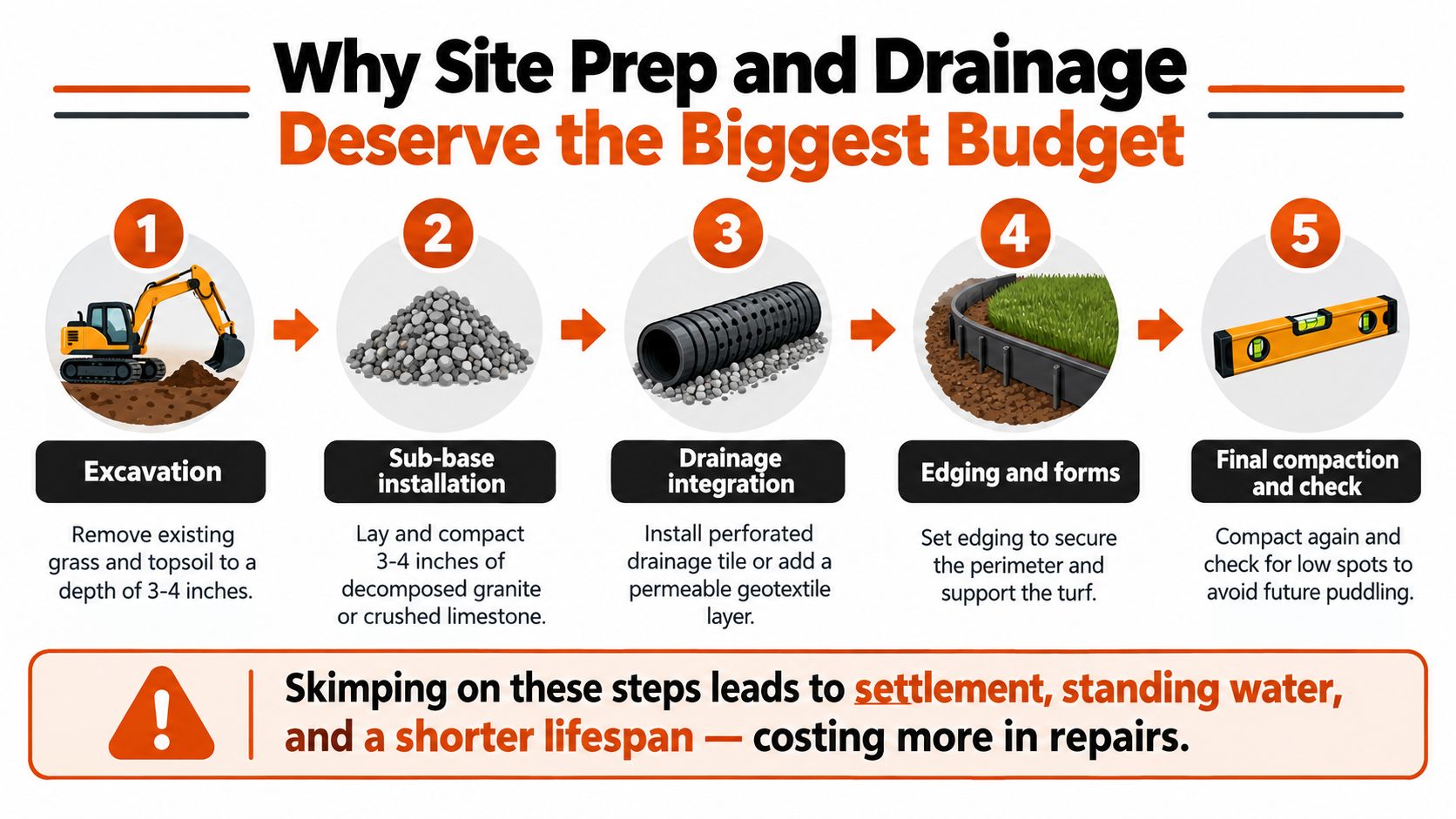
A lot of installers know homeowners compare totals first. So they trim excavation, reduce base depth, skip separator fabric, or avoid real drainage planning. The green looks fine at handoff. Then Austin rain shows up, clay shifts, and the bill comes due later.
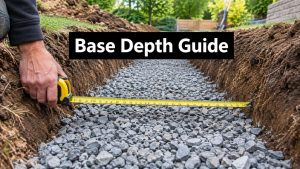
Proper prep means excavation to consistent depth, removal of unstable organics, compacted aggregate in lifts, and a drainage plan that fits the slope and soil. If your lot holds water or sits on heavy clay, this is not optional.
Austin soils punish shortcuts
One broad cost guide shows installed artificial putting green pricing commonly clustering around $15 to $40 per square foot, with premiums driven less by turf than by contour shaping, drainage, edging, and labor intensity once a build becomes a performance system (installed putting green pricing by project complexity). That's exactly right in Central Texas.
If your yard needs drainage work beyond a simple permeable base, review what goes into a proper yard drainage system installation. Homeowners who understand that scope ask much better questions during quoting.
Spend here first, decorate later
Recent pricing content also notes annual synthetic green upkeep may be only about $100 to $350 or even $50 to $300, while entry-level backyard greens can run roughly $15 to $25 per square foot and premium short-game systems $40 to $60+ per square foot. The useful takeaway is simple: the cheapest install can become the expensive one if it needs rework to fix settled infill, weak drainage, or poor roll quality (putting green turf cost and maintenance ranges).
If the budget is tight, shrink the footprint. Don't slash the base and drainage package.
A green can survive a simpler fringe. It won't survive bad water management for long.
Long-Term Value, Maintenance Savings, and ROI
A backyard green isn't magic ROI. It's a use-value purchase first. That's the honest version.
Where synthetic greens do save money
One cost comparison notes that artificial grass installation generally runs about $5 to $25 per square foot, while natural sod installation is only about $1 to $2 per square foot up front. Even so, synthetic can stay competitive in high-use settings because it avoids repeated mowing, irrigation, and chemical inputs over time (artificial grass versus sod cost comparison).
That's the right way to think about it. Natural grass is cheaper to start. It usually isn't cheaper to keep looking and playing like a putting surface.
Maintenance is low, but quality still matters
If a synthetic green is built correctly, yearly upkeep is relatively modest compared with maintaining a real grass area to anything close to putting condition.
| Annual Cost Comparison: Natural Lawn vs Artificial Putting Green vs Golf Membership | Natural lawn (500 sq ft) | Artificial green (500 sq ft) | Golf/Topgolf membership |
|---|---|---|---|
| Water use and irrigation | Ongoing | Minimal compared with lawn watering | Not applicable |
| Mowing and edging | Ongoing | None | Not applicable |
| Fertilizer and lawn treatments | Ongoing | None | Not applicable |
| Surface brushing and cleanup | Minimal | Ongoing light maintenance | Not applicable |
| Infill touch-up and performance tuning | Not applicable | Occasional | Not applicable |
| Access to regular practice | Limited by condition | Daily at home | Requires recurring membership spend |
The main point is this: synthetic reduces routine lawn work, but a better system also holds performance longer. That means less fiddling with infill, fewer drainage headaches, and more consistent roll.
ROI is real, but daily use is the real reason
I don't like inflated resale talk on outdoor projects. Some buyers will love a putting green. Some won't care. The cleaner argument is daily use. If you practice, host, or want a backyard feature your family uses year-round, the value is easy to justify.
For homeowners weighing lifespan and wear, it helps to read about artificial grass durability in real backyard conditions. Durability isn't just about fibers. It's about whether the whole build keeps doing its job.
The people happiest with these installs aren't the ones chasing some huge paper return. They're the ones who walk outside and use it.
What to Have on Hand Before You Request a Quote
Most first quotes are soft because the homeowner gives soft information. Fix that, and the proposal gets a lot tighter on the first visit.
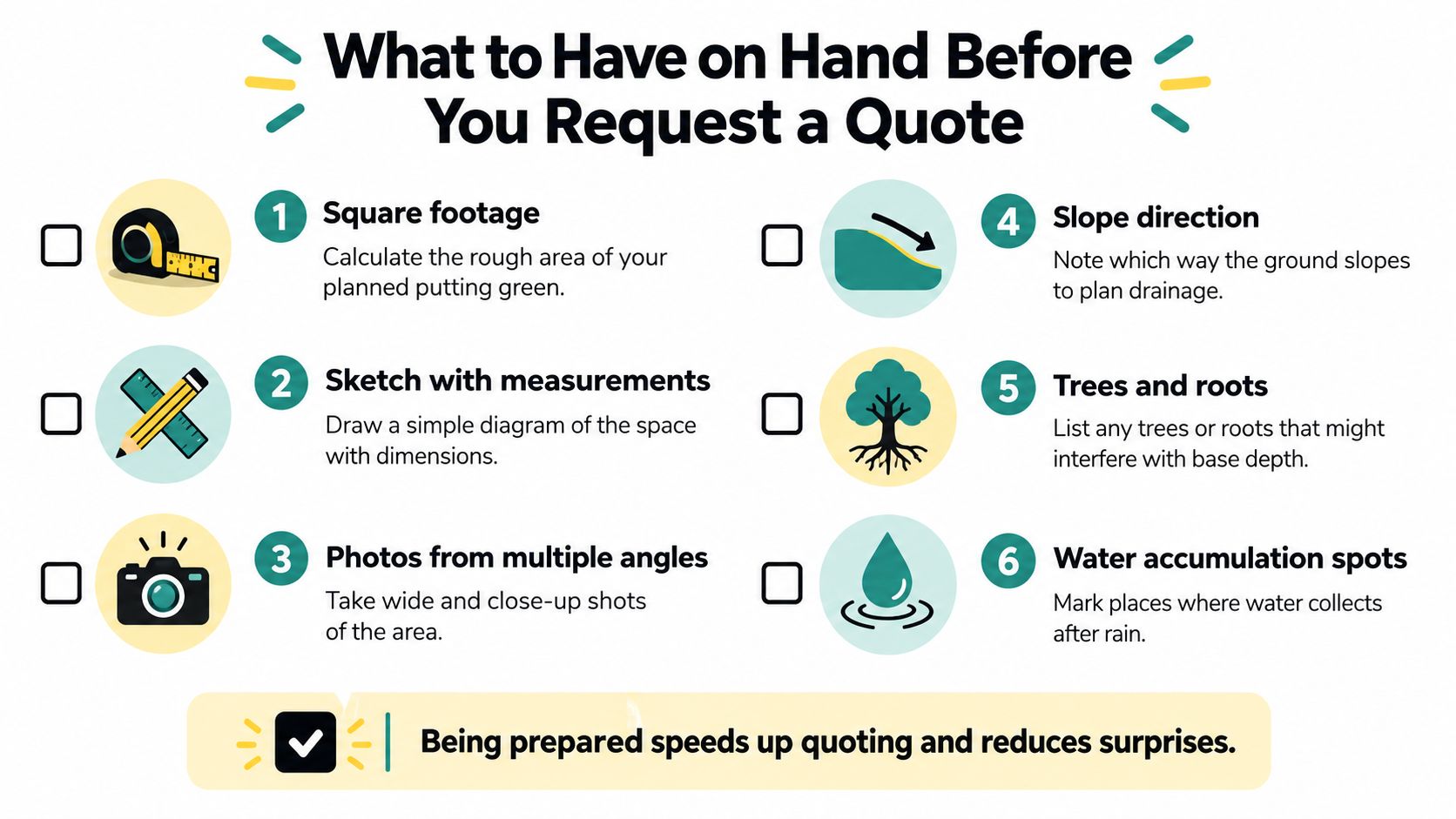
Bring real project details
Before you call, pull together these basics:
- Rough square footage: It doesn't need to be perfect, but it needs to be close.
- A simple sketch: Show dimensions, patio edges, fence lines, and trees.
- Photos from multiple angles: Wide shots help more than tight close-ups.
- Slope direction: Mark where the yard falls and where runoff heads.
- Drainage trouble spots: Note any place where water sits after rain.
- Feature priorities: Cups, fringe, chipping apron, lighting, or bunker-style edges.
Make your budget usable
A budget range helps more than a fake “just give me your best number.” If you say you want a serious practice green but only want the cheapest option, the quote process gets wasteful fast.
Bring a realistic target and say what matters most:
- Ball roll quality
- Looks
- Low maintenance
- Short-game versatility
The better your notes are before the visit, the less guesswork ends up inside the bid.
If you're in an HOA, check whether visible edging, lighting, or grade changes trigger review. And if your water bill is part of the reason you're considering synthetic, have a recent one ready. That gives the conversation some real-world context instead of vague assumptions.
Scheduling Your On-Site Putting Green Consult in Austin
The site visit is where a decent project becomes a defined project. Don't treat it like a quick sales stop.
How to make the consult useful
Book it during dry weather if you can. Mud can hide shape, and standing water can make a yard look worse or better than it really is. Walk the footprint in person and mark the proposed shape before the final quote gets written.
Then ask for the bid to be broken into separate categories: turf, base, drainage, edging, cups, and labor. If it's bundled, you can't tell where money is going.
What to ask before you sign
Use the consult to verify the job, not just the price.
- Ask for recent local examples: Drive by if the contractor can share addresses.
- Ask who installs it: The quoting crew and the install crew should not be strangers to each other.
- Ask about compaction and drainage: If the answers get fuzzy, keep shopping.
- Ask for warranty details in writing: Materials and workmanship should both be clear.
If you want to compare scope against a defined service process, review this backyard putting green installation overview. It helps you see whether a contractor is talking about the full build or just the visible finish.
The two decisions that matter most are simple. First, decide whether you want a casual backyard feature or a true practice surface. Second, decide whether you're willing to pay for proper prep. Once those answers are clear, the right quote usually becomes obvious.
Modern Yard builds custom Austin putting greens with the part that matters most done right: site prep, drainage, base construction, and a surface spec matched to how you'll use it. If you want a candid quote that breaks out turf, rock, drainage, edging, and labor instead of hiding everything inside one number, visit Modern Yard Landscapes and schedule an on-site consult.