
You're probably looking at your house right now and doing the same math most Austin homeowners do every fall. The roofline would look great lit up. The live oaks would too. But then reality shows up. You've got a ladder, a box of tangled lights, one outlet you're not sure you trust, and a calendar that's already full.
That's usually the moment people stop searching and start asking better questions. Not “Can I hang lights?” but “What am I buying if I hire this out?” In Austin, that matters more than people think. A quick install for one season is one thing. A clean design, safe power load, reliable service in December, and a system that still makes sense years from now is something else entirely.
Austin already treats holiday lighting like a city-scale tradition. The Trail of Lights started in 1965 as Yule Fest in Zilker Park and now features more than 2 million lights, 90 lighted holiday trees, and more than 70 other displays and lighted tunnels according to the Trail of Lights event page. Homeowners feel that standard whether they mean to or not. Once the city glows, a bare roofline stands out.
Why Austin Homeowners Hire Out Holiday Lights
A homeowner in Lamar Triangle told me the same story I hear every year. He spent two weekends trying to do a simple single-story roofline. Austin gave him hot shingles, a stubborn ladder setup, and one bad outlet. By New Year's, he still had extra wire jammed in the attic and half a strand out.
That's the problem with DIY in Central Texas. It's not just hanging lights. It's climbing in warm November weather, dealing with mixed-age roofing materials, working around live oaks that eat strands, and then remembering you still have to take everything down when the season's over and the first freeze shows up.
What a pro crew actually changes
A real installer doesn't show up with random big-box leftovers. They show up with commercial-grade LED C9 bulbs, 5mm wide-angle strings, custom-cut roofline runs, and clips that fit the fascia instead of hoping one universal clip works everywhere. That's the difference between a display that looks sharp from the street and one that looks patched together.
You're also buying service, not just materials. The better setups include maintenance through the season, takedown after the holidays, and storage that keeps lights from cooking in a garage or getting crushed under moving boxes.
Practical rule: If the quote only talks about “installing lights” and not maintenance, removal, and storage, you're not comparing equal services.
Some homeowners want one clean season and no commitment. Others are already tired of re-renting lights every year and should be looking at permanent systems instead. Both approaches can make sense. What doesn't make sense is deciding from a satellite-image quote and a text message.
If you want to see how year-round systems fit into the broader outdoor lighting conversation, this page on year-round festive lighting installation in Austin, TX is worth a look before you commit to a seasonal-only setup.
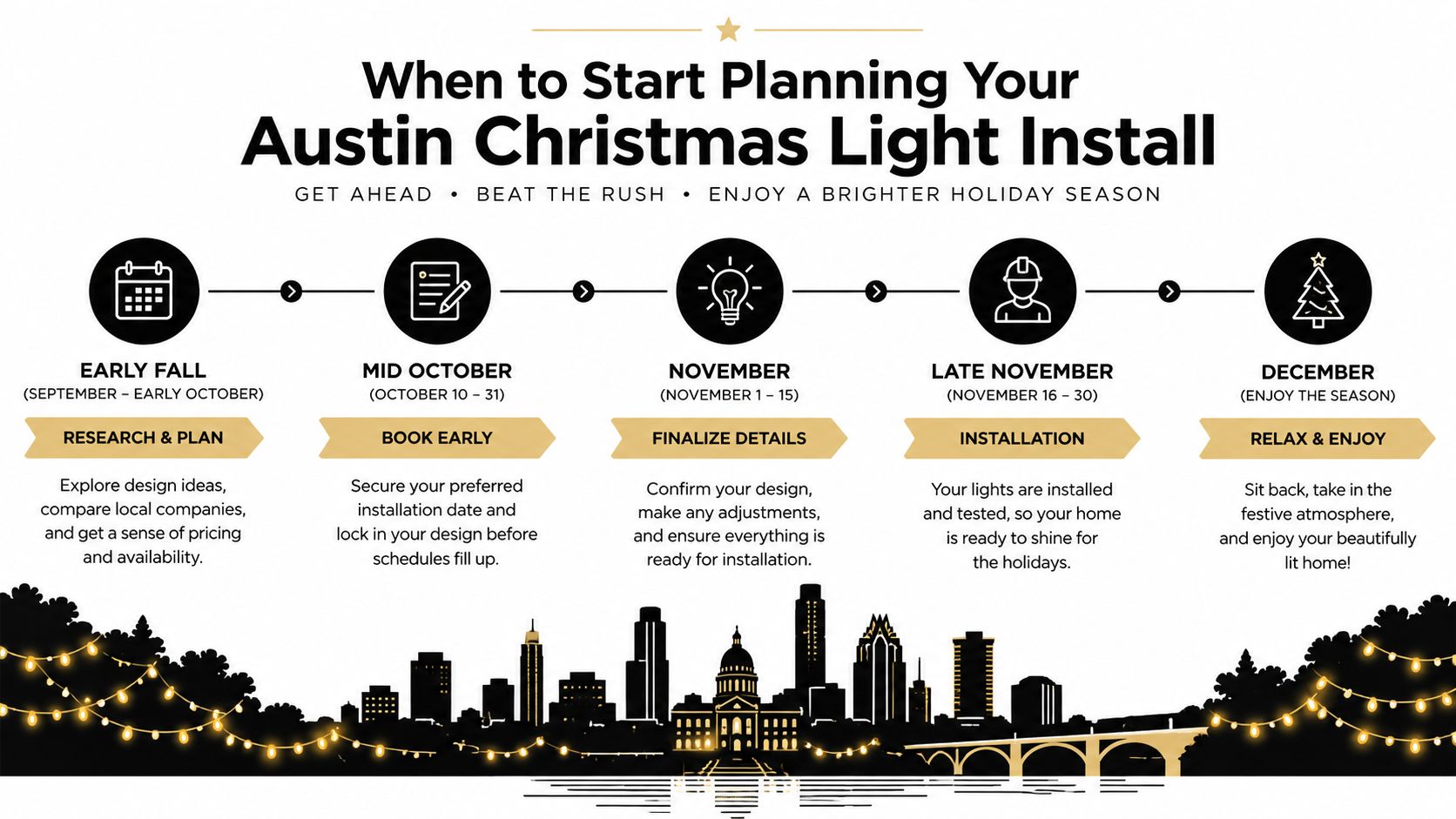
When to Start Planning Your Austin Christmas Light Install
Most homeowners wait too long. Then they get stuck with whatever dates are left, fewer design choices, and a rushed install window. If you want good work, start before the weather feels festive.
Summer is when the smart decisions happen
June and July are for the first real conversation. That's when you decide whether you want a one-season rental look or a permanent track system you can use beyond Christmas. It's also the right time to talk through color temperature, roofline coverage, tree lighting, and whether your home even suits a roofline-only design.
August is when quotes need to get locked down. Good crews don't keep open-ended holiday calendars forever. Once they start mapping neighborhoods and routes, the flexible slots disappear.
If you're leaning toward a system you can use beyond December, compare your seasonal options against permanent holiday light installation in Austin, TX before you sign a rental agreement for another year.
September and October decide how smooth the season feels
September is the cutoff month for homes that need custom line cutting, unusual clips, or careful planning around high peaks and odd fascia details. That includes a lot of Austin houses, especially remodels where one side of the home doesn't match the other.
October is the sweet spot for installation. You avoid the holiday crunch, the crew can work deliberately, and you're not trying to beat every other homeowner in town after Thanksgiving.
A simple planning rhythm works well:
- June or July: Choose the display type and settle on the look.
- August: Approve the quote and get on the calendar.
- September: Finalize custom materials for tricky rooflines.
- October: Install before the late-season scramble.
- After New Year's: Schedule takedown within the agreed service window.
The homeowners who call at Thanksgiving usually aren't choosing from all options. They're choosing from what's left.
Austin has had a long public holiday-light tradition because people here keep showing up for it. The Trail of Lights began in 1965, the Zilker Holiday Tree first lit in 1967, the event was canceled in 2010 and 2011 due to funding issues, then returned in 2012, and it later shifted to drive-through in 2020 and 2021 before returning to walk-through in 2022, as summarized by the East Texas Historical Association article on Texas Christmas traditions. Austin doesn't treat holiday lighting like an afterthought. Neither should you.
Design Options That Work for Austin Homes
Good holiday lighting should fit the house, not fight it. A lot of Austin displays go wrong because people copy a photo from a different neighborhood, on a different roof shape, with different trees. The cleanest install usually comes from doing less, but doing it in the right place.
Four layouts that actually fit local architecture
Here's how I'd match common Austin home styles to the display.
| Austin Christmas Light Layouts Compared | ||||
|---|---|---|---|---|
| Home Style | Best Layout | Bulb Type | Watts / 100 ft | Avg Linear Feet |
| Ranch home | Warm-white roofline outline | LED C9 | Depends on the product and total load. Size by wattage, not string count | Varies by house |
| Two-story Craftsman | Roofline plus wreaths and column wraps | LED C9 plus 5mm wide-angle strings | Depends on the product and total load. Size by wattage, not string count | Varies by house |
| Mid-century | Minimal trunk and canopy lighting | 5mm wide-angle strings | Depends on the product and total load. Size by wattage, not string count | Varies by tree count and frontage |
| Limestone facade in the Hills | Path lights and tree uplighting with selective accents | Mixed low-voltage style accents and LED holiday strings | Depends on the product and total load. Size by wattage, not string count | Varies by layout |
I'm leaving the wattage as a product-specific issue on purpose. That's the honest answer. The right way to size a display on a standard residential circuit is to use total wattage divided by voltage, not count strings and guess. A practical rule for continuous load is about 1,440 W on a 15 A circuit and 1,920 W on a 20 A circuit, based on the 80% rule outlined in this holiday lighting commercial install guide.
What usually looks right, and what usually doesn't
Classic ranch homes in places like Circle C and older central neighborhoods usually look strongest with a clean roofline and warm-white lamps. Don't overcomplicate that house. Let the shape do the work.
Two-story Craftsman homes often need a second layer so the lower half of the house doesn't disappear. That's where wreaths, garland, or column wraps earn their keep.
Mid-century homes are where people overdo it most often. If the architecture is clean, keep the lighting clean. Trunks, a simple canopy wrap, and one disciplined line usually beat a full-outline overload.
If you're comparing outline styles for your own home, contour lighting installation in Austin, TX is the category to study first.
On a historic or architecturally clean house, blinking multicolor sets usually cheapen the elevation faster than homeowners expect.
Net lighting on young red oaks is another mistake. Sparse canopies don't hide the grid, so the tree ends up looking unfinished. If the tree hasn't filled in, skip the net and wrap selectively.
What Christmas Light Installation Really Costs in Austin
This is the first question people ask, and most answers online are too vague to be useful. In Austin, the issue isn't just price. It's which cost model you're buying.
The broad local range is wide. One Austin estimate puts a typical professional Christmas light install at about $301, with a range of $179 to $438, while other Austin pricing pages place residential installs closer to $500 to $1,500 and permanent systems around $594 to $1,189 or even $2,000 to $8,000 for a home, according to this Austin holiday lighting cost overview. That spread isn't fake. It usually means people are comparing very different scopes.
The three pricing models
Most Austin homeowners fall into one of three buckets:
One-season rental install
The installer provides the lights, hangs them, services them during the season, removes them, and stores them. This is the easiest path if you want zero ownership.Multi-year lease-style program
The contractor may spread costs out over time, but you still need to read the fine print on replacement terms, service calls, and whether pricing rises later.Permanent track lighting system
You pay more up front, but you stop repeating the seasonal install cycle. This makes sense for homeowners who want holiday lights, game-day colors, party lighting, and architectural accent use beyond December.
What changes the quote
The quote moves up or down based on things homeowners often miss:
- Roof complexity: Peaks, dormers, and second-story transitions slow everything down.
- Access conditions: Tight side yards, steep grades, and fragile landscaping affect setup.
- Electrical reality: Safe power matters more than adding more bulbs.
- Material ownership: Are you renting a seasonal package or paying into a permanent asset?
- Storage and takedown: If it's not spelled out, ask.
Here's the simplest way to compare them.
| Christmas Light Installation Cost Models in Austin | |||||
|---|---|---|---|---|---|
| Cost Model | Upfront Cost | Year 1 Total | Annual Cost After Year 1 | Ownership | Maintenance |
| Seasonal rental | Lower entry cost in many cases | Varies by layout and service bundle | Repeats each season | Installer usually owns materials | Often installer during season only |
| Lease-style arrangement | Moderate | Depends on contract terms | Continues under agreement | Mixed, contract-dependent | Contract-dependent |
| Permanent system | Higher up front | Higher in year one | Lower seasonal labor exposure afterward | Homeowner typically owns system | Usually shared between owner and installer service |
My opinion is simple. If you love lights every year and plan to stay in the house, permanent systems deserve a serious look. If you only care about Christmas and want zero hassle, seasonal rental is still a good fit. The mistake is buying one while expecting the economics of the other.
Safety, Permits, and Austin Code Requirements
A lot of cheap quotes fall apart. Nice photos don't tell you whether the display is safe, legal, or likely to stay working through the season.
The non-negotiable electrical rules
For temporary holiday decorative lighting, the National Electrical Code allows it under Section 590.5(B) only if it isn't installed for more than 90 days, according to the NFPA holiday lighting article. That's a hard compliance window homeowners rarely hear about.
Austin-specific guidance cited in this Christmas lighting safety guide says temporary decorative lighting is permitted only on a temporary basis for up to 90 days, requires an approved permit, and only LED and fiber optic types are permitted for this use. That same guidance also says the lights must be tested/listed to UL 588 and a photo of the listing label must be submitted for the permit.
For outdoor safety, I treat GFCI protection as mandatory. The Texas Department of Insurance guidance summarized in this holiday electrical safety article also says outdoor electric lights should be plugged into GFCI-protected circuits, damaged strings should be discarded, and no more than three standard-size sets should be connected per single extension cord.
Roof work and ladder discipline
The physical side matters just as much as the electrical side. A safe roofline workflow is straightforward: use outdoor-rated, undamaged strands, set ladders on level ground, follow the 4:1 setup rule, keep three points of contact, use clips instead of nails or staples, and stop if the roof is wet, icy, or frosted, as laid out in this roofline holiday lighting safety workflow.

If you're planning something larger or more decorative than a basic roofline, this outdoor display guide gives useful design and setup ideas that pair well with a contractor walkthrough.
What to ask before anyone touches your house
Use this short filter before you approve an install:
- Ask about outlet protection: If the crew can't clearly identify GFCI-protected exterior power, stop there.
- Confirm listing and product type: Temporary decorative lighting should be LED-focused and properly listed.
- Get permit clarity in writing: Especially if the scope goes beyond a simple temporary setup.
- Avoid staple-happy installs: Nails and staples can damage cords and create future headaches.
If your main concern is a clean, code-conscious roof outline, house outline lighting installation in Austin, TX is the type of service page you should compare against any quote that sounds too casual about safety.
Hiring the Right Austin Christmas Light Installer
Austin gets flooded with pop-up holiday crews every season. Some are competent. Some are just people with a ladder and a pickup trying to make December money. Homeowners usually can't tell the difference until something fails right before guests arrive.
That's why vetting matters more than shopping the lowest number.
What a real operator should be able to answer
A legitimate installer should answer basic questions without dancing around them. Who services the display if a strand goes out in December? Is takedown included? Who stores the materials? Are the workers part of the company, or did somebody round them up that morning?
Seasonal labor in Austin is tight enough that it affects scheduling and crew quality. Austin-area job postings referenced in this Austin holiday lighting labor and pricing overview show seasonal work paying roughly $18 to $20 per hour in some postings, while another listing offered $200 to $500 per day. If a company is scrambling for labor late in the season, you feel it as the customer through slower scheduling and weaker consistency.
The hiring checklist I'd use on my own house
- Insurance first: Ask for proof of general liability and workers' comp coverage. Don't accept vague assurances.
- Written scope: The quote should say whether it includes install, in-season service, takedown, and storage.
- Local references: Ask for recent Austin-area jobs, not generic testimonials.
- Crew structure: Find out whether the people on your roof are employees or temporary labor.
- Failure plan: Ask what happens if part of the display dies close to Christmas.
One useful comparison point is how other contractors frame service expectations for residential holiday light installation. Not because you should copy another company's package, but because it helps you spot whether an Austin quote is complete or suspiciously thin.
If a contractor won't provide a written contract and proof of insurance, move on. The calendar isn't so full that you need to buy that risk.
I'll make one practical recommendation here. Modern Yard Landscapes offers Christmas lighting in Austin as a defined service that includes design, installation, maintenance, removal, and storage. That's the kind of full-scope package homeowners should compare any bid against, whether they hire that company or someone else.
Cash-only deposits, no paperwork, and fuzzy answers about service calls are all red flags. Don't talk yourself into them because the price looks convenient.
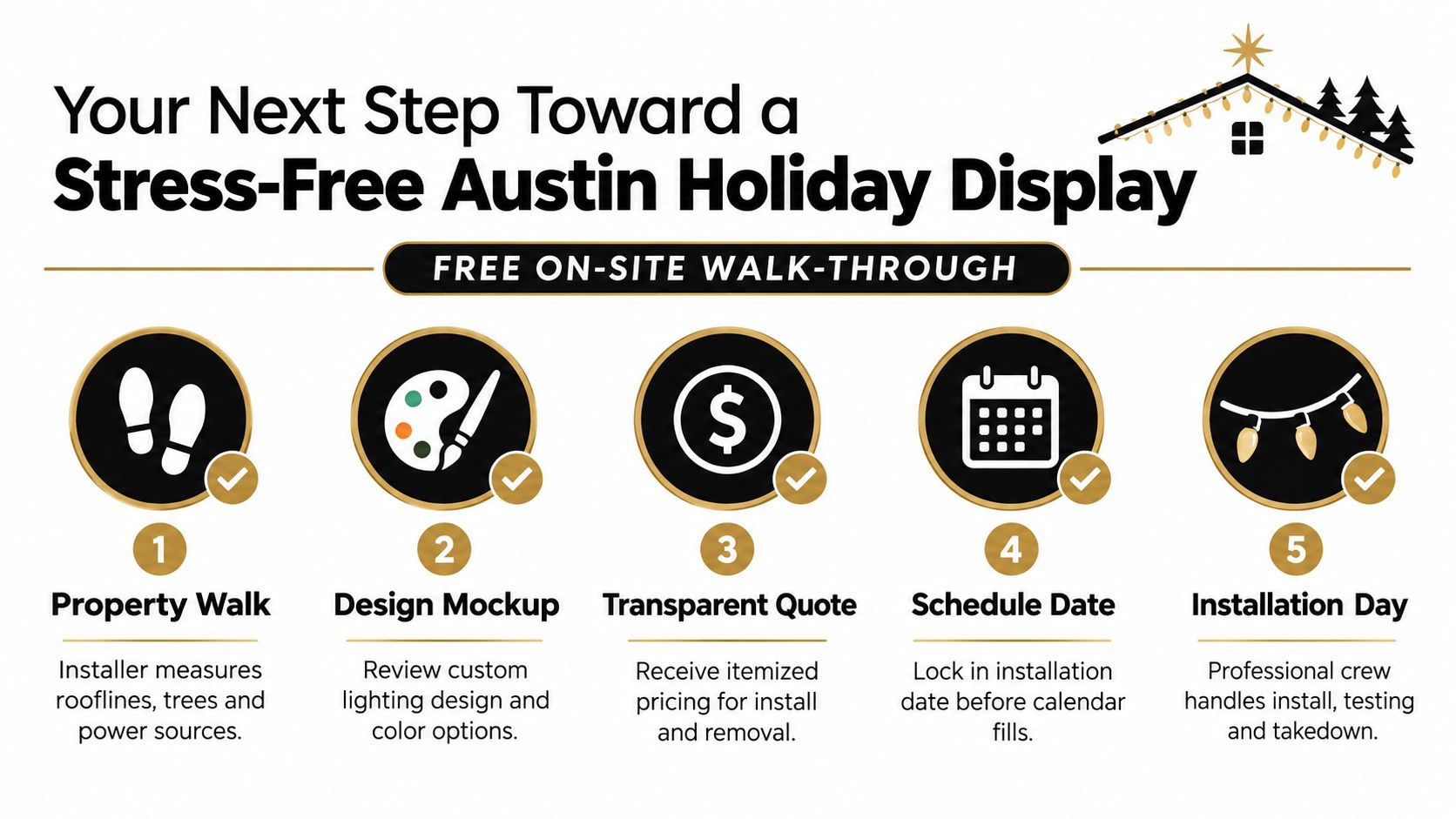
Your Next Step Toward a Stress-Free Austin Holiday Display
If you've read this far, you don't need another generic checklist. You need an on-site walk-through.
That's where answers come from. A good installer measures the rooflines, checks where the power is, confirms whether exterior receptacles are protected, notes difficult access points, and maps the display to the house you own. Not the blurry house a satellite image guessed at.

What to have ready before the appointment
The walk-through goes faster and gets better results if you bring a few decisions with you:
- Your preferred install window: Earlier is usually better.
- A short design wish list: Warm white, multicolor, roofline only, trees, wreaths, pathway, or permanent options.
- HOA considerations: If your neighborhood has restrictions, say it up front.
- A realistic budget range: That keeps the design conversation grounded.
Why this step matters more than anything else
The walk-through ties everything together. It confirms whether your timeline is still realistic. It tells you whether a seasonal rental or permanent system makes more sense. It exposes safety issues before a ladder touches the house. And it gives you a quote based on your property, not a guess.
That's what builds trust in this business. Clear measurements. Straight answers. No surprise charges later.
If you're serious about Christmas light installation in Austin, stop trying to solve it from a browser tab. Get a professional to the property and make the decision with real information.
Modern Yard handles Austin Christmas lighting the practical way: on-site design, professional installation, in-season maintenance, takedown, and storage, with the property-specific walkthrough that makes the whole plan accurate. If you want a cleaner quote, a safer install, and fewer December headaches, visit Modern Yard Landscapes and schedule a walk-through.