
Your lawn doesn't fail all at once. It starts with one hot week you ignored, then a sloppy mow, then a watering mistake, and suddenly you're staring at brown tips, thin spots, and a yard that looks tired before summer's even over. If you live in Austin, that pattern is normal, but it's also avoidable with a lawn maintenance schedule that follows grass growth, soil moisture, and heat instead of blind calendar dates.
That's the shift homeowners need to make. Lawn care stopped being an occasional chore a long time ago, when mechanical mowing, sprinklers, and powered equipment made scheduled upkeep possible for ordinary properties, not just estates. Modern Austin lawns need the same discipline, but with smarter timing and less guesswork, especially when heat, drought, and fast growth all show up in the same season.
A rigid checklist won't save a stressed yard in Central Texas. A conditional plan will. If you're weighing whether to keep repairing a natural lawn or move to a lower-input option, start with drought-resistant lawn alternatives and compare the upkeep, not the fantasy version of lawn ownership.
Why Your Lawn Needs a Real Schedule in Austin
An Austin lawn can look fine on Monday and show heat stress by Friday. Cutting too short removes shade from the soil, speeds moisture loss, and leaves thin patches exposed. Watering on a fixed habit creates runoff, encourages shallow roots, and still leaves turf thirsty when temperatures rise.
Use a repeating routine, then adjust it according to grass type, soil moisture, and heat signals. That conditional approach gives warm-season turf the care it needs without forcing every yard into the same calendar checklist.
What history got right, and why it still matters
Scheduled lawn care became practical through better equipment. Edwin Budding's 1830 mechanical mower changed mowing from a labor-heavy task for wealthy estates into a repeatable routine. The 1868 reel mower patent, 1871 lawn sprinkler patent, and 1935 power rotary mower later made mowing and irrigation more consistent. By the late 1800s, the power mower was already in use, and by 1945, DDT was sold generally in the United States as a lawn pesticide, adding another standardized maintenance practice history of lawn care.
Lawns eventually covered about 50 million acres in the United States. That scale reinforces a practical point: healthy turf depends on regular decisions and timely work, not occasional rescue jobs.
Austin lawns need climate discipline, not calendar obedience
Long hot stretches and warm-season grass make a generic spring, summer, and fall checklist unreliable. Growth may accelerate after rain, then slow sharply during intense heat. Your mowing and watering decisions should respond to what the turf and soil are showing that week.
Use the calendar as a reminder, not as the final authority. Check whether the soil is drying, whether the grass is actively growing, and whether heat is increasing demand before you mow or irrigate. A climate-smart schedule also makes the DIY decision clearer. Homeowners can handle routine mowing, inspections, and simple adjustments when the lawn is stable. Call for help when thinning, renovation, irrigation problems, or repeated heat damage demand tighter timing.
If natural turf keeps consuming more time than you can give it, compare it with drought-resistant lawn alternatives. Artificial turf removes mowing and routine watering, but it still needs debris removal, rinsing, odor control, and checks in high-use areas. Choose the surface that matches your schedule, not an idealized version of lawn ownership.
The Core Rules That Drive Every Mowing and Watering Decision
Austin turf stays healthier when you respond to growth and soil moisture instead of mowing or watering on autopilot. Two rules guide nearly every decision: the 1/3 rule for mowing and weekly water demand. Follow them consistently, and you reduce scalping, runoff, fungal pressure, and the gray-green color that signals heat or moisture stress.
Practical rule: If the lawn looks ready before mowing day, follow the grass. Growth rate matters more than a fixed Tuesday or Saturday routine.
Mow by height, not by habit
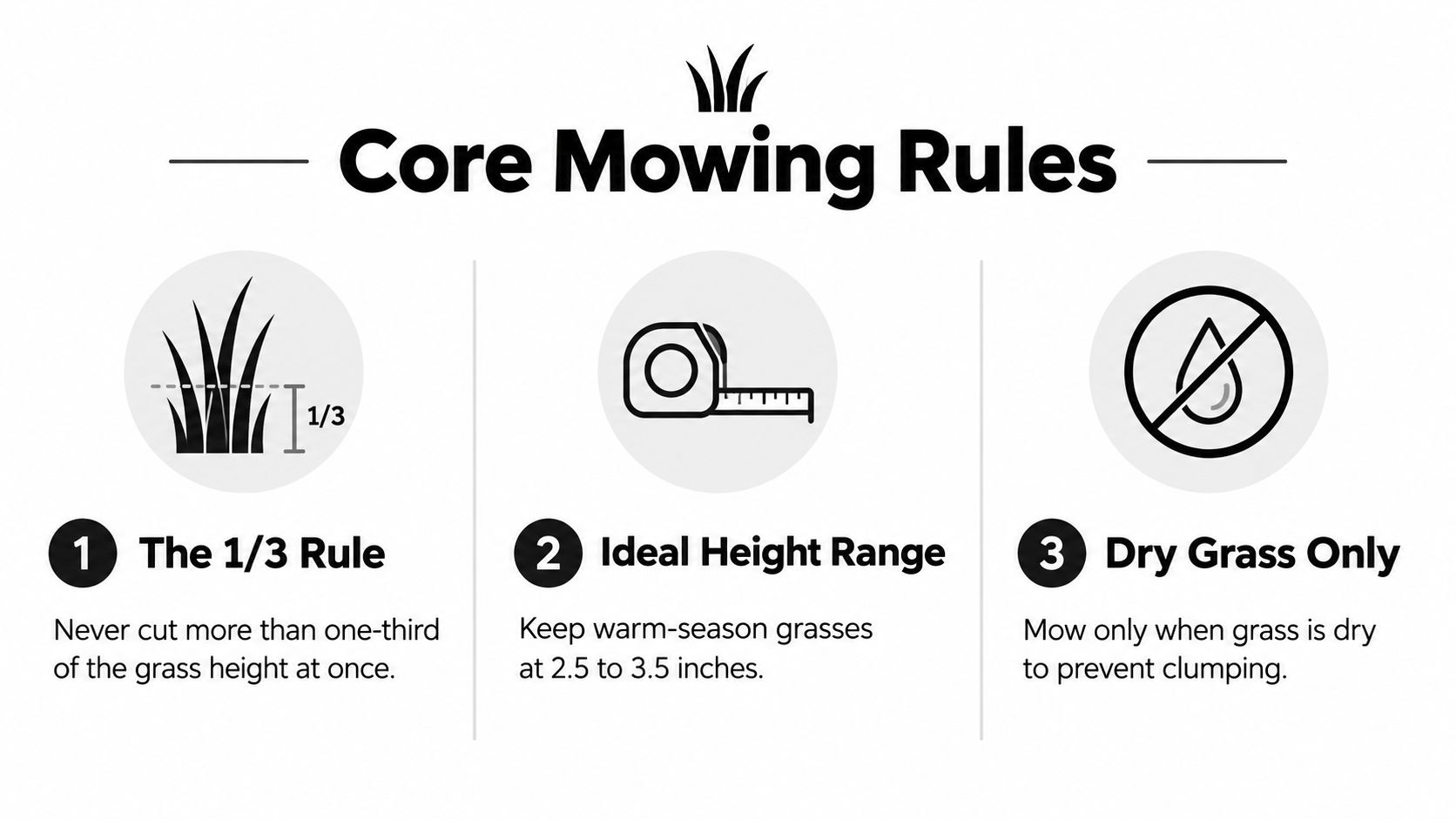
Never remove more than one-third of the leaf blade in one cut. If your target height is 2 inches, mow when the grass reaches about 3 inches, and keep most lawns within a 2.5 to 3.5 inch range ACES home lawn maintenance. Cutting more aggressively removes too much leaf surface and leaves turf less able to handle Austin heat.
Rutgers guidance indicates that once-a-week mowing generally works for turf maintained in that height range, while taller grass can go longer and shorter grass needs more frequent attention Rutgers lawn maintenance. Treat that as a growth-based guide, not a standing appointment. Fast growth after rain may require an earlier cut. Slow growth during heat may not.
Water to a weekly need, then split it up
Measure irrigation by weekly inches, then adjust for rainfall, soil, and heat. Extension guidance places cool-season turf at roughly 0.5 to 1.5 inches of water per week, with about 1 inch per week as a general lawn-care benchmark from rainfall plus irrigation. Apply it, when possible, between midnight and 6 a.m. to reduce wind losses and improve distribution MSU irrigation practices.
Split the weekly amount into lighter applications when the soil cannot absorb a heavy dose. Check the soil before running the system, and watch how quickly footprints disappear. If blades spring back and moisture remains below the surface, skip irrigation. If the soil is dry and the turf stays flattened, water thoroughly enough to reach the root zone without creating runoff.
Water by demand, not by a calendar square. A working schedule changes with grass type, soil moisture, and heat.
For a practical checklist covering routine mowing and watering, use these lawn maintenance tips. DIY works when the lawn is stable and the system is operating correctly. Call a turf professional for persistent thinning, irrigation faults, drainage problems, or repeated heat damage.
Your Seasonal and Month by Month Lawn Maintenance Schedule
Austin lawns need a flexible schedule because warm-season grass responds to conditions, not calendar dates. St. Augustine and Bermuda may stay dormant through part of winter, then green up at different times depending on sun exposure, soil warmth, and moisture. Use the month-by-month guide below as a decision framework. Let growth, soil moisture, and heat stress determine the actual work.
Late winter into early spring
February and March call for inspection before intervention. Clear branches and leaves, check low spots after rain, and look for standing water or soil compaction. In February, check frost-sensitized St. Augustine and Bermuda for uneven green-up, especially in south-facing spots. A lawn waking early in one area does not mean the whole yard is ready for mowing.
Start mowing only when the grass is actively growing and tall enough to cut without scalping. Apply pre-emergent when local weed pressure begins to rise and conditions support germination control. A cool, quiet lawn needs observation, not forced feeding or aggressive cutting. Repeated bare areas, drainage failures, or weak green-up are good reasons to bring in a turf crew before spring work expands.
Peak spring and summer growth
By late spring, mowing frequency should follow grass growth rather than the weekend. The maintenance season often runs about 9 months, from March through November, and 72.9% of mowing in 2025 happened on a biweekly schedule LawnStarter industry report. Use that as a reference, not an automatic rule. Rapid growth may require more frequent cuts, while heat-stressed turf may need fewer passes.
Keep the mowing height appropriate for the grass, remove only a modest amount of blade at each cut, and avoid scalping browned or wilted turf. A lawn that stays flattened after foot traffic needs attention, while blades that recover quickly do not need an extra irrigation cycle. Check shaded and sunny areas separately because the same yard can have different moisture needs.
Smart controllers and soil moisture probes can improve an automated system, but they do not replace inspection. Set cycles around actual soil conditions and pause irrigation after useful rain. Homeowners who want to compare robotic mowing options can review Robot Mowing Reviews on Kress mowers. Robotic equipment can reduce cutting labor, but it cannot correct poor mowing height, drainage, or heat damage.
Fall and winter cleanup
As temperatures ease, reduce the workload instead of carrying summer settings into a slower growth period. Mow when the turf needs it, clear leaves before they block light, and check irrigation zones for broken heads, leaks, or uneven coverage. In October and November, prepare equipment for less frequent use and remove debris that can hold moisture against the grass.
Winter care depends on turf response. Warm-season grass is expected to slow or go dormant, so keep traffic low when the soil is wet and avoid unnecessary fertilizer or mowing. December is a good time to check for compacted paths, exposed roots, and drainage problems that may become obvious after rain. In January, inspect protected areas for disease or lingering debris, then leave dormant turf undisturbed unless a specific problem requires action.
| Austin Month by Month Lawn Task Checklist | Key Tasks | Frequency |
|---|---|---|
| February | Check frost-sensitive St. Augustine and Bermuda for uneven green-up, inspect drainage and equipment | As needed |
| March | Monitor active growth, begin mowing when needed, apply pre-emergent at the proper local window | Weekly to biweekly |
| April | Increase mowing as growth accelerates, inspect soil moisture, spot-treat problem weeds | Weekly |
| May | Hold the correct mowing height, adjust irrigation for heat, check sunny areas for stress | Weekly |
| June | Keep blades high, mow before excessive height develops, inspect irrigation coverage | Weekly to biweekly |
| July | Reduce unnecessary passes, check dry spots and heat stress, protect shaded turf from overwatering | Weekly to biweekly |
| August | Follow soil moisture signals, avoid cutting stressed grass, correct uneven irrigation | Weekly to biweekly |
| September | Reduce mowing as growth slows, inspect irrigation, clear leaves and storm debris | Biweekly |
| October | Cut less often, check drainage, prepare equipment for the dormant period | Biweekly |
| November | Finish seasonal cleanup, repair irrigation issues, remove lingering leaves before dormancy | As needed |
| December | Limit traffic on wet soil, inspect compacted paths and drainage after rain | Light upkeep |
| January | Leave dormant turf undisturbed, check for disease, exposed roots, and debris in protected areas | Light upkeep |
Natural Lawn Care vs Low Maintenance Artificial Turf Care
Natural grass rewards good timing, but it asks for ongoing labor. Artificial turf removes most of the recurring yard work, which is why it's a serious option for Austin homeowners who want a clean look without living on a mower schedule. The right answer depends on whether you value the feel of living grass or the simplicity of a lower-input surface.
If you're comparing options, stop thinking in slogans. Compare the weekly burden, water use, and the kind of attention each surface demands.
Side by side, the difference is obvious
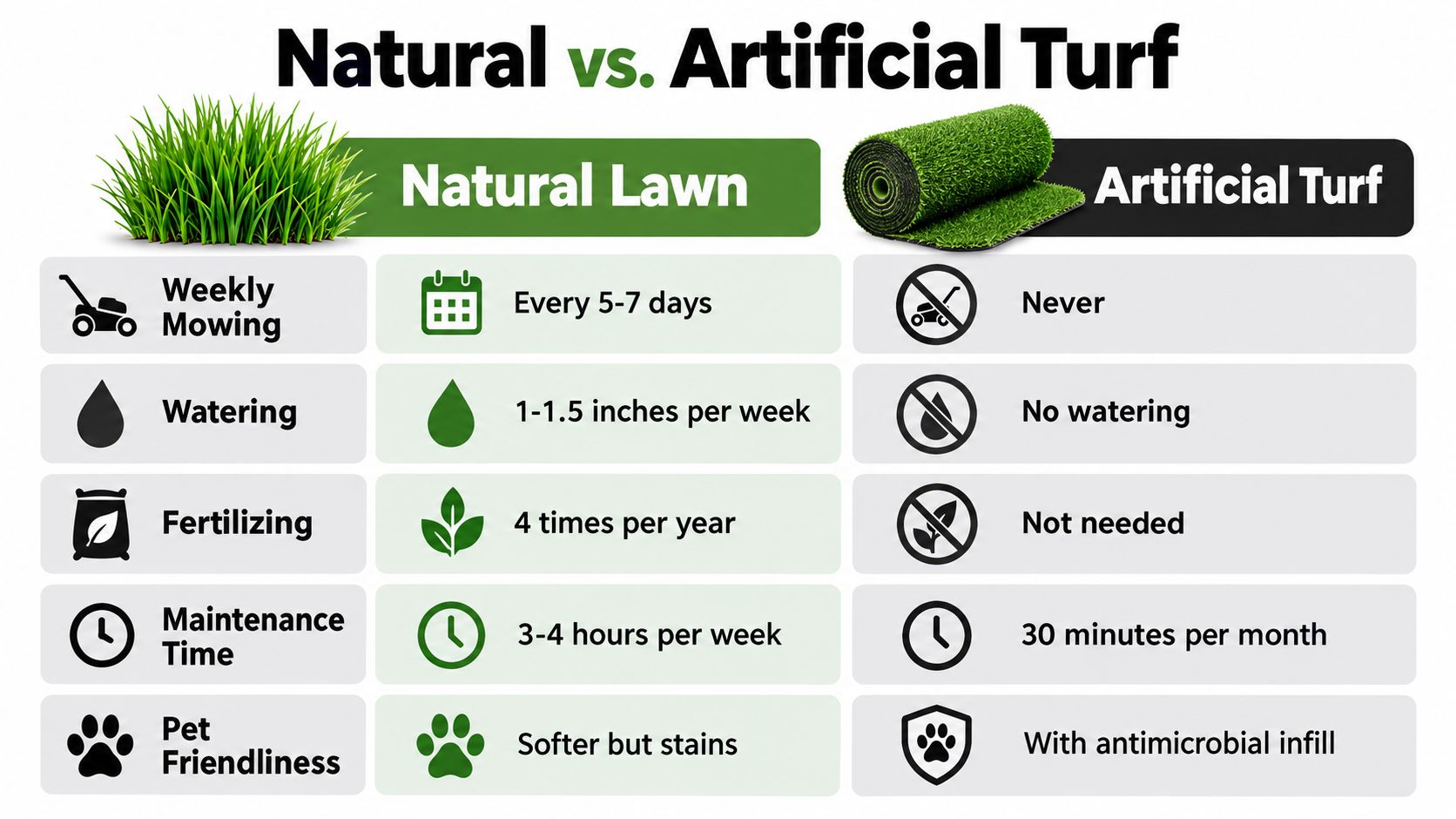
Natural lawns need repeated mowing, irrigation checks, weed control, and seasonal adjustments. Artificial turf shifts the work to periodic rinsing, brushing, and infill upkeep, especially when the product is installed with proper drainage and a durable backing. The maintenance story changes completely when the goal is a stable appearance with less routine labor.
For homeowners also considering drought-smart design, The Cactus Outlet landscaping guide is a smart complement because it frames low-water design beyond turf alone. That matters in Austin, where a yard can be attractive without pretending every square foot needs to function like a sports field.
| Factor | Natural Lawn | Artificial Turf |
|---|---|---|
| Weekly mowing | Regular cuts during active growth | Not needed |
| Watering | Needs ongoing irrigation | No watering for turf health |
| Fertilizing | Seasonal feeding may be part of the plan | Not needed |
| Maintenance effort | Recurring, weather-driven | Mostly rinse, brush, and inspect |
What Austin homeowners should choose
Choose natural grass if you want living turf and you're willing to keep the timing tight. Choose artificial turf if your priority is lower upkeep, a consistently green look, and less dependence on irrigation. For pet areas and putting greens, artificial turf often wins on day-to-day convenience because the schedule is simpler and the surface stays usable year-round.
If you go artificial, install it correctly. Proper drainage, UV-resistant fibers, and the right infill matter more than a glossy sales pitch. If you're comparing service options, artificial turf maintenance services should be part of the conversation because even low-maintenance surfaces still need periodic care to keep performing well.
Special Care Tips for Pets Putting Greens and High Traffic Areas
The base schedule gets you most of the way there. The areas that fail first are usually the ones that get the most use, dog runs, backyard putting greens, and family lanes that take a beating every weekend. Those zones need small adjustments, not a complete overhaul.

Pet areas need drainage and hygiene, not guesswork
Pet-friendly turf works best when drainage is built in and odors don't have a chance to settle. A good routine includes rinsing after use, checking for compacted spots, and keeping the infill clean enough that the surface doesn't trap smells. If you're planning a dog run, look at dog-friendly lawns before you settle for a generic setup that won't hold up.
Putting greens and heavy-use zones need surface control
Backyard putting greens live or die by consistency. Brush the fibers, inspect the roll, and make sure the infill stays even so the ball doesn't take odd hops. In traffic lanes, vary mowing direction on natural grass and protect the soil from repeated compaction, because the same path taken every time will flatten the turf and wear it out early.
The fastest way to ruin a nice yard is to treat every square foot the same. High-use zones need their own maintenance rhythm.
For commercial or family properties, the warning sign is always the same, repeated wear in the same lanes, dirt that stays packed, and patches that recover slowly. That's when drainage upgrades, regrading, or a more durable surface make sense instead of another round of temporary patchwork.
Keep Your Lawn Perfect Year Round With Expert Help
A reliable lawn maintenance schedule starts with decisions based on turf condition, not a calendar alone. Check grass type, soil moisture, and heat signals before mowing or watering. In Austin, that means a crew that adjusts mowing height before the first heat spike instead of after brown tips appear.
Use this test to decide whether to DIY. If you can inspect moisture, change mowing practices, and respond quickly after heat or heavy traffic, keep the routine in your hands. Call for help when drainage, compaction, pests, grading, or recurring bare areas keep defeating the schedule. For homeowners comparing broader service options, lawn care and pest control near me can identify companies that manage recurring lawn problems together.
Natural grass gives you a living surface, but it demands seasonal adjustments and regular observation. Artificial turf removes mowing and much of the watering, yet it still needs rinsing, brushing, infill checks, and drainage maintenance. Choose natural turf for its growth and feel. Choose artificial turf when predictable weekly upkeep matters more.
Modern Yard Landscapes handles turf installation, artificial turf care, custom putting greens, and pet-friendly runs, with attention to site preparation, drainage, and long-term performance. If you want a property-specific plan in the greater Austin area, visit our team at modernyardlandscapes.com and schedule a walkthrough. Bring your current problem areas, recent watering habits, and preferred level of DIY work so the recommendations fit the yard instead of forcing it into a fixed checklist.