
You're probably in the same spot as a lot of Austin homeowners. You want a backyard that looks sharp, handles heat, and doesn't turn into a weekend chore. Then you start researching, and every article starts throwing around modern and contemporary like they mean the same thing.
They don't.
In outdoor design, that difference matters because it changes everything. Your patio layout, plant choices, edging, lighting, and even whether artificial turf feels clean and architectural or softer and more natural. If you get the style wrong, the yard can feel disconnected from your house and frustrating to maintain.
I'll make this simple. The difference between modern and contemporary comes down to one core question. Do you want a style that follows a fixed design language, or one that reflects what works best right now for Austin living? Once you answer that, the rest gets easier.
Choosing a Landscape Style for Your Austin Home
A homeowner in Austin usually doesn't call asking for “a historically bounded design vocabulary.” They say something more honest. “I want the yard to feel clean, updated, and easy to live with.” Or, “I'm tired of dead grass, messy beds, and a backyard that looks unfinished.”
That is the starting point.
Confusion doesn't stem from a lack of taste; it arises because design jargon gets in the way of practical decisions. You see a backyard with straight concrete pads, steel edging, and clipped planting beds, and someone calls it modern. You see another yard with turf, limestone, softer planting shapes, and a few sculptural accents, and someone calls that modern too. That's where people get stuck.
In Austin, style can't be separated from climate or lifestyle. A yard has to hold up to heat, dry spells, intense sun, and the way people use outdoor space here. Kids run through it. Dogs wear paths into it. Friends gather on patios most months of the year. If a design looks good in a photo but fights your daily life, it's the wrong design.
Start with how you want the yard to feel
Before you choose a style, get specific about your priorities:
- Low maintenance: You want less mowing, less mud, and fewer dead spots.
- Entertaining: You need usable patio space, clean circulation, and a layout that feels intentional.
- Kid and pet use: You need durable surfaces and clear zones.
- Water-wise planting: You want something that fits Austin's conditions, not a thirsty lawn plan from another climate.
If water-wise planting is on your mind, these tips for beautiful, sustainable gardens are worth reading because they line up with what performs in dry conditions.
Practical rule: If you can't explain why a design works for your property in plain English, it probably isn't the right plan yet.
Don't choose a label first
Choose the outcome first. Then choose the style that supports it.
If you want order, symmetry, and a crisp architectural look, modern will probably fit. If you want something updated but more flexible, natural, and responsive to how people live in Austin now, contemporary is usually the better answer.
That clarity is what helps homeowners trust the process. It also helps you know when it's time to stop scrolling and schedule an appointment with someone who can walk your property, listen to how you use it, and turn abstract style terms into a real plan.
The Roots of Modern and Contemporary Design
If you want to understand the difference between modern and contemporary, stop treating them like interchangeable compliments. They describe two different ideas.

Modern is a defined historical style
Modern design is not “whatever looks sleek.” It's a specific design era. According to Better Homes and Gardens on modern vs contemporary design, modern design emerged between the late 1800s and the mid-20th century, specifically spanning from the early 1900s through the 1960s, and it has remained aesthetically static for nearly 100 years.
That matters because modern has rules.
Its roots include the Bauhaus school, founded in 1919, along with Scandinavian design and Art Deco influences. Designers like Le Corbusier, Charles and Ray Eames, and Florence Knoll shaped a style where form and function are valued as equals. In plain terms, modern design rejects clutter and ornamental excess. It prefers strong lines, disciplined geometry, warm woods, and earthy neutrals.
If you've ever looked at a house or yard and thought, “That feels crisp, balanced, and intentional,” you were probably reacting to modern principles.
For homeowners trying to connect house architecture with outdoor design, the RBA modern plans catalog gives a useful visual reference for what modern architecture looks like when it's done with discipline.
Contemporary means current
Contemporary design is different because it isn't locked to one historical period. It reflects what's current now. That means it changes.
A contemporary style can borrow some modern restraint, but it isn't bound by modern rules. It can use curves, asymmetry, mixed materials, and more adaptive layouts. It responds to how people live today, not how designers worked in the middle of the last century.
Modern is a period style. Contemporary is a moving target.
Why homeowners mix them up
They share some surface traits. Both can look clean. Both usually avoid fussy ornament. Both can feel open and uncluttered.
But the logic behind them isn't the same:
- Modern: fixed vocabulary, historically rooted, rule-driven
- Contemporary: evolving vocabulary, current, more flexible
- Modern: order first
- Contemporary: responsiveness first
That's why this isn't just semantics. If you tell a designer you want “modern” when you really want a current, softer, more livable Austin backyard, you can end up with a yard that feels too rigid. If you ask for “contemporary” when you really want timeless geometry and architectural discipline, the yard can drift into trend-chasing.
Key Distinctions in Landscape Characteristics
Stand in your backyard and look at the house first. If the outdoor layout ignores the architecture, the whole property feels off, no matter how expensive the materials are.
This is the core difference between modern and contemporary design in Austin. Modern yards follow a strict visual system. Contemporary yards respond more freely to how the lot, climate, and family live.
| Characteristic | Modern Design | Contemporary Design |
|---|---|---|
| Lines | Straight, stark geometric lines | Fluid, curved lines |
| Layout | Symmetrical and ordered | Asymmetrical and adaptable |
| Materials | Concrete, steel, poured stone, manufactured surfaces | Mixed materials, including natural stone and sustainable composites |
| Color palette | Neutral, monochromatic, earthy | Neutral base with selective color pops |
| Planting style | Structured, repeated, controlled | Looser, more varied, often ecosystem-aware |
| Visual feel | Crisp, hard-edged, minimalist | Softer, current, layered, flexible |

Lines and layout
This breakdown of modern and contemporary architecture and outdoor design explains the core difference clearly. Modern design is a fixed historical style built on form follows function and sharp geometry. Contemporary design reflects current preferences, so it allows curves, asymmetry, and a broader material mix.
In a modern Austin yard, that usually means straight edging, rectangular pads, aligned planters, and clear sightlines from the house. Everything looks intentional because it is.
A contemporary yard bends more easily around mature oaks, pool shapes, drainage paths, and entertaining zones. That flexibility matters on Austin lots, where grade changes, heat exposure, and irregular property lines are common.
Materials and planting
Materials make the style obvious fast. Modern spaces use concrete, steel, large-format pavers, and surfaces with crisp edges. Planting stays disciplined, often with repeated masses and tight spacing so the yard reads clean in every season.
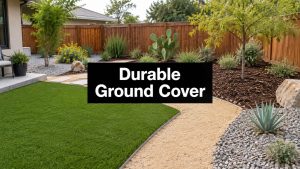
Contemporary spaces give you more freedom. You can pair limestone with metal, artificial turf with native grasses, or gravel with composite screening and still keep the design polished. That approach usually fits Austin better if you want a yard that looks current without demanding constant trimming, watering, and repair.
This is also where high-performance artificial turf earns its keep. In a modern design, turf creates a flat, controlled green plane that sharpens the geometry. In a contemporary design, it softens transitions between patios, planting beds, and gathering areas while still handling sun, pets, and heavy foot traffic.
If you like greenery that feels softer and more layered, vertical elements can help. Little Green Leaf's guide to greenery shows how framed planting features add structure without making the yard feel stiff.
Symmetry versus flexibility
Use this filter.
- Choose modern if you want strong geometry, repeated forms, and a yard that mirrors the discipline of the house.
- Choose contemporary if you want a cleaner look that still adapts to trees, slope, family use, and changing design preferences.
- Choose modern if your home has flat planes, long horizontal lines, and minimal ornament.
- Choose contemporary if your property needs softer circulation, mixed materials, or a less rigid arrangement of outdoor rooms.
Hard surfaces usually decide whether the final result feels resolved or confused. Patios, steps, retaining edges, and walkway geometry need to support the style you chose from the start. If you want examples that fit Austin homes, these Austin hardscaping ideas show the structural pieces that hold both styles together.
A lot of bad yard designs fail for one reason. The lines outside do not match the logic of the house.
How These Styles Look in an Austin Backyard
A style choice means nothing if it falls apart by August.
In Austin, your yard has to handle punishing sun, fast drainage, muddy dog runs, and long outdoor seasons. So the question is not which label sounds better. It is which approach gives you a backyard that still looks sharp after heat, foot traffic, and weekend use.

Turf and planting
In this context, Austin conditions force clarity.
A modern Austin backyard usually treats turf as a clean, controlled surface. You see broad green rectangles, crisp edging, restrained plant palettes, and open space that matches a home with strong architectural lines. High-performance artificial turf works especially well here because it keeps that uniform finish without the watering, patching, and seasonal inconsistency of natural grass.
A contemporary Austin backyard uses turf with more flexibility. The turf may weave between limestone gravel, native planting, steel edging, shade pockets, or curved bed lines. It still looks polished, but it feels more responsive to the lot and the way the family uses the space.
That difference matters in Austin because materials now do more than carry a look. They solve problems. Good artificial turf can reduce mud, stay cleaner around pets, and hold up under full sun, which makes it a smart fit for both styles. The visual result may read modern, while the performance side feels current and practical.
Hardscaping and circulation
Modern yards need discipline. Contemporary yards need control without rigidity.
If you want modern, commit to geometry. Use rectangular patios, straight walkways, flush step transitions, and materials that stay quiet and consistent. Concrete, large-format pavers, and metal edging usually do the job better than busy stone mixes. On the right house, that restraint looks expensive.
Contemporary gives you more freedom to respond to the property. You can curve a path around an oak, widen a patio where people gather, or mix textures without making the space feel disorganized. That makes contemporary a better fit for many Austin lots with slope shifts, tree roots, or awkward access down the side yard.
If you want examples that show how crisp lines and open space can feel livable, these modern backyard design ideas show the composition clearly.
Lighting and everyday use
Lighting exposes bad decisions fast.
A modern backyard needs lighting that reinforces order. Keep fixtures simple. Highlight edges, stairs, and key architectural lines. Too many decorative fixtures will clutter the space and weaken the whole design.
A contemporary backyard allows a little more warmth. You can layer light around dining zones, lounge seating, and planting areas without losing the clean overall feel. The goal is comfort with restraint.
For typical Austin households, the pattern is pretty predictable:
- Pet owners: Contemporary layouts usually hide wear better and make room for durable turf zones, shade, and easier cleanup.
- Frequent entertainers: Modern works well when you want the patio to lead the yard and frame everything around it.
- Families with kids: Either style can work, but drainage, surface durability, and heat management matter more than the label.
- Homeowners replacing a failing lawn: Contemporary often gives you more room to combine turf, gravel, native plants, and shaded seating areas.
The best Austin backyard is the one that still works after a brutal summer, a few parties, and a dog that runs the same route every day.
Where homeowners make the wrong call
They chase a look and ignore how the yard will perform.
A yard can read modern in photos and still fail because the drainage is wrong, the turf is cheap, or the materials get too hot to use. It can read contemporary and still feel messy because there is no structure holding it together. Good design solves for the house, the lot, and the way you live outside in Austin.
That is also how you judge the company you hire. A good designer does not bury you in style jargon. They ask how the sun hits the yard at 5 p.m., where the dog wears a path, whether you host often, and how much upkeep you will tolerate. That is how you get a backyard that fits your home instead of fighting it.
Which Style Is Right for Your Home and Lifestyle
A homeowner in Austin usually hits this decision at the same point. The patio is tired, the grass is struggling, and the online photos all start to blur together. What you need is a clear direction that fits your house, your lot, and the way you spend time outside.

Choose based on the house first
Start with the architecture.
If your home has strong rooflines, large panes of glass, clean stucco or masonry, and sharp geometry, modern is usually the right call. It supports the structure and keeps the yard from looking disconnected.
If your home has a mixed material palette, a softer facade, or a backyard with irregular edges and mature trees, contemporary is often the better fit. It gives you more flexibility to solve real property conditions without forcing rigid lines that feel out of place.
Choose based on how much upkeep you will actually tolerate
At this point, homeowners either make a smart decision or create extra work for themselves.
Modern works best when you want control. Fewer materials, tighter lines, and a disciplined layout can keep the space clean and orderly. Contemporary works best when you want a polished look that bends a little more around pets, kids, shade patterns, and changing needs. In Austin, both styles benefit from smart drainage, heat-aware material choices, and high-performance artificial turf that stays green without the watering, mowing, and mud.
If low upkeep matters, these low-maintenance backyard ideas that hold up in Austin will help you sort out what performs well.
Choose based on how the yard will function in Austin
A style label means very little if the yard is miserable in July.
Accent's analysis of modern and contemporary design performance explains that modern design typically favors durable, industrial materials and a more controlled layout, while contemporary design allows more adaptation to existing grade, plantings, and residential use. That tracks with what works in Austin backyards.
Modern is a strong choice for homeowners who want a patio-driven setup with crisp edges, repeatable materials, and a restrained look. Contemporary usually wins on tricky residential lots because it handles change better. Existing oak trees, drainage issues, dog runs, pool access, and multiple seating zones are easier to solve when the design has more flexibility built in.
A simple filter that works
Use this to make the call:
- Choose modern if your house already has bold architecture and you want the outdoor space to feel structured, quiet, and timeless.
- Choose contemporary if you want a current look that adapts better to real backyard conditions and day-to-day family use.
- Choose modern if symmetry, clean lines, and material consistency matter more to you than softness.
- Choose contemporary if your priority is comfort, usability, and a refined yard that does not feel too rigid.
- Choose premium artificial turf in either style if you want less watering, less mud, cleaner edges, and a yard that still looks finished after a hard Austin summer.
My recommendation is simple. Pick the style that still makes sense after heat, foot traffic, pets, and weekend hosting have tested it for a full year.
Trust clear advice, not design jargon
You do not need perfect terminology before you call a designer.
You need someone who can walk the property and ask smart questions. Where does the late-day sun hit hardest? Which route does the dog run every day? Do your kids need open play space? Do you want a quiet morning coffee area, a dining patio, or both? Good answers to those questions shape a yard that fits your life, and that matters far more than whether you started by saying modern or contemporary.
Bring Your Vision to Life with Expert Guidance
You step into the backyard at 6 p.m., and the problems show up fast. The west sun is still blasting the patio, the dog has worn a dirt path along the fence, and the grass near the pool already looks tired. That is the moment style stops being a label and starts becoming a real property decision.
Modern and contemporary both can work in Austin. The wrong one creates extra maintenance, awkward traffic flow, and materials that look good for six months, then struggle through heat, drought, pets, and heavy use. The right one fits your house, supports how you live, and stays sharp without demanding constant upkeep. In many yards, high-performance artificial turf is part of that answer because it keeps lines clean, reduces mud, and holds its finish through long summers.
Good guidance saves you from expensive guesswork.
You do not need another vague design mood board. You need a pro who can walk the property, study grade changes, sun exposure, drainage, entertaining zones, and pet habits, then turn that into clear recommendations. On one Austin lot, that may mean crisp concrete pads, steel edging, and restrained planting. On another, it may mean a softer, more current mix of shade structures, larger gathering areas, and turf that can handle daily traffic.
That is why the design process matters. A serious advisor helps you decide what belongs in your yard, what will fail in Austin conditions, and where to spend money first. If you want to see what that process should include, review professional yard design services for Austin homes before you book a site walk.
My recommendation is simple. Hire someone who can explain the tradeoffs in plain English, show you how the space will function in July, and build a plan around your lifestyle instead of forcing your property into a style category.
If you want a backyard that looks sharp, handles Austin conditions, and suits your lifestyle, talk with Modern Yard Landscapes. They handle artificial turf, hardscaping, drainage, pet-friendly spaces, custom putting greens, and full outdoor design across the Austin area. Schedule a consultation, walk the property with a pro, and get a plan you can trust.