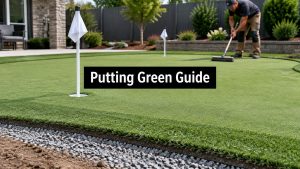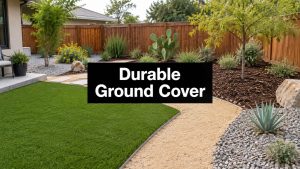

You've chosen the turf color, blade height, and texture. The samples look convincing, and you're ready to enjoy a lawn that stays green through an Austin summer. Then the installer asks a deceptively simple question: what border do you want around the artificial grass?
That decision isn't a finishing detail. In Austin, intense sun, dense clay soil, and sudden downpours can expose a weak perimeter long before the turf itself looks worn. A proper border for artificial grass holds the installation together, protects the base, manages runoff, and creates the clean transition that makes the entire project look intentional.
Your Turf Is Chosen But the Job Is Not Done
Most homeowners spend their time comparing turf products, and that makes sense. The turf is the visible part of the project. But synthetic grass doesn't root into the soil, so the perimeter must provide the restraint that natural grass gets from its root system.
A border keeps the compacted base from spreading outward. It gives the turf backing a firm edge to finish against, helps limit lifting and shifting, and keeps infill from migrating into nearby beds, gravel, or paving. If the perimeter moves, even excellent turf can develop gaps, wrinkles, soft spots, or exposed backing.
Austin adds another layer of difficulty. Clay soil can hold water and change firmness as it wets and dries. Summer heat puts stress on exposed materials, while a sudden heavy rain can move loose soil and base material toward the lowest edge of the yard. A border that looks fine on installation day may fail if it isn't matched to the grade and drainage plan.
A practical rule: Treat the border as insurance for the whole turf investment, not as an optional decorative upgrade.
The finished edge also affects safety. A border set too high can create a trip point. One set too low or left unsupported can allow the turf to sag. The right detail should sit flush with the finished surface, maintain a stable transition, and leave water a clear path away from the turf system.
Before choosing a material, the ground has to be prepared correctly. The guide to preparing ground for artificial turf explains why excavation, grading, and compaction matter before any edging is installed. A strong border can't compensate for a soft or poorly graded foundation.
Why Your Turf Border Is More Than a Pretty Edge
During an Austin summer, a turf edge beside a driveway can face intense sun, foot traffic, clay soil, and sudden downpours in the same season. A reliable turf perimeter must contain the base, protect the grass edge, and give water a clear route away from the installation.
It contains the base
The compacted base acts like a patio's foundation. It needs a defined boundary so it does not spread into surrounding soil or wash toward a lower point during heavy rain. Without that containment, the perimeter can become softer than the center of the yard, allowing the turf to dip or pull away from the edge.
Install the border against a properly excavated and compacted perimeter. The base should meet the edge cleanly, with no concealed void beneath it. That support matters beside walkways, patios, and dog runs, where people and pets repeatedly load the same narrow strip.
It protects the turf edge
Artificial grass may remain flat across the main field while starting to fail at a corner or side transition. Foot traffic catches unsupported edges, and heat cycles stress the backing. Loose infill can escape through gaps, leaving the exposed edge easier to disturb.
The border provides a firm stopping point. The installer still must secure the turf backing with suitable fasteners or an appropriate hardscape connection, but stable edging limits lateral movement and gives the fastening detail something solid to work against.
Synthetic turf's history shows why perimeter detailing matters. The product moved from concept to practical use in the 1960s, including a major milestone in 1964 at the Moses Brown School in Providence, Rhode Island, followed by the widely recognized public breakthrough in 1966 when AstroTurf was installed in the Houston Astrodome. As turf expanded from sports venues into residential yards, reliable containment and edge finishing became more important. (Preferred Turf's history of synthetic turf)

It manages water
A border should guide water, not trap it. If the edging creates a raised lip, runoff can collect along the perimeter. On a slope, that pressure can work against the base and stress seams. Austin's clay soil infiltrates slowly, so an edge may stay saturated after the surface looks dry.
Every transition needs its own detail. Turf meeting a concrete walkway should finish flush. Turf beside gravel needs restraint to keep aggregate from spreading into the grass. Turf beside a planting bed needs separation that limits soil and weed intrusion without forming a dam.
For a clean metal finish, review the steel edging options from Modern Yard Landscapes. The useful test is whether the complete perimeter works with the compacted base, finished grade, and drainage outlet, not merely whether the edge looks sharp on installation day.
Comparing the Top 5 Artificial Grass Borders
An Austin turf installation can face intense sun, heavy rain, and shifting clay soil within the same season. A straight panel beside a driveway needs different support from a curved dog run beside a planting bed. Choose the border by weighing durability, installation complexity, appearance, drainage behavior, and local conditions, not by material price alone.
| Border Type | Durability | Typical Cost | Austin Climate Suitability | Best For |
|---|---|---|---|---|
| Commercial-grade steel | High when properly installed and protected | Higher initial investment | Strong for clean lines and curves, provided drainage remains open | Modern residential and commercial layouts |
| Poured concrete curbing | Permanent and durable | Higher installation complexity | Strong for fixed, high-traffic borders, with careful drainage detailing | Patios, driveways, pool areas, and permanent property lines |
| Decorative pavers | Durable when installed on a compacted base | Moderate to high | Good where the paver system has stable support and a runoff path | Walkways, patios, mow-strip transitions, and visible design borders |
| Pressure-treated timber | Moderate, dependent on moisture exposure | Moderate | Limited where soil stays wet or edges receive constant sun and irrigation | Rustic layouts and raised transitions |
| Plastic bender board | Practical containment with flexible shaping | Lower initial investment | Useful for curves, but installation quality and support matter | Garden beds, curved lawns, and budget-conscious projects |

Commercial-grade steel
Steel creates a narrow, modern line around geometric layouts, gravel strips, planting beds, and gentle curves. Its rigidity helps contain the turf, while a slim profile can stay visually quiet when installed close to the finished grade.
Commercial products are commonly specified at 22 mm in height, with 5 mm or 10 mm top-profile widths, according to Perfectly Green's turf edge information. Some commercial packs include 24 linear metres and 150 mm galvanized steel fixing spikes, according to the same turf edge information from Perfectly Green. Those dimensions affect how easily the edge stays flush and how well the spikes resist sideways movement.
Steel's trade-off: It offers a refined, durable line, but it needs accurate placement and careful treatment at drainage crossings.
Steel suits Austin's modern outdoor designs because it avoids the rot concerns associated with timber and preserves usable lawn area. Its rigidity also exposes mistakes quickly. If the grade is uneven or the curve is poorly set out, steel will not conceal the problem the way a flexible board might.
Poured concrete curbing
Concrete provides the most permanent boundary in this group. It works well beside driveways, pool decks, patios, and other areas where the edge receives repeated contact. A formed curb can follow a custom shape and create a clear transition between turf and hard surface.
The higher installation complexity comes from excavation, forming, mixing, placement, and finishing. Concrete is also difficult to relocate if the property owner later changes the yard layout. That permanence is valuable for a fixed design, but it deserves careful planning before the pour.
Concrete's trade-off: It delivers permanence and strength, but poor grading or an unplanned outlet can turn a solid curb into a water barrier.
Austin concrete work must account for movement, finished grade, and stormwater flow. The curb should guide water toward a planned discharge route rather than behave like a sealed wall around the turf.
Decorative pavers
Pavers add visual weight and can connect turf with an existing patio, walkway, retaining wall, or outdoor living area. They also provide a useful hard transition where furniture, carts, or frequent foot traffic approach the grass.
Their long-term performance depends on the base beneath them. Installed over loose clay or poorly compacted fill, individual units can settle or tilt, leaving an uneven edge that catches debris and changes the turf line. The installation should define joint treatment, surface runoff, and the connection between the pavers and turf backing.
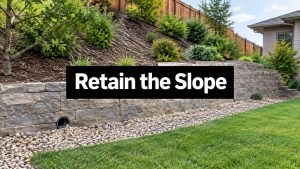
For projects that combine edging with grade changes or structural elements, retaining wall design ideas from Modern Yard Landscapes can help place the border within the wider property layout. The edge should work with nearby walls, paths, and planting areas, not appear as an isolated strip.
For broader garden applications, the Task Masters Inc. installation guide provides practical context on soil preparation, layout, and how edging meets surrounding materials.
Pressure-treated timber
Timber fits a rustic garden, raised planting area, or simple rectangular turf layout. It is easy to cut and offers a warmer appearance than steel or concrete. It can also coordinate with other timber features in an outdoor design.
Moisture and exposure limit its service life. Soil contact, irrigation, and trapped runoff can accelerate deterioration, while intense Austin sun can dry and weather the exposed surface. Timber generally needs more inspection and upkeep than a masonry edge, particularly where clay remains damp after sudden storms.
Timber's trade-off: It can look natural and cost less than masonry, but it's a maintenance choice rather than a set-it-and-forget-it perimeter.
Plastic bender board
Bender board is flexible around planting beds, trees, and pet areas. It is easier to shape than steel or concrete and can provide basic containment when installed with enough stakes and firm backfill.
Installation quality determines whether it remains useful. A board that bows between widely spaced stakes creates a wavy turf line. A border without support on both sides can shift as clay soil dries, swells, or becomes saturated. Plastic makes sense for a low-traffic residential curve, but the lowest initial price should not decide the selection.
Local rules can override material preference. A 2026 Scottsdale municipal design guideline requires artificial turf to be surrounded by a permanent concrete or masonry header or curb at least 4 inches wide and disallows metal or plastic edging. (Scottsdale artificial turf design guidelines) Austin homeowners should verify neighborhood, municipal, and project-specific requirements before approving any border material.
The Critical Role of Drainage in Border Selection
A sudden Austin downpour can expose a border problem within minutes. Water that should move across the turf system may collect against a raised curb, especially where compacted clay drains slowly. Intense sun then dries the surface unevenly, while repeated wet and dry cycles can shift an edge that was installed without proper grade control.
Artificial turf works as a layered drainage assembly. Water passes through the turf, backing, infill, base, and finish stone before leaving the site. Guidance for synthetic turf commonly expects at least 10 inches per hour of permeability through the turf, backing, and infill, with the base and finish stone providing at least 14 inches per hour. Project specifications commonly call for a 1% to 2% slope away from structures. (Sports Builders drainage guidance)
The border has to preserve that flow path. Steel, concrete, or pavers can act like a dam when their finished elevation sits above nearby surfaces or closes the lowest route to a drain, swale, or lower grade. Review the complete artificial turf drainage system before selecting the visible edge.
What a good perimeter does
A drainage-conscious border sits flush with adjacent grades or is deliberately coordinated with them. Depending on the site, the installation may need openings, weep points, or a transition that lets surface water continue moving. Confirm the discharge route before setting the edge, not after the turf is installed.
Sports-surface guidance recommends silt buckets or silt traps in drains beside synthetic turf to limit infill movement into stormwater systems. Perimeter edgings should remain true to line within ±25 mm and level, while collector drains may sit outside the perimeter edging, according to FIFA football-turf guidance. (ESTC infill containment guide)
The same principle applies to residential yards. The border should hold the turf in place while allowing drains to collect and discharge water safely. It should not make runoff search for a path through the edge or force water back toward the house.
Why the outlet matters
Drainage design includes the route beyond the lawn. Artificial turf field guidance describes lateral drains spaced between 8 m and 15 m, depending on site conditions, and connected to collector drains outside the perimeter edging. Outlets may discharge to a storm sewer, soak-away, or nearby watercourse. (The Football Association drainage guidance)
Residential yards will not automatically use that same layout. The practical lesson is to coordinate the border, sub-base, collection points, and outlet as one system. A border that looks precise at installation can still create standing water if the final discharge point was never planned.
A New Jersey government review likewise describes turf performance as dependent on drainage through multiple layers, rather than the visible surface alone. (New Jersey Department of Environmental Protection synthetic turf report)
Our Professional Recommendation for Austin Landscapes
For most Austin installations, the strongest choices are commercial-grade steel and permanent masonry, meaning poured concrete or properly installed pavers. They give the perimeter enough stability for clay soil, intense sun, and frequent use, while still allowing the design to match a modern home, a commercial property, or a custom outdoor living area.
Steel is a strong fit when the goal is a crisp, low-profile line. It works especially well beside gravel, decomposed granite, planting beds, and straight architectural lines. It can also follow curved layouts without the visual bulk of a concrete curb, provided the edge is staked securely and the grade allows water to pass.
Masonry makes more sense when the border needs to function as part of the hardscape. A paver strip can tie artificial grass into a patio or walkway. Concrete curbing can provide a permanent boundary beside a driveway or pool area. These choices take more planning, but they create a stable transition where people, pets, and outdoor equipment repeatedly approach the turf.
The material isn't the whole decision
The most common mistake is choosing a material before looking at the site. A premium border installed over an unstable base can still move. A low-profile edge installed across a drainage path can still trap water. The right recommendation depends on the turf shape, soil condition, adjacent surfaces, elevation changes, and the location of the drainage outlet.
A good Austin installation should answer practical questions before materials are ordered:
- Where will runoff go? The border must preserve a clear path toward a drain, swale, or approved discharge point.
- What receives traffic? A dog run, walkway edge, and decorative backyard lawn need different levels of restraint.
- Will the edge be visible? Steel can disappear into a minimalist design, while pavers or concrete can become an intentional architectural feature.
- Can the border be changed later? Concrete is permanent. Steel and pavers may offer more flexibility, depending on the installation.
Most consumer guidance focuses on lifting and appearance, but it often misses the drainage question. The important homeowner concern isn't only which material looks attractive. It's how to prevent pooling, weed intrusion, and a trip hazard at the same time. (Artificial Turf Portland's edging options guide)
Where budget materials fit
Plastic bender board still has a place. It can be appropriate for a curved garden edge with low traffic and a sound, well-compacted base. Timber can work for a specific rustic design where the owner accepts future maintenance. Neither should be presented as interchangeable with steel or masonry in every Austin setting.
My recommendation is to spend first on site preparation and drainage, then select the border that matches the conditions. A durable edge can reduce repairs, but only when it's installed as part of the complete turf system.
Get a Perfect Border Every Time with Modern Yard
A border that survives Austin's heat and sudden downpours starts with the ground beneath it. The finished edge may look simple, but its performance depends on careful preparation, accurate grading, and a material suited to the property.
The installer begins by reviewing existing grades, clay-heavy soil, hardscape transitions, access limitations, and likely runoff paths. Marking the turf boundary before excavation helps confirm that the finished line looks right from the house, street, and primary outdoor living areas.
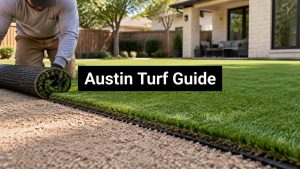
Perimeter excavation and base preparation follow. The trench or masonry footprint must be deep and stable enough for the selected material. The base extends fully to the edge, is compacted carefully, and is checked for soft spots. Where the perimeter meets a drain, walkway, gravel channel, or lower outdoor area, the transition is resolved before turf installation.
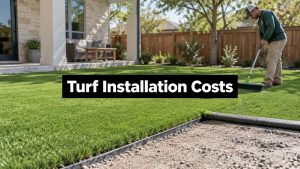
Steel edging is set to remain straight or follow the planned curve without leaving a raised lip. Pavers need support from a stable, compacted base. Concrete curbing is formed and finished to meet the surrounding grade. Each option has its own installation requirements, but the practical target is consistent: a firm edge, a flush transition, and uninterrupted drainage.
The turf is rolled out, allowed to settle, trimmed gradually, and secured against the border. Cutting too much at once can create a gap, while loose fastening allows movement. The final grooming lifts compressed fibers so the perimeter looks integrated with the lawn instead of attached afterward.

The artificial grass market was estimated at USD 4,628.34 million and is projected to reach USD 7,124.62 million by 2028, according to Data Bridge Market Research's artificial grass market information. Wider adoption does not guarantee a successful installation. Long-term value still depends on the edge, the base, and how rainwater moves through the property.
Modern Yard offers artificial turf installation, commercial-grade steel edging, stone and paver borders, drainage work, retaining walls, putting greens, and pet-friendly dog runs across the Austin area. A consultation lets property owners review site conditions, compare border materials, and understand the required preparation before work begins.
Modern Yard Landscapes can design and install a border for artificial grass that suits your Austin property, tolerates local heat and rain, and meets adjoining hardscape or planting beds cleanly. Visit Modern Yard Landscapes to request a free, no-obligation consultation and schedule an on-site conversation about your turf project.