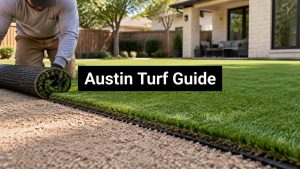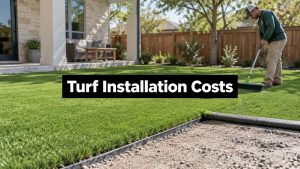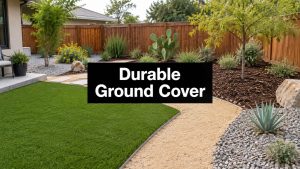

Artificial turf in Austin usually lands around $7 to $19 per square foot installed, and most residential jobs sit closer to $9 to $14. For a 1,000-square-foot yard, you're generally looking at $7,000 to $14,000.
You're probably standing in the backyard right now, looking at heat-stressed grass, bare patches, and a water bill you don't love. That's the moment homeowners start hunting for a number, and in Austin the number matters because our soil, heat, and drainage conditions are never as simple as a national average makes them sound.
What Austin Homeowners Pay for a New Lawn
A lot of people start with the wrong question. They ask what a lawn should cost, when they should be asking what their yard will cost after Austin gets done with it. A flat suburban lot in a softer market is one thing, but here you're dealing with caliche, summer stress, tight access, and the kind of drainage issues that turn a bargain quote into a mess later.
If you're replacing a tired yard with synthetic turf, a realistic Austin ballpark is $7 to $19 per square foot installed. Most residential projects sit closer to $9 to $14. On a 1,000-square-foot yard, that usually means $7,000 to $14,000 total.
A national average won't tell you much if your yard needs demolition, soil correction, or trenching around existing beds. That's why one homeowner gets a mid-range quote and the neighbor gets a premium one for what looks like the same size lawn. The yard doesn't care about square footage alone, it cares about what's underneath it.
Practical rule: If a quote doesn't show you what's happening with prep, drainage, and access, it's not a real quote. It's a teaser.
Austin homeowners who want a straight answer should ask for line items, not vague promises. Material, labor, prep, disposal, and drainage work should all be spelled out before anyone starts digging. That is also how Modern Yard Landscapes keeps pricing honest, by tying the number to site conditions instead of tossing out a low opener and changing it later.
If you are comparing bids from different crews, ask what each one includes for access, grading, and cleanup. The cheap quote often leaves out the ugly work, then charges for it after the crew is already on site. That is the fastest way to blow past your budget, and it is why clear pricing matters more than a flashy discount. It is the same logic behind marketing for lawn pros, good operators earn trust by being specific up front.
The Six Cost Drivers That Shape Your Estimate
The cleanest way to understand a turf quote is to treat it like buying a car. Two vehicles can both be “SUVs,” but trim level, drivetrain, and options change the sticker fast. Lawn pricing works the same way, because material quality, yard shape, and site prep all show up in the final bill.
1. Material grade
Turf is not turf. Fiber denier, UV resistance, and pile height change the feel, the look, and how well the lawn holds up in brutal Texas sun. If you want a cleaner finish and longer wear, you pay for it.
2. Square footage and shape
A simple rectangle is easy. Curves, narrow side yards, pool cutouts, and tree rings force more cutting and more waste. That extra handling shows up in labor.
3. Labor complexity
Crew access matters. A backyard with a wide side gate is a different job than one where the team has to move material by hand through a tight corridor, around slopes, or over existing hardscape.
4. Site preparation
This is foundation work, not lawn work. Demolition of old grass, removal of bad soil, and caliche handling take time and equipment, and skipping them is how cheap installs fail early.
5. Drainage corrections
If water has nowhere to go, turf becomes a problem instead of a solution. For homeowners who need a deeper dive on that issue, drainage solutions for yards are worth reading before you sign anything.
6. Specialty add-ons
Antimicrobial infill, cooling technology, putting-green tiers, and commercial-grade steel edging all raise the price because they solve different problems. They're not fluff when the yard needs them.
| Cost Driver | What It Covers | Typical Impact on Quote |
|---|---|---|
| Material quality | Fiber type, UV resistance, pile height | Raises cost when you move into higher-grade turf |
| Turf quantity and shape | Total square footage, curves, seams, waste | More coverage and more cuts mean more money |
| Labor complexity | Access, slopes, hand work, tight areas | Complex yards take longer and cost more |
| Site preparation | Demolition, soil removal, grading, caliche handling | Often one of the biggest price swings |
| Drainage corrections | Base work, runoff control, water movement | Can turn a basic install into a rebuild |
| Specialty features | Infill, cooling, putting greens, edging | Adds cost where performance matters |
For contractors, marketing for lawn pros matters because the best companies don't hide the variables. They explain them. That's the kind of operator you want quoting your house.
Natural Sod vs Artificial Turf in the Austin Climate

Sod looks cheaper at the start, and that's not a trick. Professional sod installation commonly runs about $1.65 to $2.60 per square foot in major U.S. markets, while reseeding is much cheaper upfront at about $1.00 to $3.00 per square foot (LawnStarter's sod price guide). Turf costs more up front, but it solves a different problem, especially in Austin where water demand and maintenance wear on homeowners year after year.
Upfront cost versus ongoing upkeep
Sod gives you immediate green coverage at a lower entry price. Turf asks for a bigger check and gives you a cleaner, more stable result. If you want a lawn that stays visually consistent without the cycle of mowing, watering, and patch repair, turf wins that argument.
The tradeoff is simple. Sod is cheaper to install, but it keeps asking for money and attention. Turf costs more on day one and asks for far less after that.
For homeowners comparing both sides carefully, optimize local SEO for landscapers is a reminder that the best decisions come from specific, local guidance, not broad one-size-fits-all pricing pages. The same applies to your yard.
Austin reality changes the math
Austin heat punishes weak lawns. Water restrictions make it harder to keep natural grass looking uniform, and that's before you factor in the cost of irrigation, fertilization, and mowing. A lawn that looks fine in spring can get expensive fast once the weather turns.
My straight advice: If you plan to stay in the house for years and you want a yard that doesn't force your weekends around it, turf starts making more sense than sod.
For a side-by-side look at the product choices, see artificial turf vs natural grass. The right answer isn't universal, but Austin homeowners should be honest about how much time and water they're willing to spend.
Sample Project Estimates for Common Austin Yards
A quote stops feeling abstract once you see what is driving it. Austin yards do not price the same way across the city, because heat, caliche, drainage, and access can push one job from ordinary to premium fast.
Small dog run or side yard
A 500-square-foot pet-friendly run usually starts with demolition, then base prep and compaction, then turf, infill, edging, and labor. Small jobs expose the fixed costs right away, because cleanup, hand cutting, and moving material through a tight side yard do not get cheaper just because the footprint is smaller.
A practical budget usually breaks into these parts:
- Demolition and removal: Old grass, debris, and any soft spots that need to come out
- Base prep and compaction: Grading and stabilization so the surface stays put
- Turf material: Pet-friendly synthetic grass chosen for traffic and drainage
- Infill: Chosen for stability and easier maintenance
- Edging and labor: The finish work that keeps the install tight around borders
Mid-size family yard with a putting green
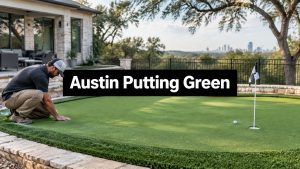
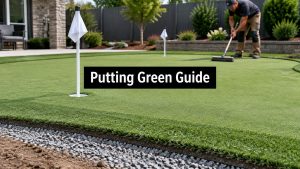
A 1,200-square-foot backyard tells you more about the site than the turf. Add a small putting green, and the quote climbs because the crew has to hold tighter tolerances, make cleaner seams, and build a base that stays consistent under play.
For a job like that, the cost of artificial turf should be discussed as a project total, not a loose square-foot guess. Specialty features always raise the price, and they also raise how much value you get out of the yard.
Full-yard transformation
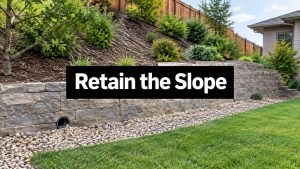
A 3,000-square-foot job with retaining-wall tie-ins and drainage tile changes the budget completely. You are not just buying turf at that point, you are paying for a site solution, which means more prep, more labor, and more coordination between systems.
Watch the access first. If a crew cannot get materials to the back efficiently, labor climbs faster than most homeowners expect.
For a yard this size, the biggest swings usually come from demolition depth, drainage correction, and whether irrigation lines need relocation. Those are the items I would ask about first in any walkthrough. For the install itself, artificial turf installation details should spell out the sequence before anyone starts digging.
A sharp quote also shows you what was assumed. If the installer does not spell out soil removal, drainage work, haul-off, access limits, and finish grading, the number on the page is incomplete. That is where homeowners get surprised later, usually after the crew opens up the yard and finds more caliche or worse drainage than expected.
For buyers who want to compare project scope against long-term value, Sendvo real estate mail platform is a useful example of how visible, local value gets communicated clearly. The same idea applies here. Transparent pricing beats teaser pricing, especially when the yard itself decides how much labor the job really needs.
ROI and the True Cost of Owning a Lawn Over Time
The cheapest lawn is the one that stops billing you every year. That is the part most price pages ignore, and it is the part Austin homeowners should pay attention to first. A lawn is not just an install, it is a recurring cost tied to water, labor, fertilizer, and eventual replacement.
What natural grass keeps charging you for
Natural grass keeps asking for water, mowing, fertilization, and replacement down the road. In Texas, that adds up fast because the lawn still has to survive summer heat, dry stretches, and restrictions that can make upkeep harder than it looks on paper. Artificial turf removes mowing and fertilizing from the budget and cuts the water burden hard.
For homeowners thinking about broader property value conversations, Sendvo real estate mail platform is a useful example of how local marketing works when you need to show value clearly. The same logic applies to your yard, buyers notice visible upkeep and consistency right away.
The breakeven question
The key question is not whether turf costs more at the start, because it does. The key question is how long you plan to own the house and what you are currently spending to keep a natural lawn looking decent. If you are staying put for the long haul, the higher upfront price starts to look less like a luxury and more like a deliberate trade.
A homeowner who wants a steady green look without constant work usually comes out ahead on simplicity, even before you count the savings from lower upkeep. That matters even more in water-stressed neighborhoods where a natural lawn can turn into a chore instead of an asset.

For a closer look at pricing, the cost of artificial turf gives you a useful baseline to compare against your current lawn budget. If your yard already needs a lot of water and attention, the long view usually favors turf.
Financing Options, Warranty Coverage, and Eco-Friendly Perks
Big projects get easier when the payment plan and the protection plan are both clear. That's what homeowners should demand. A good turf contractor should be able to explain how the work is financed, what the warranty covers, and which parts of the install are protected in writing.
What to expect from financing and warranties
For larger installs, financing lets a homeowner spread the cost instead of delaying the project for another season. Warranty coverage should separate materials from workmanship so you know who stands behind the turf and who stands behind the install.
That distinction matters. A strong material product can still fail if the base is bad, and a great install can still look wrong if the wrong product was chosen for the yard.
Why the eco-friendly part is real
The environmental upside is practical, not decorative. Less watering, no fertilizer runoff, and no pesticide-heavy maintenance routine mean less waste going into the ground and the drain. Durable materials also keep the yard from cycling through replacement as often.
Modern Yard Landscapes also handles related work like drainage tile and retaining walls, which matters because bundling those fixes into one visit can save the headache of repeating mobilization later. One crew, one plan, fewer surprises.
Good quotes protect the owner twice, once on day one and again in year five.
If the contract is vague, the price is probably not the only thing that's weak. Make them show you the warranty terms before you sign.
Getting an Accurate Site-Specific Quote From Modern Yard Landscapes
A real quote starts with a conversation, not a calculator. You call, the team asks a few direct questions, and then they come out to look at the yard in person. That walkthrough is where soil, slope, drainage, access, and existing conditions get evaluated the way they should.
During that visit, ask the questions that expose whether the estimate is detailed or padded. Ask what infill is included, how drainage will be handled, whether the crew expects to relocate irrigation, and what the warranty covers in writing. Those answers tell you more than the total number on the page.
A good estimate should break the work into the same pieces you've already seen here, not hide everything under one vague line. That means demolition, prep, turf, edging, labor, and any specialty features should be visible before you commit. If it's not itemized, you're being asked to trust too much too soon.
The simplest next step is to schedule the site visit with Modern Yard Landscapes and get a number tied to your actual yard, not a generic average. That's how you make a smart call instead of guessing at a price range that may have nothing to do with your soil or drainage.
Frequently Asked Questions About Lawn Installation in Austin
How long does installation usually take?
Most jobs move from demolition to final walkthrough in a short, planned sequence, but the exact timeline depends on prep, drainage, and access. A clean site goes faster than one with caliche removal or irrigation changes.
Can pets and kids use the new lawn right away?
They can usually use it once the install is complete and the crew has given the final handoff, but I'd still ask about any settling, seam checks, or cleanup steps before letting everyone charge out there.
What maintenance does artificial turf need in a Texas summer?
Less than a natural lawn, but not zero. It still needs basic cleaning and occasional grooming so debris doesn't build up and the fibers stay upright.
Do HOAs usually allow turf in the Austin area?
Many do, but approval depends on the specific neighborhood rules. Bring your HOA language to the consultation so the design and product choice can fit the requirements the first time.
A CTA for Modern Yard Landscapes. If you want a quote that actually reflects your yard, call Modern Yard Landscapes and schedule an on-site walkthrough. Ask for a written, factors-based estimate, then compare it line by line against what your lawn really needs.