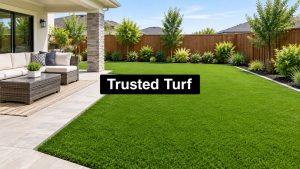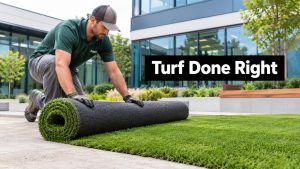

You're standing over a failing Austin lawn in late July. The St. Augustine is thinning beneath the oaks, the exposed soil is cracking, and the water bill is sitting on the counter while you debate new sod, xeriscaping, or artificial turf. The right answer depends less on what looks good in a showroom and more on what your yard, watering schedule, drainage, pets, and local rules can realistically support.
A smart turf grass Austin decision starts with the site. Austin's hot summers, restricted watering windows, heavy soils, shade, and changing environmental policy can punish the wrong installation. This guide compares natural and artificial options, explains the preparation that protects your investment, and gives you a practical way to evaluate an installer. For another useful perspective on reducing lawn demand, review these drought-resistant lawn alternatives.
Why Austin Lawns Deserve a Smarter Turf Decision
Austin lawns face a difficult combination of intense heat, irregular rainfall, compacted soils, and limited irrigation opportunities. The City of Austin says turfgrass typically needs about 1 inch of water per week during summer, while native planting beds may need only 1/2 to 3/4 inch every other week under suitable conditions, as explained in the city's WaterWise landscaping rebate FAQs. That difference matters when a lawn covers a large portion of a residential lot.
Traditional St. Augustine also carries a measurable water burden. Texas Water Development Board research cited by Austin Water found traditional St. Augustine averaging 596 gallons per day per home, compared with 418 gallons per day for buffalograss and 456 gallons per day for no-grass xeriscapes. The study reported average savings of about 175 gallons per day for buffalograss and no-grass settings compared with traditional St. Augustine, and Austin-focused reporting identifies lawn irrigation as 32% of the city's water use through the same city resource.
Practical rule: If the reason your lawn failed was heat, shade, poor drainage, or insufficient irrigation, replacing it with the same turf in the same conditions won't solve the problem.
Austin's watering schedule makes the choice even more important. Chapter 6-4 of the Austin Code of Ordinances assigns watering days by property type and address parity. For residential properties with automatic or manual irrigation, odd-numbered addresses water on Wednesday. Hose-end and drip irrigation at odd-numbered addresses may operate on Wednesday and Saturday, while commercial and multifamily properties follow separate rules.
That schedule can make new sod risky if the irrigation system can't deliver consistent coverage. It also creates an opportunity to stop forcing grass into spaces that are better suited to native beds, gravel, shade planting, or a carefully designed artificial surface.
Your lawn affects more than curb appeal. The wrong turf can mean repeated replacement, muddy traffic lanes, invasive runners in planting beds, or a surface that becomes uncomfortably hot. The right selection reduces those problems and gives you a defensible plan if your HOA, drainage design, or future city requirements become part of the project.
How Austin's Climate and Code Shape Your Turf Choices
Start with the conditions your lawn experiences, not the name on the sod label. Austin's full-sun turf can require about 0.75 to 1.75 inches of irrigation per week, depending on temperature and exposure, according to regional grass and watering guidance. At 95 to 100°F, full-sun turf may need about 1.50 inches per week, and at 101 to 105°F, the benchmark rises to about 1.75 inches.
The same guidance recommends applying irrigation in multiple cycles with 30 to 60 minutes between cycles, allowing water to soak into the soil instead of running off. That approach matters on Austin's compacted clay-loam soils, where a long, single watering cycle can move water toward sidewalks, foundations, and low spots rather than into the root zone.

Diagnose the yard before choosing the grass
Walk the property at different times of day and answer four questions:
- Sun exposure: Does the proposed lawn receive direct sun, filtered oak shade, or deep shade?
- Water movement: Does rain leave puddles, flow toward the house, or disappear quickly?
- Traffic: Will children, dogs, customers, or delivery crews cross the area repeatedly?
- Watering access: Can your irrigation system cover the lawn within Austin's permitted schedule?
A slope changes the installation plan. So do mature pecan and live oak roots. Dogs create concentrated wear and urine exposure that a broad lawn may not tolerate, even when the grass species itself performs well. A narrow side yard with little sun should not be judged by the same standards as an open backyard.
Drainage deserves its own inspection because turf selection can change how water behaves at the surface. Before choosing a synthetic surface, read this practical overview of stormwater management and ask where water will go after it moves through the surface and base.
Treat policy as part of the design
Austin's environmental discussion has moved beyond water savings. In late 2025, the Environmental Commission recommended considering artificial turf as impervious cover, exploring a citywide ban with limited exceptions, and examining an opt-in buyback program, according to city environmental commission materials. The same materials state that artificial turf isn't eligible for the City of Austin WaterWise landscaping rebate.
That doesn't make artificial turf automatically wrong. It means you should verify how the proposed surface affects drainage, lot calculations, permits, HOA approval, and rebate eligibility before ordering materials.
Best Natural Turf Grass Options for Austin Yards
Natural grass remains the better choice for many Austin lawns, especially where people sit, children play, or afternoon heat makes synthetic surfaces uncomfortable. The four practical options are hybrid Bermuda, Zoysia, St. Augustine, and buffalograss. Each one solves a different problem, and none is a universal winner.
| Grass | Heat Tolerance | Water Needs | Shade Tolerance | Wear Recovery | Best For |
|---|---|---|---|---|---|
| Hybrid Bermuda | Excellent in full sun | Low to moderate when established, higher during heat stress | Poor | Fast and aggressive | Open, sunny, high-traffic lawns |
| Zoysia | Very good | Moderate to low once established | Light to moderate shade | Slow | Dense, attractive lawns with mixed exposure |
| St. Augustine | Good | High in hot weather | Best of these warm-season options | Low to moderate | Traditional Austin yards beneath filtered shade |
| Buffalograss | Good | Lowest of the group | Limited | Slow to moderate | Low-mow, low-water areas with strong sun |
Hybrid Bermuda
Choose hybrid Bermuda if the lawn receives strong, uninterrupted sun and takes regular foot traffic. It handles heat well, recovers aggressively, and creates a fine, durable playing surface. The trade-off is maintenance. Bermuda grows quickly, needs frequent mowing, and can spread into beds or neighboring areas if edging and bed maintenance are neglected.
Pick this if: You want the strongest natural option for a sunny yard, sports area, or active open lawn. Skip it if: mature trees cast substantial shade across the planting area.
Zoysia
Zoysia gives Austin homeowners a dense, refined lawn with a comfortable feel underfoot. It tolerates light shade better than Bermuda and generally needs less frequent mowing, but it establishes slowly and recovers slowly after severe damage. Empire Zoysia is a practical cultivar to discuss when you want a coarser, durable texture, while other cultivars may suit a finer appearance or different shade conditions.
Pick this if: You want a dense lawn and can wait for careful establishment. It's often the most balanced choice for a yard with sun and light shade.
St. Augustine
St. Augustine provides the classic broad-leaf Austin look and remains the strongest natural candidate for filtered shade. It's also the grass most likely to frustrate homeowners who expect a low-water lawn. It needs more irrigation during hot weather and can suffer from chinch bugs, disease, thatch, and wear in dog corridors.
Palmetto St. Augustine is worth discussing where shade tolerance and a traditional appearance matter, but cultivar selection won't overcome deep shade, poor drainage, or chronic traffic.
Pick this if: You want broad blades beneath a tree canopy and can maintain irrigation. Skip it if: water use, pets, or heavy traffic are your main concerns.
Buffalograss
Buffalograss is the low-water, low-mow specialist. It performs best in sunny areas where the homeowner accepts a less manicured texture and slower recovery. It isn't the right answer for every Austin lot, especially where shade, heavy traffic, or a consistently lush appearance is required.
Pick this if: conservation and reduced mowing matter more than a dense carpet. Skip natural turf entirely if: the site is shaded, poorly drained, mostly hardscape, or subjected to concentrated pet traffic.
For product comparisons outside turf, golfers can use this comparison of Vice Tour White specifications as an example of how specific product selection should be. Turf bids deserve the same level of detail.
Sod gives immediate coverage and the most predictable establishment. Sprigs cost less in some situations but need patience and careful moisture management. Seed works for certain grasses and schedules, but Austin's heat, weeds, and watering restrictions make timing critical. For a broader low-maintenance discussion, review these low-maintenance turf grass options.
When Artificial Turf Is the Better Answer in Austin
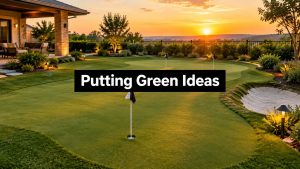
Artificial turf makes sense in Austin when natural grass repeatedly loses for a specific, predictable reason. Pet runs turn muddy and develop odor. Oak-shaded side yards thin out. Narrow strips become impossible to mow. A putting green needs a consistent roll that ordinary turf can't provide. Rental owners may also prefer a surface that doesn't require recurring mowing and irrigation coordination.
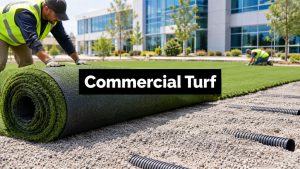
The installation still has to match the use. A pet area needs permeable backing, a properly draining base, and an infill system selected for odor control and heat management. A putting green needs a short, stable surface and precise sub-base grading. A commercial entry area needs a durable fiber system that can handle concentrated traffic without matting.
| Use Case | Pile Height | Face Weight | Infill Type | Drainage Rate |
|---|---|---|---|---|
| Pet run | 1.5 to 2 inches | 60+ oz | Cooler acrylic or silica blend | Perforated backing with engineered sub-base |
| Active residential yard | 1.5 to 2 inches | 60+ oz | Acrylic or silica blend | Positive grade and permeable base |
| Putting green | 0.5 inch | Product-specific | Putting-green infill | Precisely graded drainage system |
| Shaded side yard | 1.5 to 2 inches | 60+ oz | Heat-conscious infill | Perforated backing and open base |
The drainage rate is not a marketing detail. One municipal artificial-turf specification requires water to percolate through at a minimum of 30 inches per hour and requires an underlying drainage system to prevent runoff, pooling, and flooding, as shown in this artificial turf drainage code specification. Austin's clay soils make the base even more important than the face fibers.
The trade-offs sales pitches skip
Artificial turf gets hot in direct Austin sun. Austin Water warns that it can worsen the urban heat island effect and create a hotter microclimate around homes, while the Environmental Commission presentation raised concerns about PFAS, microplastics, compacted subgrades, reduced infiltration, and landfill disposal at the end of the product's life, as summarized in local Austin coverage of artificial turf and xeriscaping.
Pet turf also needs maintenance. Rinsing helps, but professional odor remediation may be needed every 12 to 18 months for dog installations. A bad base can trap smells and heat for years, regardless of how attractive the turf looked on installation day.
Choose artificial if shade, concentrated traffic, pets, or a specialized use makes natural turf unreliable. Don't cover a large, sunny recreation area with synthetic turf without planning shade and cooling. For more detail on the decision, read why synthetic turf can fit certain Austin properties. Homeowners planning the surrounding space can also use AI for backyard design to test layout ideas before construction.
Site Preparation and Installation the Right Way
Preparation determines whether a turf project stays level, drains after storms, and remains comfortable to use. Artificial turf doesn't fail because the fibers suddenly forget how to look like grass. It fails when installers leave unstable soil, skip grading, underbuild the base, or ignore the property's existing water path.
Build the base before laying the surface
A proper artificial installation begins with excavation, usually 4 to 6 inches where site conditions require that depth. Existing Bermuda and weeds need full removal, including rhizomes. Leaving live runners beneath the surface invites future growth at seams, edges, and drainage openings.
The base should consist of crushed limestone or decomposed granite installed in 2-inch lifts, with each lift compacted before the next one is placed. The target is 95% compaction, not a quick pass with a plate compactor over loose fill. A stable base keeps the surface from developing waves, depressions, and soft spots.

Control water before it reaches the turf
Laser grading should create a positive fall of about 1% to 2% away from the slab, where site geometry allows it. Installers should hand-tamp edges near the foundation and set bender board or concrete edging flush with the finished grade. These details prevent the perimeter from becoming a low channel that collects soil and water.
Heavy Central Texas downpours may require 4-inch drain tile tied to daylight or a dry well. The right solution depends on the property, but the principle doesn't change. Water must have a designed route out of the installation.
Weed fabric can help beneath artificial turf, but it isn't a universal fix. It should be used where it supports weed control without blocking the intended drainage path. Natural turf generally needs soil improvement instead, often with 2 to 3 inches of compost tilled into local clay before sodding.
Natural turf also needs seasonal judgment. Sod is the dependable route when you need quick coverage and can water during establishment. Seed and sprigs require more time, careful moisture, and a warm growing window. An installer who can't explain the establishment plan is not ready to recommend the grass.
Real Cost Ranges and What Moves the Price
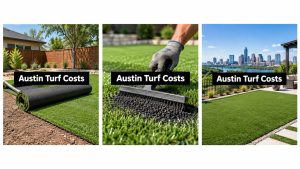
Austin turf pricing depends on the surface, access, demolition, grading, drainage, irrigation changes, and material specifications. The figures below are planning ranges for 2026, not promises for every property.
| Turf Type | Installed Cost / sq ft | Annual Maintenance | Expected Lifespan | 10-Year Total for 1,000 sq ft |
|---|---|---|---|---|
| Bermuda sod | $0.40 to $0.75 | Mowing, irrigation, fertilizer | Site and care dependent | Requires a property-specific quote |
| Zoysia sod | $0.85 to $1.50 | Mowing, irrigation, fertilizer | Site and care dependent | Requires a property-specific quote |
| St. Augustine sod | $0.70 to $1.25 | Higher irrigation and pest attention | Site and care dependent | Requires a property-specific quote |
| Buffalograss seed or plugs | $0.35 to $0.70 | Lower mowing and irrigation | Site and care dependent | Requires a property-specific quote |
| Residential artificial turf | $7 to $14 | Rinsing, brushing, infill care | Product and installation dependent | Requires a property-specific quote |
| Artificial putting green | $12 to $20+ | Brushing and surface care | Product and installation dependent | Requires a property-specific quote |
Natural turf usually costs less at installation, but its lifetime expense includes irrigation, mowing, fertilization, pest treatment, aeration, patching, and water use. Artificial turf shifts the expense toward excavation, base construction, drainage, edging, infill, and eventual surface maintenance.
Water savings can be meaningful. A neutral industry comparison citing water-authority estimates places synthetic-turf savings at about 55 gallons per square foot per year, or roughly 55,000 gallons annually for a 1,000-square-foot lawn, as described in this synthetic turf water-savings comparison. Actual savings depend on what irrigation served the area and whether the system is capped or redesigned.
The items that change the bid
- Access: Narrow gates and hand-carried materials increase labor.
- Demolition: Existing turf, concrete, roots, and contaminated soil require removal.
- Drainage: Tile, outlets, dry wells, and grading add work but often prevent expensive failure.
- Irrigation: Systems may need to be removed, capped, or converted for planting beds.
- Material choice: Pile height, face weight, backing, infill, seam layout, and warranty affect price.
Never compare two bids by square-foot price alone. Compare the excavation depth, base material, compaction process, drainage plan, edging, turf product, and cleanup line by line.
How to Choose a Reputable Austin Turf Installer
A trustworthy installer makes the hidden work visible before you sign. Ask for a written scope that separates demolition, excavation, base depth, compaction method, grading, edging, drainage, turf product, infill, seams, and cleanup. If the proposal only says “install premium turf,” it isn't specific enough to protect you.
Verify the company before comparing products
Request current certificates for general liability and workers' compensation coverage. Confirm that the contractor handles the required Texas credentials for the work being performed, and ask about Austin Water irrigation registration when the project touches in-ground irrigation.
The product should be named. Ask for the manufacturer, product line, face weight, pile height, backing type, stitch information, infill, and UV warranty. A public turf specification requires at least an 8-year manufacturer warranty against defects in materials and workmanship, full replacement of damaged product during the warranty period, and coverage broad enough to replace all turf if necessary, as shown in this public artificial turf warranty specification. That doesn't make every product equivalent, but it gives you a useful standard for asking precise questions.

Ask questions that expose shortcuts
- How deep will you excavate, and what material goes into the base?
- How will you verify compaction?
- Where will stormwater and pet drainage go?
- What happens at the foundation and bed edges?
- Which warranty covers labor, seams, fading, drainage, and pet damage?
- Can I visit three local installations that are more than two years old?
Drive by the references. Look for settled edges, visible seams, puddling, matting, weeds, and odor. A low bid often reflects a thinner base, missing geotextile where it's needed, limited drainage work, or an off-brand product.
Cash-only demands, no written contract, refusal to identify the turf line, and pressure to sign immediately are enough reason to leave. A professional installer should be comfortable with comparison, questions, and a site-specific explanation.
Your Next Step Toward a Hassle-Free Austin Lawn
Use the coming week to gather information before you invite bids.
- Photograph the yard: Take photos in morning, midday, and afternoon light so shade patterns are clear.
- Review your water bill: Use a recent Austin Water bill to understand your current irrigation burden and set a realistic water budget.
- Measure the area: Calculate turf square footage separately from planting beds, patios, walkways, and drainage zones.
- Document problem spots: Photograph puddles, bare soil, tree roots, dog paths, slopes, and irrigation overspray.
- Check approval requirements: Review HOA rules and ask the city about drainage, impervious-cover treatment, permits, and rebate eligibility before purchasing artificial turf.
- Schedule competing site visits: Get two or three written proposals with matching scope details, not vague square-foot totals.
If the project includes major grading, drainage rework, retaining structures, or HOA review, add a designer to the conversation. That extra planning can prevent you from choosing a surface that solves one problem while creating another.
A reliable turf grass Austin plan matches the surface to the microclimate. Bermuda may be right for a sunny play lawn, Zoysia for a dense mixed-exposure yard, St. Augustine beneath filtered trees, buffalograss for a low-water zone, and artificial turf for a contained pet run or specialized space. The right answer starts with an inspection, not a catalog.
Modern Yard Landscapes provides Austin-area artificial turf installation, pet-friendly dog runs, custom putting greens, drainage tile, and preparation with written, factors-based estimates. Visit Modern Yard Landscapes to schedule a complimentary site visit and get a line-item recommendation based on your yard's drainage, shade, traffic, turf choice, and budget.