
By July in Austin, a lot of yards tell the same story. The sprinkler runs, the grass still looks tired, bare spots spread near the fence line, and the water bill shows up like an insult. You mow a lawn that doesn't even look good, then pay to fertilize grass that still goes patchy when the heat settles in.
That's why so many homeowners start searching for low maintenance turf grass. They're not pursuing some extravagant outdoor design concept. They just want a yard that doesn't fight them every weekend.
The problem is most advice on this topic is too soft and too generic. It bypasses the core question. In Austin, do you want less maintenance, or do you want to be mostly done with lawn maintenance altogether? Those are two very different decisions, and if you blur them together, you'll waste money.
The End of the Brown Lawn Blues in Austin
One neighbor waters more, another waters less, and both still complain their lawn looks rough by mid-summer. That's Austin. Heat, hard soil, shade in the wrong spots, dog traffic, kid traffic, and a yard that never seems to behave like the photo on the seed bag.

Why people get stuck in the same lawn cycle
Most homeowners try the same sequence over and over.
- Water more: The grass greens up a little, then stress shows up again.
- Throw down fertilizer: Growth comes back, but so does mowing and often weed pressure.
- Patch the dead spots: New grass struggles because the underlying site problem never changed.
- Hope next season is different: It usually isn't.
That cycle gets expensive fast, but the bigger issue is frustration. You're paying in time, not just money. Saturday mornings disappear into mowing, edging, repairing, cleaning up clippings, and wondering why the lawn still looks worn out.
Practical rule: If your lawn only looks decent when you're constantly feeding it, watering it, and babying it, you don't have a low-maintenance lawn. You have a high-maintenance lawn on life support.
The promise and the catch
Low maintenance turf grass sounds like the answer, and in fairness, it can help. Some grasses and some management styles need fewer inputs than the classic thirsty, needy lawn. That can mean less mowing, less fertilizer, and less irrigation.
But “less” is the word that matters.
Natural turf can absolutely be the right choice for some Austin yards, especially if the site conditions line up with the grass. If they don't, you end up forcing a grass to live where it doesn't want to live. That's when low maintenance turns into constant compromise.
A lot of homeowners don't need another compromise. They need a surface that stays green, handles use, and quits turning into a seasonal project.
What Low Maintenance Actually Means for Your Yard
A lot of Austin homeowners hear “low maintenance” and picture a lawn that stays green with almost no effort. That is not how natural grass works. Low maintenance means fewer inputs and lower expectations, not a yard you can ignore, as UMass Amherst explains in its turf maintenance guidance.

Reduced input is the real definition
If someone pitches a “low maintenance” lawn without talking about irrigation, mowing, fertility, and appearance standards, skip the sales pitch.
Here is the plain-English version. You can cut back on fertilizer. You can water less than a high-input lawn. You can mow less often in some cases. But you are still signing up for a living surface that responds to heat, shade, soil problems, pet traffic, weeds, and wear.
That trade-off gets ignored in a lot of lawn guides.
A lower-input grass often means slower growth, less color, more seasonal inconsistency, and less ability to recover when the yard gets hammered. For some homeowners, that is a fair deal. For others, it just means paying for a lawn that looks mediocre instead of dead.
What low maintenance still requires
Natural grass still needs a manager. That manager is usually you.
You still have to mow at the right height. You still have to watch irrigation habits. You still have to control weeds before they spread. You still have to accept that thin spots and stress show up faster when you reduce inputs too far. In Austin, that matters because a lawn can go from passable to rough-looking in a hurry once heat and traffic pile on.
The hidden cost is not just water or fertilizer. It is the constant attention. A low-maintenance natural lawn can reduce the workload, but it does not remove the workload.
That is the difference homeowners should care about. Low maintenance natural grass means less work than a needy lawn. Artificial turf means no mowing, no fertilizing, no muddy dead zones, and no trying to guess whether one more watering cycle will save the yard. If you are done babysitting grass, read why synthetic turf makes sense for homeowners who want a no-mow, low-hassle yard.
Low maintenance is still maintenance. If you want to stop doing lawn chores, you need a different surface, not a different grass seed.
Natural Grass vs Artificial Turf The Austin Reality
Austin isn't some neutral testing ground where every lawn option gets a fair shot. Your yard has heat, uneven sun, compacted areas, pet traffic, and the usual wear near patios, gates, and play zones. That local reality matters more than the marketing label on any grass.
Where natural low-input lawns work
Some natural lawns can be managed with fewer inputs if the species matches the site. Kansas State classifies fine fescues, buffalograss, common Kentucky bluegrass, and pasture-type tall fescues as utility turfgrasses for low-maintenance settings, and guidance tied to those recommendations stresses that species selection matters first, not just cutting back on care.
Tall fescue gets attention because it has strong heat, traffic, and drought tolerance among cool-season grasses, develops a deep root system that tolerates clay and alkaline soils, and in some low-input programs can get by with only 3 to 5 summer irrigations. Iowa State also notes that a low-maintenance tall fescue lawn may need only one nitrogen application in late fall at 1 lb N per 1,000 sq ft, as summarized in Kansas State's turfgrass selection guidance.
That sounds good, and it is good. But those are still conditions, still programs, still management.
The Austin tradeoff most articles skip
Natural grass has limits. Shade changes everything. Heavy use changes everything. Pet paths, party traffic, and kids cutting the same route across the yard change everything. Even low-input grasses have strengths and weaknesses, and those weaknesses show up fast in real family yards.
Artificial turf changes the category. It doesn't need to be coaxed through drought. It doesn't thin out because one corner gets hammered every afternoon. It doesn't care if the dog runs the same loop by the fence.
Here's the blunt version. If your goal is a usable, consistent, green surface, artificial turf is usually the more reliable answer in Austin.
| Feature | Low-Maintenance Natural Grass | Modern Artificial Turf |
|---|---|---|
| Water demand | Lower than high-input lawns, but still requires management | No ongoing irrigation to keep blades green |
| Appearance | Varies by season, stress, shade, and wear | Consistent year-round look |
| Shade performance | Depends heavily on species | Not limited by shade in the same way |
| Heavy foot traffic | Can thin, compact, or wear down | Built for repeated use |
| Mud and bare spots | Common in stressed or high-use areas | Avoids the mud cycle |
| Fertilizer and weed control | Usually reduced, not eliminated | Different upkeep profile, no fertilizing for grass growth |
| Weekend labor | Less than a needy lawn, still ongoing | Mostly cleanup rather than lawn care |
If you want a deeper side-by-side on the decision, compare the tradeoffs in this artificial turf vs natural grass guide.
My recommendation for most Austin homeowners
If you love natural grass and don't mind managing it, choose a species that fits the site and accept the tradeoffs. Don't expect miracles.
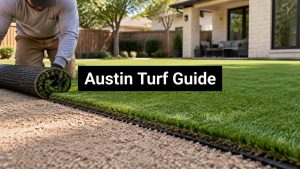
If your real goal is to stop wrestling with the lawn, stop shopping for a “better” version of maintenance and switch categories. A professionally installed artificial turf system does what low-maintenance natural grass only partially promises. It gives you a lawn-looking surface without the constant lawn battle.
Uncovering the True Cost and Water Savings
A cheap lawn on day one can turn into an expensive habit.
That's the part a lot of Austin homeowners learn the hard way. Natural grass spreads the pain across months and years, so the bill feels manageable until you add it up. Water in summer. Fertilizer and weed control. Mowing gear or lawn service. Repair work after heat, dogs, shade, or heavy foot traffic. The running cost is the story, not just the install price.
Water savings matter, but so does what you're saving from
The EPA's WaterSense guidance makes a simple point in its turfgrass and water efficiency guidance. Choosing climate-appropriate turf and watering it efficiently can reduce outdoor water use compared with a thirstier lawn.
That helps. It does not erase the job.
Even a drought-tolerant natural lawn still needs management to stay presentable in Austin. You are dialing down irrigation, not eliminating it. If your goal is lower water bills, low-maintenance grass can help. If your goal is to stop paying to keep grass alive through brutal heat, artificial turf is the cleaner answer because it stays green without routine irrigation for growth.

The costs homeowners leave out
The missed expenses are usually the repeating ones, not the obvious ones on the first quote.
- Patch repair: Worn spots near gates, patios, play zones, and dog paths keep asking for attention.
- Seasonal treatments: Fertilizer, pre-emergents, weed control, and pest treatments do not disappear just because the grass is marketed as low maintenance.
- Equipment or service bills: Mowers, trimmers, repairs, fuel, and lawn crews all keep adding to the total.
- Watering mistakes: Too little water leaves brown areas. Too much water invites weeds, runoff, and shallow roots.
- Time: Weekend lawn work has a cost, even if it never shows up on an invoice.
The hidden trade-off is simple. Low-maintenance natural grass lowers some inputs. It does not remove the cycle.
Why turf pricing depends on the system, not the square foot pitch
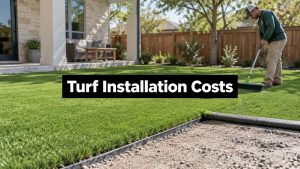
Artificial turf has a higher upfront cost, so homeowners should be picky. Bargain pricing usually means corners got cut somewhere in the base, drainage, edging, seams, or material quality. That is where future problems start.
Ask better questions. How much base prep is included? How is drainage handled? What infill is being used? How are the edges secured? A contractor who stays vague on those details is telling you plenty.
If you want a realistic breakdown, start with this artificial turf cost guide for Austin homeowners. It explains the factors that shape the finished system and the long-term value. Modern Yard Landscapes installs residential and commercial turf systems in Austin with site preparation, drainage work, and material options for pet areas, play areas, and standard outdoor lawns.
A Perfect Yard for Austin Families Pets and Kids
The family yard has a different job than the front lawn people admire from the street. It needs to hold up to dogs cutting corners, kids dropping toys, friends coming over, and adults wanting a clean place to sit without stepping into mud.

Natural grass breaks down by use pattern
This is one of the biggest reasons homeowners end up disappointed with low maintenance turf grass. The grass may be low-input on paper, but the yard itself doesn't live on paper.
Michigan State points out a simple truth in its guidance on low-maintenance lawns. Site match matters. Fine fescues do better in partial shade and can need less water and fertilizer, while warm-season choices like buffalograss are drought-tough but perform poorly in shade. That same guidance also notes that the “best” option may be a site-specific mix or even a turf alternative, because no single natural solution fits every yard, as described in Michigan State's low-maintenance lawn resource.
That's the hidden headache for families. The front yard may want one thing. The side yard may want another. The dog run may need something else entirely. Kids and pets don't care what the ideal species chart says. They use the whole yard hard.
Why turf makes family use simpler
Artificial turf sidesteps most of those site-specific failures. Shade doesn't wipe it out. Heavy use doesn't turn it into a dirt track. Pets don't create the same muddy traffic lanes you get in natural grass.
That changes day-to-day life in practical ways:
- Cleaner play: Less dirt tracked into the house.
- Fewer dead zones: High-use spots don't collapse the way natural turf often does.
- Better consistency: The yard looks like one finished surface instead of a mix of struggling areas.
- Pet-friendly function: With the right system design, cleanup is straightforward and the surface stays usable.
Families don't need a lawn that looks good only when nobody uses it. They need one that still works after the soccer ball, the dog, and the birthday party.
If pets are a big part of the equation, look at pet turf installation options built for dog runs and backyard pet zones. The right layout, base prep, and infill choices matter a lot more than people realize.
Your Next Steps to a Flawless Lawn
If your yard keeps disappointing you, stop treating it like a small problem. It's usually not a fertilizer problem or a sprinkler-setting problem. It's a system problem. The wrong surface is being asked to do the wrong job in the wrong conditions.
Decide what you actually want
Most homeowners need to answer one question truthfully.
- Do you want real grass with less maintenance? Then pick a species that fits the site and accept that you'll still be mowing, watering, and managing it.
- Do you want a lawn-looking surface without the lawn burden? Then artificial turf is the cleaner answer.
- Do you want the yard to stay usable for family life? Prioritize durability, drainage, and ease of cleanup over tradition.
That answer clears up the whole project.
Don't ignore the parts under the surface
People spend too much time looking at the blade sample and not enough time asking what's underneath it. A turf installation lasts or fails based on the unglamorous work.
Here's what matters:
- Grading: Water has to move where it should.
- Base preparation: The surface needs stability, not soft spots and dips.
- Drainage planning: Pet areas, shaded zones, and low spots need special attention.
- Edging and seams: Clean lines and secure connections keep the lawn from looking cheap.
A cut-rate install can look fine for a short while, then start showing every shortcut. Seams become visible. Edges loosen. Drainage problems show up after storms or rinsing. That's not a turf issue. That's an installation issue.
Make the first move simple
You don't need to commit on the first call. You do need a real site assessment. A good contractor should look at sun exposure, drainage, access, current grade, how you use the yard, and whether part of the space should remain with its current design and features instead of all going to turf.
That's how you avoid wasting money on the wrong fix.
If you're done fighting brown patches, mud, and high-maintenance lawn routines, talk with Modern Yard Landscapes. We'll look at your yard, walk through the tradeoffs honestly, and help you figure out whether artificial turf is the right fit for how you actually live.