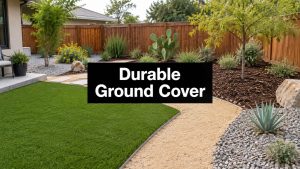

A lot of Austin backyards look usable on paper and disappointing in real life. The fence line leans with the slope, the grade falls away just enough to make furniture feel off, and every heavy rain seems to move a little more soil where you wanted a clean patio edge. Homeowners usually start by thinking about paver color, pattern, or where the grill should go. The fundamental question is often lower to the ground. What is going to hold the patio in place for years?
That's where a retaining wall for paver patio projects becomes more than a nice border. On many Central Texas lots, it's the part that makes the patio possible in the first place. If the site drops, sheds water poorly, or has clay soil that shifts with moisture, the wall is doing structural work whether it looks decorative or not.
From a Sloped Yard to Your Dream Paver Patio
A common Austin scenario goes like this. The backyard isn't steep enough to look dramatic, but it's sloped enough that a patio feels awkward. One side wants to sit higher than the other. The base material wants to migrate toward the low side. Near the fence, runoff cuts a shallow channel every time it rains.

That's usually the moment the project changes from “install some pavers” to “solve the grade correctly.” A well-built wall creates the flat area the patio needs, but above all, it controls the soil around it. Without that control, even a beautiful paver surface can start to drift, settle, or separate at the edges.
What homeowners usually see first
The symptoms are often observed before their underlying cause is understood:
- The yard feels hard to use. Chairs wobble, drainage paths cut through gathering space, and the low end of the yard becomes dead space.
- The fence line starts becoming part of the problem. Soil builds up in one area and washes away in another.
- The patio idea gets smaller. Homeowners start trimming the plan to fit the slope instead of building the yard they want.
Austin has plenty of lots where a patio needs to work with hillsides, side-yard runoff, and expansive soils. If that sounds familiar, it helps to look at examples of low-maintenance hillside landscaping before deciding whether a wall, terracing plan, or drainage correction makes the most sense.
A retaining wall should support the outdoor space you want to use, not just hide a grade problem.
The wall changes what the yard can become
When the layout is right, the wall lets the patio sit where it should. Close enough to the house to feel connected, far enough into the yard to become an outdoor room, and level enough to function like one. That's the difference between squeezing pavers into a difficult backyard and building a space that improves how the property lives day to day.
Done correctly, the wall becomes the quiet structural piece behind the finished look. You notice the seating area, the clean paver lines, and the usable square footage. You don't notice the pressure it's holding back, the water it's moving, or the grade transition it solved. That's exactly how it should work.
When Your Paver Patio Absolutely Needs a Retaining Wall
Some patios can sit directly on a properly prepared base with simple grading around them. Others need a wall. The trick is knowing the difference before the excavation starts.
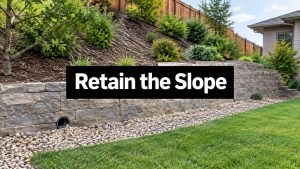
A retaining wall isn't just an outdoor accent. It's a design feature and structural control for slope and drainage. It helps keep soil in place, prevents patio edges from sinking, and reduces washout around the pavers, according to guidance on retaining walls and backyard drainage. That same guidance notes that many modular wall systems are limited to about 2 to 3 feet in basic configurations, while walls over 4 feet often need geogrid reinforcement, and a proper build includes gravel base, filter fabric, and a drainage pipe.
The first trigger is slope
If the patio area won't be level without cutting into the high side or building up the low side, a wall often stops being optional. Pavers need a stable, confined base. On a sloped yard, that base has to end somewhere. If nothing holds that edge, gravity will.
Think of the wall like a buttress for the patio base. The pavers are the visible surface. Under them sits compacted base material. Around that base sits surrounding soil. When the yard slopes away, the wall acts as the controlled edge that keeps those layers where they belong.
The second trigger is moving soil
Austin homeowners often focus on the patio surface and overlook what the adjacent soil is doing. That's a mistake. If the soil near the edge creeps downhill or erodes during storms, the patio can lose support even if the pavers were installed neatly.
Look closely if you have any of these conditions:
- A fence near the patio line. Soil movement can create pressure in one area and washout in another.
- A bare low corner of the yard. Water usually tells you where the future problem is.
- Previous settling. If an old walkway, planter edge, or small pad has already moved, the patio needs more than cosmetic grading.
For homeowners comparing options, speaking with retaining wall contractors near me is usually more useful than looking only at patio galleries. The wall decision is a structural one first.
Practical rule: If you need the wall to keep soil from pushing into the patio base or washing out from under the edge, you're not choosing a feature. You're solving a support problem.
The third trigger is patio longevity
A patio can look finished on day one and still be on a path toward failure. The trouble usually starts at the perimeter. Once edge support weakens, individual pavers can shift, joints can open, and low spots can develop.
That doesn't mean every sloped yard needs a wall. Some properties are better candidates for regrading, a stepped layout, or a smaller terrace. But when the project depends on holding grade, controlling runoff, and preserving the patio base, the retaining wall is part of the actual patio system. Treating it like an add-on is what leads to callbacks and repairs later.
Choosing Your Wall Material Cost Durability and Austin Style
Material choice affects how the wall looks, how it performs, and how much complexity the project carries. Homeowners often start with appearance. Contractors usually start with site conditions. The best decisions account for both.
Industry pricing gives a useful baseline. In 2026, Angi reported typical retaining wall installation at about $40 to $360 per linear foot for walls between 2 and 6 feet tall, with an average project around $6,078 and a common range of $3,199 to $9,201. Angi also notes that vinyl may cost about $10 to $15 per square foot, while concrete may cost about $30 to $50 per square foot in many projects, which helps explain why material selection changes the economics so much on a patio wall. You can review those numbers in Angi's retaining wall cost guide.

Segmental block versus stone versus timber
For most Austin-area patios, these are the material conversations that matter most.
| Material | Average Cost (per sq. ft.) | Best For | Austin Style Match |
|---|---|---|---|
| Segmental concrete block | Concrete often runs about $30 to $50 per sq. ft. in Angi's pricing examples | Patio walls that need consistent geometry and dependable installation methods | Works with modern, transitional, and clean-lined homes |
| Natural stone limestone or sandstone | Qualitatively higher-cost material choice | Homeowners prioritizing a native, timeless look | Strong fit for Central Texas character |
| Treated timber or railroad ties | Qualitatively lower to moderate upfront cost | Rustic looks and simple, lower-demand landscapes | Best in informal settings, less ideal for long-term patio support |
| Large boulders or gabion baskets | Qualitatively moderate to high depending on stone and layout | Naturalistic yards and bold grade transitions | Good fit where the site already has strong natural character |
What works best in real patio builds
Segmental concrete block is often the practical choice for a retaining wall for paver patio construction. The units are consistent, interlock well, and pair naturally with paver layouts. They're easier to build accurately around curves, steps, and seat-height transitions than many natural materials.
Natural limestone or sandstone gives a patio a strong Austin feel. It looks rooted in its surroundings instead of imported from a catalog. The trade-off is usually cost, material variation, and the need for an installer who knows how to build for both appearance and structure.
Treated timber gets chosen for budget reasons and rustic style, but it's usually not my first recommendation where the wall directly protects a paver base. It can work in the right setting, yet it doesn't offer the same long-term confidence as masonry-based systems where moisture and soil pressure are involved.
Boulders or gabion baskets create a different kind of project. They can look excellent on larger sites, especially where a highly natural edge is the goal. They're less common for tighter patio footprints where clean dimensions and furniture-friendly transitions matter.
A style choice still needs sound construction
Homeowners often bring inspiration photos. That's helpful, but the best match isn't always the prettiest wall sample. It's the one that fits the grade, handles drainage, and supports the patio layout without creating a maintenance problem.
If you're collecting ideas, a gallery of retaining wall design ideas can help narrow the visual direction before final material selection.
For anyone considering stone or paver cuts as part of a custom patio edge, it also helps to understand the tools professionals rely on. A resource like this open box Dewalt 10 inch saw gives homeowners a sense of the kind of wet-cut equipment used for clean masonry work around detailed hardscape features.
The right wall material should match the house, the grade, and the maintenance expectations. If one of those three gets ignored, the project usually feels off later.
The Unseen Heroes Drainage and Foundations
Most retaining wall failures don't start with the face of the wall. They start behind it and under it.
That matters even more in Austin, where clay-heavy soils can behave well in dry weather and then become a different material once water enters the picture. Homeowners sometimes think the wall is there to hold pavers in place. In practice, the wall's hardest job is often controlling the water and soil conditions that would otherwise damage the patio.

Why pressure builds where you can't see it
Water trapped behind a wall creates force. When that force builds in clay soil, the wall isn't just holding back earth anymore. It's resisting saturated, heavier material and the pressure of water that can't move out fast enough.
That's why drainage can't be treated like an accessory. Allan Block's raised patio guidance highlights the importance of wall rock, backfill, compaction, and a 1% patio slope for runoff in these systems, which reinforces a point many homeowner guides miss. The wall is really part of a broader water-management plan, not just a vertical edge. You can see that approach in Allan Block's raised patio construction article.
The base sets the future of the wall
Manufacturer guidance for segmental retaining walls gives a clear foundation rule. The trench should be wide enough for a compacted base roughly twice the block width, and the first course should be buried about halfway into the soil on roughly 3 to 6 inches of paver base. Home Depot's build guidance explains that this burial helps prevent sliding and overturning at the base, and it's one reason foundation and drainage failures are such a common cause of small wall problems. That guidance is laid out in Home Depot's retaining wall installation instructions.
That buried first course is one of the details homeowners rarely notice and professionals never skip. If the bottom course isn't stable, the rest of the wall is cosmetic confidence over a weak start.
What the wall needs behind it
A durable patio wall should be built as a system, not as stacked facing units. That system typically includes the following working parts:
- Compacted granular base: This gives the wall a stable footing and helps distribute loads.
- Free-draining gravel behind the wall: This creates a path for water to move instead of collecting against the wall.
- Filter fabric: This helps separate soils from clean drainage stone.
- Drain pipe: This carries water away before it can build pressure where you don't want it.
If you've been researching builder-level moisture protection details, this guide on concrete wall waterproofing for builders is a useful supplemental read. It's not a substitute for proper retaining wall design, but it helps homeowners understand how water control thinking applies across masonry work.
On clay-heavy sites, drainage isn't a finishing detail. It determines whether the wall will stay straight and whether the patio edge will remain supported.
Austin sites need a whole-yard view
This is the part generic DIY content usually misses. The wall might be fine on its own and still fail as part of the yard. If roof runoff dumps near the patio. If a neighboring grade pushes water toward the fence line. If the patio surface sheds water into the wrong corner. Those site conditions can undo good-looking masonry.
That's why the smarter conversation is often about the whole drainage path, not just the wall section. Homeowners dealing with runoff, puddling, or low-side washout should look at drainage solutions for yards at the same time they evaluate a retaining wall. In many Austin projects, the patio, wall, and drainage plan have to be designed together or one of them will underperform.
Navigating Austin Permits and Project Height Limits
The point where a patio wall becomes more than a backyard feature is usually the point where homeowners need to slow down and make a better decision.
Many modular systems are commonly used for lower walls. Once the wall height rises into the range where engineering is needed, the project changes. The design has to account for reinforcement, the site often needs tighter planning, and the budget usually expands because the work is no longer just excavation and block installation.
Why height changes everything
A taller wall carries more responsibility. It may need reinforcement. It may affect drainage flow in a more significant way. It may also trigger permit and design requirements depending on local conditions.
The practical issue isn't just paperwork. It's that every mistake gets more expensive as wall height increases. A short decorative border and a tall grade-holding wall don't belong in the same mental category, even if both use similar-looking block.
When to compare alternatives
Many homeowners can save money and frustration by stepping back. Many assume a wall is the default fix for any slope, but walls add excavation, compaction, drainage detailing, and maintenance complexity. At the height where engineering and permits enter the picture, it's worth comparing alternatives like regrading or stepped patios, a decision gap also highlighted in this video discussion on retaining wall decision thresholds.
A better process looks like this:
- Define the usable space first. Decide how much level patio you need.
- Check whether the grade can be reshaped. Some yards can be improved with terracing or regrading instead of one larger wall.
- Treat wall height as a cost trigger. As height climbs, complexity usually climbs with it.
- Ask about drainage before finishes. If the runoff plan is weak, material selection won't save the project.
A higher wall isn't automatically the better answer. Sometimes it's just the more expensive answer to a layout problem that could have been solved another way.
For Austin homeowners, local review requirements can vary by site and municipality, so the safest move is to confirm what applies before construction starts. That protects your timeline and keeps the project from stalling after the yard has already been excavated.
Why Your Austin Paver Patio Deserves a Professional
A patio wall looks simple after it's finished. Straight face. Clean cap. Crisp paver edge. The work that determines whether it lasts is buried.
That buried work includes reading the grade correctly, shaping the excavation, building a compacted base, controlling drainage, and knowing when the wall has crossed from landscaping into structural construction. In Austin, that judgment matters because clay soils and runoff patterns can punish shortcuts quickly.
The difference between installed and built right
A crew can place pavers and stack wall block. That doesn't mean the system was designed well. The difference shows up later. Edges move. Water exits where it shouldn't. The low side settles. A fence line starts feeling the pressure of trapped soil and runoff.
A qualified professional approaches the job in the opposite order. First comes drainage path, wall need, and grade transition. Then foundation geometry. Then material and finish details. That sequence protects the investment you're making in the visible patio.

What to ask before you hire anyone
If you're talking to contractors, ask direct questions. Not just about block style or timeline, but about drainage, base prep, and whether they believe a wall is the right answer for your yard.
This checklist of 10 questions to ask a contractor is a useful starting point for homeowners who want to compare bids more intelligently.
Focus on answers like these:
- How will water move away from the wall and patio? If the answer is vague, keep looking.
- What's the plan for the first course and base preparation? Good installers can explain this clearly.
- Does the site need a wall at all? A trustworthy contractor will sometimes recommend a simpler solution.
- Who handles permit or engineering coordination if needed? You want clarity before work begins.
The best contractor for this job isn't the one who promises the fastest install. It's the one who solves the grade and drainage problem before laying the first visible piece.
A retaining wall for paver patio work is one of those projects where craftsmanship matters, but judgment matters even more. You're not only buying a finished look. You're buying stability, drainage control, and the confidence that the yard will still function after seasons of heat and heavy rain.
If you want a second opinion on whether your yard needs a retaining wall, better drainage, or a simpler grading fix, Modern Yard Landscapes can help. They work with Austin-area homeowners on patios, drainage, turf, and retaining walls with a practical, site-specific approach. Reach out to schedule a consultation and get a plan that fits your yard instead of forcing your yard to fit a generic design.