
A lot of Austin homeowners are dealing with the same ugly pattern right now. The backyard drops harder than it looked during the walkthrough, every big rain cuts new channels into the slope, mulch washes downhill, and the area you wanted to turn into turf, a patio, or a clean retaining wall project starts looking like a liability instead of an upgrade.
That problem usually gets worse before it gets better. Water starts moving where you don't want it. Soil shifts. Edging lifts. Fence lines lean. Then somebody suggests a quick fix with plants, a few blocks, or extra gravel, and the yard still fails the next time a hard storm rolls through.
You don't need a patch. You need the right slope stabilization techniques for Austin conditions, especially if you're trying to combine stability with high-end landscaping that still looks sharp.
Your Sloping Austin Yard Is a Problem We Can Solve
A steep yard isn't just annoying. It limits how you use the property, makes maintenance harder, and can put expensive outdoor installations at risk. If you're trying to install artificial turf, build usable terraces, protect a foundation, or stop runoff from chewing through your backyard, the slope itself is the first problem that has to be solved.

What homeowners usually notice first
Clients don't call because they're thinking about geotechnical engineering. They call because they see real damage:
- Soil loss after storms that leaves exposed roots, rock, and uneven grade
- Water collecting in the wrong places near the house, hardscape, or bottom of the hill
- Failed outdoor improvements where sod, mulch, or decorative gravel won't stay put
- A backyard they can't use because it feels too steep, too messy, or too risky
Those are valid concerns. They're also signs that the slope needs a system, not another cosmetic layer.
The real goal isn't just holding dirt
The point of slope work is to reclaim the yard. A stable slope lets you add retaining walls that are long-lasting, turf that drains correctly, and planting zones that don't slide downhill with the first serious rain. It also protects the money you're about to put into the property.
Practical rule: If the slope can't manage water, no finish material on top of it will save the project.
That's why I'm blunt with homeowners. Don't pick the prettiest surface solution first. Pick the stabilization approach that fits the soil, the runoff, and the way you want to use the yard five years from now.
What a good consultation should feel like
You should expect a clear explanation of what's failing, why it's failing, and which parts of the fix are optional versus essential. If a contractor won't explain drainage, compaction, reinforcement, and maintenance in plain English, keep looking.
You're not overreacting by taking a sloped yard seriously. In Austin, that slope can affect drainage performance, the longevity of outdoor features, and the value of every upgrade built on top of it.
Why Austin Slopes Are Uniquely Challenging
Austin slopes fail for local reasons, not just generic ones. The soil profile, storm pattern, and hardscape trends here create a combination that punishes shortcuts. A plan that works in a mild climate with steady rainfall often falls apart in Central Texas.

Clay, runoff, and sudden saturation
Austin-area yards often deal with expansive clay and intense storm events. That's a bad combination. Dry clay opens up, water gets deeper into the slope during a downpour, and the soil can lose strength fast once it becomes saturated.
The core issue is water. Drainage control is the most widely used and generally the most successful slope stabilization method globally because water-related issues are the primary cause of slope failure. Heavy rainfall increases pore water pressure and saturates soil, which drastically reduces shear strength, according to the ground failure hazards reference discussed here.
If you want the short version, it's this: Austin slopes usually don't fail because the yard is ugly. They fail because water gets into the wrong place and stays there too long.
Why generic fixes disappoint
A lot of common backyard fixes treat the symptom instead of the mechanism.
- Extra mulch can wash.
- Topsoil and seed can thin out before roots establish.
- A small decorative wall can hold almost nothing if water builds behind it.
- Turf over bad prep can trap moisture and create a bigger mess.
That's why proper erosion control for Austin landscapes has to start with how water moves across and through the slope, not with whatever finish material looks best on Pinterest.
Water changes the slope before you see the damage on the surface.
The site conditions that complicate design
Austin yards also bring awkward terrain into the mix. Shallow limestone, uneven subgrade, older drainage patterns, and bare slopes left after construction all make stabilization more technical than homeowners expect.
A few site realities matter a lot:
- Shallow bedrock can redirect water instead of letting it drain naturally.
- Vegetation loss leaves soil exposed and more vulnerable to runoff.
- Flash-flood style rain events hit fast, which means weak spots don't get a gentle test.
- Tight backyard access can limit the type of wall, drain, or reinforcement system a crew can install.
That's why slope stabilization techniques in Austin need to be designed as complete systems. Drainage, reinforcement, grading, and surface finish have to work together. If one piece is missing, the hill usually tells you.
A Practical Guide to Stabilization Methods
Most residential slope stabilization techniques fall into three buckets. Vegetative methods use roots to help bind soil. Structural methods use built elements such as walls or terraces. Geotechnical methods reinforce the soil mass itself with products below the surface. Good projects often combine more than one.
Vegetative methods
Think of vegetation as a living blanket. It can reduce surface erosion and soften the look of a slope. On mild grades with manageable runoff, it has value.
But don't romanticize it. Vegetation is not a serious standalone answer for every Austin hillside. It takes establishment time, irrigation discipline, and ongoing care. If runoff is already cutting channels or the slope supports expensive features, plants alone usually aren't enough.
Structural methods
Retaining walls, terracing, rock armor, and grade changes are the visible side of slope correction. These methods physically hold soil, reshape the yard, and create usable flat space.
For homeowners planning hardscape upgrades, this category often makes the most practical sense. A properly engineered wall can turn dead space into a lawn panel, seating area, or turf zone. A poorly built wall becomes a water trap with expensive failure written all over it.
Geotechnical methods
This is the part most homeowners never hear about until they talk to somebody who actually understands slopes. Geogrids, anchors, reinforced soil zones, and subsurface drainage systems strengthen what's under the surface.
In high-rainfall conditions, micro-helical anchors reached a Factor of Safety of 1.685 with a 34.0% improvement over unreinforced conditions, outperforming soil nailing at 1.647 with 30.9% improvement and geotextiles at 1.605 with 27.7% improvement, based on the comparative reinforcement findings in this engineering paper. That matters on steep problem slopes where surface treatments aren't enough.
Slope Stabilization Method Comparison
| Method | Best For | Relative Cost | Maintenance Level |
|---|---|---|---|
| Vegetation and live planting | Mild slopes, low visual impact projects, erosion control at surface level | Lower upfront | Higher ongoing |
| Retaining walls and terracing | Creating usable space, holding grade, pairing with premium landscaping | Moderate to higher | Lower if built correctly |
| Geogrids and soil reinforcement | Slopes needing internal strength before finish materials go in | Moderate to higher | Low once buried |
| Anchors and engineered reinforcement | Steeper or higher-risk slopes needing deeper stabilization | Higher | Low after installation |
| Drainage systems such as French drains and subsurface collection | Sites where water is the main trigger | Moderate | Moderate inspection, low disruption |
What homeowners should do with this information
If your project includes a seating area, turf, pavers, or a wall, don't separate that goal from the slope fix. Build them together. The drainage layer, subgrade prep, and reinforcement strategy should be decided before finish materials are chosen.
If you're still in the early planning stage for the outdoor living side, a practical resource like this DIY backyard patio guide helps you think through layout and use. Just don't confuse patio planning with slope engineering. One sits on top of the other.
For sites where runoff keeps winning, start with yard drainage solutions that address subsurface water movement. That's usually where the primary solution begins.
The best-looking yard on a bad slope is just a delayed repair bill.
Integrating Retaining Walls and Advanced Drainage
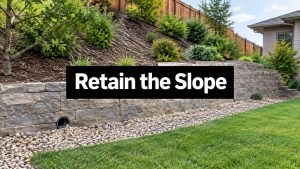
A retaining wall by itself is not a slope stabilization plan. It's one component. If the wall doesn't include the right backfill, compaction, pressure relief, and water management, you're building a very expensive failure point.
Why walls fail
Most residential wall failures come from trapped water and poor base preparation. Hydrostatic pressure builds behind the wall, the soil mass gets heavier, and movement starts. You might first notice bulging, cracking, leaning, or separation at the cap and joints.
That's why I push integrated systems. A wall needs drainage behind it and below it. Depending on the site, that can include free-draining aggregate, perforated collection lines, French drains, weep holes, swales, and discharge planning that doesn't move the problem to another part of the yard.
Where MSE walls fit
For steeper sites, Mechanically Stabilized Earth walls deserve serious attention. They use compacted backfill reinforced with high-strength geotextiles or steel grids, enabling slope angles up to 70° to 80° while maintaining an FoS of at least 1.5 against internal and external failure modes, with reinforcement tensile resistance in the 50 to 150 kN/m range and accommodation for 2% to 3% strain without structural distress, according to the MSE wall design reference here.
That sounds technical because it is. The homeowner takeaway is simpler. MSE systems let engineers build steep, reinforced landforms that handle movement better than many conventional wall setups.
The combination that works best
For many Austin properties, the strongest approach is layered:
- Grade correction first so runoff has a controlled path
- Retaining structure second where soil needs physical restraint
- Subsurface drainage throughout so water doesn't build pressure
- Surface finish last whether that's turf, planting, gravel, or pavers
If you're exploring design directions, these retaining wall design ideas for residential landscapes can help you think about aesthetics. Just remember that appearance should follow engineering, not replace it.
A wall should relieve pressure, not collect it.
Stabilization for Artificial Turf Landscapes
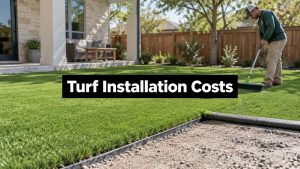
Artificial turf on a slope is where a lot of expensive mistakes happen. Homeowners see a clean, low-maintenance finish and assume the hard part is choosing the turf product. It isn't. The hard part is what sits underneath it.
Turf doesn't fix a bad slope
If the subgrade is unstable, turf can shift, wrinkle, bubble, or funnel water in ways that shorten the life of the install. On slopes, the risk gets worse because water moves faster and gravity keeps pulling at every layer beneath the surface.
One of the most overlooked issues is how to stabilize the hill without trapping water at the turf-soil interface. That question is often skipped in generic guides. A more reliable approach uses geosynthetic reinforcement such as geogrids to improve soil strength while also supporting drainage, which helps prevent water pooling that can void turf warranties, as noted in this discussion of slope stabilization methods for turf-related installations.
What a proper turf slope build needs
A good hillside turf system usually includes several buried decisions that nobody sees after the job is done:
- Subsurface drainage planning so runoff and groundwater don't sit under the turf
- Reinforcement layers such as geogrids where the slope needs added internal stability
- Compacted base preparation matched to the angle and use of the area
- Edge restraint and transitions that keep seams and borders from creeping downhill
If any of those pieces are skipped, the turf may still look good on install day. That's not the standard that matters. The standard is whether it still performs after repeated storms and regular foot traffic.
Where turf makes sense on a slope
Turf can be a strong solution when the slope has already been engineered for drainage and stability. It creates a clean finish, reduces routine yard work, and works well in contemporary outdoor spaces where homeowners want a polished look without the headache of trying to keep natural grass alive on an awkward hill.
If you're comparing approaches for a steep backyard, these low-maintenance hillside landscaping ideas are useful for the design side. The key is to treat turf as the finish layer, not the stabilization method.
Choosing the Right Solution for Your Property
The right answer depends on what the slope is doing, what you want the yard to become, and how much ongoing maintenance you're willing to tolerate. I'd rather tell a homeowner an inconvenient truth upfront than let them spend money on the wrong category of fix.
If you want the lowest-maintenance result
Go structural or integrated. Retaining walls paired with drainage and soil reinforcement usually cost more upfront, but they're often the smarter long-term choice for Austin properties with serious runoff, steep grade, or premium finish materials.
That's especially true if you're adding turf, a patio edge, steps, or clean architectural planting beds. Those features need a stable platform.
If you want the most natural look
Vegetation can work, but only if you understand the maintenance reality. Bioengineering solutions like vegetation can have hidden ownership cost. In drought-prone zones like Austin, transplants may have only 50% survivability without precise watering, turning the project into a 3 to 5 year active maintenance commitment, according to the coastal and steep-slope bioengineering reference here.
That's the part many contractors gloss over. Plants don't equal permanence. On the wrong slope, they equal replanting.
A blunt decision filter
Use this filter before you commit:
- Choose vegetation-first if the slope is mild, aesthetics matter most, and you're prepared to maintain it.
- Choose a wall-based system if you need usable flat space or reliable grade retention.
- Choose reinforced subsurface solutions if the hill shows movement, washout, or repeated instability.
- Choose a combined system if you're investing in high-end landscaping and want it to last.
If the slope already has a history of erosion, don't ask a decorative solution to do an engineering job.
Secure Your Property with Expert Guidance
Slope work is one of those projects where honesty matters more than polish. You need somebody to tell you whether the underlying issue is drainage, grade, wall design, reinforcement, or a combination of all four. You also need to hear what won't work, even if it's the cheaper idea.
That's how trust gets built. To gain immediate trustworthiness and secure appointments, service providers need to be transparent, explain the why behind recommendations, and answer questions truthfully so homeowners don't feel a hidden agenda, as outlined in this guidance on transparent communication that builds client trust.
What a trustworthy recommendation sounds like
A good advisor doesn't rush you into the biggest project. They explain where water is moving, which risks are cosmetic versus structural, and what trade-offs come with each option. They also tell you if a lower-cost approach is realistic, or if it's just delaying a larger repair.
That kind of conversation makes scheduling a site visit feel less risky, not more. You're not agreeing to be sold. You're agreeing to get a clear read on the property.
What you should ask before booking
- What's causing the slope to fail
- Which parts of the fix are mandatory
- How drainage will be handled
- What maintenance the finished system will still require
- How the stabilization plan affects turf, walls, or other upgrades you want
If a contractor answers those questions clearly, you're talking to the right team. If they dodge them, keep your wallet closed.
If you want a clear, honest plan for your yard, schedule a consultation with Modern Yard Landscapes. They handle slope stabilization, drainage, retaining walls, and artificial turf with the kind of site-specific thinking Austin properties demand. You'll get straightforward recommendations, transparent explanations, and a path to a yard that looks better because it's built on something stable.