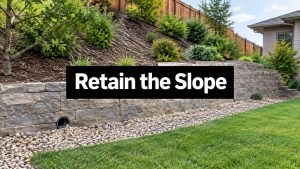

Most homeowners looking up the cost to install a retaining wall will see a national basic range of $35.41 to $48.62 per square foot. That's a useful starting point, but for Austin yards with clay soil, runoff, and slope, that number is only the beginning of the story.
If you're reading this, you're probably dealing with a yard that looks fine from the patio and terrible once you walk it. Maybe the fence line is washing out. Maybe the back corner stays soggy. Maybe you've got a slope you can't mow safely, and every hard rain sends mulch and soil downhill.
That's when people start searching for a price per square foot. Fair enough. But a retaining wall isn't like buying flooring or sod where you can plug in a rough area and get close. On retaining walls, the number that matters least at the start is often the number people ask first.
A wall can look simple and still require serious base work, drainage, excavation, hauling, and sometimes engineering. Another wall can be longer than you expected but cheaper to build because the site is open, the height stays low, and water moves the right way. That's the inside baseball most quotes leave out.
A smart buyer in Austin shouldn't ask only, “What's your price per foot?” Ask, “What is this wall doing, and what has to happen behind it so it doesn't fail?”
Your Guide to Retaining Wall Costs in Austin
A lot of Austin retaining wall jobs start the same way. A homeowner buys a house with a sloped backyard, figures they'll add a few plants and maybe level out one section later, then one wet season exposes the underlying problem. Soil starts moving. The lower part of the yard turns mushy. The usable space shrinks.
The first number people usually find is the national basic installation range. In May 2026, Homewyse estimated the basic cost to install a retaining wall at $35.41 to $48.62 per square foot in its cost model, and it specifically notes that site-specific factors like drainage, grading, and permits can push the total higher, which matters in places like Austin where those issues are common (Homewyse retaining wall cost data).
That's why I don't like giving homeowners a casual “ballpark” before seeing the property. It sounds helpful, but it usually creates the wrong expectation.
Why Austin yards throw off generic pricing
Austin lots have quirks that change a quote fast:
- Clay soil behavior means water doesn't always drain the way homeowners think it does.
- Slope and runoff patterns can force extra excavation and drainage work.
- Tight backyard access can turn a straightforward install into a labor-heavy project.
- Code and permit triggers can change a garden wall into a structural project.
Practical rule: If someone prices your wall like it's just stacked material and labor, they're probably ignoring the part that keeps it standing.
What a trustworthy quote should actually do
A useful retaining wall quote should explain the job, not just total it. You want to see whether the contractor has accounted for the wall height, base prep, drainage path, spoil removal, access, and whether any engineering review may be needed.
Here's the plain truth. The right wall for your yard might not be the cheapest-looking option on paper. But the wrong wall is always the expensive one, because you pay for it twice.
That's why the cost conversation in Austin has to start with the site. Not the material brochure. Not a rough square-foot guess. The site.
Comparing Retaining Wall Materials and Prices
Material matters, but not in the way most homeowners think. People focus on the cheapest installed price. They should focus on whether the material matches the job and how long it will realistically hold up.
National 2026 data shows most retaining wall projects land around $3,500 to $9,400, and material choice is one of the biggest reasons prices and lifespan vary. That same data notes timber can be the lowest upfront option at $15 to $25 per square foot, while segmental concrete blocks cost more but can last three to four times longer (LawnStarter retaining wall pricing guide).

Retaining wall material comparison
| Material | Avg. Cost / Sq. Ft. (Installed) | Lifespan | Maintenance Needs |
|---|---|---|---|
| Timber | $15 to $25 | Roughly 15 to 20 years | Higher |
| Segmental concrete block | Higher than timber | Three to four times longer than timber | Lower |
| Poured concrete | Varies by engineering and site | Long-term structural option | Moderate |
| Natural stone | Usually premium-priced | Long-lasting when built right | Moderate |
Timber works when budget is the boss
Timber gets attention because the upfront number is attractive. For a short garden edge or a modest retaining wall, that can make sense. But I'd be careful about building your whole plan around the lowest entry price.
Timber is a budget-first choice, not a longevity-first choice. If you already know you want a wall that feels permanent, timber usually isn't where I'd steer you.
Segmental block is the default choice for a reason
For most Austin homes, segmental concrete block is the practical middle ground. It looks clean, handles residential applications well, and usually gives homeowners the best balance of appearance, durability, and replacement cycle.
If you want to understand why certain materials hold up better outdoors, Ofir Engineering's material guide is worth reading. It's not a retaining wall pricing guide, but it does a good job explaining how material choice affects long-term performance.
Poured concrete is for cleaner lines and tougher demands
Poured concrete appeals to homeowners who want a modern look or need a more structural solution. It can be a strong option, but it's less forgiving when the site work and drainage are sloppy. A clean concrete face doesn't fix a bad foundation behind it.
For homeowners comparing base assemblies and what sits under the wall itself, this guide to retaining wall base material is worth reviewing before you approve a quote.
Cheap material and good material are not the same thing. A wall that lasts is usually the better deal, even when the invoice is higher on day one.
Natural stone is about character, not savings
Natural stone can look fantastic in Austin. On the right house, it feels like it belongs there. But nobody should choose stone because they think it's the budget option. They should choose it because they want the look and they understand they're paying for craftsmanship and material variation.
My recommendation is simple:
- Choose timber if the wall is small and upfront budget is your main concern.
- Choose segmental block if you want the safest value choice for most residential yards.
- Choose poured concrete when the design or structural demands call for it.
- Choose natural stone when appearance is driving the decision and you're ready to pay for that finish.
The Real Cost Drivers Beyond Materials
The final price of a retaining wall is usually decided by what happens before the first visible block or stone goes in. Homeowners see the face of the wall. Contractors deal with what's below grade and behind the wall. That's where the job is won or lost.

Site prep is not optional
A retaining wall sits on preparation, not hope. That means excavation, leveling, grading, and building the right base before the wall ever starts rising. If the wall footprint isn't cut properly into the slope, the whole job starts compromised.
Bad site prep is the reason some quotes look suspiciously low. They're leaving out work that still has to happen. You either pay for it upfront, or you pay for movement and failure later.
Drainage decides whether the wall survives
Water is the true enemy. Not the dirt. Not gravity by itself. Water pressure behind a wall is what wrecks a lot of installations.
For residential walls 3 to 6 feet high, poured concrete is commonly priced at $20 to $45 per square foot, but costs rise when the design needs reinforced footings, rebar, and extensive drainage layers to manage lateral earth pressure and water buildup (poured concrete retaining wall cost details).
That's not a concrete-only lesson. It applies to every material. Every wall needs a plan for drainage.
What should be included behind the wall
A proper quote should account for more than the visible finish. The wall may need:
- Gravel backfill so water doesn't sit against the structure
- Drain pipe or drain tile to move water to daylight or another approved outlet
- Filter fabric to keep fines from clogging the system
- Compaction in lifts so the soil behind the wall stays stable
If you want a plain-English breakdown of construction methods, how to build retaining walls gives a useful overview of what a proper assembly includes.
If a contractor talks a lot about the face material and barely mentions drainage, you're not hearing the most important part of the job.
Access and hauling change labor fast
Some Austin properties are easy. A machine can get right where it needs to go, material staging is simple, and excavated soil can be hauled efficiently. Others require hand-carrying block through a side gate, working around utilities, or navigating steep backyard access.
That labor difference is real. It's not padding. It's the physical reality of the site.
Permits matter too, but they don't show up the same way on every project. Sometimes they're minor. Sometimes they signal the wall has crossed into a completely different class of build.
Why a 4-Foot Wall Can Cost More Than a 3-Foot Wall
This is the part most homeowners never hear until they get a quote they don't like.
A small increase in wall height can completely change the project. Not because the contractor is trying to upsell you, but because height changes the engineering, the risk, and often the legal requirements.

The 4-foot wall rule
One of the biggest cost jumps happens when a wall crosses roughly 4 feet in height. Current cost guidance notes that this threshold can trigger engineering, reinforcement, and permit requirements, potentially shifting a project from the $3,500 to $10,000 range into the $15,000 to $25,000+ range (Colonial Newburgh retaining wall cost overview).
That's a massive difference, and it catches people off guard because the wall doesn't look dramatically taller. But structurally, it's a different animal.
What changes above that threshold
Once a wall gets into that category, the build often needs more than stacked units and backfill. You may be looking at:
- Engineering review or stamped plans
- More reinforcement
- Deeper or more substantial footing design
- Permit coordination and inspections
- A more serious drainage strategy
And if the wall is also dealing with runoff, you may need a broader site water plan, not just a wall. For that reason, some homeowners also look at drain tile system installation alongside the retaining wall itself.
A wall that looks only one foot taller to you can look like a liability to an engineer or city reviewer.
My advice if your yard needs more height
Don't force a single tall wall just because it seems cleaner on paper. In a lot of yards, terracing with multiple shorter walls is the smarter move. It can improve drainage, soften the look, and avoid turning the entire job into a more complicated structural build.
The bigger point is this. If a contractor doesn't bring up the 4-foot rule on their own, ask why. They should be talking about it before you sign anything.
Sample Austin Retaining Wall Project Estimates
Numbers make more sense when you can see the job in your head. These are the kinds of projects Austin homeowners commonly ask about, and they show why retaining wall pricing moves so much from one yard to the next.

The simple garden wall
A homeowner wants a low wall to define a bed, stop minor washout, and clean up the front yard. This is usually the most straightforward type of retaining wall project. The wall stays low, access is decent, and the build is more about organization and erosion control than major structural support.
In jobs like this, homeowners are often operating inside the broader national project ranges already discussed earlier. The price usually depends less on dramatic engineering and more on the finish material, shape, cap details, and whether drainage corrections are needed nearby.
The slope correction wall
This is a common Austin backyard problem. The owner wants to reclaim a section of sloped yard so it can be used. Maybe for play space, maybe for a seating area, maybe just so the yard stops washing into the lower fence line.
The cost to install a retaining wall can start climbing fast. Even if the wall face doesn't look huge, the quote can increase because the project may include excavation, base prep, spoil removal, drainage behind the wall, and height-related design changes. If the wall is flirting with the threshold discussed above, it can move from a non-structural element into a structural job very quickly.
The steep-access hillside project
Then there's the hard one. The lot is steep. Access is tight. Material has to be moved through a side yard or down a grade. The wall might need multiple tiers because a single tall wall isn't the smart solution.
For these projects, the visible wall is only part of the budget. The primary work is in logistics, sequencing, soil movement, and drainage planning. A quote that looks high on these jobs is often just a quote that's honest.
A rough way to classify your own project
| Project type | What usually drives the price |
|---|---|
| Low decorative wall | Material choice, curves, caps, finish details |
| Mid-height yard wall | Drainage, excavation, usable-space creation |
| Tall or tiered slope wall | Engineering, access, reinforcement, permits |
Most homeowners don't underbudget because they chose the wrong block. They underbudget because they didn't realize what the wall had to do.
If you're trying to estimate your own yard, don't just measure length. Look at height, water path, access, and what sits uphill from the wall. Those four things will tell you more than any online calculator.
Thinking Long-Term Your Wall's ROI and Property Value
A retaining wall is rarely just a wall. It creates usable yard space, controls erosion, and gives shape to land that may currently be wasted. In Austin, where outdoor living matters, that can make a big difference in how a property functions day to day.
That's why I think homeowners should stop treating this as a pure expense. A properly built retaining wall can turn a sloped, frustrating area into flat, workable ground for planting, play, seating, or drainage control. That's practical value you feel every week, not just when you sell.
Where the return actually comes from
The return usually shows up in three places:
- More usable space because the yard becomes easier to enjoy and maintain
- Less long-term damage risk from erosion and unmanaged runoff
- Better presentation because the property looks planned instead of patched together
If you're thinking about resale too, Trademaster's guide for homeowners is a solid read on the kinds of improvements buyers notice. It's broader than retaining walls, but the point holds. Functional outdoor upgrades tend to matter when they solve obvious property problems.
Cheap walls usually have bad ROI
A wall with weak drainage, poor compaction, or the wrong material choice can become a liability. It may lean, crack, bulge, or start moving soil where you were trying to stop it. That kind of work doesn't add confidence or value. It creates another project.
The better investment is the wall that solves the problem once. That's the true ROI.
Get a Transparent Quote from Modern Yard Landscapes
If you've made it this far, you can already see why retaining wall pricing gets messy. The good news is that a solid quote doesn't have to be mysterious.
A transparent quote should show what you're paying for and why. It should reflect the actual yard, not a canned square-foot guess. That means walking the slope, checking drainage patterns, looking at access, discussing material options, and identifying whether the wall is serving a purely aesthetic function or crossing into structural territory.
What to expect from a real site visit
A useful consultation should include:
- Site evaluation of slope, runoff, soil movement, and access
- Clear scope discussion so you know whether drainage, excavation, and hauling are included
- Material options with honest tradeoffs, not just the cheapest line item
- Height review so there are no surprises if the wall approaches a code threshold
If you're comparing contractors, review a company's local service focus and retaining wall offering before you call. For example, this page on retaining wall contractors near me shows the kind of service category you want to see from a contractor doing this type of work.
My recommendation
Don't hire the quote that sounds easiest. Hire the one that makes the job understandable.
In the Austin area, Modern Yard is one option for homeowners who want retaining wall work, drainage-aware site prep, and a factors-based estimate rather than a vague per-foot number. That's what you should expect from any contractor you consider.
The right next step is simple. Schedule the visit, walk the yard with someone who knows what to look for, and get the scope in writing before you decide.
If you want a retaining wall quote that accounts for the real issues on your property, not just a generic price per foot, contact Modern Yard Landscapes. We'll look at the slope, drainage, access, and wall height, explain what's driving the cost, and give you a clear path forward.