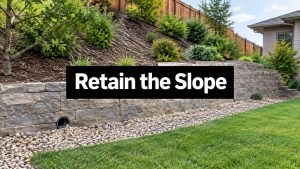

Retaining wall installation cost typically runs $20 to $53 per square foot, and most residential projects land between $3,500 and $10,000. In real life, though, the final number usually comes down to your site conditions, your material choice, and whether your wall is acting as simple landscaping or doing serious structural work.
If you're researching this right now, you're probably looking at a slope that keeps washing out, a yard you can't use well, or a wall that's already leaning and making you nervous. Around Austin, those problems get more expensive when someone prices the job like a basic garden feature and ignores what the ground is doing. Rocky soil, drainage paths, tight side-yard access, and elevation changes can turn a cheap-looking quote into a frustrating project fast.
The good news is that retaining wall pricing isn't mysterious once you break it down properly. A solid estimate should explain what you're paying for, where the risk is, and what corners should never be cut.
The Big Picture on Retaining Wall Costs
A realistic starting point is this. Most residential retaining wall projects in major U.S. markets fall in the $3,500 to $10,000 range, with a national average near $6,300. On a unit basis, that works out to roughly $20 to $53 per square foot or $40 to $300 per linear foot, depending on height, material, and site complexity, according to this retaining wall cost guide.
That range is wide for a reason. Two walls can look similar in photos and cost very differently to build. One might sit on an easy, accessible section of yard with stable soil and straightforward drainage. The other might require cutting through hard ground, moving spoil through a narrow gate, rebuilding drainage behind the wall, and adding engineering because of height or load.

What drives the number up or down
The headline price is only the top layer. The total cost comes from a mix of factors:
- Wall purpose: A decorative garden wall is different from a wall that has to hold back a serious slope.
- Material choice: Stone, concrete, wood, and vinyl sit in different budget bands and perform differently over time.
- Height and pressure: Taller walls carry more load and often trigger reinforcement, engineering, and permit requirements.
- Site conditions: In Austin, rocky excavation and drainage corrections often matter as much as the visible wall face.
- Access: If crews can't bring equipment where it needs to go, labor rises quickly.
A lot of homeowners compare retaining wall projects the same way they compare a patio or fence. That's understandable, but it can lead to bad assumptions. A retaining wall behaves more like a structural outdoor element. If the soil, drainage, or grading is wrong, the wall doesn't just look bad. It can move, crack, bulge, or fail.
Cheap wall pricing often means expensive omissions. Drainage, excavation, reinforcement, and base prep are the first places weak bids hide their shortcuts.
If your project also has drainage issues below grade, it's smart to understand adjacent repair categories too. Homeowners comparing outdoor infrastructure costs sometimes find the cost of trenchless pipe lining helpful because it shows the same pattern: the visible surface work is only part of the budget when underground conditions are involved.
For Austin-specific planning, it's worth speaking with experienced retaining wall contractors near you who can evaluate the slope, access, and drainage in person instead of guessing from photos.
A Line-Item Breakdown of Your Project Quote
A trustworthy quote shouldn't be one lump sum with no explanation. It should show you what the wall needs to perform, not just what it costs to look finished on day one.
Homewyse puts base installation at $35.41 to $48.62 per square foot and notes that actual cost can vary significantly with site conditions and options. The same source also notes that permitting alone can add $1,000 to $4,000 depending on local jurisdiction, which is why hidden engineering and site requirements matter so much in final pricing, as shown in this installation cost breakdown.
Materials and visible construction
This is the part most homeowners expect to pay for. It includes the wall block, stone, timber, or other facing material, plus caps, base aggregate, backfill rock, drainage components, and finishing pieces.
A quote that only lists the face material is incomplete. The wall you see is only one system component. The base beneath it and the drainage behind it often determine whether the installation holds up.
Labor and equipment
Labor covers layout, excavation, hauling, base prep, compaction, setting the wall, backfilling, cleanup, and detail work. Equipment costs may be built into labor or listed separately, especially when access is tight or excavation is difficult.
In Austin, this line can change fast if crews hit shallow rock or if material has to be moved by hand through a side gate. A wall in an open backyard is one kind of job. A wall behind a house with limited access is another.
Practical rule: If a bid is much lower than the others, ask what it excludes before you ask why it's cheaper.
Site preparation and drainage
Budget surprises often emerge during site preparation. This phase can include grading, cutting into a slope, removing old wall material, exporting soil, and stabilizing the footprint before the first block or stone goes in.
Drainage work matters just as much. Water pressure is one of the main reasons retaining walls fail. A proper system typically includes free-draining backfill and a path for water to move away from the wall instead of building up behind it.
Common quote items in this category include:
- Excavation: Digging the trench, cutting the slope, and removing spoil.
- Base preparation: Compacting a stable foundation so the wall doesn't settle unevenly.
- Drainage components: Perforated pipe, gravel backfill, outlets, and filter separation where needed.
- Regrading: Shaping the area above and below the wall so water moves where it should.
If you want a clearer picture of how proper assembly works from base to backfill, this guide on how to build retaining walls is useful because it shows why the hidden layers matter as much as the finished face.
Engineering and permits
Not every wall needs engineering, but many taller or load-bearing walls do. If a wall supports a driveway, sits near a structure, handles a strong slope, or crosses height thresholds, professional design may be part of the right solution.
Permits belong in the same conversation. They aren't glamorous, but they're part of doing the job correctly. If a quote ignores permit or engineering risk altogether, that's not transparency. That's postponing the conversation until after work starts.
How Material and Wall Height Drive Your Budget
Material selection changes both the price and the long-term behavior of the wall. According to this retaining wall material cost guide, professionally installed vinyl walls run about $10 to $15 per square foot, wood about $13 to $35 per square foot, concrete about $30 to $50 per square foot, and natural stone about $30 to $75 per square foot. The same source notes labor commonly runs $50 to $75 per hour and can account for 40% to 50% of the final project price.
That tells you something important. Homeowners often focus on material price first, but labor and installation complexity can narrow or widen the gap quickly. A heavy natural stone wall with difficult access can climb for reasons that have nothing to do with the stone invoice alone.
Material trade-offs that matter
Not every material belongs on every site.
| Material | Avg. Installed Cost / Sq. Ft. | Estimated Lifespan | Best For |
|---|---|---|---|
| Vinyl | $10 to $15 | Varies by product and conditions | Light-duty, shorter landscape walls where budget matters most |
| Wood | $13 to $35 | Shorter-lived than block or stone | Rustic looks and lower upfront cost |
| Concrete | $30 to $50 | Long-term durability depends on design and installation | Clean lines, structural performance, versatile residential use |
| Natural stone | $30 to $75 | Long-lasting with proper construction | Premium appearance, custom work, homes where aesthetics lead |
Wood can make sense for a simple, lower wall where the goal is cosmetic improvement and the budget is tight. Concrete block is often the practical middle ground because it balances structure, appearance, and repeatable installation. Natural stone usually fits homeowners who care a lot about the finished look and are willing to pay more for it.
If you're pairing a wall with hardscape work, this look at a retaining wall for a paver patio can help you think through how material choice affects the overall yard design.
Height changes everything
Wall height doesn't just mean more blocks or more stone. It changes the engineering problem.
As walls get taller, the load behind them increases. That can mean deeper excavation, a broader base, reinforcement, stronger backfill strategy, and tighter tolerances. It can also move a project out of the “decorative feature” category and into a more structural one.
What typically doesn't work is picking a material because it's cheapest on paper, then asking it to do a job better suited to a stronger system. That's how homeowners end up replacing a wall sooner than they expected or paying for repairs that could've been avoided with a better design upfront.
The Hidden Factors That Impact Final Cost
The biggest mistakes in retaining wall budgeting usually come from the parts homeowners can't see from the patio. Slope behavior, drainage, reinforcement, and excavation conditions decide whether a quote is realistic.
According to Angi's retaining wall cost guide, retaining walls over 3 feet tall need rebar reinforcement, permit costs commonly run $50 to $450, and drainage excavation can add $60 to $70 per linear foot. Those numbers explain why “cost per foot” is often the wrong first question. The better question is what the site requires for the wall to stay put.

Austin ground conditions can change the whole job
In Austin, one of the most common pricing pivots is excavation. Some yards dig easily. Others hit caliche, fractured limestone, or stubborn rock shelves that slow production and increase hauling, equipment wear, and labor.
Access is another big one. If a machine can't reach the wall area, crews may need to move material with wheelbarrows, compact in smaller lifts, and spend more time on every phase. That doesn't make the job overpriced. It makes the quote honest.
Drainage is not a cosmetic upgrade
Water behind a retaining wall is pressure. Pressure is movement. Movement is failure.
A lot of low bids understate drainage because it isn't what the homeowner sees at the end. But drainage pipe, clean backfill, and water routing are what protect the wall after the first major storm.
If your property already struggles with runoff or soggy areas, a broader drainage plan may belong in the same conversation. This guide on drainage tile installation cost is useful for understanding how subsurface water management can affect the total project scope.
A retaining wall that ignores drainage is a repair project waiting for weather.
Reinforcement, permitting, and risk
Once a wall climbs in height or supports meaningful grade pressure, reinforcement becomes part of doing the job right. So do permit conversations. Those items aren't “extras” in truth. They're part of the cost of a compliant, durable installation.
From a contractor side, legitimate pricing also reflects insurance, trained labor, and the kind of risk management that keeps projects safe. Homeowners who want to understand that side of job costing may find these Coverage Axis X-mod insights helpful, since they show how safety and workers' compensation experience affect business overhead in construction trades.
Sample Austin Retaining Wall Project Budgets
Nationally, a practical benchmark for professional installation is $20 to $53 per square foot, with an average near $33 per square foot. On a project basis, the national average is $6,300, while typical homeowner spend falls around $3,500 to $9,400, according to this national retaining wall pricing guide.
That benchmark is useful, but homeowners usually want to know what a project like theirs might feel like in practice. Here are three common Austin scenarios.
Small front-yard garden wall
A homeowner wants to clean up a sloped front bed, stop mulch from washing out, and create a sharper border along the lawn. The wall is relatively short and meant to organize the outdoor space more than hold back a major grade change.
This kind of project often lives near the lower end of the typical national project range when access is easy and drainage demands are limited. It's usually the most straightforward category to price because the risk is lower and the wall behaves more like outdoor structure than site stabilization.
Mid-height backyard terracing wall
This is common in suburban Austin. The backyard has a usable area problem, not just a visual problem. The homeowner wants a flatter section for seating, turf, play space, or a future patio.
The budget usually moves into the middle of the typical range because the wall is doing more work. Excavation, compaction, backfill, and drainage become more consequential. Material selection matters too, especially if the wall will be a visible focal point from the house.
The wall itself may be only one part of the project. Creating usable yard space often means the grading work around it carries just as much value.
Taller engineered hillside wall
This is the project where bad quoting causes the most pain. The property has a meaningful slope, visible runoff, and signs that water management can't be ignored. The wall may need reinforcement, permit review, and closer attention to how surface and subsurface water move through the site.
These projects usually push toward the high end of the typical range and can go beyond it when complexity stacks up. The expensive part isn't only the height. It's the combination of structural demand, excavation difficulty, drainage correction, and access.
What works here is a complete plan. What doesn't work is pricing it like a decorative wall and hoping field conditions stay simple.
Considering Your Retaining Wall's Return on Investment
A retaining wall is easy to think of as a cost because the invoice is visible. The better way to look at it is as a property improvement that solves a site problem and makes outdoor space more usable.
In Austin, the return often starts with function. A well-built wall can turn a sloped, frustrating part of the yard into level space you can use. It can also help control erosion, organize drainage, and protect nearby landscaping from repeated washout.
Upfront price versus long-term value
A cheap material isn't always the low-cost choice over time. According to Colonial Newburgh's retaining wall cost analysis, timber is the cheapest option at about $15 to $25 per square foot installed, has a lifespan of about 15 to 20 years, and isn't recommended above 3 feet. The same source says segmental concrete block costs about $20 to $35 per square foot and lasts three to four times longer.
That's the kind of trade-off homeowners should think about before choosing based only on the first quote. If a site has moisture exposure, real grade pressure, or a taller height requirement, a lower upfront option can become the more expensive path once replacement, maintenance, or failure risk enters the picture.
Where homeowners usually see the payoff
A good retaining wall can improve value in several ways:
- Usable space: Flat, functional areas are easier to enjoy and easier to design effectively.
- Erosion control: Keeping soil where it belongs protects beds, paths, and adjacent improvements.
- Drainage performance: Water managed correctly causes fewer headaches later.
- Curb appeal: The wall becomes part of the home's finished look instead of a visible problem area.
- Confidence: You're less likely to face a preventable rebuild because the wall was underbuilt from the start.
The strongest return doesn't come from buying the fanciest wall. It comes from matching the design, material, and drainage approach to what the property needs.
How to Get an Accurate Estimate for Your Project
The best estimate starts with a site visit, not a texted photo and a rough price. Retaining wall installation cost is too dependent on slope, soil, drainage, height, and access to price responsibly from guesses.
A solid process is simple and low-stress when everyone is working from the same information.

What to have ready before the visit
Bring whatever helps explain the problem clearly:
- Photos of the area: Wide shots, problem spots, and anything that shows runoff or slope issues.
- Your goals: Are you trying to stop erosion, create level yard space, replace a failing wall, or improve appearance?
- Material preferences: If you like natural stone, segmental block, or a cleaner modern look, say so early.
- Access details: Gate width, side-yard clearance, fences, utilities, and anything else that affects equipment access.
- Survey or plans if you have them: These can help with layout and property-line conversations.
What to ask when comparing quotes
Not every estimate is equally thorough. Ask direct questions.
- What's included in the base price? You want clarity on excavation, drainage, backfill, cleanup, and finish work.
- What could change the cost after work starts? Good contractors can usually point to the likely variables.
- Will engineering or permits be needed? Even if the answer depends on final design, the issue should be discussed.
- How is drainage being handled? If the answer is vague, that's a warning sign.
Homeowners who want to understand how reputable companies build pricing can also look at these effective pricing strategies for contractors. It gives helpful context for why detailed, transparent quotes are healthier than vague low numbers.
A practical site visit checklist
Before scheduling, jot down three things:
- Where the water goes now
- How tall the wall likely needs to be
- What result matters most to you, function, appearance, or both
That short list makes the appointment more productive and usually leads to a more accurate conversation from the start.
If you're in the Austin area and want a retaining wall estimate that accounts for slope, drainage, access, and material choices before the surprises show up, contact Modern Yard Landscapes. A detailed site visit is the fastest way to get a realistic plan, a durable design, and a quote you can trust.