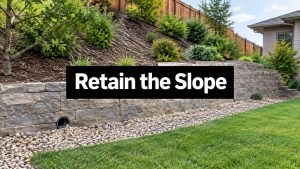

Retaining wall cost usually starts at $20 to $53 per square foot nationally. In Austin, that number is only the starting point, because clay soil, slope, drainage, and access can quickly affect the budget.
If you're reading this, there's a good chance your yard is doing one of three things. It's washing out after storms, it has a slope nobody uses, or it's holding back the landscaping plans you want. A retaining wall fixes those problems, but only if it's built for Central Texas conditions.
A lot of online guides give you a neat national average and stop there. That's not enough for Austin homeowners. The actual cost of a retaining wall here depends less on the brochure version of the material and more on what's happening under the surface.
Your Guide to Austin Retaining Wall Costs
A common Austin scenario looks like this. The backyard drops off harder than it seemed during the home tour, water keeps moving soil downhill, and the lower part of the lot turns into a muddy strip every time we get a decent rain. The homeowner starts searching retaining wall cost and sees broad national numbers that sound useful, but they don't explain what happens when that wall sits on expansive clay.
The national baseline is still worth knowing. A professionally built retaining wall typically ranges from $3,500 to $9,645, or about $20 to $53 per square foot, according to Lawn Love's retaining wall cost guide. That gives you a reasonable starting point for budgeting.
Practical rule: Use national averages to set expectations, not to approve a contractor or a design.
In Austin, local conditions decide whether your project stays near the baseline or moves well beyond it. A simple wall on a cooperative site is one thing. A wall on a steep lot with poor drainage, tricky access, and moving clay is a different project entirely.
Here's what I tell homeowners who want the straight answer:
- Material matters, but it's not the whole story.
- Height changes everything, because taller walls need more structure.
- Drainage isn't optional, especially in Central Texas soils.
- Cheap bids usually hide risk, not efficiency.
The right way to budget a retaining wall is to think like a builder, not a shopper. You're not just buying blocks or concrete. You're paying for excavation, base prep, drainage, reinforcement, engineering when required, and a design that won't lean, crack, or trap water.
Decoding Prices Per Foot and Square Foot
Retaining wall quotes confuse a lot of homeowners because contractors don't always price the same way. One company talks in linear feet. Another talks in square feet. If you don't know the difference, it's hard to compare bids fairly.
The simplest way to think about it is this. Linear foot pricing is like pricing a fence. Square foot pricing is like pricing flooring. One measures length. The other measures height times length.
For walls between 2 and 6 feet tall, costs typically range from $40 to $360 per linear foot, and taller walls are often quoted by the square foot because that better reflects the added material and engineering, according to GreenOp Landscape's 2025 retaining wall pricing guide.
When linear foot pricing makes sense
If the wall height is fairly standard and the site is straightforward, linear foot pricing can be a practical shortcut. It gives homeowners a fast ballpark number without forcing a long conversation about geometry.
That works best when the contractor already knows the wall type and the design won't vary much across the run.
When square foot pricing is the better number
Square foot pricing becomes more honest when the wall height grows or changes along the yard. A wall that's longer and taller doesn't just use more material. It also demands more excavation, more backfill management, and more structural thinking.
If two quotes use different units, don't compare the totals until you convert them to the same basis.
Use this quick check before you sign anything:
- Ask what the measurement covers. Does it include drainage, reinforcement, excavation, and cleanup, or just the visible wall face?
- Confirm the average and max height. A wall that starts low and ends tall should not be priced like a uniform garden border.
- Look for design assumptions. If one bid assumes easier access or less excavation, it may look cheaper on paper and cost more later.
A good quote should make the pricing logic obvious. If it doesn't, that's a warning sign.
Cost Breakdown by Retaining Wall Material
Material is the part most homeowners focus on first, and that's understandable. It's visible, it affects curb appeal, and it has a big influence on retaining wall cost. But the smart move is to compare materials by price, lifespan, and fit for Austin conditions, not by upfront number alone.
The broad ranges are straightforward. Timber usually lands at $10 to $40 per square foot and lasts about 15 to 25 years. Concrete block walls run about $15 to $55 per square foot. Natural stone sits at the premium end at $25 to $85 per square foot and can last 100+ years, based on the cost ranges summarized in the verified national data.
Side by side material comparison
| Material | Estimated Cost per Sq. Ft. | Typical Lifespan | Best For |
|---|---|---|---|
| Timber | $10 to $40 | 15 to 25 years | Budget-minded projects, garden walls, rustic yards |
| Concrete blocks | $15 to $55 | Long-lasting option | Most residential yards, clean lines, flexible designs |
| Natural stone | $25 to $85 | 100+ years | Premium landscapes, high-visibility walls, long-term value |
Timber
Timber is the low-entry option. It can look good in the right setting and it works for simpler walls where the goal is basic grade separation, not a long-lived structural feature.
The downside is durability. In Austin heat and moisture swings, timber is usually the material homeowners replace sooner than they expected. If you're planning to stay in the house a long time, timber often looks cheap only at the beginning.
Concrete block
Concrete block is the practical middle ground. It gives you cleaner installation options, a broader design range, and a better balance between price and service life. For most residential properties, this is the material I'd put on the shortlist first.
It also plays well with the kind of stepped and tiered layouts that make sloped yards useful again. If you want inspiration before you choose a wall type, these retaining wall design ideas show the kinds of layouts that work well in modern Austin yards.
Concrete block is often the best value choice when you want durability without paying stone prices.
Natural stone
Natural stone is expensive for a reason. It delivers the strongest visual impact, and it can hold up for generations when the base, drainage, and wall design are done right.
The mistake is choosing stone for appearance alone. If the site prep is weak, premium stone on a bad foundation still fails. Good-looking materials don't rescue bad construction.
My recommendation
If you want the best mix of cost control and long-term performance, start with concrete block. Choose timber only for smaller, lower-risk applications. Choose natural stone when appearance matters enough to justify the premium and you're committed to doing the structure correctly from day one.
Beyond the Bricks Austin-Specific Cost Factors
Most retaining wall cost articles spend too much time on the face material and not enough on the conditions behind it. In Austin, that's backwards. The hidden work below grade is often what determines whether the wall lasts or fails.

The biggest local issue is expansive clay. Austin's clay-heavy soils often require 20% to 50% more investment in foundation depth and drainage reinforcement, which can add $5 to $15 per square foot, according to LawnStarter's retaining wall price overview. That's the kind of cost homeowners miss when they compare a local bid to a generic national average.
Clay soil changes the job
Clay doesn't behave like stable, forgiving fill. It swells when wet, shrinks when dry, and pushes against structures in ways that punish weak design. If the wall doesn't have the right base and water management, the pressure shows up later as movement, cracking, bulging, or leaning.
That's why the cheapest wall on paper is often the most expensive wall over time.
Drainage is the part you can't skip
A retaining wall is not just a stack of material holding back dirt. It's a drainage system with a wall attached to it. If water gets trapped behind the structure, the wall has to resist more pressure than it was meant to handle.
For many Austin properties, drainage upgrades belong in the same conversation as the wall itself. If water already collects in the yard, these yard drainage solutions are often part of the actual fix, not an optional add-on.
Most wall failures I see don't start with the visible face. They start with bad drainage and weak prep behind the wall.
Access, slope, and permits
Two walls with the same dimensions can cost very different amounts if one has easy machine access and the other sits behind a narrow gate on a steep lot. Hauling material by hand, cutting into a hill, and staging equipment in tight spaces all drive labor complexity.
Permitting matters too. Once wall height reaches the threshold where structural compliance comes into play, the project gets more serious. That's not red tape for the sake of red tape. It's there because taller retaining walls can create real risk if they're not designed correctly.
Here's the blunt version:
- Difficult access raises labor burden
- Steep slopes increase excavation and stabilization work
- Poor drainage raises failure risk
- Expansive clay demands deeper, smarter prep
- Permit-triggering wall heights remove guesswork from the process
If a contractor barely talks about any of that, they're either oversimplifying the job or trying to get in the door with a low number.
DIY vs Professional Installation A Clear-Eyed Comparison
DIY retaining walls appeal to a lot of homeowners because the visible part looks manageable. Stack material. Level it. Backfill it. Done. For a small decorative garden wall, that instinct isn't crazy.
For a true retaining wall on an Austin slope, that instinct gets people in trouble.

Where DIY can make sense
If the wall is small, non-structural, and mostly decorative, a skilled homeowner can sometimes pull it off. The appeal is obvious. You control the pace, you avoid hired labor, and you get the satisfaction of building it yourself.
That's the best-case version.
Where DIY usually breaks down
Retaining walls fail for boring reasons, not dramatic ones. The base isn't compacted well enough. Drainage isn't planned correctly. The first course is slightly off. Backfill is wrong. Water pressure builds. Soil moves. Then the wall starts telling the truth.
If you're trying to understand why contractor pricing can look high compared to your material list, Constructo Marketing's guide to general contractor markup is worth reading. It gives useful context on what homeowners are paying for beyond raw materials.
Here's the decision framework I'd use:
- Choose DIY if the wall is low-risk, decorative, and failure won't damage drainage patterns or usable space.
- Choose a pro if the wall is holding back meaningful soil, touches grading, or needs to last.
- Definitely choose a pro if permits, structural review, or difficult site conditions are involved.
Why professional installation usually wins
Professional installation is not just labor. It's design judgment, site prep discipline, code awareness, and accountability if something goes wrong. That matters a lot more with retaining walls than with many other outdoor features.
If you want to see what goes into doing the job correctly, this guide on how retaining walls are built helps clarify why the visible face is only one part of the work.
A retaining wall only looks simple after an experienced crew handles the hard parts you never see.
The cheapest way to build a retaining wall is to build it once. That usually means professional installation.
Real Austin Project Costs from Modern Yard Landscapes
Numbers make more sense when they look like real jobs. Here are the kinds of situations Austin homeowners deal with, and how retaining wall cost tends to show up in practice.

Scenario one, a straightforward poured wall
A typical 4-foot-high by 50-foot-long poured concrete wall in Austin runs about $6,800 to $7,400, and an engineer-stamped design adds $200 to $500 when required, based on Austin retaining wall pricing from ProMatcher. That's a useful reference point because it reflects a common residential wall size.
This kind of job usually fits homeowners who need a clean structural solution and want a durable wall profile without going decorative first.
Scenario two, a sloped backyard with access issues
Take that same basic wall idea and put it behind a home with a narrow side yard, a sharper grade change, and limited equipment access. The visible wall might not change much, but the work does. Material handling gets slower, excavation gets fussier, and drainage details become less forgiving.
That's where homeowners get burned by low estimates. The quote looked competitive because it treated a difficult site like an easy one.
Scenario three, a wall tied into a larger landscape plan
A retaining wall often isn't a standalone project. It's part of creating usable yard space, protecting new turf, reshaping drainage, or building tiers for planting and access. In those cases, the wall cost has to be judged as part of the full outdoor layout, not as an isolated line item.
If you're comparing local options, working with retaining wall contractors near you who understand Austin soils and grading patterns matters more than finding the lowest number online.
Here's the key lesson from real projects:
- Simple dimensions do not guarantee a simple build
- Site conditions change labor more than homeowners expect
- Engineering and drainage can be the difference between a fair quote and a bad shortcut
The most useful estimate is the one based on your actual lot, not somebody else's generic wall.
Your Top Retaining Wall Questions Answered
Do I need a permit for a retaining wall in Austin
If the wall reaches the local threshold where structural review is required, treat permitting as part of the job from the start. That's not the place to improvise. A good contractor should identify that issue early and tell you plainly what applies.
What's the biggest mistake homeowners make on retaining wall cost
Most owners focus on the visible material while overlooking the site itself. The block, timber, stone, or concrete receives the most attention, yet the success of the project depends on excavation, drainage, base prep, and whether the design fits Austin soil conditions.
Is the cheapest bid ever the best value
Usually not. Low bids often leave out the ugly but necessary work. If a contractor is vague about drainage, access, wall reinforcement, or how they're handling clay, you're not looking at savings. You're looking at deferred problems.
How should I compare quotes
Use a short checklist:
- Scope clarity: Does the bid spell out excavation, base prep, drainage, cleanup, and any engineering needs?
- Site assumptions: Did the contractor account for slope, soil, and access?
- Material honesty: Are you comparing the same wall system, not just similar-looking finishes?
Good retaining wall quotes answer the uncomfortable questions before you have to ask them.
What's the smartest next step
Get an on-site evaluation from a local team that understands Central Texas soils and won't give you a fantasy number just to win the call. A retaining wall is one of those projects where local judgment matters as much as construction skill.
If you want a retaining wall that holds up in Austin, talk to Modern Yard Landscapes. They're fully insured, they understand drainage and grade work, and they build with the kind of site-specific planning that keeps a wall from becoming an expensive redo. Schedule an appointment and get a quote based on your yard, your soil, and your slope, not a generic online average.