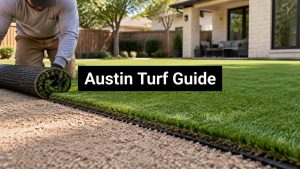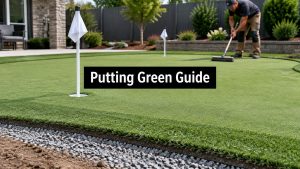

You're probably looking at a patch of yard and thinking the same thing most homeowners do at the start of this project: it doesn't seem that complicated. Clear the space, bring in base material, roll out turf, cut in a few cups, done.
That's the part that trips people up.
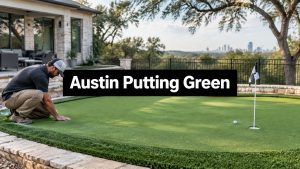
A backyard putting green looks simple when it's finished, but the playing quality comes from what you don't see. In Austin, that matters even more. Clay-heavy soil, sudden downpours, hard summer heat, and yards with subtle drainage problems can turn a nice-looking DIY green into a bumpy, slow-draining surface that never putts right.
If you're researching how to build a backyard putting green, it helps to think like an installer first and a golfer second. The green has to fit the yard, shed water, hold its grade, and keep a consistent roll. If any one of those pieces is off, you'll notice it every time you putt.
Planning Your Perfect Backyard Green
A good putting green starts on paper. Shape, size, cup placement, fringe, approach area, and drainage all need to work together before anyone excavates a single inch.

Start with how you'll actually use it
Some homeowners want a compact practice green for short putts. Others want a larger feature that feels like part of the yard and gives family or guests more variety. Both can work, but the design should match the purpose.
The first questions I'd answer are simple:
- Practice first or visual centerpiece
If your goal is repetition and skill work, keep the layout clean and the breaks subtle. - Single-user or social space
A family green usually benefits from a little more surface area and more than one cup location. - Pure putting or short-game feel
If you want chips and bump-and-runs, the surrounding fringe and transitions matter as much as the green itself.
Size affects both play and budget. The average residential putting green is around 500 square feet, and professional synthetic builds are commonly priced at about $15 to $40 per square foot according to Motz's backyard putting green planning guide. That's why layout decisions made early save expensive redesign later.
Fit the design to the yard, not the other way around
Backyard greens rarely sit in a perfect open rectangle. Fences, patios, pool decks, tree lines, and drainage routes usually determine the footprint.
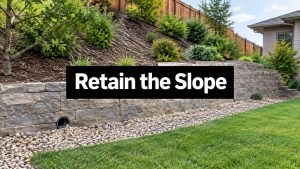
In sloped or awkward yards, elevation changes may call for contouring or even structural support. If you're trying to understand grade management in more difficult sites, this overview of retaining walls for Australian properties is a useful primer on how retaining systems help control soil and create usable levels.
Practical rule: The prettiest shape on paper is a bad design if the site can't drain or compact properly.
Check the site like an installer
Here, most DIY plans fall short. People focus on where the green will look best, not where it can perform.
Look closely at:
- Sun exposure
Full sun is preferable, especially if nearby trees drop debris or keep the area damp. - Air movement
A boxed-in corner can stay wet longer after rain. - Existing slope
Even mild pitch changes affect ball roll and how much base work the site needs. - Trees and roots
Shade, debris, root movement, and future growth all create long-term problems. - Runoff
If water already crosses that part of the yard, the green must be designed around it.
For homeowners comparing styles and broader yard integration, these artificial grass landscape ideas can help you think beyond the green itself and plan the surrounding space at the same time.
Building the Unseen Foundation
The base is the project. Turf is the finish layer.
Most putting green failures come from bad excavation, weak compaction, or drainage that looked fine on install day but couldn't handle real weather. In Austin, where clay soil can hold water and shift with moisture changes, the foundation has to be built with precision.

Strip out everything that can decay or move
The first job is removal. Sod, roots, loose topsoil, and any organic material have to come out. If they stay under the build, they break down, settle, and create soft spots.
One installation guide recommends choosing a site with no more than 3% slope and compacting the base after leveling and contouring, using a plate compactor to prevent future settlement and soft spots, as explained in XGrass's installation guide. That advice matters because compaction isn't a cleanup step. It's what gives the surface long-term stability.
A lot of DIY builds fail here because the subgrade feels firm enough underfoot, so the installer moves on too early. A ball will expose imperfections your shoes won't.
Build the base in layers, not guesses
For synthetic greens, builders commonly install a 2 to 4 inch gravel base plus 6 to 8 inches of compacted aggregate, and a well-built synthetic green can last 10 years or more if it's maintained properly, according to University of Arkansas Extension guidance.
Those numbers tell you two things. First, the base is substantial. Second, longevity depends less on the turf roll and more on what's under it.
A clean process usually looks like this:
- Excavate to consistent depth
Remove enough material to make room for the full base system and finish height. - Establish drainage direction
Don't wait until the top layer to decide where water should go. - Install aggregate in controlled lifts
Spread, level, then compact each layer before adding the next. - Shape contours carefully
Realistic breaks are subtle. Overbuilt contours create awkward drainage and gimmicky putts. - Fine grade the surface
The final base should be smooth, stable, and free of loose pockets.
If you want a broader look at sub-base work for synthetic surfaces, this guide on preparing ground for artificial turf covers the same discipline from a site preparation perspective.
Austin soil changes the difficulty
In Central Texas, the hidden challenge is often the native ground, not the turf product. Clay can hold moisture, dry hard, and behave differently across the same yard. That means one section may compact well while another stays softer or drains poorly.
That's why local installation experience matters. Modern Yard handles synthetic turf and putting green builds in Austin with site prep that accounts for drainage, access, and topography, which is the part generic online DIY advice usually skips.
A putting green base should feel boring before turf goes down. If it already feels dramatic, uneven, or soft, the finished surface won't improve it.
Foundation standards matter across trades
This isn't unique to putting greens. Any exterior surface that needs to stay flat over time depends on proper site prep, lift-by-lift compaction, and drainage planning. The same logic shows up in this expert guide for durable concrete foundations, even though the final surface material is different.
That's the trade-off homeowners need to understand. DIY can save labor on paper, but the labor you're skipping is the exact work that controls how the green performs years later.
Choosing and Laying Your Turf
This is the part most homeowners picture first. It's also the part they underestimate.
The turf has to do more than look clean. It needs to accept cuts cleanly, seam tightly, sit flat over contours, hold cups securely, and respond well to infill. If the material is wrong or the install is rushed, the green may look finished while still putting poorly.

Pick turf made for putting, not general landscaping
Not all artificial grass belongs on a putting surface. Lawn-style turf is designed to look lush under foot traffic. Putting turf is selected for tighter, cleaner ball roll and more controlled finish work around cups and seams.
When comparing options, focus on:
- Pile structure
Short, consistent fibers support more predictable putts. - Backing quality
A stable backing helps the turf sit flat and resist movement. - Seam behavior
Some products cut and join more cleanly than others. - Infill compatibility
The turf and infill need to work together to produce the roll you want.
If you're sorting through categories and product differences, this breakdown of artificial grass types helps clarify which materials are suited to golf performance versus general lawn applications.
Cut and place the turf with the grain in mind
Turf rolls are heavy, awkward, and easy to distort during placement. Once they're laid out, installers need to watch grain direction, avoid stretching, and make sure the turf relaxes naturally over the shaped base.
For durable synthetic builds, published DIY specs commonly call for 3 to 5 inch excavation, a 4-inch crushed-rock base compacted to 90% to 95% density, and perimeter fastening with 3-inch nails every 3 to 6 inches, according to Purchase Green's installation specifications. Those specs show how much precision is expected even in so-called DIY guidance.
If someone rushes this phase, the problems show up fast:
| Issue | What causes it | What you notice |
|---|---|---|
| Wrinkles or ripples | Turf shifted during placement or base wasn't cleanly finished | Putts wander or bounce |
| Visible seams | Poor trimming, bad alignment, weak joining | Lines across the green |
| Lifting edges | Sparse fastening or movement at the perimeter | Corners curl or separate |
Seams are where DIY jobs usually give themselves away
A good seam disappears visually and plays cleanly. That takes accurate trimming, matching pile direction, and careful joining pressure. If either edge is cut unevenly or the material is pulled too tight, the seam reads as a line and often affects roll.
I've seen homeowners do solid excavation and decent base work, then lose the whole look of the project at the seam. That's frustrating because by then the hard labor is already done.
If you can spot the seam while standing over a putt, you'll probably feel it in the roll too.
The perimeter matters just as much. Fastening has to be tight enough to stop movement without distorting the edge. On a small green, tiny edge mistakes are more visible because there's less space for the eye to ignore them.
Mastering the Finishing Details
The last stage determines whether the green feels custom or unfinished. Cups, edging, and infill all affect playability, appearance, and maintenance.
Set cups flush and stable
A cup that sits proud of the turf ruins putts. A cup that settles low collects debris and looks sloppy. The sleeve has to be anchored so it stays flush after traffic, brushing, rain, and temperature swings.
Cup placement also affects how the green gets used. A small surface with too many aggressive cup locations becomes frustrating instead of useful. Good layouts create options without forcing impossible putts on every line.
Choose edging that holds shape
Edging does more than frame the green. It protects the perimeter, keeps transitions clean, and helps the finished build hold its shape against surrounding ground material.
Options vary by look and function. Steel edging gives a crisp profile. Stone creates a heavier visual border. For homeowners comparing decorative edge materials outside the golf category, this guide to installation and costs for edging is a helpful reference point for understanding finish options around an outdoor feature.
Tune the surface with infill
Infill is where the green starts to feel right. Too little, and the turf won't stabilize properly. Too much, and the surface can feel overly firm or respond differently than intended.
Published DIY specs commonly recommend 0.5 to 1.5 lb of infill per square foot for synthetic putting greens in order to stabilize fibers and tune ball speed, as noted in the earlier source from Purchase Green. The exact target depends on the turf and the kind of roll you want, but the principle is the same. Even distribution matters.
A clean finishing checklist looks like this:
- Brush the fibers evenly
This opens the turf and helps infill settle consistently. - Check cup transitions
Roll balls from multiple angles before calling the job done. - Inspect edges
Tight lines at the perimeter keep the whole green looking intentional. - Test roll in several zones
A green shouldn't only putt well from the center.
Good finish work is subtle. You notice it because nothing distracts you.
Austin-Specific Challenges and Common DIY Pitfalls
Austin yards punish shortcuts. A putting green that might survive a mediocre build in a milder region can struggle here because the soil, heat, and runoff patterns are less forgiving.

Clay soil changes how water behaves
A lot of Austin-area properties have heavy clay content. Water doesn't always move through it the way homeowners expect, and that creates problems under synthetic surfaces if the grading isn't deliberate.
USGA guidance notes that synthetic greens usually rely on surface drainage and often need a slight turtle-backed shape, while natural-style greens need dedicated subsurface drainage. Without proper drainage, a green is “doomed to failure,” according to the USGA's backyard putting green guidance.
That warning fits Austin perfectly. The issue isn't just whether water lands on the green. It's whether the yard pushes water toward it, whether the base sheds it fast enough, and whether the perimeter traps it in place.
The most common local DIY mistakes
These are the failures I see most often on self-installed greens or low-budget installs:
- Uneven compaction
The surface may look flat at first, then develop shallow dips after use or weather. - Ignoring runoff from nearby hardscape
Patios, pool decks, and side yards often send water straight toward the green. - Overbuilding contours
Homeowners want dramatic breaks, but dramatic breaks often create drainage headaches. - Weak seam work in full sun
Heat exposes install flaws quickly, especially at edges and joints. - Choosing turf for color instead of performance
A pretty sample doesn't guarantee a true putting surface.
For homeowners comparing materials that can handle Central Texas conditions better, this guide to heat-resistant artificial turf is worth reviewing alongside any putting green turf discussion.
In Austin, a green doesn't fail all at once. First it drains a little slow. Then one edge lifts. Then a low spot starts showing up in every putt.
Know when the site is beyond a simple DIY build
Some yards are workable for experienced DIYers. Others need regrading, better water management, or retaining solutions before a putting green even becomes the right conversation.
Red flags include:
| Yard condition | What it usually means |
|---|---|
| Water stands after rain | Surface drainage alone may not be enough |
| Yard falls into a low corner | The green may collect runoff from the rest of the property |
| Soil cracks hard when dry and stays slick when wet | Base prep and moisture behavior need closer attention |
| Trees or fences block airflow and sun | The area may stay damp and collect debris |
That's where a consultation helps. Not because every yard is complicated, but because some are complicated in ways that don't show up until after the turf is down.
The True Cost and Timeline of Your Project
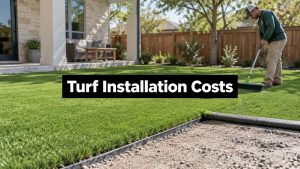
A backyard green often looks affordable until the first truckload shows up. Homeowners in Austin usually start with turf price per square foot, then run into the parts that drive the budget: excavation in heavy clay, hauling off spoil, importing base material, renting compaction equipment, cutting cups, setting edging, and fixing mistakes that only show up after the first rain.
Time gets underestimated the same way.
On a flat, accessible yard with good drainage, a small DIY build can be reasonable if you already know how to grade, compact, and finish turf cleanly. In Austin, many yards are not that simple. Clay soil sticks to equipment when wet, sets up hard when dry, and exposes base prep errors fast. Tight side-yard access can turn a one-day material move into a much longer job. If runoff from the rest of the yard reaches the green area, the scope changes again.
DIY cost versus installed value
DIY usually saves labor on paper. The trade-off is that you take on every hidden cost and every correction.
A practical comparison looks like this:
- DIY lowers the upfront invoice
You still pay for base material, delivery fees, tool rental, disposal, cup hardware, and your own labor. - Professional installation cuts down on expensive rework
If the base settles, the surface wrinkles, or water holds along one edge, the repair often means pulling turf back up and rebuilding part of the foundation. - Complicated sites erase DIY savings quickly
Yards with drainage issues, elevation change, retaining needs, or limited access usually cost more than the original materials list suggests.
I've seen plenty of projects where the turf itself was not the expensive part. The expensive part was rebuilding a surface that looked fine on install day and putted poorly a month later.
Timeline is part of the cost
A putting green project rarely moves in one straight line. Materials have to be scheduled, weather has to cooperate, and the site has to stay workable from excavation through finish work. For a crew, that sequence is manageable because equipment, labor, and material handling are lined up. For a DIY build spread across evenings and weekends, delays stack up fast.
Austin weather makes that more noticeable. A stretch of rain can leave clay subgrade too soft to work properly. A hot, dry week can harden the soil enough to slow excavation and fine grading. Every pause leaves an open work area in the yard, plus pallets, rock, and tools that need to stay in place until the next step is done.
The result is simple. The longer the project drags out, the more chances there are for surface contamination, disturbed base material, shifted edges, and extra cleanup.
If you want a green that drains correctly, rolls true, and still looks right after a Texas summer, get a site-specific quote before buying materials. A consultation with Modern Yard Landscapes can tell you whether your yard is a straightforward build or a project that needs more serious grading and drainage work.